Sierra Mar at Post Ranch Inn – Big Sur, California

Famous French mime Marcel Marceau once remarked “do not the most moving moments of our lives find us all without words.”  Without words, a rare state for someone who uses so many of them, aptly describes my reaction at gazing for the first time upon Big Sur with an awe and reverence few sights outside of New Mexico have ever inspired in me.  It eventually dawned on me that my friend Señor Plata may have best described Big Sur when he declared “God spent just a little more time creating Big Sur.”  Translating literally from the Spanish words “El Sur Grande” meaning “the Big South,” Big Sur is a fabled 90-mile expanse of coastline with breathtaking views of precipitous cliffs which plunge into the sea, rolling fog which creeps in slowly and shrouds those cliffs, towering redwood groves reaching toward Heaven, steep flower-strewn mountains, deeply turquoise waves made frothy by being beaten on jagged rocks,  and unspoiled beaches secreted in coves.  National Geographic Traveler named Big Sur one of the “50 Places of a Lifetime” and “One of the World’s Greatest Destinations.” Big Sur’s spectacular coastline twists and winds along the western flank of the Santa Lucia Mountain Range  on Highway…

Casanova Restaurant – Carmel, California

For they could not love you But still your love was true And when no hope was left inside On that starry, starry night You took your life as lovers often do But I could have told you, Vincent This world was never meant For one as beautiful as you ~Don McLean When Vincent van Gogh painted “The Starry Night” depicting the view of a swirling night sky from the window of his room at the sanatorium Rémy-de-Provence, there’s no way he could possibly have known that its fame would be spread by the heart-rending lyrics of a song.  In 1970, his painting was immortalized in pop culture on the refrain to Don McLean’s 1970 poignant Vincent.  Throughout his 37 year life, van Gogh’s “suffering for his sanity” was exacerbated by the fact that his work and lifestyle were more widely criticized than they were recognized. van Gogh spent the last seventy days of his life as a tenant at the Auberge Ravoux, a country inn in a small village some  22 miles northwest of Paris.  The Auberge Ravoux was a favorite among Dutch and American painters and still attracts art enthusiasts from throughout the world.  It also continues to…

Dudley’s Barbecue – Albuquerque, New Mexico

The United States Department of Agriculture defines barbecue as “any meat cooked by the direct action of heat resulting from the burning of hardwood or the hot coals therefrom for a sufficient period to assume the usual characteristics” including the formation of a brown crust and a weight loss of at least thirty percent.” To the citizens of the great state of North Carolina, that definition is heresy, an example of government ineptitude and maybe even reason enough to secede from the union. Everyone in the Tar Heel state knows barbecue is all about pork. In fact, the words “barbecue” and “pork” are synonymous…and don’t ever call pork “the other white meat.” Doing so would be to utter fighting words (similar to suggesting to a Norteño that a little bit of cumin will improve chile) and to disparage centuries of tradition. You can get away with saying that in North Carolina tobacco is a vegetable, but to suggest beef as a viable barbecue option is blasphemy. North Carolinians go especially hog wild for pulled pork that’s been slow roasted for hours over low heat rendering it so tender that it’s “pulled” from the roast with one’s fingers or forks. In…

Mr. Tokyo – Albuquerque, New Mexico

In a 2011 interview, Green Bay Packers Superbowl winning quarterback Aaron Rodgers revealed that during the National Football League season, the comments he hears most often from fans and the questions they ask him most have to do with Fantasy Football: “Is Jermichael (Finley) playing this week?” “Who’s starting at running back?” Until rather recently, the questions most frequently asked this humble blogger were “what’s your favorite (restaurant or food)?” and “what restaurant would you recommend for a (birthday, anniversary or special event)?”  Those questions have  been supplanted by curiosity about Bob of the Village of Los Ranchos (BOTVOLR), the most prolific (126 comments as of this writing) commentator to this blog.  “What’s Bob like?”  “Where does Bob get his ideas?” “What are Bob’s favorite foods?” Bob’s comments are not only insightful and entertaining, they often reflect his civic-mindedness.  He’s an unabashed promoter of his adopted hometown of Albuquerque, greeting visitors to our fair city as an ambassador for the Albuquerque Convention and Visitors Bureau.  Although he’s quite fearless when it comes to trying new restaurants and food trends, some of his favorites include the old standards which have graced the area for decades: The Monte Carlo Steakhouse, The Dog…

Roadkill Cafe – Seligman, Arizona

 I had my dinner yesterday In a place they call the Roadkill Cafe They serve their dishes full of tricks Scraped off Highway 66. From the Roadkill Cafe menu The legality of gathering and consuming roadkill varies from state to state.  In Tennessee, gathering and consuming flattened fauna (save for domestic pets) is not only perfectly legal, it made for great comedic fodder when Volunteer State native Al Gore ran for the Presidency.  In Maine, the police have to tag the furry Frisbees before you can take them home to cook it, while in Wyoming, the tagging is done by a game warden.  Only if you have a scientific collecting permit and plan to study it can you pick up roadkill in California.   Arizona state laws not only prohibit gathering and consuming roadkill, jurisprudence specifically prohibits the hunting of camels.  States in which roadkill is legal would envy the menu at Seligman, Arizona’s famous Roadkill Cafe on Route 66.  The menu includes such flattened food and car-crashed carrion as “Rack of Raccoon,” “Long Gone Fawn,” “Rigor Mortis Tortoise,” and “The Chicken That Almost Crossed the Road.”  Political correctness doesn’t spare the child either.  The children’s menu includes “Donald Forgot to…

China Poblano – Las Vegas Nevada

Mexican history and folklore recount the story of a remarkable woman who would come to be venerated as a holy woman and prophetess.  Born to nobility in India and possessing remarkable beauty, she was kidnapped as a young child and brought to Mexico, an intended gift to the Viceroy of Mexico whose personal harem of gorgeous women was known far and wide.  When she arrived in Acapulco on a Chinese ship, people were in awe of her breathtaking appearance and exotic ensemble, detailed with dazzling sequins and complex embroidery.  Her stye would come to be imitated far and wide by Mexican women who called it and her China Poblana which translates literally to “Chinese Pueblan.”  At the time, China was a term used to describe the entire Far East and all Asians. Instead of winding up one of the Viceroy’s concubines, she was adopted by a childless couple from Puebla who loved and raised her as their own daughter.  An extremely attractive and capable young woman, she nonetheless opted for a spartan life in a convent. Though she did not take her vows as a nun, she did lead an ascetic life and was reputed to have had visions of…

Joe’s Seafood, Prime Steak and Stone Crab – Las Vegas, Nevada

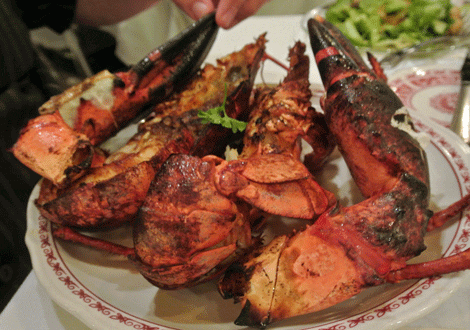
“Stone crab is probably what God eats every night of the year, but in Florida we mortals only have it from mid-October to mid-May…” Curiosity Killed the Cat Sitter by Blaize Clement Whether or not stone crab is really what God likes for dinner might make an interesting literary debate, but there’s no disputing that ordinary and not-so-mere mortals have loved the captivating crustaceans of citrus country for nearly a century.  In 1913 Joe Weiss discovered that stone crabs were not only edible, they were delicious–so much so that his small lunch counter in then backwater Miami Beach became an epicurean epicenter.  High society–everyone from Will Rogers, Gloria Swanson and Emelia Earhart to the Duke and Duchess of Windsor and J. Edgar Hoover–flocked– to his restaurant.  So did a nemesis of Hoover’s Federal Bureau of Investigation.  Using the alias Al Brown, public enemy number one Al Capone and his entourage dined at Joe’s every evening.  Capone liked and respected Joe’s wife so much (and ostensibly her preparation of stone crabs) that every Mother’s Day, he sent a truck to the restaurant to deliver a horseshoe-shaped bouquet of flowers which read, “Good Luck Mother Joe’s.”  Jennie Weiss never realized who he…

Atrisco Cafe & Bar – Santa Fe, New Mexico

From the snow-capped mountains to the coral shores You’re the only one my heart adores You’ve only got three competitors Tacos, enchiladas and beans From the Mississippi to the Amazon There’s not much we don’t agree upon Wish we could get together on Tacos, enchiladas and beans Love ’em, dozens of ’em I consume them by the score And when I’m through, what do I do I stamp and holler for more You can have the fourth position on my list Must admit your kisses would be missed But how in the world could I exist Without tacos, enchiladas and beans Doris Day In the dark ages when I was growing up in the high mountain community of Peñasco, the world wasn’t nearly as connected as it is today.  My siblings and I thought we were deprived by being subjected to  such unsophisticated foods as tacos, enchiladas and beans. We didn’t know any better.   The three television stations (KOB, KOAT and KGGM) which piped  seventeen hours  of programming per day (7AM through 12AM) through our rooftop antenna into the  static-prone black-and-white television in our den depicted only families who ate such elegant food as pot roast, fried chicken and…

Japanese Kitchen – Albuquerque, New Mexico

For generations, traditional New Mexican food as it had been served for generations by Hispanic families in Northern New Mexico was surprisingly rare in restaurants throughout the Land of Enchantment.  Many restaurants throughout the state served “Mexican” style food similar to what our neighbors in Arizona and Texas offered.  That meant insipid chile lacking the flavor and piquancy which has become a hallmark of New Mexican cuisine.  Once restaurants such as Rancho de Chimayo began serving traditional New Mexican food, the genre immediately made tremendous inroads, quickly usurping the popularity of the interlopers. Though tradition has certainly not gone by the wayside, New Mexican food has both grown and evolved over the years largely through the influence of “Santa Fe style” whose genesis may be rooted in the confluence of Pueblo adobe style and Spanish territorial architecture, but whose influences have branched to other aspects of the city’s laid-back culture of joie de vivre and self-expression.  Mark Miller, the high priest of Southwestern cuisine and other inventive chefs recognized the potential for chile, the centerpiece of New Mexican cooking, to be used in ways heretofore unexplored.  They have revolutionized the use of New Mexico’s official state “vegetable” and in the…

Bacchus Nibbles – Lake Zurich, Illinois

In Roman mythology, Bacchus was known as the god of wine and ecstasy. A youthful and handsome god with flowing tresses usually depicted wearing wine leaves or ivy on his head, he represented both the intoxicating and the beneficial influences of wine. Bacchanalian festivals, typified by riotous drunken merrymaking and sometimes orgiastic festivity are still celebrated in institutions of higher learning throughout America (who can forget the hilarious movie Animal House and the antics of the Delta House fraternity?). At Bacchus Nibbles Restaurant & Wine Shop, in Lake Zurich, a northwest Chicago suburb, wine can be appreciated in a “wine cave-like” atmosphere of civility and quaint refinement that  an aspiring sommelier might welcome. An impressive assemblage of wine, along with sundry liqueurs and liquors is on display in well organized racks throughout the restaurant.  The stacked wine bottles separate the dining areas.  The cozy restaurant belies its somewhat ramshackle, timeworn exterior which frankly doesn’t have the curbside appeal nearly the equal of its menu. The menu is a compendium of diverse indulgences not only from the Mediterranean, but from throughout the world.  Appetizers and specials of the day may include such succulent surprises as egg rolls, Norwegian smoked salmon, Thai…

El Camino Family Restaurant – Socorro, New Mexico

America’s oldest and longest continuously used “highway,” El Camino Real de Tierra Adentro, (Spanish for the Royal Road of the Interior Land) includes a 404 mile stretch that bisects much of the Land of Enchantment  from south to north.  A large portion of that stretch is barren and desolate, one especially treacherous and dry section even designated by the Spanish conquistadores as the Jornada del Muerto, Spanish for “route of the dead man.”  For nearly 400 years–from 1598  (more than two decades before the Mayflower’s storied landing) to 1882–El Camino Real served as both a trade route and as the route taken by settlers and conquerors alike. For four centuries, thousands of intrepid Spanish and Mexican colonists, conquering warriors and evangelizing Franciscan priests and friars alike traversed the 1,600 mile route from Mexico City as far as San Juan Pueblo, New Mexico, many founding and settling villages along the route.  The direct descendants of these bold-spirited pioneers can be found living in those villages and cities today.  Vestiges of the unique culture, language, music, legends and faith founded by their ancestors exist into the 21st century. Spanish explorer Don Juan de Oñate, who today is both revered and reviled, led…