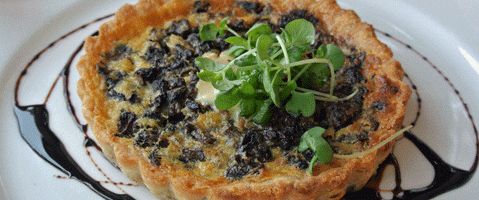
Cafe Chloe – San Diego, California (CLOSED)

From your seat on the sidewalk patio of Café Chloe, you can see Petco Park, the open-air home of the San Diego Padres. You’ll have a front row view of a veritable cavalcade of motorized and foot-powered conveyances—from swanky Maseratis to sleek inline skates. Passers-by on foot include some of the city’s most downtrodden as well as its captains of industry. As you take in your surroundings in the cozy, urban neighborhood café and wine bar in San Diego’s chic East Village, you might occasionally be transported, perhaps more than fleetingly, to a quaint Parisian cafe of your past or your dreams. More than any other French bistro we’ve visited, Café Chloe takes us back to leisurely spring days in small, homey bistros by the Seine where we sipped coffee as intense and spicy as the city in which it’s served. That’s the magic of Café Chloe, a culinary gem which may have the look and feel of Paris, but whose heart and soul belong to San Diego. In fact, Café Chloe has been recognized by Eater San Diego as one of the “38 essential San Diego restaurants,” a compilation of myriad restaurants across a gamut of cuisines. These are…

The Town House Restaurant – Albuquerque, New Mexico (CLOSED)

America’s highway system expansion which began in the 1930s not only “shrank” America, it introduced the entertaining, educational–some might say bizarre–phenomenon of the roadside attraction.  Entrepreneurs competed with each other to create gawk-inspiring, curiosity motivating, must-see-to-believe attractions to snare the attention of motorists and motivate them to part with some of their money.  Neon lights festooned Route 66 while fiberglass and concrete statues became part-and-parcel of America’s highways and byways.  This was true roadside art which became a part of the fabric of Americana, albeit a kitschy tradition fading with the passage of time (which aptly describes many of the statues themselves).  Among the most famous statuary art are life-sized fiberglass statues of stocky steers (corpulent cows and beefy bulls, if you prefer) which became the symbol of steakhouses along the motorways and byways.  Ironically, this statuary was not designed for use as symbology for restaurants.  In the 1950s, Bob Prewitt, a manufacturer of fiberglass trailers created life-sized fiberglass animals to prove the trailers were large enough to accommodate the real thing.  Soon the manufacture of animals became the primary focus of his business.  He created almost as many types of animals as Noah took on board his ark.  The…

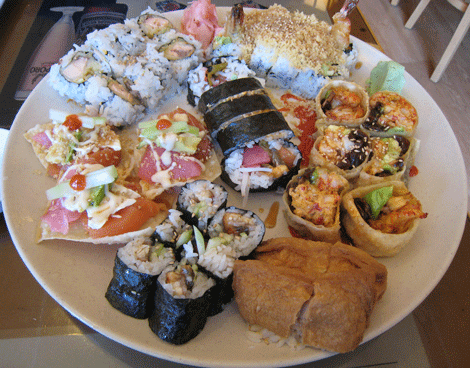
I Love Sushi – Albuquerque, New Mexico (CLOSED)

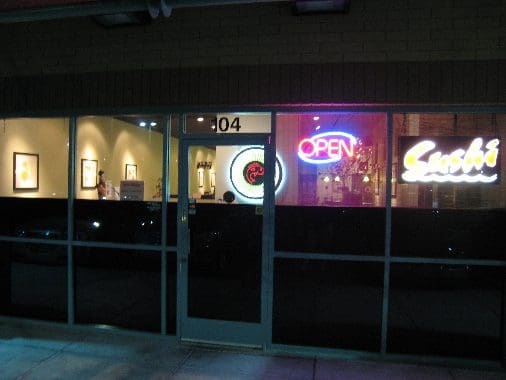
According to the US Census Bureau, more than half (49.3) of all Americans reported they did not “dine out” between Fall, 2009 and Fall, 2011. That’s the lowest percentage since 2007 and could be indicative of the pervasive economic malaise or perhaps of the uncertainty as to what constitutes “dining out.”  The Census Bureau did not define the term so it’s conceivable “dining out” was interpreted as a meal at a “fancy restaurant” with table service and a wine menu as opposed to say, a meal at a fast food restaurant or  picking up a burger from a food truck. One data point the Census Bureau did not research is the percentage of people who don’t like sushi.  A sushi chef acquaintance tells me sushi isn’t something people merely just “like” or are indifferent to.  They either love it or hate it.  He contends that most, not all, people who claim to hate it have never tried really good sushi.  A quick perusal through Google seemingly contradicts his theory, revealing numerous sites and Facebook pages dedicated to the derision of sushi.  In almost all cases, the haters had tried sushi and found it not to their liking (to say the…

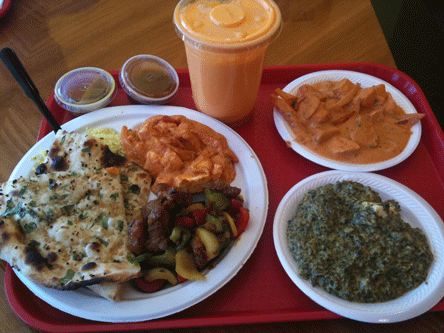
Saffron Tiger Indian Cuisine Express – Albuquerque, New Mexico (CLOSED)

Is there anything that screams monotonous, tedious homogeneity louder than the typical food court at any mall in cosmopolitan America?   “But,” you might argue, “the food court is a paragon of diversity where you can get your fill of pizza, sushi, burgers, cinnamon rolls, sweet and sour mystery meat and a veritable United Nations line-up of ethnic foods all in one place.”  While that might be true, my argument is that the same boring sameness you find in Albuquerque’s mall food courts can be found at any food court in any mall.  Only airports have a similarly comparable array of uninspiring food-court-type selections. Despite the “culinary diversity” in food courts, there is an almost general scarcity of local culinary representation.  At least that’s the case in the contiguous area shared by multiple food vendors; small private vendors are usually relegated to outlying areas of the mall.  Food courts are, by and large, the haven of fast food chains which can afford the steep rent commanded in the premium heavily-trafficked area. Typical food court tenants may include McDonalds or Burger King, Edo Japan, Sbarro, China Wok, Cinnabon and others of that ilk. An argument could be made that food courts make…

Best Lee’s – Albuquerque, New Mexico (CLOSED)

When John Lucas, Elizabeth Eisner Reding and Mike Reding, three trusted gastronomes who frequent this blog, heartily recommended I try Best Lee’s, my initial reaction was, “they’ve got to be kidding.”  Our sole visit to Best Lee’s in Rio Rancho exemplified the mediocrity and boring “sameness” that plagues many of New Mexico’s Chinese restaurants–a homogeneity my discerning friend Bill Resnik refers to as “copycat menus full of candied, fried and breaded mystery meats that all taste the same.” It’s a good thing Chinese Restaurant News (CRN) doesn’t read my blog.  CRN, a highly respected monthly trade publication serving the more than 43,100 Chinese restaurants across America, selected Best Lee’s as one of America’s best Chinese restaurants for 2008.  In fact, during the “year of the mouse,” Best Lee’s earned distinction as one the top 100 Chinese restaurants in the categories of “Top 100 Local Favorites” and “Top 100 Overall Excellence.”  The latter is the publication’s highest honor. The “Local Favorites” award is presented to restaurants which have “proven their success over many years and through difficult circumstances.”  Such honorees must also “maintain an important community presence and have a significant and devoted customer base.”  The award for “Overall Excellence” is accorded to restaurants…

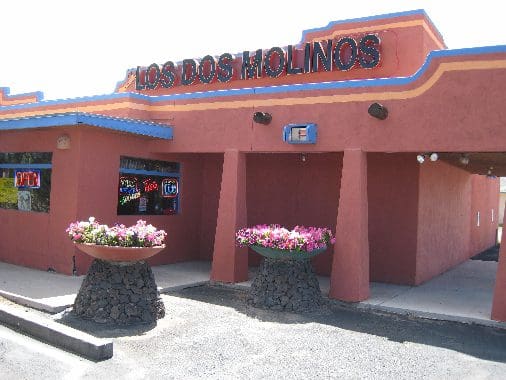
Los Dos Molinos – Springerville, Arizona (CLOSED)

Just how hot is the chile at Los Dos Molinos? The New York Times suggests you “travel with a fire extinguisher” and that “everything, with the exception of the margaritas, is incendiary.” New York magazine raves that “Not since Drew flashed Dave has Manhattan witnessed a hotter display than the one at Los Dos Molinos.” The Arizona Central dining guide asks “can you take the heat,” calling Los Dos Molinos “the lodestone for leather tongues.” Now these are all unimpeachable sources with impeccable credibility (at least when it comes to restaurants), but the source that got my attention quickest was a Garfield comic strip in which the irascible cat is challenged to a hot pepper eating contest by Jon, Garfield’s long-suffering human companion. In the first panel, Jon pops a jalapeno pepper into his mouth without breaking a sweat. Garfield follows with a cayenne pepper which Jon then one-ups with a Habanero which draws more than a bead of sweat. Not to be outdone, Garfield tosses a “Los Dos Molinos Death Pepper” into his mouth. The pepper is so incendiary that in dragon fashion, he shoots a massive fireball out of his mouth, scorching Jon in the process. Holding an…

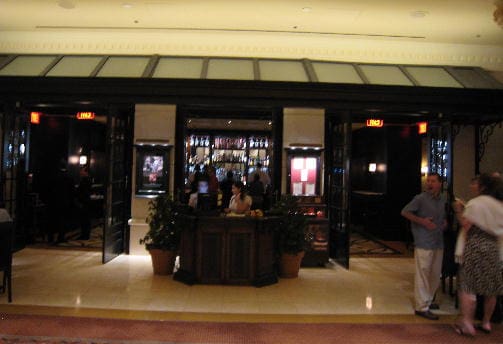
Ristorante B&B – Las Vegas, Nevada (CLOSED)

A pair of trademarked orange Crocs on the reception kiosk was as close to Mario Batali as we got. It’s as close as some of the wait staff has gotten in the months since Ristorante B&B launched. We had expected no less. Batali has parlayed his celebrity chef status into a veritable empire of highly acclaimed restaurants in New York City, Los Angeles and Las Vegas. Like many restaurant impresarios, the “Great One” is intimately involved in the development of the concept and menu for all the restaurants which bear his name. He was also involved in the selection of the kitchen staff who execute to his vision. That’s why visits to some of his outlying restaurants are few and far in between. Whether you like the celebrity chef concept or not, you’ve got to respect that Molto Mario is always striving to improve upon his craft. Like a culinary anthropologist, he is as interested in the provenance of the cuisine he creates as he is in the actual end product. A 2005 winner of the James Beard Award for “Outstanding Chef of the Year,” Batali is a legitimate chef force, not just “another pretty face” engaged in kitchen warfare…

The Original Wineburger – Phoenix, Arizona (CLOSED)

Every year, children of all ages fall in love all over again with the heart-warming 1947 Christmas movie, Miracle on 34th Street. We’re aghast when the district attorney demands that defense lawyer Fred Gailey provide “authoritative proof” that Kris Kringle is “the one and only Santa Claus.” We share Gailey’s seeming desperation when he offers as evidence, a solitary letter addressed to Santa Claus at the NYC Courthouse. We’re enraged when the D.A. retorts that one letter is hardly enough proof, and are proudly vindicated when Gailey has guards march in with huge bags overflowing with letters. We revel in Gailey’s argument, “Your Honor, every one of these letters is addressed to Santa Claus. The Post Office has delivered them. Therefore the Post Office Department, a branch of the Federal Government, recognizes this man, Kris Kringle, to be the one and only Santa Claus.”  We cheer at justice being served when the sympathetic judge, desperate not to be portrayed as the man who found Santa Claus guilty, declares, “Uh, since the United States Government declares this man to be Santa Claus, this court will not dispute it. Case dismissed.” Authoritative proof! That has been in dispute for years when it…

Sushi Eye – Tempe, Arizona (CLOSED)

To Western diners used to restaurant ambience defined by an effusive, sensory bombarding, over-the-top flamboyance, many Japanese restaurants feel stark and barren in comparison. That austerity is actually by design. The Buddhist teaching of “wabi” which means “quiet of tranquility” posits a non-attachment to material things. Wabi values the ability to make the most of starkness and poverty by cherishing the subtle beauty found only in a very simple environment. In some sushi restaurants, the minimalist decor is not much more than functional and and nearly as raw as sashimi. Lighting is subtle, perhaps even romantic. The ambience seems to inspire hushed tones and an almost reverent mood, in some cases almost as if you’re at a Buddhist temple. That’s the concept of wabi. In wabi fashion, the not quite wasabi colored walls at Sushi Eye are relatively stark, festooned with but a few framed images. The restaurant’s activity center and heart, the sushi bar, is more brightly illuminated. A single neko cat, symbolizing good luck, sits on that bar. Sushi Eye is situated in a nondescript Tempe strip mall practically next door to the Fascinations Superstore where sensual shopping can precede sushi sampling if you’re so inclined. It opened…

Banana Leaf – Rio Rancho, New Mexico (CLOSED)

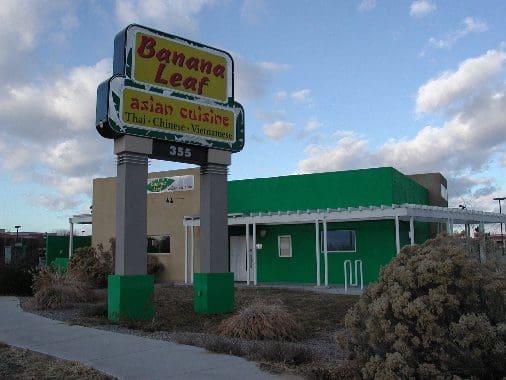
Banana leaves, although completely inedible, are used for slow, moist cooking of tough meats as well as for quicker steaming, baking or grilling of delicate ingredients such as chicken and fish. Used while still fresh and green, they lend a very moist quality to any food prepared in them and also imbue foods with a delicious herbal flavor. While Southeast Asian nations have used banana leaves in food preparation for generations, only recently have innovative American chefs begun to explore their infinite possibilities. It’s no wonder there are so many Asian restaurants named for this utilitarian, albeit inedible food ameliorant. Rio Rancho’s Banana Leaf restaurant opened in January, 2005 to some popular acclaim. Bringing you the culinary cuisine of Southeast Asia kitchens to your table, it features Chinese, Thai and Vietnamese items on a diverse, multi-page menu. What it doesn’t feature is any items prepared with the item for which it is named (bummer). Owned and operated by a Vietnamese family which also operates restaurants in Roswell, New Mexico as well as in California, it is another sign that the “city of vision” has arrived with a flourish. Complementary wonton chips are brought to your table while you peruse a…

Korean Barbecue House – Albuquerque, New Mexico (CLOSED)

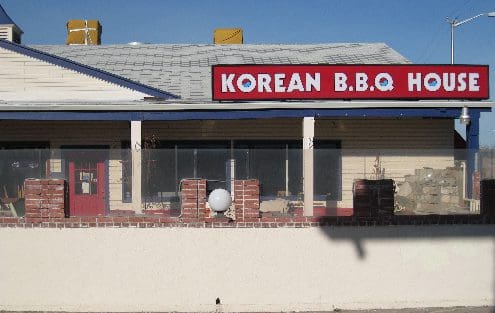
For dining patrons in the know, the 2002 closure of the Fu Shou House was one of the most heartrending moves in the Duke City restaurant scene. In the Korean B.B.Q. House, Fu Shou was reborn. While the Fu Shou proprietors don’t own the Korean B.B.Q. House, they did hold court in the kitchen for a while after the restaurant’s launch crafting the delicious entrees for which they were renown. Another chef now stewards the kitchen, but has maintained the high standards of his predecessors. Initially serving both Korean and Chinese food, this Central Avenue restaurant now focuses exclusively on Korean food and has already captured quite a loyal following–for good reason. The bulgogi is spicy, sweet, tangy and absolutely delicious. Ditto for the bulkalbi which thankfully was also meaty and relatively free of fat. Unlike bulgogi and bulkalbi served at some other Duke City restaurants (primarily Japanese and Chinese restaurants), the Korean B.B.Q. House version was made of high quality meat, not the sinewy, fatty stuff which should be saved for the house pets. Both the bulgogi and bulkalbi are served with five side dishes, including one of the spiciest kimchees in town. An accompanying egg drop soup was…