Sai Gon Sandwich – Albuquerque, New Mexico (CLOSED)

If ever there was a culinary Kobayashi Maru (for the non-Trekkies among you, that’s a no-win scenario), it might well be naming the best sandwich (or best food of any kind) in the world. Imagine the challenge. There are potentially hundreds of thousands of delicious candidates, many worthy of acclaim as the very best in their block, city, state or province…but the world’s an awfully big place. A lifetime might not be enough to sample but a few thousand sandwiches. Any sandwich you select would undoubtedly be disputed vehemently. Surely, you say, no authoritative source exists which would possibly have the temerity, much less breadth of knowledge, to name just one sandwich as the very best in the planet. Such hubris would invite derision and debate. Perhaps then it’s appropriate that the most recent source to declare one sandwich as definitively the best in the world comes from the island nation in which was born the man (the Earl of Sandwich) for whom the ubiquitous sandwich is named. That source is The Guardian, one of the most respected periodicals in the United Kingdom (even though it doesn’t feature “Page 3” girls). According to The Guardian, the “world’s best sandwich isn’t found…
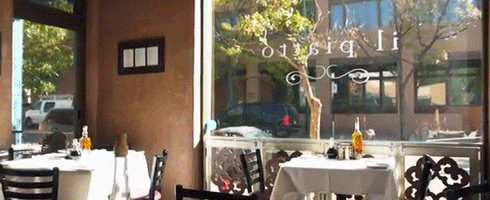
Il Piatto Italian Farmhouse Kitchen – Santa Fe, New Mexico (CLOSED)

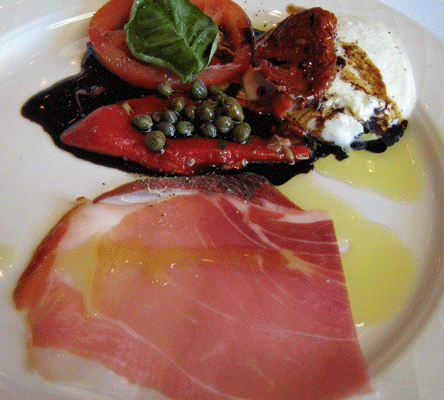
As an independent observer of the New Mexico culinary condition, I used to think the most prominent delta in quality between restaurants in the Land of Enchantment and those in large metropolitan cities are in the areas of seafood, barbecue and Italian food. It’s easy to understand the dearth in outstanding seafood restaurants. We are, after all, a landlocked state some 800 miles or so from the nearest ocean. While many New Mexican restaurants have fresh seafood flown in frequently, it’s not quite the same as having seafood literally off the boat and onto your plate. In recent years, the launch of several very good to excellent barbecue joints has done much to narrow the gap in the barbecue arena: Sugar’s BBQ in Embudo, The Ranch House in Santa Fe, Sparky’s in Hatch and Mr. Powdrell’s Barbecue House in Albuquerque. This terrific quadrumvirate has given us barbecue you can enjoy every day of the week, maybe even more than once a day. We may not ever have transcendent barbecue like Arthur Bryant’s in Kansas City, but the same can be said about everywhere else in the world. My argument used to be that New Mexico does have some nice, maybe…

El Sarape – Albuquerque, New Mexico (CLOSED)

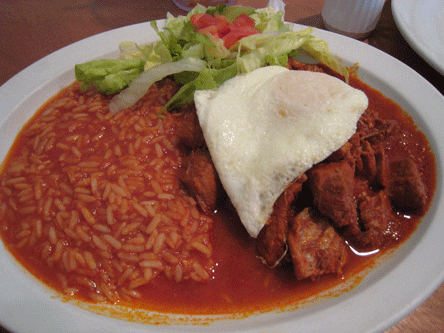
Before the advent of political correctness, the unchecked use of controversial stereotypes was rampant throughout America.  Starting in the 1930s, for example,  ethnic caricatures in the guise of tchotchkes (salt shakers, cookie jars, plant pots and the like) could be seen in households throughout the fruited plain. Neon-spangled roadside five-and-tens  dotting the motorways and byways were primary culprits in the sale of kitschy, tacky knickknacks propagating such stereotypes as mammies, cigar-store Indians and the Mexican peasant taking a siesta while reclining against a saguaro.  The sleeping Mexican, often called Pancho, was particularly prominent throughout the Southwest.  Generally attired in huaraches, pantaloons, a sash which doubled as a belt, a massive sombrero that hid his face and a colorful sarape, that image perpetuated the stereotype of the lazy Mexican. While politically conscious Americans of all ethnicities found the sleeping Mexican offensive, in the border towns and in the barrios, the image was often used in front yards by families of Mexican descent as a symbol of home.  According to Maribel Alvarez, an associate professor at the University of Arizona, Mexican workers viewed the sleeping Mexican not as a laughable stereotype or curio, but as a symbol of honor–a hard-working Mexican resting…

Il Mulino of New York – Las Vegas, Nevada (CLOSED)

While it may seem that Las Vegas is one perpetual bachelor party with hundreds of drunken frat boys expressing themselves loudly through expletives while leaving a hazy trail of smoke in their wake as they converge upon casino after casino, Sin City does have its pockets of civility.  One such refuge is Il Mulino during the lunch hour when it’s a veritable island of isolation and paragon of propriety despite being mere feet from the maddening throngs.  Perhaps it’s that aspect of propriety that explains the absence of teeming masses during lunch. Yes, it’s THAT Il Mulino, scion of the famous Italian restaurant held in reverential esteem and cited by the cognoscenti as perhaps the very best Italian restaurant in all of the five boroughs comprising New York City (although Mario Batali might have something to say about that).   The Las Vegas outpost of the fabulous Metropolis Italian restaurant is located at the top level of the Forum Shops at Caesars next door to Tommy Bahama.  The setting is so elegant, the ambiance so splendorous that you’ll quickly forget the proximal partiers. It’s not the crapulous carousers who frequent Il Mulino at night, but a more conservative, nattily attired crowd…

Fu Yuang – Albuquerque, New Mexico

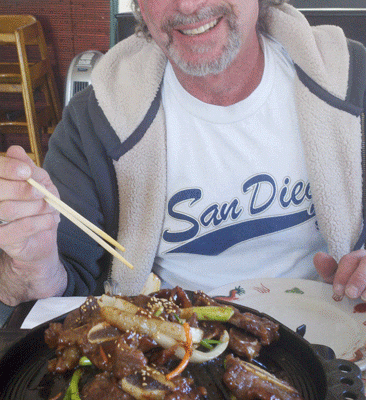
“I’ve eaten a river of liver and an ocean of fish! I’ve eaten so much fish, I’m ready to grow gills! I’ve eaten so much liver, I can only make love if I’m smothered in bacon and onions” ~ Hawkeye Pierce MASH 4077, Korea FROM THE FU YUANG FACEBOOK PAGE: Our Dear Fu Yuang friends, we closed the doors for business on Saturday, November 21st, 2020. 😢 Mia is no longer able to meet the physical demands of operating the restaurant. We tried to sell the restaurant to many prospective buyers, with no luck due to COVID-19. We want to thank everyone for their kindness, dedication, & support over the past 26 1/2 years. We will truly miss you all. Thanks for all the memories we have made together at Fu Yuang! For eleven years, televisions across the fruited plain were tuned in to CBS where the antics of the 4077th Mobile Army Surgical Hospital (MASH) enthralled audiences with a unique blend of crude hilarity and heartfelt humanity.  Set in South Korea during the Korean War, the series centered around a group of resilient doctors, nurses and support staff in an isolated hospital compound which saw more than its share…

Sandiago’s Mexican Grill – Albuquerque, New Mexico (CLOSED)

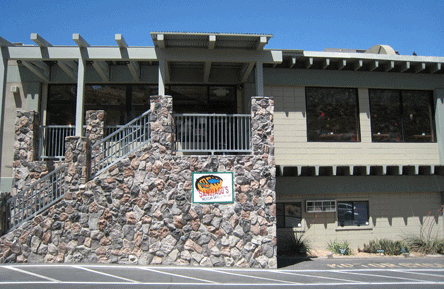
You don’t have to go out of town to dine to feel like you’re dining out of town.  A drive to Sandiago’s Mexican Grill on the base of the Sandia Tramway will do that for you.  This colorful restaurant in which everything but the ceiling appears tiled in multi-hued splendor evokes images of coastal Mexico Lindo Y Querido in all its glory. If you’re an atheist, the spectacular view of the city lights, particularly on a cold winter night, might just convince you that there is a God.  The summer view of the entire city bathed in light under Albuquerque’s cerulean skies is equally awe inspiring. Sandiago’s is part of the sprawling, multi-story complex which houses the boarding station to the world’s longest tramway.  Situated at 6,300 feet above sea level, it is the highest (in altitude anyway) restaurant in the city. If you’re seated against the windows on the restaurant’s east side, your view is of Sandia Peak and of tramway cars climbing to the 10,378 foot peak. If you’re seated on the restaurant’s west side or on the patio, your view is of the Duke City.  It’s a picturesque panorama, particularly on nights in which a spectacular sunset…

Angelina’s Restaurant – Espanola, New Mexico (CLOSED)

“I get no respect.”  Comedian Rodney Dangerfield parlayed that catch-phrase into a lengthy and lucrative career.  With his uniquely self-deprecating sense of humor, Rodney invariably made himself the butt of his own brilliant one-liners: “I could tell my parents hated me.  My bath toys were a toaster and a radio.”  Despite his schtick as a perpetual loser, Dangerfield was a beloved comedic icon about whom Jim Carrey once wrote, “Rodney is, without a doubt, as funny as a carbon-based life-form can be.”  True to the formula which made him a success in life, his tombstone is engraved, “there goes the neighborhood.” The citizenry of the beautiful Española valley can certainly empathize with Rodney Dangerfield.  Inexplicably, Española has, for decades, been the punch line of cruel jokes.  My friend Bill Resnik, a stand-up comedian for nearly three decades, says every  stand-up comedian performing in New Mexico has at least one Española joke in their repertoire, but admits that in the comedy circuit, the name of the town being made fun of changes from state to state.  Española jokes are, to some extent, just repackaged jokes.  Many of those jokes will work if you substitute “blond” or “Aggie” or “Redneck” for Española.…

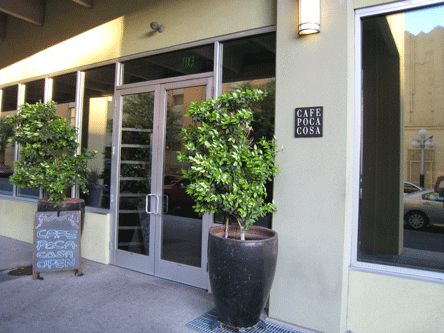
Cafe Poca Cosa – Tucson, Arizona (CLOSED)

Stereotypes would have you believe English food and Mexican food are at the opposite end of the spectrum from one another…as different as day and night.  Those stereotypes paint English food as bland and unimaginative while Mexican food is depicted as spirited and exciting.  That makes it deliciously ironic that perhaps the foremost authority on Mexican food is an adventurous English woman named Diana Kennedy.  In 1957, she moved to Mexico and has spent most of her life since researching and documenting the culinary history of Mexican cuisine. For her inestimable contributions to the documentation of regional Mexican cuisine, the government of Mexico awarded her the “Order of the Aztec Eagle” award, the Mexican equivalent of knighthood while Queen Elizabeth herself dubbed her “Member of the British Empire,” an award of similar distinction.  Once described in The Seattle Times as “the diva of doing it right,” Diana Kennedy champions authenticity in technique and ingredients and she’s a stickler for precision. The late Craig Claiborne, pioneering food critic for the New York Times, once described Mexican cuisine as “peasant food raised to the level of high and sophisticated art,” an apt description of how Diana Kennedy elevated the cuisine of her adopted…

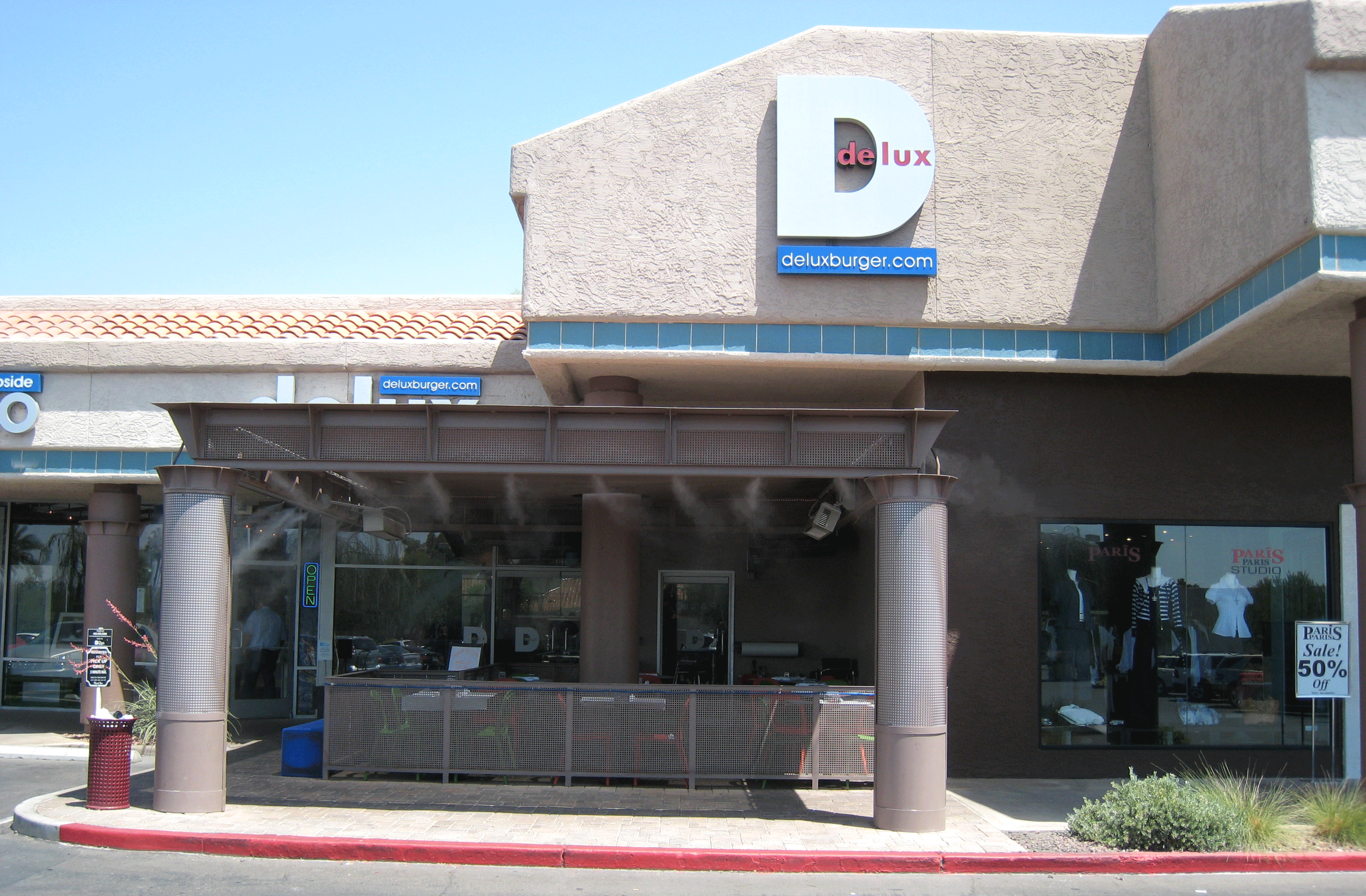
Delux Burger – Phoenix, Arizona (CLOSED)

“I ordered a cheeseburger at lunch the other day. I had never eaten at this particular restaurant before, and whenever I am unsure about the quality of the food at a place, I always order a cheeseburger. How many ways can you foul up something as simple as a cheeseburger? The bread can be too hard, or the meat might not be cooked to your liking, but that can be fixed quite easily. After I ordered my cheeseburger – medium well with a soft bun – the waiter asked me, “Do you want a plain cheeseburger or one of our specialties?” There is such a thing as a specialty cheeseburger? A cheeseburger is a piece of hamburger meat with some cheese on top of it served on a hamburger bun.” Leave it to humorist Lewis Grizzard to succinctly sum up the truth to which “purists” across the fruited plains hold fast about their beloved burgers–that it’s all about the beef with “some” cheese.  Alas the burger in which the sacrosanct flavor of beef is the focus rarely earns accolades for its solid, if unspectacular and unadorned qualities.  Invariably when you read about a burger earning acclaim as “best in town,”  that burger is crowned…

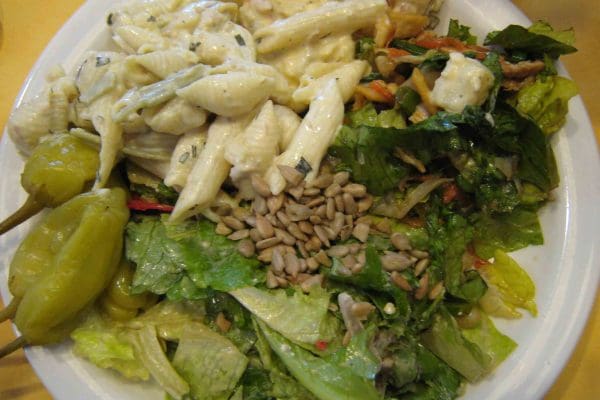
Sweet Tomatoes – Albuquerque, New Mexico (CLOSED)

In the early 1980s, Albuquerque native and Tokyo Olympian Buster Quist (whose brother Terry I worked for at the time) launched within the Coronado mall, one of the Duke City’s very first salad bars.  The salad bar concept was a few years ahead of its time and the restaurant venture went belly up—a condition portly Americans have, not coincidentally, experienced en masse (no pun intended) over the years. Salad has been a popular dietary staple for a long time, but only in recent years have creative cuisine crafters added imagination, flair and flavor to what used to be bland and unimaginative greenery.  The lack of imagination in crafting salads has always reminded dieters that the word “diet” is simply “die” without the letter “t.”  Today restaurants such as Sweet Tomatoes have added a creative flair that includes high calorie ingredients that can be diet devastating. At Sweet Tomatoes, a burgeoning franchise, it will take self-discipline to steer clear of such diet destroying delicacies as the chocolate chip muffins, chocolate muffins, warm apple cobbler, Asiago focaccia and tomato focaccia bread, all of which are not only tempting, but pretty good. Sweet Tomatoes lets you craft every salad combination conceivable with a…

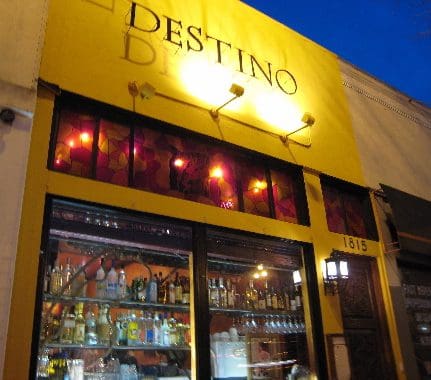
Destino Nuevo Latino Bistro – San Francisco, California (CLOSED)

In 2004, The Economist (a British weekly news publication) proclaimed that “Peru can lay claim to one of the world’s dozen or so great cuisines.” In 2005, Bon Appetit declared Peruvian “the next hot cuisine,” extolling its “vibrant ceviches, crispy, spiced rotisserie chickens and packed-with-flavor empanadas” then encapsulating its declaration with “this is one cuisine we could eat every day.”  A year later, at the world’s premier gastronomic forum, the International Summit of Gastronomy, Lima (the coastal nation’s capital city) was touted as the “gastronomic capital of the Americas.” What’s surprising is not that the culture-rich cuisine of a small, multi-ethnic nation rarely on the world’s stage received such acclaim, it’s that it took so long.  Peru’s culinary traditions, after all, began in pre-Columbian times. Peru was home not only to the oldest known civilization in the Americas (the Norte Chico civilization flourished as early as the 30th century BC) but later to the largest civilization in the Pre-Columbian Americas–the Incan empire. Immigration melded the culture and cuisine of the Spanish, Basque, African, Moorish, Sino-Cantonese, Japanese and in the 19th century, the Italian, French and British with Peru’s indigenous peoples, the descendents of the pre-Incas and Incas, to combine the…