Soo Bak Seoul Bowl & Soo Bak Foods – Albuquerque, New Mexico

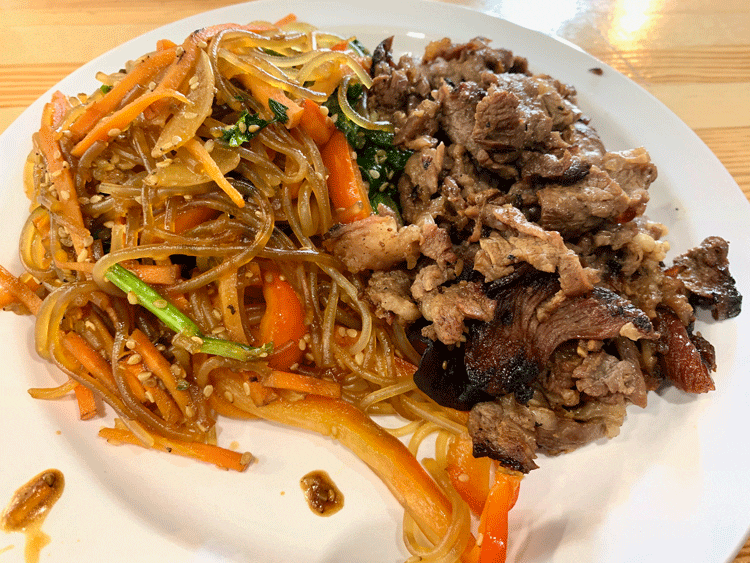
Announcer: “The story you are about to read is true. The menu has been changed to showcase the delicious mashup of Korean and Mexican cuisines. Roy Choi: “This is the city: Los Angeles, California. I work here. I’m a chef.” Since 2008, there’s been a dragnet in progress across the city of Los Angeles. Instead of a coordinated attempt by police to catch criminals, this dragnet is a coordinated attempt by four mobile food kitchens (that’s food truck to you, Bob) to attract hungry diners. Those mobile food kitchens are named Kogi Korean BBQ-To-Go and have pioneered a technological approach for enticing eager eaters by announcing its location on social media. Diners have since been lining up like flash mob of bees to a honey-coated hive, prompting Newsweek to hail Kogi as “the first viral eatery.” Kogi is widely acknowledged as the forerunner of the gourmet truck phenomenon, the catalyst which elevated the food-truck concept from “roach coach” to legitimate destination rolling restaurant. Founder-chef Roy Choi even made Time Magazine’s list of the 100 Most Influential People for 2016. Kogi’s “Seoul meets Mexico City” concept has spawned a phalanx of flatterers…er, imitators across the country. And why not? Unlike so…

Punchy’s Wood-Fired Pizza – Albuquerque, New Mexico

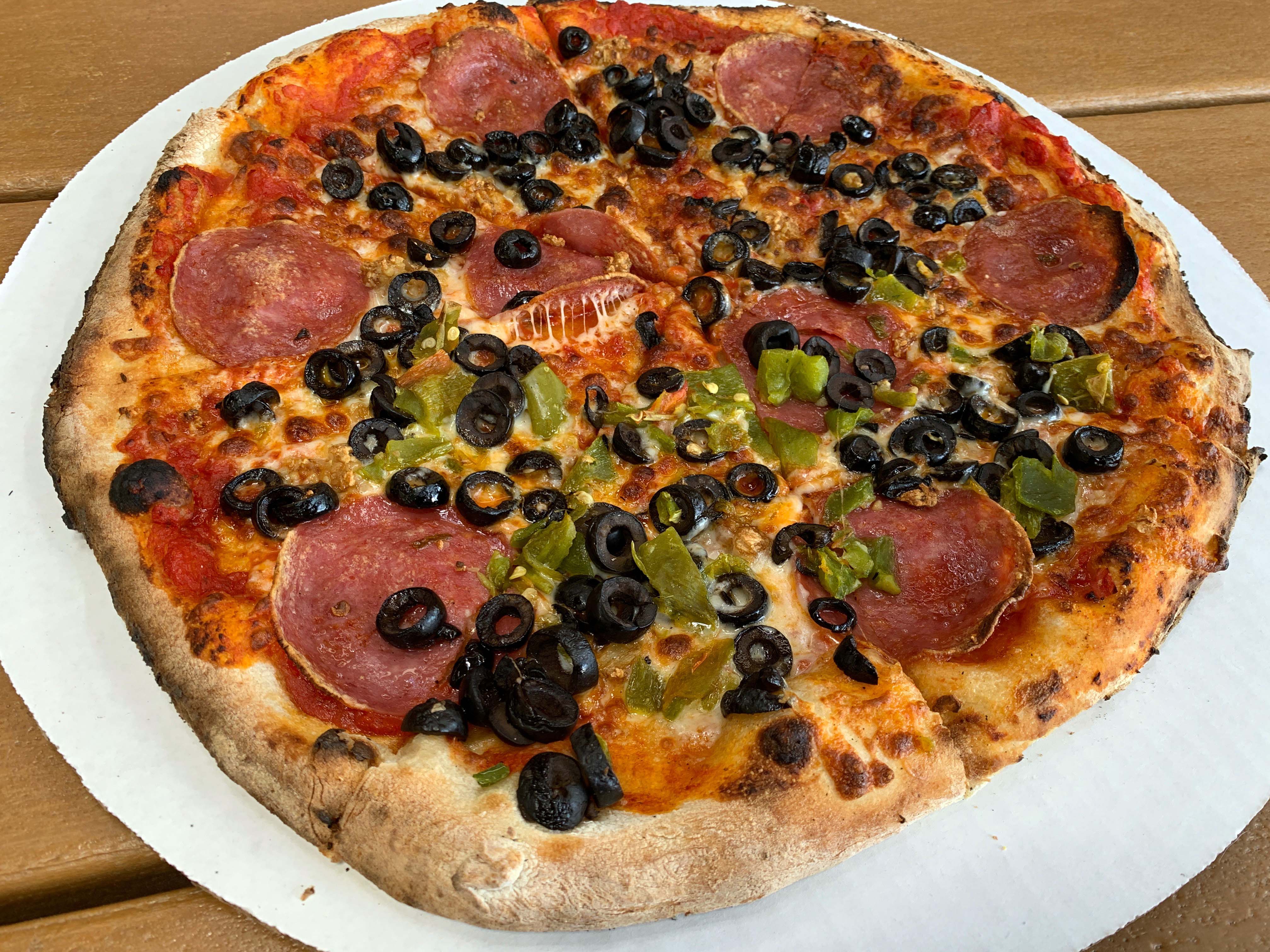
In the parlance of the pugilist, “punchy” is synonymous with punch-drunk, the result of having been battered violently by an opponent. You know, like Rocky Balboa after a few rounds with Apollo Creed. Don’t ever try to correct the family of Giordano Bruno (1905-1992) if they insist on a different definition. They’ll tell you Grandpa Giordano, the family patriarch, earned the nickname Punchy because of his punching prowess as a Golden Gloves boxing phenom. He could really pack a punch they say, winning 80 bouts and going undefeated during his career. More often than not, it was his hapless opponents who were left loopy after a fusillade of lefts, rights and uppercuts.  Punchy’s talents weren’t limited to the squared circle. He could really cook some knockout Italian dishes, too. When he emigrated to Chicago from Milan, Italy in the 1920s he brought with him family recipes from Tuscany and Naples, the birthplaces of his parents—and the latter, also the birthplace of modern day pizza as we know it. Punchy worked as a chef in Chicago then New York (and if you can make it there…) before moving to New Mexico in 1943. During Sunday family get-togethers, Punchy taught his grandchildren…

Rollin’ On In Food Truck – Albuquerque, New Mexico

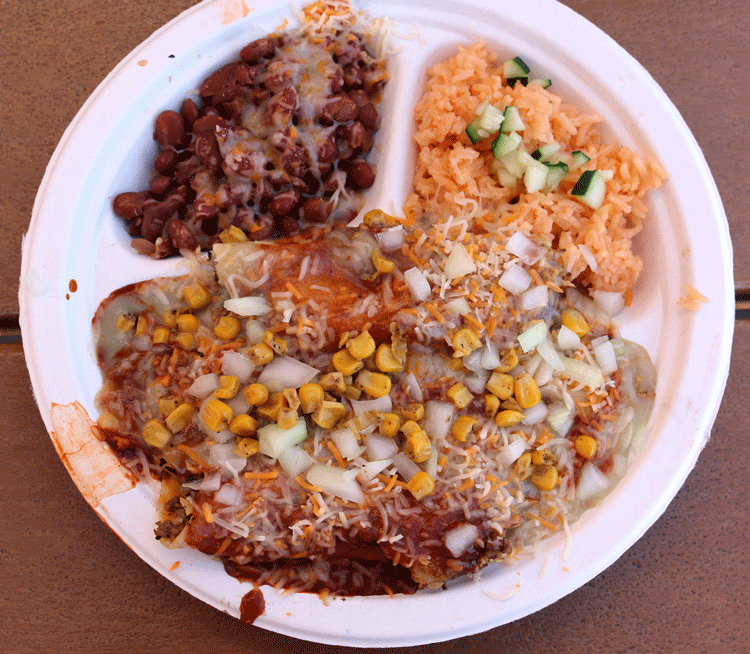
While their brick-and-mortar counterparts can afford to have multi-page menus to please a wide variety of palates, mobile food kitchens (that’s food trucks to you, Bob) are somewhat at a disadvantage. By sheer necessity, food trucks must be limited, well-defined, maybe even singularly focused.  The advantage the successful ones have is that they can concentrate on creating memorable dishes around their concept using a few common ingredients.  Rollin’ On In, for example, lists only four entrees on its menu: three tacos, a quesadilla, three enchiladas and a burrito. With those four entrees, however, there are an infinite number of “build-your-own” possibilities.  Your construction options include four fillings (shredded chicken, shredded pork, ground beef and potato and veggie mix), eleven fresh faves (cheese, lettuce, tomato, onion, fresh jalapeño, grilled corn, green onion, red cabbage, cucumber, cilantro and lime) and four sauces (lime and cilantro ranch, salsa, red chile and green chile).  Okay, mathematically the number of options isn’t infinite, but with over 300 million possible combinations for each entree, (don’t ask me to show my math) that’s still an impressive number. Food Network celebrity chef Bobby Flay once lamented, “when people pile seven things onto one burger, it drives me nuts!.” …

Street Food Institute – Albuquerque, New Mexico

“The more street food we have, the more it’s embraced by every income strata, the better world we have.” ~Anthony Bourdain Jonathan Gold, the first restaurant critic to win the Pulitzer Prize for criticism, called food trucks “the new incubators of culinary innovation.” Indeed, chefs and entrepreneurs who ply their talents in food trucks and express themselves through  distinctively creative cuisine aren’t just fostering culinary trends.  They’re doing so at a rate at which their brick-and-mortar counterparts couldn’t conceive, much less execute. Food trucks are exposing consumers to unorthodox flavor combinations and ingredient fusions, creating a growing demand for more novelty and culinary diversity. Add fast and inexpensive to the mix and you’ve got a trifecta of reasons food trucks continue to expand. Every day across the planet, street food is consumed by 2.5 billion people. Across the fruited plain alone, food trucks generated 1.2 billion in revenue in 2015, a 12.4 percent growth over the previous five years. One industry publication projects an annual growth rate of about 9.3 percent for the next ten to fifteen years. Coupled with much lower start-up costs than brick-and-mortar restaurants, food trucks may sound like a lucrative proposition as well as a culinary…

Gourmet Döner Kebab – Albuquerque, New Mexico

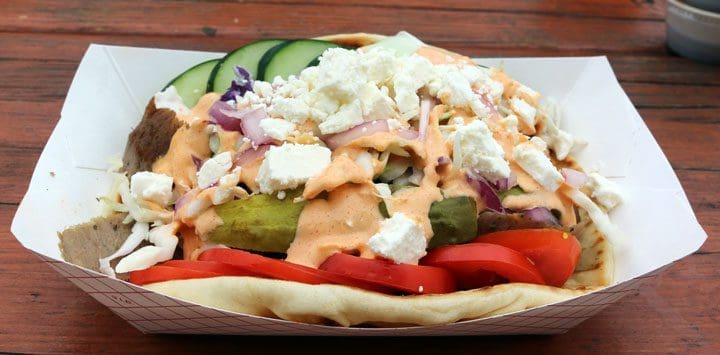
In my review of Taco Fundacion, I explained that some pundits believe the taco is poised to become the most ubiquitous and popular dish in the fruited plain, supplanting the fruited plain’s sacrosanct burger. While conquering the culinary affections of a country would be a huge accomplishment, one particular type of sandwich (loosely defined) has conquered an entire continent. Europe is absolutely crazy for kebabs! From the Iberian Peninsula to the Caucasus region, the döner kebab has become the world’s most popular spit-grilled meat. We witnessed some of its popularity first-hand when we lived in England where döner kebabs are considered an icon of urban food culture. They’re even served in centuries-old pubs alongside a pint (or six) of beer and the sacrosanct British chips. Döner kebabs are even more popular in Germany which is now considered the kebab capital of the world. Easily the most popular street food in Germany, döner kebabs by far exceed the popularity of the sausage, long a German source of historical and cultural pride. According to Thrillist, as of 2014, there were some 17,000 kebab slingers in Germany and more kebab stands than McDonald’s and Burger King combined. Aside from vegans, vegetarians and calorie…

Lollie’s New Mexican Food – Albuquerque, New Mexico (CONVERTED TO FOOD TRUCK)

NOTE:  Lollie’s New Mexican Food is now operating out of a food truck.  In the frontier wilderness of New Mexico–long before the advent of culinary schools and home economics classes–a cook’s credentials weren’t bestowed by some accredited institution of higher learning. Instruction in the culinary arts was most often imparted lovingly by mothers. Recipes were passed on from one generation to another, using ingredients often grown in the family farm and livestock raised locally. “Credentials” were earned by reputation and the word of mouth of satisfied diners (most often family members, neighbors and visitors). A good cook was known about far and wide. Lollie Padilla can relate to the New Mexican culinary traditions of yore, having worked next to her mother (to whom the restaurant is dedicated) in learning to cook homemade, wholesome New Mexican dishes at a very young age. On April 3rd, 2013, Lollie launched the eponymous Lollie’s New Mexican Food restaurant in the Barelas-South Valley area in which she was raised as were generations of her family. Two things are immediately obvious: Lollie was a very good student and her mother was a very good cook. Don’t let the restaurant’s motto “Proudly Serving The Southwest” confuse you.…

The Supper Truck – Albuquerque, New Mexico

On December 20th, 2014, a part-paean, part elegy graced this blog. The opening stanza read: “Supper Truck, I hardly knew you! Inexplicably and to the detriment of my taste buds, I didn’t partake of your delightfully creative interpretation of Southern cuisine until your very last day of serving Albuquerque. So, why do I miss you so much already? Most likely it’s the lost opportunities to partake of Southern cuisine inspired by the dynamic food truck scene of Charleston, South Carolina, one of my very favorite culinary destinations in America. It begs a paraphrase of a time-honored question is it better to have loved and lost the chance to further enjoy your edgy, contemporary, fusion twists on classic Southern comfort food favorites than never to have loved them at all?” To write a second chapter about the Supper Truck is to write a tale of rebirth, of starting over. Some six months after our inaugural visit, founding owner Amy Black sold both the truck and naming rights to Kristen Galegor and Claude Freeman. Because Amy had emphasized she wouldn’t sell until she found “the right person with the rare combination of drive, creativity and community-mindedness” which epitomized her purview, Duke City…

Cheesy Street – Albuquerque, New Mexico

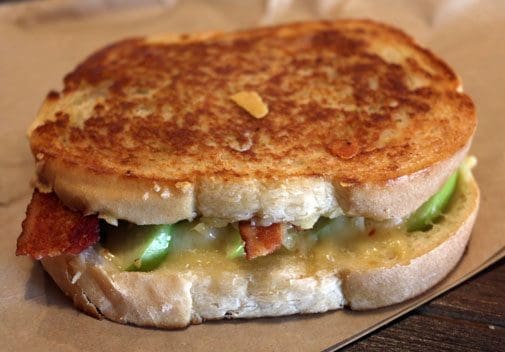
There once was a sandwich with cheese, That quickly brought me to my knees. Toasted, roasted. Oh sweet bliss. I’d be completely remiss Not to say, I’ll take two please. ~Ode To Grilled Cheese Courtesy of Clean Eats, Fast Feets Comedian Rodney Dangerfield used to joke that “I’m at the age where food has taken the place of sex in my life. In fact, I’ve just had a mirror put over my kitchen table.” Masterfully delivered in his inimitable perennial loser persona, that joke followed the thematic formula of his landmark 1980 album “No Respect.” With that joke, the pudgy bug-eyed comic unabashedly hinted at the importance of food porn in his life without actually uttering the term. Fittingly, Dangerfield, who based his entire comedy routine on getting no respect, isn’t even given the respect and credit for first suggesting the notion of food porn. In fact it wasn’t until 1984 that the term “food porn” was coined when author Rosalind Coward wrote in her groundbreaking book Female Desires: How They Are Bought and Packaged: “Cooking food and presenting it beautifully is an act of servitude. It is a way of expressing affection through a gift… That we should aspire…

El Chicken 100% Carbon – Albuquerque, New Mexico (CLOSED)

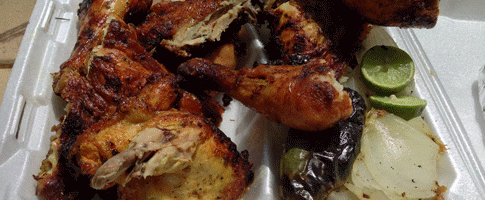
My environmentally conscious friend Bruce “Sr. Plata” Silver doesn’t have a large carbon footprint.  No environmental activist would ever condemn him for fouling the air and water with a large amount of greenhouse gas emissions. Instead, Sr. Plata leaves large “carbon fingerprints,” the finger-licking kind you get from frequenting restaurants which specialize in pollo al carbon, chicken prepared over charcoal.  Pollo al carbon has spoiled Sr. Plata.  He craves those juicy, golden-skinned birds speckled with black char, chicken so meaty and delicious it makes store-bought rotisserie chickens look positively anorexic in comparison.  Who can blame Sr. Plata?   Pollo al carbon is absolutely addictive.  It’s truly finger-licking good, much better (by legions) than you’ll find at the Colonel’s place. Fortunately the Duke City has several outstanding purveyors of pollo al carbon. Sr. Plata’s current favorite is El Pollo Real Colombiano, but when it comes to great chicken, he’s hardly monogamous.  When the cleverly sobriqueted O-U-8-1-2 responded to Sr. Plata’s plea for more pollo places to try, we knew we’d have to visit El Chicken, a food truck stationed on the southwest corner of San Pedro and Central.  You can tell you’re getting close by the mouth-watering aroma emanating from the large…

Dudley’s Barbecue – Albuquerque, New Mexico

The United States Department of Agriculture defines barbecue as “any meat cooked by the direct action of heat resulting from the burning of hardwood or the hot coals therefrom for a sufficient period to assume the usual characteristics” including the formation of a brown crust and a weight loss of at least thirty percent.” To the citizens of the great state of North Carolina, that definition is heresy, an example of government ineptitude and maybe even reason enough to secede from the union. Everyone in the Tar Heel state knows barbecue is all about pork. In fact, the words “barbecue” and “pork” are synonymous…and don’t ever call pork “the other white meat.” Doing so would be to utter fighting words (similar to suggesting to a Norteño that a little bit of cumin will improve chile) and to disparage centuries of tradition. You can get away with saying that in North Carolina tobacco is a vegetable, but to suggest beef as a viable barbecue option is blasphemy. North Carolinians go especially hog wild for pulled pork that’s been slow roasted for hours over low heat rendering it so tender that it’s “pulled” from the roast with one’s fingers or forks. In…