Birrieria Y Tacos Alex Tijuana Style – Albuquerque, New Mexico

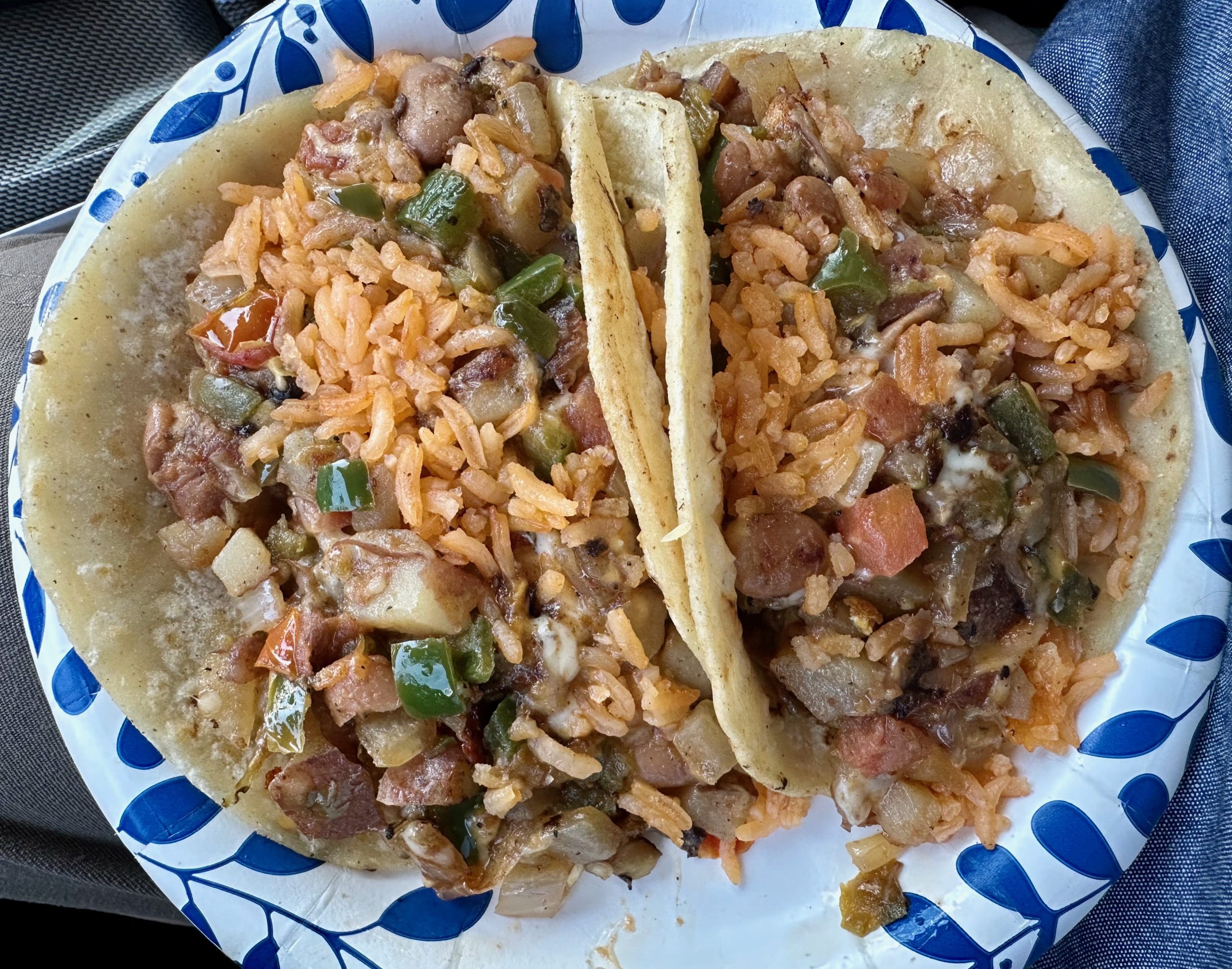
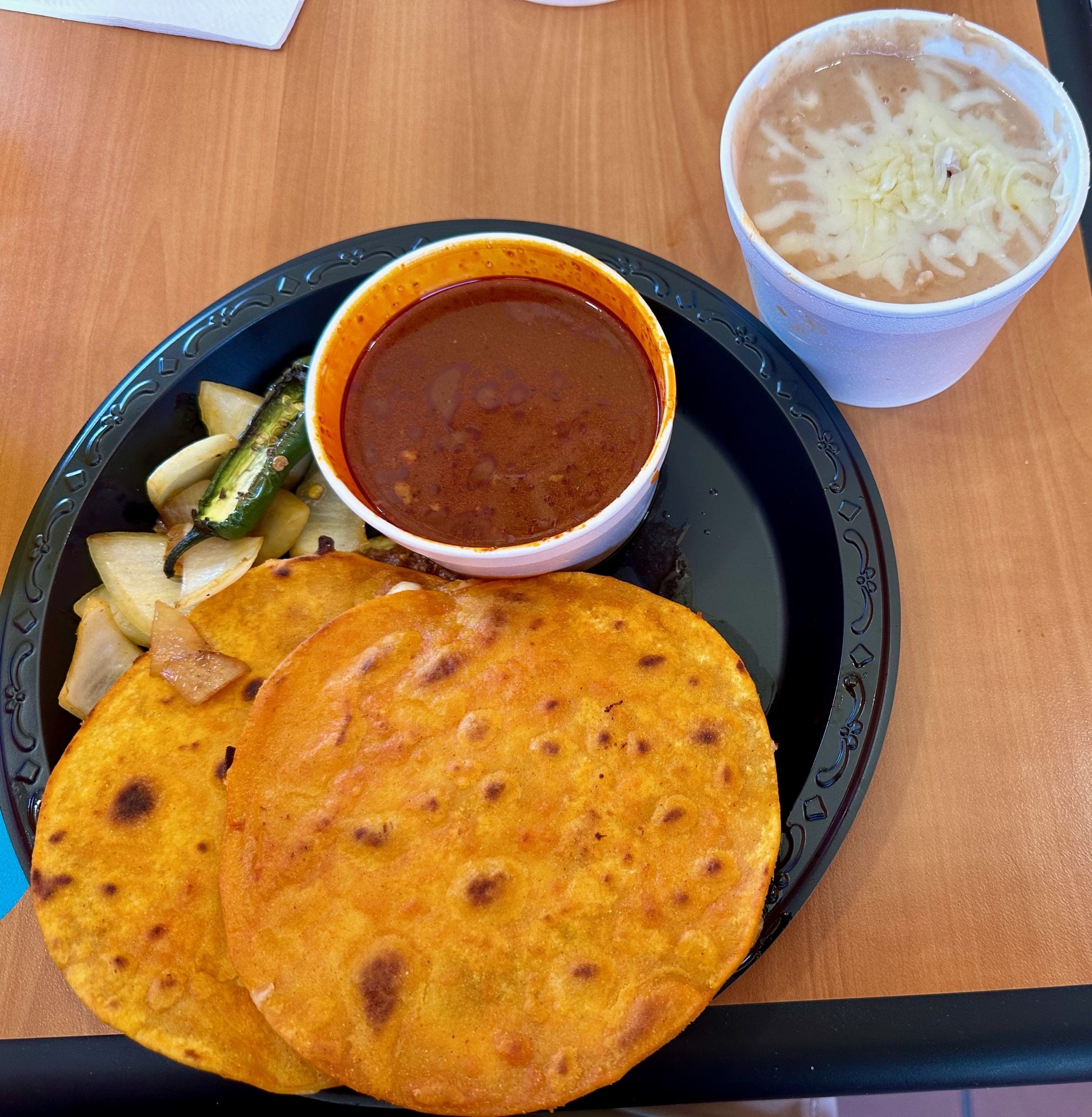
If you’ve noticed an increase in the number of recent visits on this blog to Mexican restaurants, credit much of that to Pati Jinich, ebullient host of the James Beard Award-winning and Emmy nominated PBS series Pati’s Mexican Table   Although we record the Saturday airing of Pati’s Mexican Table, we don’t usually watch it until Sunday…right before lunchtime.  It’s no wonder, therefore, that what we’ve been craving for lunch is Mexican food. It’s nigh impossible not to be utterly charmed (if not outright besotted) by the lovely Pati Jinich.   Her huge likeability quotient is the byproduct of a genuine warmth and self-effacing humor which come across with her every thickly-accented utterance.  She’s down-to-Earth and genuine, taking absolute joy in  broadening and sharing her expansive knowledge about the colorful tapestry known as Mexican cuisine.  In every episode, Pati embarks on an educational and entertaining journey.  Each dish she encounters serves as a launching point into explorations of the rich and diverse history and culture of her country of birth. In season eight (episode 811), which aired in January, 2019, Pati explored Sinaloa, “Mexico’s Bread Basket,” which produces about 40% of the meat and produce consumed in all of Mexico.  Inspired…
Gimani: A Slice Bar – Albuquerque, New Mexico

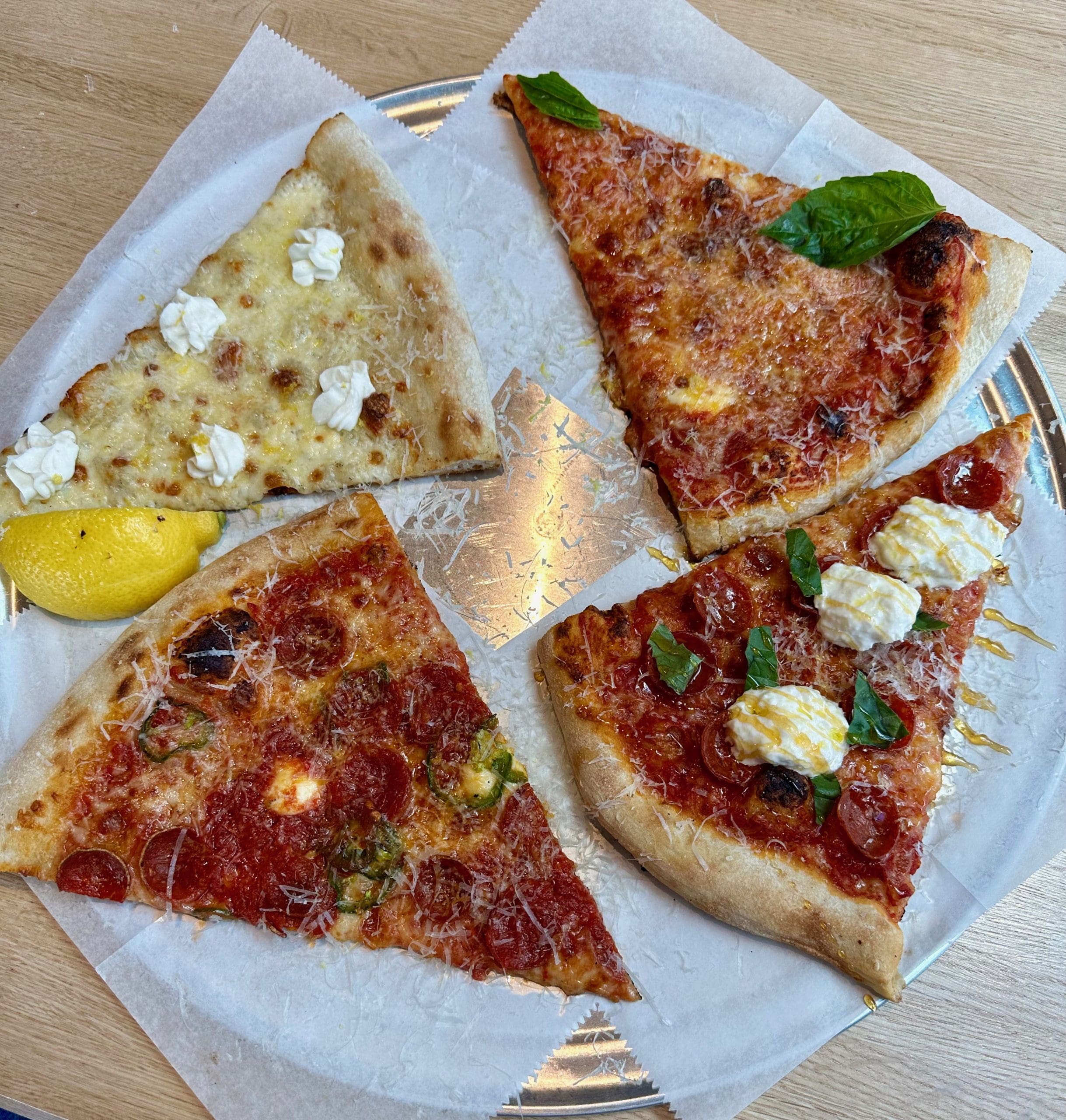
“You better cut the pizza in four pieces. I’m not hungry enough to eat six.” ~Yogi Berra In New York City, pizza by the slice is as ubiquitous as towering skyscrapers. Many of the city’s nearly 2,000 pizzerias serve pizza by the slice. Most have been doing so since the end of World War II when recently returned American veterans who had served in Italy craved the sliced pizza they had enjoyed during their service. Heck, in the Big Apple, you can even find pizza by the slice proffered by sidewalk vendors. According to my friend, the late, great Italian chef Mario D’Elia of Poppy’s Pizza & Italian Eatery, pizza is a street food.  “That’s so you can eat it while you walk,” he explained. At about three bucks a slice, it’s usually pretty decent thin-sliced pizza blanketed with cheese. The ubiquity of pizza by the slice doesn’t mean the practice is universally approved of. The other school of thought snubs its nose at the thought of serving by the slice, the triangle-shaped, tomato sauced pie Americans consume at the rate of 100 acres a day. Many traditionalists, particularly artisan pizzaiolis with coal-burning oven pedigrees disdain the practice of pizza…

Kawaii Boba Cafe – Albuquerque, New Mexico

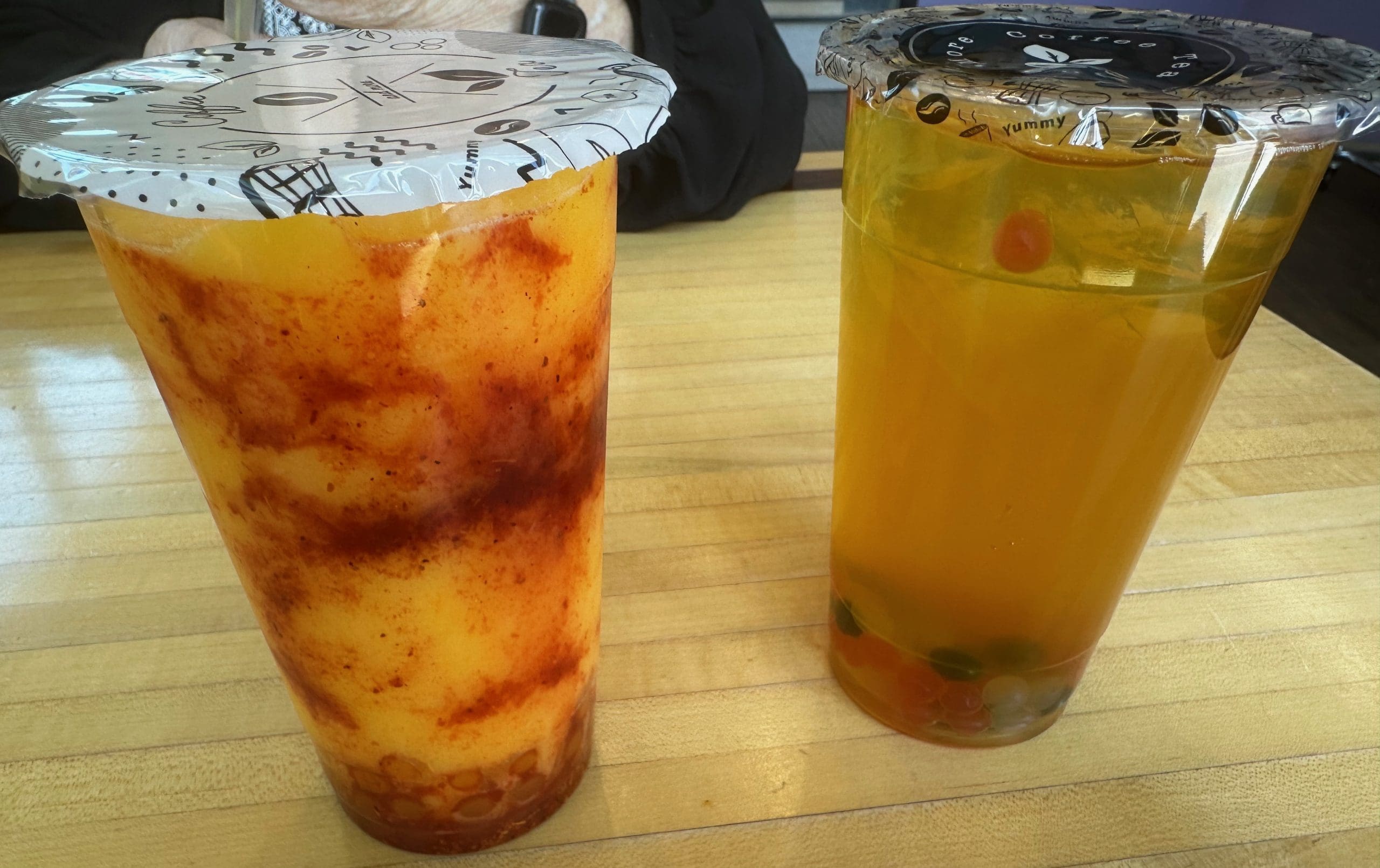
I have a confession to make.  I just don’t get anime…and can’t figure out the pokemon craze.  That’s a rather starting admission for an Information Technology (IT) professional to make.  Maybe I need help?   After all, for your stereotypical male IT professional, anime and pokemon are just steps in the typical progression of IT affectations.  They’re the logical graduation that follows a rather unhealthy obsession with Princess Leia and all things Star Wars.  Which reminds me, I found Star Wars silly and boring.  Since I’m airing dirty laundry, I may as well admit I’d just as soon watch paint dry as play a video game.  Any video game. Nor do I ever celebrate Pi day (March 14th) and my Kim had to explain what Star Wars Day (May 4th) means (May the fourth be with you). My male colleagues in the IT profession, several of whom still live in their mom’s basement, are probably apoplectic about these revelations.  They probably think I don’t like dinosaurs either.  Well, er…   All these heretical confessions probably mean I’ll have to renounce all my IT certifications and turn in my beanie.  Next thing you know my techno-nerd colleagues will hack my computer to…

Pho #1 – Albuquerque, New Mexico

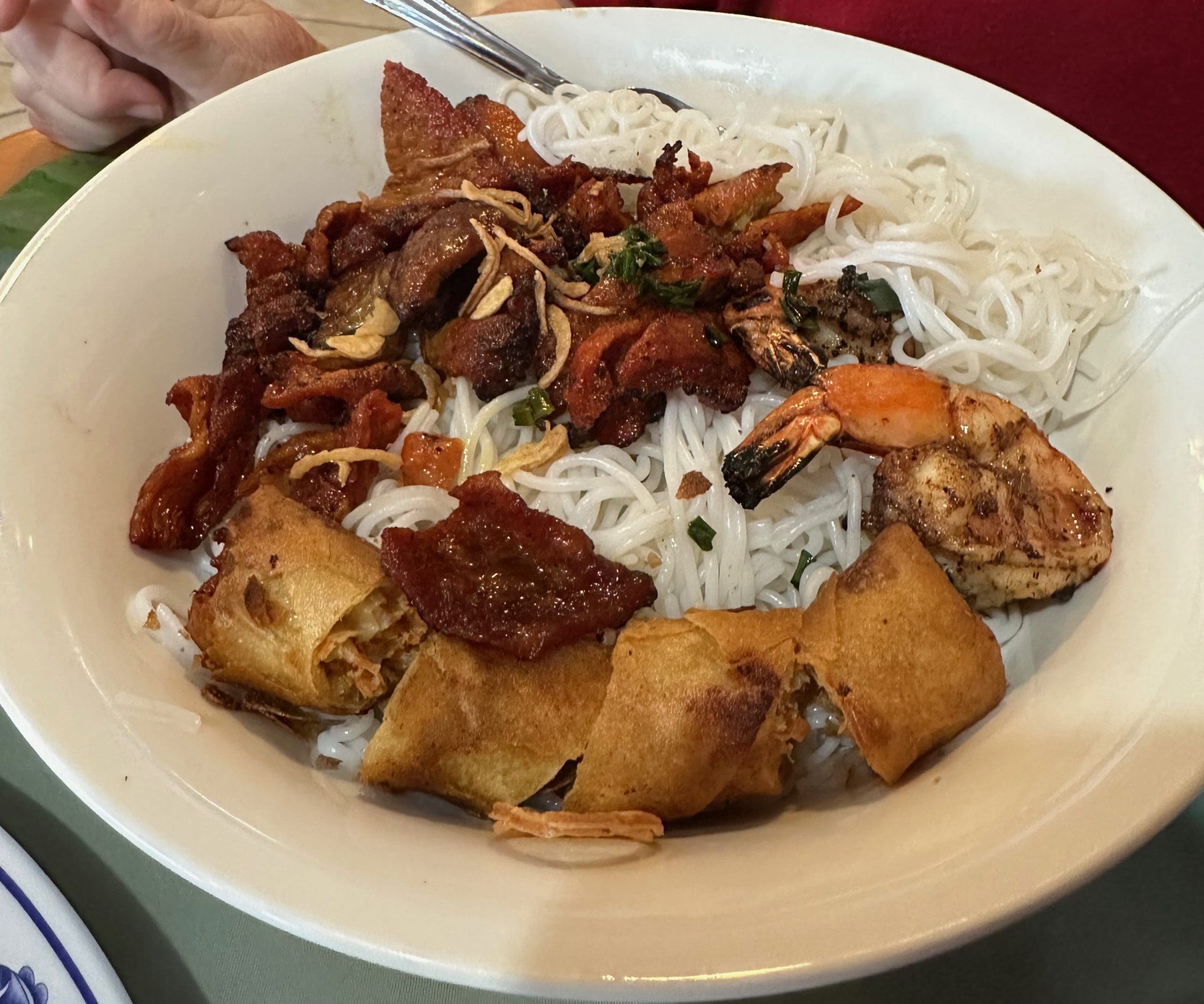
Beef.  How do I love thee? Let me count the ways. I love thee to the depth and breadth and height my pho spoon can reach. Okay, I’m no Elizabeth Barrett Browning, but if I were to count the ways I love beef, the count might stop at seven–as in the special seven courses of beef offered at Pho #1.  Serving  the Duke City for more than two decades, Pho #1 makes an audacious claim by virtue of its name but it’s a claim with which loyalists will agree.  It’s an International District gem that continues to thrive in a neighborhood some diners eschew. With more than one-hundred items on the menu–not including the seven courses of beef–Pho #1 offers a veritable compendium of Vietnamese food favorites including a large selection of pho bo (beef noodle soup).  Pho is the classic Vietnamese fast food, served in a large soup bowl with fresh rice noodles topped with your choice of beef slices (rare steak, well-done flank, brisket, tendon, tripe, skirt flank and beef ball) then sprinkled with chopped green onion, cilantro leaves and sliced onion.  Each bowl is accompanied by a plate of bean sprouts, sliced jalapenos, lime and basil. Pho…

Belle’s Urban Deli – Corrales, New Mexico (CLOSED)

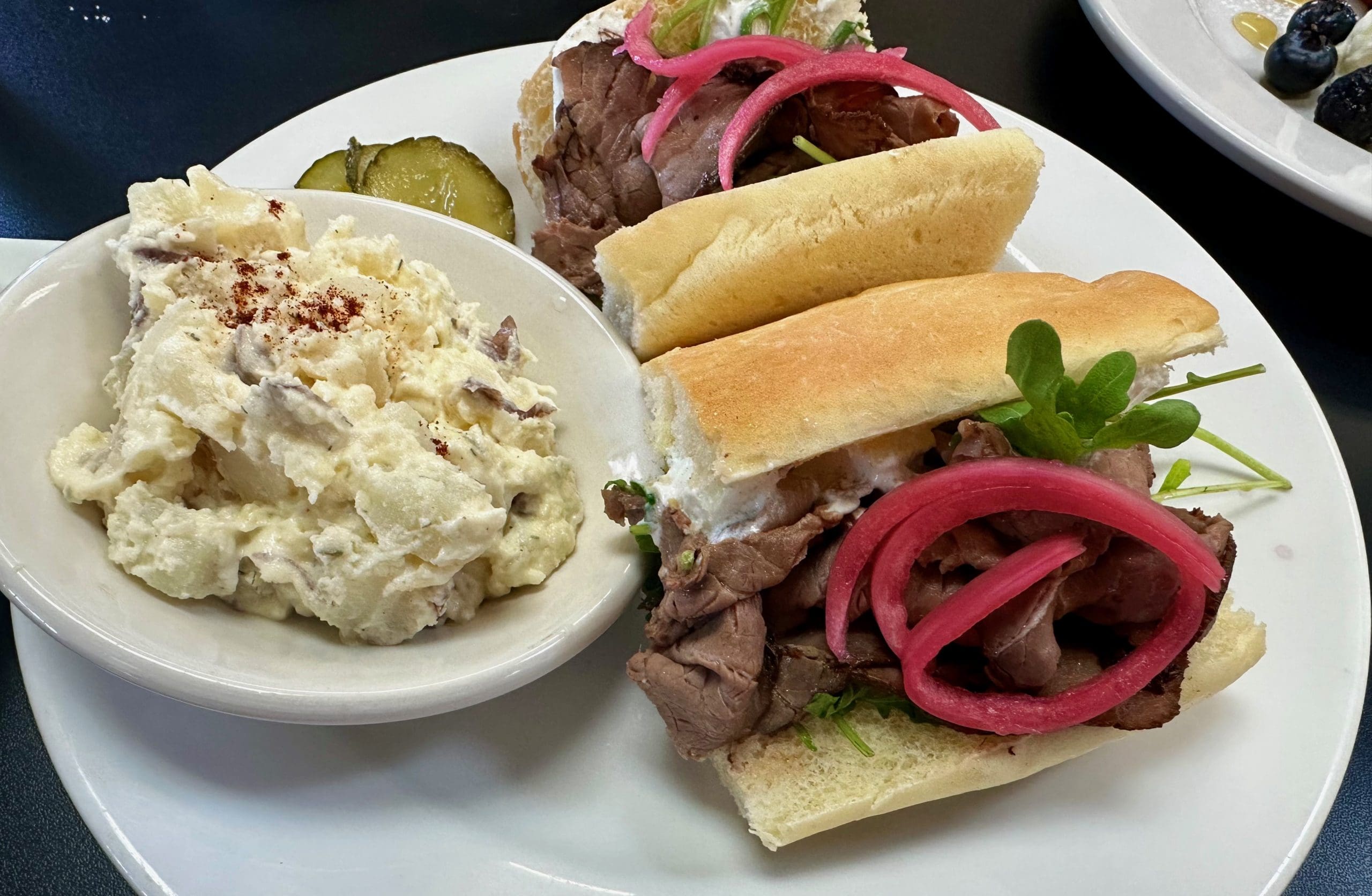
Father Mark Schultz, the charismatic former priest at the Holy Ghost Parish in Albuquerque used to joke that the reason Catholics are required to abstain from eating meat on Fridays is not because there’s a shortage of cows. That’s certainly true. There is more beef on the hoof grazing on the Land of Enchantment’s green (and mostly brown) grass than there are tax-paying citizens.  That’s why it’s always puzzled me that sandwich restaurants in New Mexico are so chintzy with their meat portions. You’d think there really was a beef shortage (and a surfeit of bread and lettuce) considering many an Albuquerque restaurant sandwich is comprised of thin shards of meat buried under half a head of lettuce and enough bread to choke a mule. Americans are obsessed with size, er…sandwich size.  We’ve come to believe that small sandwiches are un-American!  That it’s practically a mortal sin to construct, serve or eat a small sandwich.  Perhaps that train of  thinking might be attributable to a comic strip called Blondie which has entertaining Americans since 1930.  Blondie’s husband Dagwood was renowned for raiding the leftovers in the refrigerator to construct titanic, multilayered, cartoonishly exaggerated sandwiches. Those sandwiches were replete with sausage,…

El Chile Toreado – Santa Fe, New Mexico

Until 2008, the notion of gourmet culinary offerings being proffered by a mobile conveyance was unheard of.  Prior to then, food trucks were (often rightfully so) known as “roach coaches” or even worse “barf buggies.”  Roach coaches were an eyesore, a medium of last resort usually parked at construction sites, manufacturing plants, public parks or basic military training bases where captive trainees had no alternative.  Roach coaches were a pure convenience with no pretense to gourmet (or even good) cuisine.  Most of them hawked simple fare such as hot dogs and tacos as well as potato chips, cigarettes, candy and chewing gum. During the era of “convenience stores on wheels,” food trucks weren’t worried about building a brand.  Nor were they concerned with repeat business or customer loyalty. There was no such thing as social media at the time and there were no Yelp reviews. These unsightly vehicles (many with actual roaches in tow) were in business to serve a location for a short time period. After at construction job ended at one site, for example,  they would simply move onto the next profitable location and the process would continue.  These “convenience stores on wheels” served a purpose, but during…

The Compound – Santa Fe, New Mexico

“It’s good…New Mexico good.”  As a proud New Mexican, it galls me to hear apologists demean, denigrate and otherwise concede (quite erroneously) that restaurants  in the Land of Enchantment are good, but not as good as restaurants elsewhere.  It’s as if New Mexico’s restaurants can’t possibly be as good because…well, we’re New Mexico and we’re just not supposed to be very good.  Look at where we rank in so many quality of life categories.  It’s akin to University of New Mexico (UNM) Lobo basketball fans being content to make it to the “Sweet 16,” a goal no Lobos team has ever achieved. My counterargument is why the #$%*&! can’t a restaurant in New Mexico be considered one of, if not THE most outstanding restaurant in the Fruited Plains.  Similarly, why can’t the Lobos blow past the Sweet 16 and win an NCAA championship in basketball?  It’s as if a Pygmalion effect (low expectations lead to poor performance) has cast a pall over the Land of Enchantment and we’ve become the “Land of the Mediocre.” Channeling Howard Beale from the Academy Award-winning movie Network “I’m mad as hell and I’m not going to take it any more!”  The next time someone…

Level 5 Rooftop Restaurant – Albuquerque, New Mexico

For a nearly four-hundred year period, the Anasazi civilization which preceded New Mexico’s Pueblo cultures achieved the pinnacle of its technological and cultural advancement at a magnificent,  deep gorge called Chaco Canyon. Within the walls of Chaco Canyon, construction of multi-level buildings sprung up, some structures accommodating as many as  800 rooms. Not surprisingly, lower walls had to be made massive in order to support heavy stone walls up to five floors high.  It took remarkable planning to locate doors, passageways, kivas and other architectural features.  At five stories high,  Pueblo Bonito was the largest structure and the inspiration for Hotel Chaco’s spectacular restaurant Level 5  in Albuquerque’s Sawmill District. In 2017, local developer Heritage Hotels launched Hotel Chaco on Bellamah Avenue in the Sawmill District.  Formerly a 110-acre complex, the District once milled lumber, doors and shingles, at one point serving as the largest manufacturing company in the Southwest. Today there are few, if any, vestiges of the District’s historic past.  Instead, the area has exploded, metamorphosing from a lusterless industrial area to a dynamic hub for hospitality and dining.   Hotel Chaco is at the heart of the changes.  An eighty-million dollar project, the Hotel is unlike any…

La Guelaguetza – Albuquerque, New Mexico

“I am tenacious. And I love to eat.  I go into the field and see some delectable things they’re cooking, wild plants perhaps, and think, ‘Oh my God, I have to write about this.’ I just think it’s insatiable curiosity. To me, life is a continuous process of learning.” ~Diana Kennedy As an essayer of the Land of Enchantment’s culinary condition–primarily as it’s expressed by its restaurants–I’ve always marveled at the passion and appetite of Diana Kennedy who built a lifelong career by compiling, publishing and teaching indigenous Mexican recipes.   Just as Julia Child reduced the nuances and inflections of French cuisine and culinary techniques for home cooks, Diana introduced home cooks to highly developed, often centuries-old culinary traditions they didn’t even know existed.  Emanating largely from indigenous Mesoamerican cultures that predated Columbus, those culinary traditions might have been lost to time were it not for Diana Kennedy who wrote several classic books on authentic Mexican cooking. A case could easily be made that before Diana Kennedy, much of the fruited plain perceived Mexican food as some homogeneous combo plate brimming with rolled enchiladas topped with a brownish “sauce” just a shade darker than the refried beans on the plate;…

Jinja Bar & Bistro – Santa Fe & Albuquerque, New Mexico

Fusion cuisine.  The term often makes the most stodgy of purists cringe.  Even those among us with the most liberal of palates have been known to cower at its mention.  All too often, fusion cuisine is a loosely defined excuse for restaurateurs to unleash any number of unnatural flavor combinations upon the chaste, unsuspecting taste buds of diners seeking a memorable meal.  Like a shotgun culinary marriage, felonious acts have been perpetrated in the name of fusion, with disparate exotic ingredients forced together by the imagination of sadistic chefs. It would be impossible, however, to dismiss fusion cuisine entirely.  In one respect or another, much of the food we eat is a product of fusion.  There is no one national cuisine entirely self-contained and isolated.  Food is a work in progress–always adapting, always assimilating, always evolving.  Perhaps nowhere is that more evident than in the melting pot that is America where the influence of immigrant cuisine from throughout the world has resulted in a true fusion of culinary cultures, where the sum of the whole is more delicious than the cuisine of each culture individually. Over the centuries–through brutal conquests, peaceful immigration and mutually beneficial trade–Southeast Asian nations in close…

Dave’s High Desert Grill – Albuquerque, New Mexico

It’s easier, by far, to define and describe Japanese and Chinese cuisines than the melting pot (literally and figuratively) that is American cuisine.  It’s the same with French cuisine and Italian cuisine.  Virtually every cultural culinary tradition had been influenced by the traditions of neighboring countries while managing to retain elements that are unique to that particular cuisine.  American cuisine, on-the-other-hand is pretty much a mishmash of every other cuisine, near or far.  To say American cuisine consists of the cooking style and traditional dishes prepared in the United States is to sell that cuisine short.  Immigrants, in particular, have created a diverse cuisine that often varies by region. As if American cuisine sounds like a catch-all term, a phalanx of restaurants are increasingly self-glossing as “New American” restaurants, a term Scottsdale chef Dom Ruggiero of Hush Public House says “let’s me do whatever I want.” Also known as “Contemporary American cuisine” or “Modern American Cuisine,” this evolved cuisine is primarily served at upscale fine dining eateries across the fruited plain.  It’s essentially a fusion cuisine which assimilates flavors from the conflation of multicultural foods and often components of molecular gastronomy with a focus on fresh, local and seasonal farm-to-table…