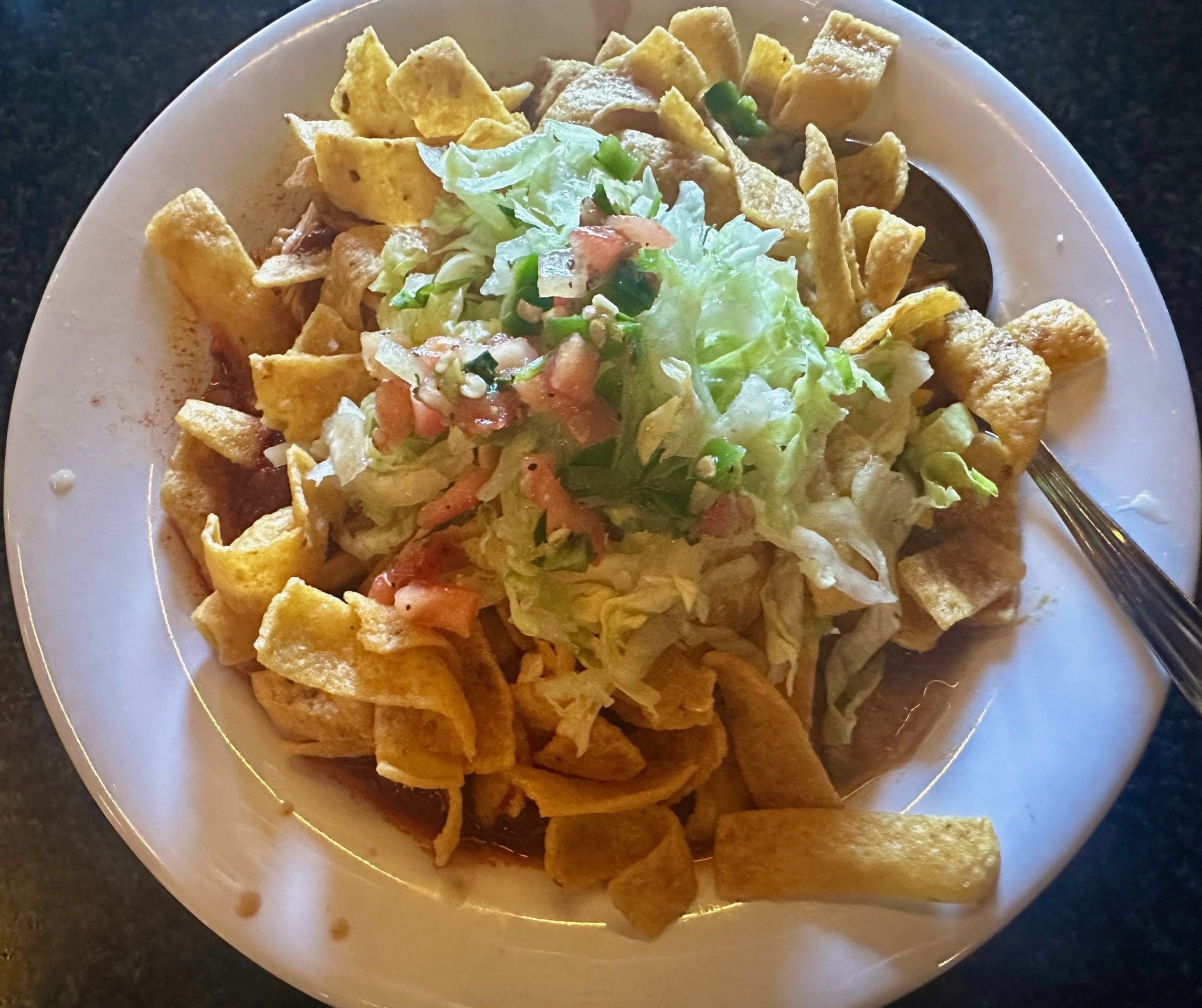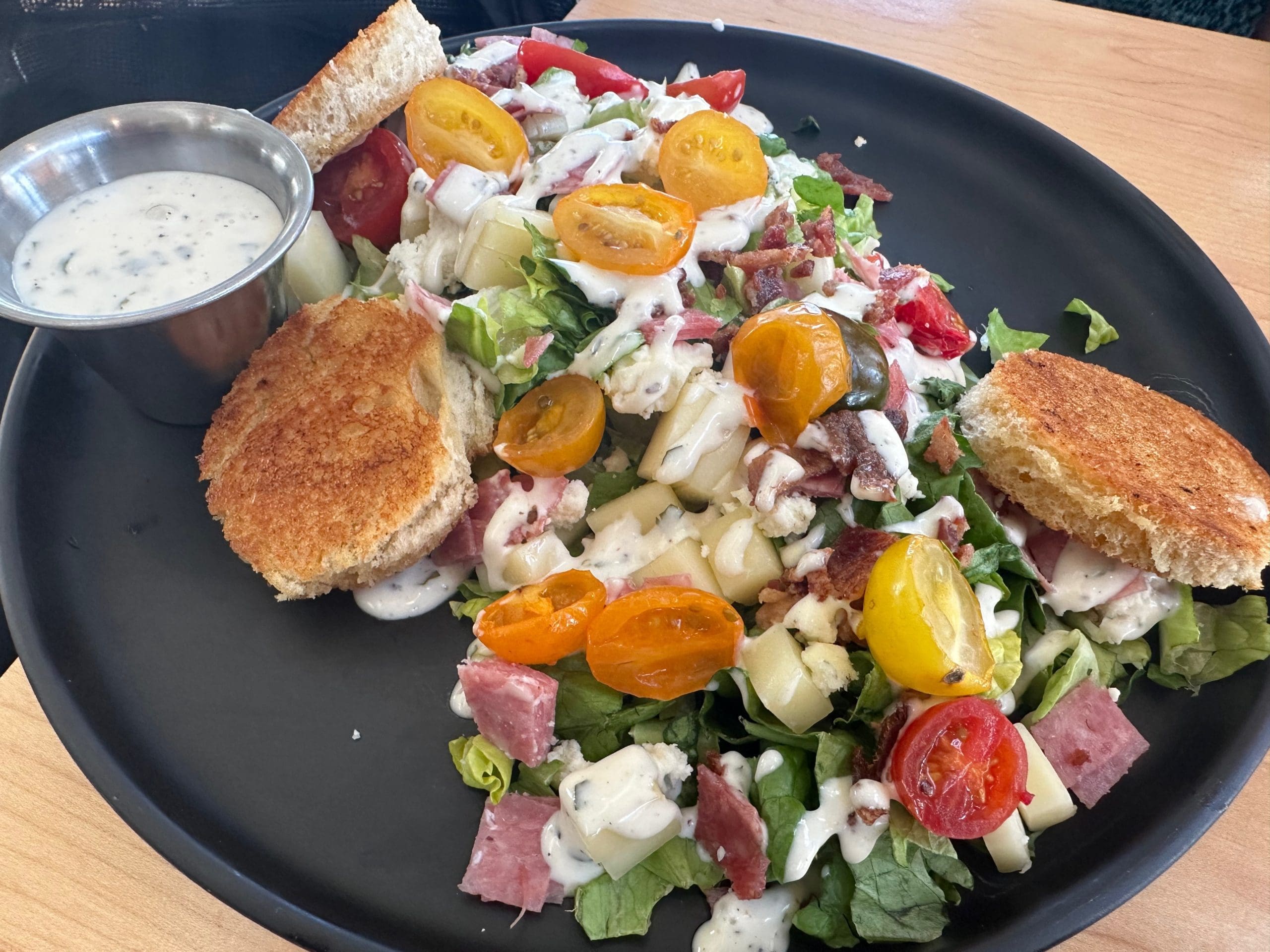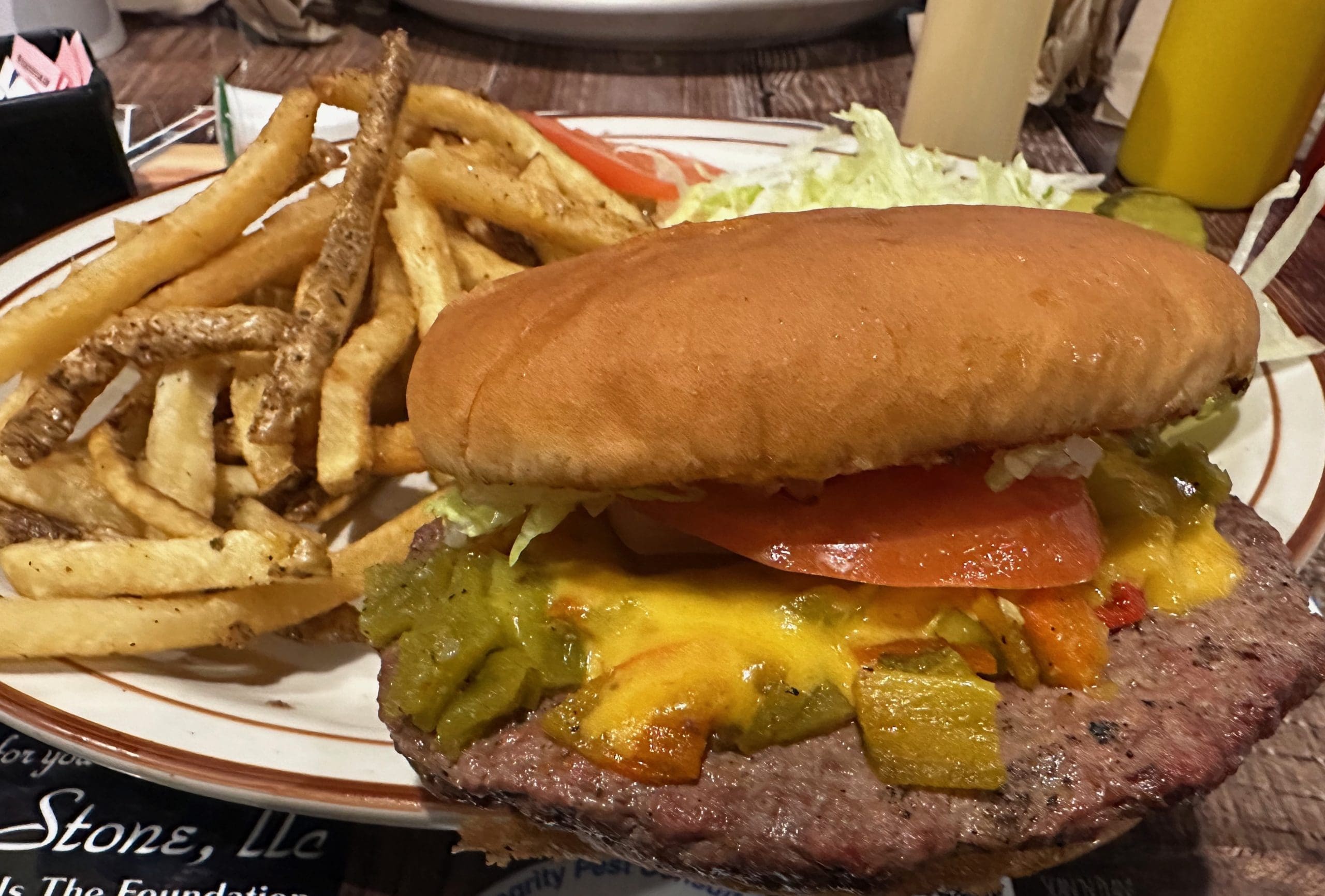
Herencia – Albuquerque, New Mexico

When he founded Los Equipales in 1996, restaurant impresario Henrique Valdovinos admitted “I wouldn’t have tried this ten years ago, but I think people are ready for it.”  As recently as a quarter-century ago, two types of Mexican restaurants existed across the fruited plain.  Most common were those sharing reciprocal expectations with diners who expected and received such stereotyped “Mexican” food as fajitas; hard-shelled tacos filled with ground beef, cheese, lettuce and sour cream; chiles rellenos made with bell peppers and enough yellow cheese to clog a dinosaur’s arteries.  Denizens under the spacious skies didn’t know any better and enjoyed the watered down versions of the real deal.  This “Mexican” food became mainstream. The other type of Mexican food restaurants might best be catgorized as “Mexican restaurants for Mexican people.”  These restaurants didn’t offer “dumbed down” cuisine and were primarily (though not exclusively) frequented by scions of Montezuma.  Among those which caught on across dining demographics were mariscos restaurants offering Mexican seafood options.  None of the ubiquitous and mostly shuttered chains (Chi Chi’s, Don Pablo’s, Pancho’s, El Torrito, etal)  served seafood.   Mexican mom-and-pop restaurants began sprouting and having success by serving the foods enjoyed by Mexican families. When he launched…

Noodle Works – Albuquerque, New Mexico

“To witness the birth of a noodle is a glorious thing. I have listened, spellbound, as an 85-year-old noodle chef in Beijing told me why the act of making noodles helped him make sense of the world.” -~Terry Durack, Noodle In the movie Mr. Nice Guy, martial artist cum actor Jackie Chan portrays a  chef with a successful television show.  In the movie’s opening scene, Chef Jackie is presiding over a flour-dusted table, stretching, twisting, and pulling a piece of dough into fine strands of noodles, a process the TV host can only describe as “alchemy.”   For the culinary obsessed among us, that was the highlight of the movie, all the “special effects” we needed.  Later on, Chef Jackie would be stretching, twisting and pulling a drug lord and his syndicate in much the same manner as he did the noodles. There’s something almost mystical about the artisan process of pulling noodles by hand.  Certainly for the onlooker, it’s entertaining to the point of being mesmerizing.  It’s not prestidigitation in that there’s no sleight of hand to deceive you.  It’s sheer brilliant mastery of an time-honored craft.  It’s performance art and scientific precision in one.  Learning to repeatedly stretch…

Tula’s Kitchen – Albuquerque, New Mexico

Tula: “My mom was always cooking foods filled with warmth and wisdom… and never forgetting that side dish of steaming-hot guilt.” As it celebrates its twenty year anniversary the 2002 Rom-Com “My Big Fat Greek Wedding” remains as timeless and funny as it was when it debuted.  Moreover, it’s still a heart-warming movie with which some of us can relate.  In my estimation, it could easily have been called “My Big Fat Northern New Mexican Wedding” and it could have been set in Peñasco.  The similarities between Greek families and Northern New Mexican families around which I grew up were startling.  That’s especially true about the food, family and eccentricities, the latter especially prominent among the movie’s well-meaning and hovering aunts and the protagonist’s domineering father. My Big Fat Greek Wedding centers around Tula Portokalos, who at thirty is only woman in her family who has failed to find a nice, Greek husband and have babies.  Living at home, Tula works as hostess at her family’s restaurant, “Dancing Zorba’s.” Tula describes her younger self as a “swarthy 6-year-old with sideburns” who was shamed by blonde schoolmates for eating “moose caca” (moussaka).  Tula remains frumpy and insecure until early in her third decade when she practically…

Sammys Cafe & Deli – Albuquerque, New Mexico

Most foodies have pondered the expession “Never trust a skinny chef.”  Maybe you’ve even mused if there’s any truth to it.   Your line of thinking probably goes something like this: “If a chef’s cooking is any good at all, how can that chef possibly resist stuffing himself (or herself)?”  With this train of thought, every chef should look like Paul Prudhomme, the brilliant Creole-Louisiana Cajun chef who once weighed more than 500 pounds.  Celebrity chef Gordon Ramsay, who’s not shy about expressing his opinion, called the notion that you shouldn’t trust a skinny chef “BS.”  To the contrary, the volatile Ramsay believes “In order to be consistently excellent, a chef must “stay fit.” As my friend Bill Resnik and I strode into Sammy’s Cafe & Deli, we ran into the very fit Chef Marc Quiñones who had just finished his morning run.  Chef Quiñones runs distances some of us get tired driving.  He’s the proverbial high-energy somatype, a dynamic whirling dervish in constant motion.  Moreover, he exemplifies a paraphrase of a famous Homer Simpson quote: “Chef Marc Quiñones: Is there nothing he can’t do?”  At least in the culinary arena, the answer to that Jack Handy deep thought is “no.” …

Pho Garden – Rio Rancho, New Mexico

NOTE:  In the first few introductory paragraphs below I describe an encounter that took place between two friends.  Though that encounter took place several years ago, it perfectly  illustrates the idealogical divide that has torn our great nation apart. It should have been a point-counterpoint debate for the ages. My ideologically opposed and perpetually squabbling friends Carlos and Hien were arguing about the concept of American exceptionalism. Carlos took the Reaganesque position that America is the shining city on a hill. “Everything about America is great,” he proclaimed. “We have the highest standard of living and pretty much the best of everything.” Hien mirrored Obama’s stance that America does not have exclusivity in believing itself to be exceptional. Much like the chasm that divides Congress, neither disputant would concede a modicum of merit in the other’s argument. When it seemed as if this argument would end in another stalemate, Hien pulled out his trump (no, not another reference to a President) card. “There’s one thing about America that isn’t exceptional,” he declared. “American fast food is terrible.” With that point having been made, Carlos, long an advocate of independent mom-and-pop eateries, capitulated. True to form, they then began an argument…

Escondido – Santa Fe, New Mexico

“For nothing is hidden that will not be made manifest, nor is anything secret that will not be known and come to light.” ~Luke 8:17 “Escondido (which translates from Spanish to “hidden”) sure proves that Bible verse wrong,” I lamented as I cursed Google Maps for having led me to a nondescript residential neighborhood in Santa Fe.  Though not as execrable as the time Google Maps insisted I make a left onto a crude and rocky dry wash when trying to get to Kayenta, Arizona, I nonetheless took Google’s name in vain then followed my instincts.  Fortunately, crossing over Agua Fria onto another neighborhood shed light on my quandrary.   There in front of me was Escondido, the restaurant destination I sought.  I still won’t forgive Google Maps for having led me astray.  Unlike in horseshoes, close doesn’t count. True to its name, Escondido is well hidden–or at least off the well-beaten and well-eaten path.   What isn’t hidden is the reputation of Chef Fernando Ruiz, a formidable chef with a colorful past and an efulgent future.  His is a story sadly not oft repeated, a tale of determination when recidivism is the path others in his shoes might have taken.  At…

Two Fools Tavern – Albuquerque, New Mexico

Read the table tent placards at the Two Fools Tavern and you’ll learn that this is where the craic is mighty. An old Gaelic term pronounced “crack,”craic refers to the lively essence of the pub experience, a unique and sometimes loud combination of good friends, good times and of course, good pints. Craic is a word for which there is no exact English translation even though there are some 9,000 pubs in the Emerald Isle. In Ireland, pubs, or public houses, are a focal point of the community–as much as the local church. It’s where friends gather for camaraderie and commiseration. The sale and consumption of alcoholic libations is perhaps the pub function with which most Americans are familiar. Most public houses offer a range of beers, wines, spirits and soft drinks with beer tending to be the most popular adult beverage. In recent years, serving food has become a more important function of the public house throughout the British Isles. Yeah, I know what you’re saying: “Good food at an Irish pub is an oxymoron.” When it comes to the culinary arts, Ireland (just like England) is the Rodney Dangerfield of Europe; its cuisine receives absolutely no respect. Irish…

Upscale Rio – Rio Rancho, New Mexico (CLOSED)

NOTE:  Upscale Rio shuttered its doors for good on 4 December 2025. My friend Schuyler used to joke that every meal we enjoyed together was “upscale” because “up” was the direction his scale climbed when we finished our marathon meals.  We were quite the trenchermen in our youth, bona fide threats to any all-you-can-eat buffet in town.  Back then–as impoverished junior noncommissioned officers in the Air Force–ten dollar meals were near the upper end of we could afford with an occasional fifteen dollar splurge.  Back then, some thirty years ago, you could get quite a bit of food for ten dollars.  Fast forward a few decades and the term “upscale” has a different meaning for both of us.  We have both been able to reap the harvest of our hard work and are able to (on occasion) afford upscale restaurants that features fine-dining. Back when a dollar would buy four burgers at Griff’s, we couldn’t have conceived of any burger being considered “upscale.”  Not even the most sage of soothsayers could possibly have had the prescience to predict the price of burgers exceeding ten dollars.  Today, it’s not uncommon to find burgers flirting with the twenty dollar mark (maybe that’s…

BUDAI GOURMET CHINESE – Albuquerque, New Mexico (CLOSED)

“The true gourmet, like the true artist, is one of the unhappiest creatures existent. His trouble comes from so seldom finding what he constantly seeks: perfection.” –Ludwig Bemelmans By definition, gourmets are connoisseurs, taking food more seriously than most and embodying the axiom “live to eat rather than eat to live.” True gourmets, as Ludwig Bemelmans would define them, appreciate food of the highest quality, exalting only in the rarefied experiences–those which require the most discerning palates and noses to cognize subtle nuances in complex and sophisticated flavors and aromas. Bemelmans, himself an internationally known gourmet, posited that the true gourmet will find joy only in tasting, smelling and appreciating perfection, not in its pursuit. I’ve known several true gourmets fitting Bemelmans definition. Most of them are insufferable and condescending. Though endowed with refined palates cultivated by years of indulgence in the finest foods and blessed with olfactory senses which would put a German shepherd to shame, they derive no sensuous enjoyment from most culinary experiences. Nothing is quite good enough. Nothing meets their demanding and exacting standards. Dining (they don’t eat) with them is a test in patience as they deride and diminish everything put before them. Perhaps the…

Villa Myriam Coffee Roastery – Albuquerque, New Mexico

Because of coffee’s olfactory-arousing properties and nuanced depth of flavors, it has the unique ability to evoke personal memories that transport java junkies to better times.  Every satisfying and stimulating sip of coffee relocates me to my Grandma Andreita’s kitchen table where I learned to love coffee brewed on her old wood stove.  For brothers David and Juan Certain, the aromas return them to Colombia where their grandfather founded Villa Myriam in 1961.   The brothers spent much of their childhood on the fields of their grandfather’s coffee plantation where they learned which coffee beans were the best. In 1999, Juan and David migrated to the US as political refugees during the hard times of violence in Colombia. After things settled, they decided to share their passion for coffee and return to the family plantation to import their beans to Albuquerque, NM.  In October 2010, the brothers started a wholesale coffee business in Albuquerque, using Albuquerque’s South Valley Economic Development Center’s commercial kitchen to roast and package the coffee. It didn’t take long for Villa Myriam coffee to become a hit in New Mexico. Though we’ve enjoyed Villa Myriam’s award-winning coffee at several restaurants, it was a foodie event–edible New Mexico’s…

Mati Peruvian Restaurant – Albuquerque, New Mexico

In 2004, The Economist (a British weekly news publication) proclaimed that “Peru can lay claim to one of the world’s dozen or so great cuisines.” In 2005, Bon Appetit declared Peruvian “the next hot cuisine,” extolling its “vibrant ceviches, crispy, spiced rotisserie chickens and packed-with-flavor empanadas” then encapsulating its declaration with “this is one cuisine we could eat every day.”  A year later, at the world’s premier gastronomic forum, the International Summit of Gastronomy, Lima (the coastal nation’s capital city) was touted as the “gastronomic capital of the Americas.” In 2011, The Wall Street Journal also called Peruvian food “the next big thing” glossing that it “provides flavors that have the world’s top toques raving, experimenting and catching the next jet.”   The following year, BBC expressed the same “next best thing” notion.  In 2014, Conde Naste Traveler called Peru “the future of gastronomy.”  One year later, The Culinary Exchange expressed that “the world’s next global food trend is…Peruvian cuisine.”  A number of other online and print publications parroted that “next big thing” mantle. As an independent  observer of the culinary condition, I had to wonder “when will Peruvian food finally arrive as the “next big thing,” especially in Albuquerque which isn’t…