Red Rock Deli – Albuquerque, New Mexico

America may be a multicultural melting pot, but thriving within its most populous metropolises are ethnic neighborhoods–pockets of diversity residing in two worlds, retaining many of the cultural and culinary traditions of their motherland while integrating into and pursuing the American dream. Cities such as Chicago have long realized that these ethnic enclaves offer a treasure trove of cultural and culinary experiences. Most of these neighborhoods welcome culinary tourism–the opportunity to showcase the cuisine of their homelands. One such example is the city of Chicago which boasts of the largest Polish population outside of Warsaw (as many as 183,000 by some estimates) in the world. Storefronts and restaurants in “Little Poland” on Chicago’s far Northwest side are bedecked in the white and red flag of Poland. They offer everything from pierogies to kielbasa. Every Labor Day weekend Chicago celebrates its Polish heritage at the Taste of Polonia festival where Polish cuisine and culture are showcased. Obviously Albuquerque doesn’t have the population to support a “Chinatown” or a “Little Poland,” but the Duke City does offer multicultural dining diversity. Although several of the city’s ethnic restaurants are clustered throughout the International District, many others are strewn throughout the metropolitan area where…

Nio Szechuan – Albuquerque, New Mexico

Several years ago Mike Muller, my friend and former colleague at Intel was sent to Chengdu, the capital of the providence of Szechuan in Southwest China.  It was an assignment I would have loved.  Unfortunately I could barely spell the name of the enterprise asset management application Mike would be training our Chinese counterparts how to use.  From an application and business knowledge perspective, Mike was the perfect man for the job.  From the perspective of culinary culture, Intel should have sent me.  Our counterparts may not have learned much about the asset management tool, but we would have had a great time feasting on the incendiary delights for which the Szechuan region is famous. Mike is “bizarro Gil,” my polar opposite when it comes to dining.  He’s absolutely brilliant, hilariously funny and a great family man, but to him adventurous dining would be using honey mustard on his chicken nuggets instead of barbecue sauce.  Mike often joked about creating a blog in which he would publish reviews of all his favorite chain restaurants:  Olive Garden, Applebee’s, Mimi’s and the like.  He nearly broke my heart when he told me about a trip to Santa Fe which culminated in a…

¡Ay Mi Mexico! – Albuquerque, New Mexico

One syllable, one word, one simple expression…yet there probably is no more expressive interjection,  heart-rending cry or honest exclamation in the Spanish language than the simple word “Ay.” This–one of the most  diminutive among all words–can say and mean so much.  Depending on the context, “Ay” is used to express such emotions as: <happiness: think “¡Ay, Chihuahua” when Despicable Me patriarch Gru espies a black villain suit he covets; surprise: ¡Ay, Cabron! what are you doing home in the middle of the day?; exasperation: ¡Ay, Que Lastima! <pain or dismay: Bart Simpson’s ¡Ay, caramba!” when he saw his parents having sex. The versatility of “ay” is virtually unparalleled (though you can usually tell what meaning or mood a speaker is ascribing to that oh, so simple and powerful expression). Informally, “ay” may preface other words in place of curse words in order to make a phrase sound less harsh.  In essence “¡Ay, caramba!” and “¡Ay, Chihuahua!” are Mexican equivalents of “oh, shoot,” “darn” or “shucks.”  Perhaps the most famous use of the term is in the immortal Mexican song Cielito Lindo whose refrain exhorts “Ay, ay, ay, ay, canta y no llores.”  Some English dictionaries translate this as “oh, oh,…

CubaMex – Albuquerque, New Mexico

Because Columbus sailed the ocean blue in 1492 and a succession of Spanish explorers followed suit, you might expect that Spanish cuisine would have proliferated across the new world.  Instead, Spanish discoveries included indigenous cooking techniques and ingredients that forever altered the way scions of Spain ate. At the time of conquest, the European diet was principally comprised of bread, olive oil, olives, “meat,” and wine.   The “new world”–Mexico in particular–was rich, fecund, and replete with such crops such as beans, pumpkins, chilies, avocados, tomatoes, cocoa, cotton, tobacco, corn, and cassava, foods that could not be found in Mother Spain. All the territories explored and conquered by the Spaniards had their own bounty of unique and delicious culinary offerings.  Because traditional Spanish foods were an ocean away, it made sense the Spaniards would adopt indigenous foodstuff.   Many of those foods were ultimately introduced to the European continent.  It was the advent of eating not just for survival, but for pleasure.  To some extent, the vast variety of new ingredients and techniques were also shared among conquered lands.  Solely from the perspective of culinary diversity and deliciousness, it was a win-win.  The uniqueness of foods among such Spanish-held territories…

El Molcajeton – Albuquerque, New Mexico

Molcajetes have become so commonplace on many a Mexican restaurant’s decor that we sometimes forget molcajetes are the traditional Mexican version of the mortar and pestle…that they have both form and function.  As we gawk in admiration at the symmetry and fine craftsmanship of a well-made molcajete, we don’t always reflect on the fact that throughout Mexico and some parts of the Estados Unidos molcajetes are still used to crush and grind spices and to prepare guacamole, moles and salsas.  In restaurants and homes in which molcajetes are used for their intended functional purpose, the guacamole, moles and salsas created within them are said to taste better, much better. As James Beard Award-Winning Writer and Chef Patti Jinich says “A wonderful thing about molcajetes, is that since they are so porous they have a remarkable memory. They store within them, the essences, oils, smells and flavors of all that has been served or made in them. Maybe that’s why it is said that molcajetes season with time and use. Maybe that’s also why it is said that making a sauce or rub or paste in a molcajete makes it taste better.”  Patti’s theory has credibility.  The rough surface of molcajetes…

Foodtopia – Albuquerque, New Mexico

When a restaurant with the curious name “Foodtopia” surfaced in 2022, long-suffering readers of Gil’s Thrilling… probably realized an etymology lesson would soon be in order.   If the suffix “topia” intrigued you as much as it did your grandiloquent blogger, hang on.  First, a review of what we all know.  Utopia is “a seemingly perfect society, one without flaws, where everyone is content and conflict and strife are unknown.”  One example of a Utopian society is the movie Zootopia in which animals live in harmony and lions sing kumbaya with antelope.  More common than movies about Utopian societies are movies and literature about dystopia, “societies that are either extremely chaotic or extremely authoritative, a hellish place where most people suffer.”  No, it’s not your place of employment, but rather something like Planet of the Apes or George Orwell’s 1984. The common element in these two opposite societal types is the suffix “topia,”  a Greek word meaning “a place with specified characteristics.”  An imaginary society with both good (Utopian) and bad (Dystopian) features might be called a “mixtopia.” Some posit an imaginary place where everything (especially the government) is as bad as it can be.  Fittingly, the term for this…

Leona Banh Mi – Albuquerque, New Mexico

“I’m not allowed in the Vietnamese sandwich shop anymore. They decided to banh mi for life.” During an ice-breaker at what promised to be a stressful project planning meeting, all participants were asked to stand up and describe their favorite childhood Christmas gift. For the most part, favorite gifts conformed to gender stereotypes. Male colleagues waxed fondly about GI Joe action figures (don’t ever call them dolls), Star Wars Lego sets and their first bike. Females in our group described Barbie dolls, playhouses and cabbage patch kids. Then it was my turn. “My favorite Christmas gift as a child,” I explained “was a dictionary.” Copious groaning ensued though for some reason no one was surprised. As a child for whom English was a second language, my first dictionary was a good friend, one consulted frequently when reading my other favorite tome, the encyclopedia. Yeah, I was a weird kid. Perhaps because it was so ponderous and not a few gazillion bytes of information floating around some ethereal concept called the cloud, the dictionary was much more uncool back then. It was also much more mysterious and stodgy. No one seemed to know how new words were added from year-to-year (I…

Frank’s Famous Chicken & Waffles – Albuquerque, New Mexico

If one measure of success is having the wherewithal to pursue those things you love most, Frank Willis has led a very successful life. A towering skyscraper of a man, Frank has had four great loves in his life: family, basketball, music and chicken and waffles. They’ve been his passions and his raisons d’être. Maybe that’s why he’s done them all well. You might remember Frank Willis as a heavily coveted recruit who played basketball for the University of New Mexico Lobos, then the only game in town. At 6’8” and 260 pounds, he was a physical presence down on the post, helping the Lobos win the Western Athletic Conference championship in 1994. Knee injuries kept him from achieving the promise he showed as a high school senior in Los Angeles. After his playing days ended, Frank remained in Albuquerque where he pined for the soul food—especially chicken and waffles–so readily available in the City of Angels. When he couldn’t find the foods he coveted, he began preparing them himself. While he cites his mother, grandmother and aunt as formative influences on his cooking, Frank also waxes nostalgic about his frequent visits to Roscoe’s Chicken and Waffles, a beloved Los…

Havana Restaurant – Albuquerque, New Mexico

“Cuba has bread and pork, but not enough vegetables. The food we were served was never warm enough. Cuba is not a place for vegetarians, picky eaters, or the gluten free.” ~Elinor Robin, PhD On 26 April 1954, CBS-TV aired the 93rd episode of I Love Lucy.  Watching the rerun decades later was essentially my introduction to Cuban food…sort of.  In the memorable episode Ricky decides to quit show business and open up a diner in which Cuban food would be the featured fare.  The Ricardos enter into a precarious partnership with their friends and neighbors Fred and Ethel Mertz.  Because Fred and Ethel have the diner savvy and Ricky has the name that brings in diners, unequal division of labor ensues.  Fred and Ethel are stuck behind the counter churning out and plating food while Ricky and Lucy run the front-of-the-house where they glad-hand with guests.  Ultimately Fred and Ethel weary of being treated like hired hands instead of partners and storm out. Without the Mertzes know-how, the diner’s early success quickly dissipates.  Ricky continually confuses Lucy with incorrect diner jargon and Lucy messes up every order she gets.  The Mertzes return triumphantly to discover a completely empty diner.…

The Frontier Restaurant – Albuquerque, New Mexico

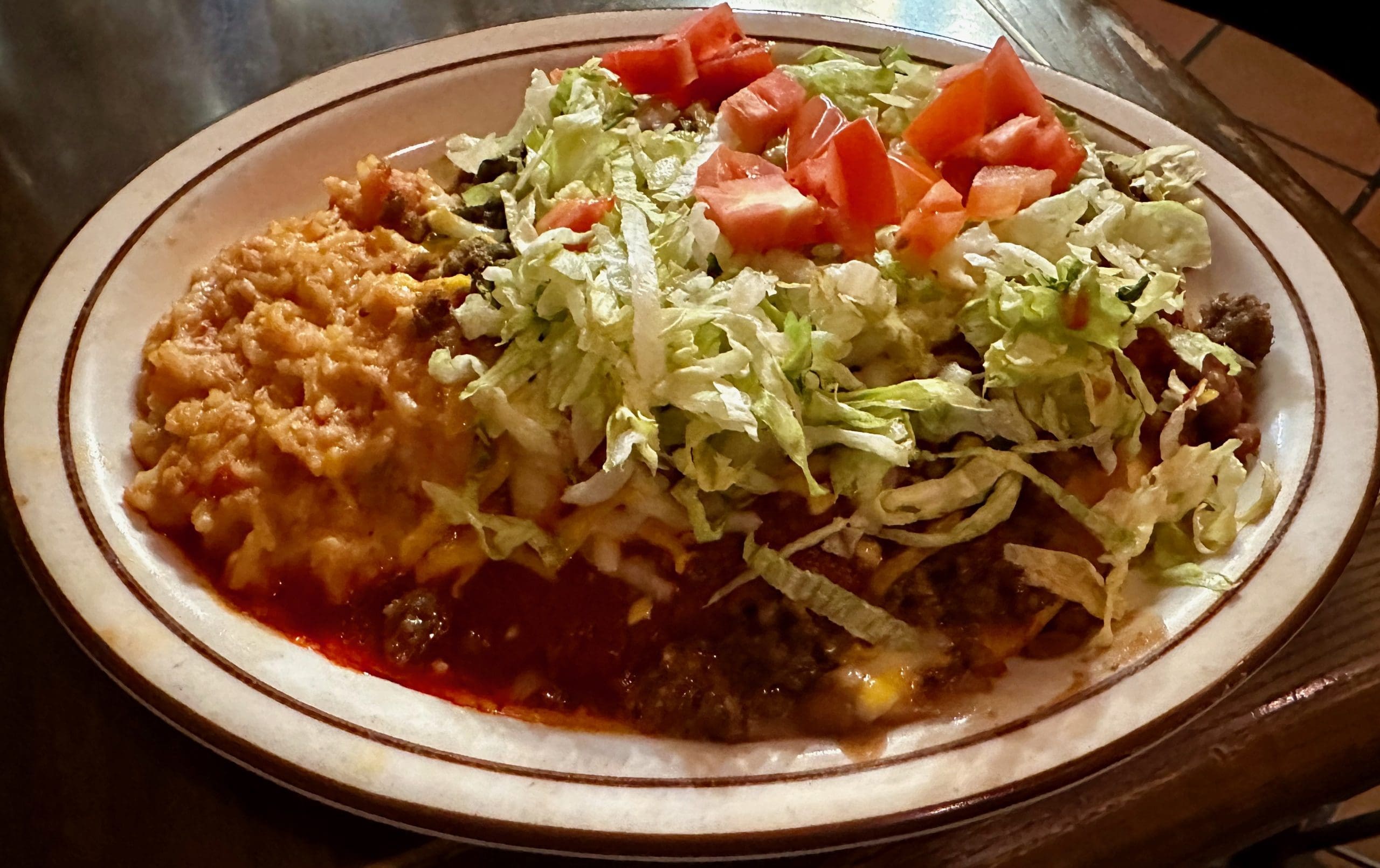
Most college and university areas have at least one restaurant that transcends the “student hang-out” label to become a popular dining destination among all demographics, whether or not the diners matriculated at the nearby institution of higher learning. In Albuquerque that dining destination is the Frontier Restaurant. In its fifty plus years of serving the Duke City, the Frontier has gone beyond providing the quintessential college eatery experience. Some contend it may well be THE quintessential New Mexican restaurant. Serving Albuquerque since February, 1971, the commodious, barn-like Frontier Restaurant occupies half a city block (quite remarkable considering it started out as a small, one room eatery), seats more than 300 patrons and features an impressive gallery quality art collection which includes several portraits of John Wayne, a favorite of the owners (for whom the University of New Mexico School of Architecture and Planning has named a gallery). The Frontier is a place to see and be seen. Everyone from UNM students to celebrities (in Albuquerque this is primarily the local television news media) and Lobo athletes frequents the Frontier. The Frontier is the brainchild of Larry and Dorothy Rainosek, transplants from Austin, Texas, who have become among Albuquerque’s most altruistic…

Rex’s Hamburgers – Albuquerque, New Mexico

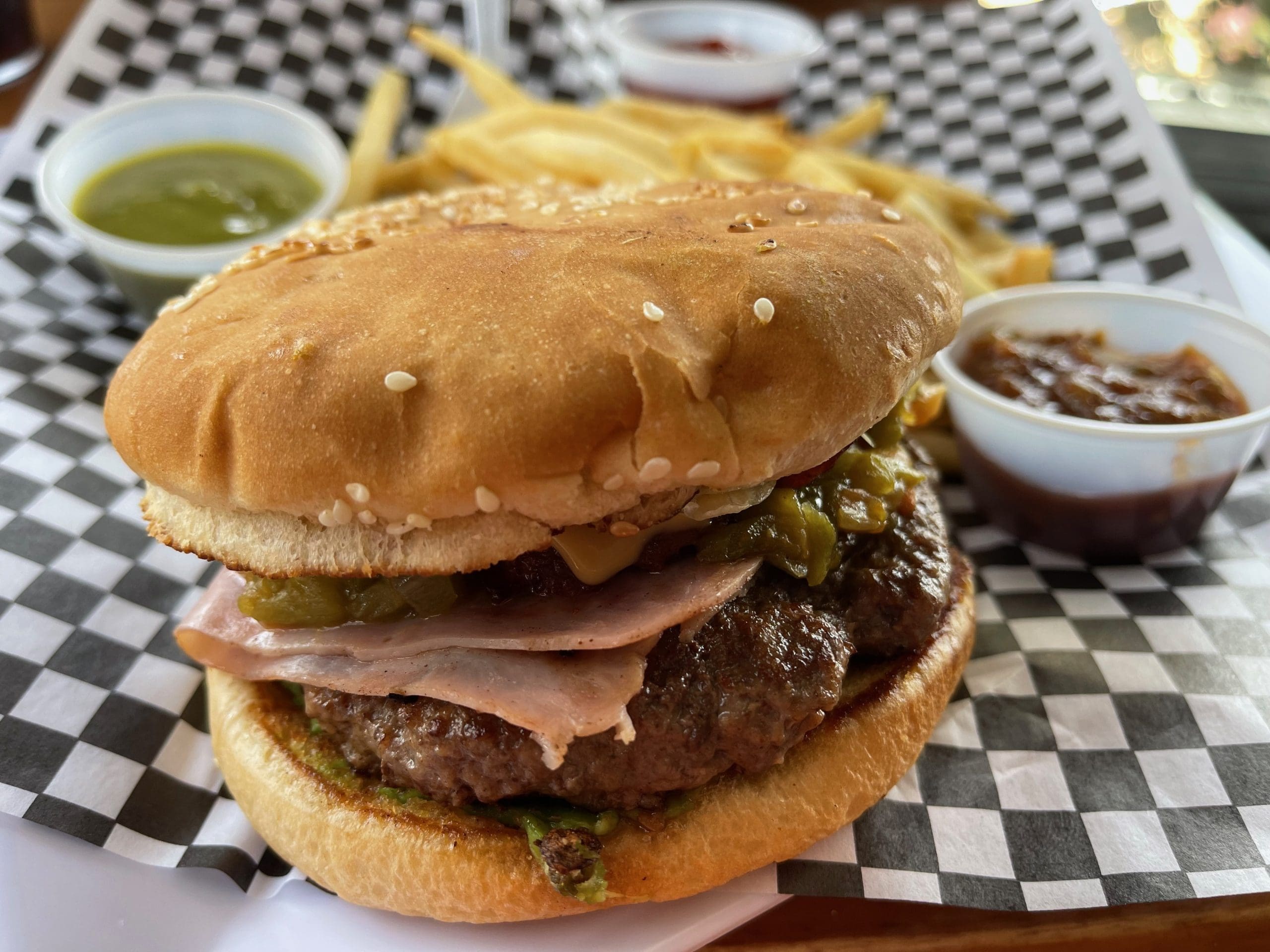
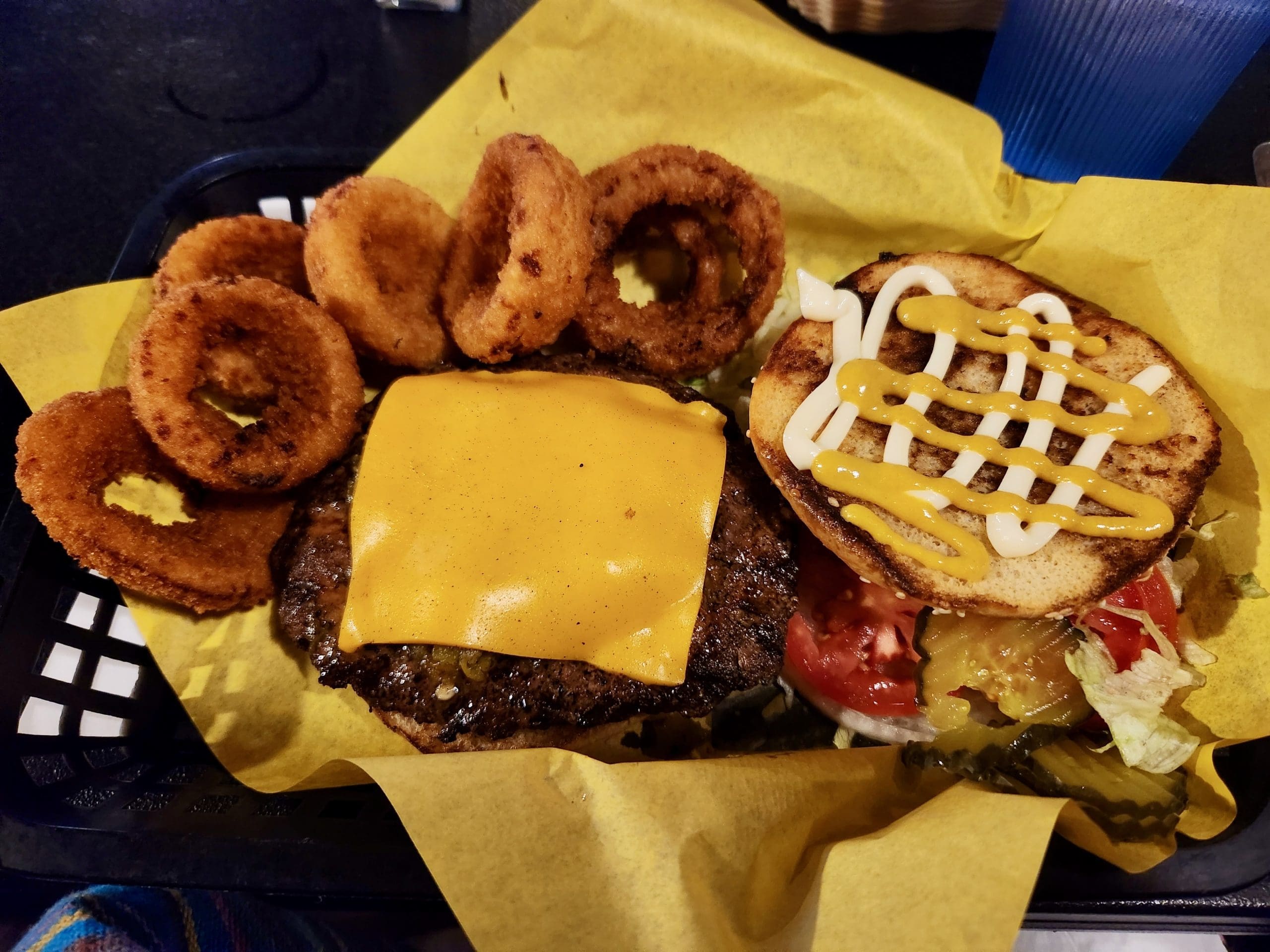
From 1988 through 2005, Rex’s Hamburgers stood practically alone in offering Duke City consumers an alternative to the homogeneous gobble-and-go offerings of deep-pocketed fast-food chains like McDonald’s, Burger King and Wendy’s. Rex’s earned and retained the hearts of Albuquerque diners for nearly 20 years. During its halcyon days, it garnered the long defunct’s Abq magazine’s “Best of Albuquerque” honors for several consecutive years. The reason Duke City patrons were so loyal to Rex’s was because Rex’s was at the diametric extreme opposite of the chain restaurants. Whether ensconced in a strip mall or housed in a single tenant edifice, Rex’s offered real sit-down service at a relaxed and reasonable pace. Moreover, it served hamburgers the way they are intended to be prepared. That means they started with real meat, never frozen, formed into a ball and flattened on the griddle with a spatula then allowed to cook slowly to retain the beef’s natural juiciness. Unlike at the Golden Arches, you never had to wonder what filler was used in Rex’s all-beef patty. It was always 85 percent lean and 15 percent fat, the time-tested optimum balance for optimum flavor. It was always served hot and with only the freshest of…