Leroy’s New Mexican Food – Albuquerque, New Mexico

As with any city of comparable size, many of Albuquerque’s most popular dining destinations are clustered in neighborhoods bustling with commerce and activity. You could say there’s a well-beaten–and well-eaten–path to these neighborhoods. Chain addicted diners know they can find their favorite Madison Avenue sanctified corporate megaliths on the frontage roads flanking I25 as well as in the Coors Bypass area. For a more vibrant and roguishly in-vogue dining experience, Duke City residents head for Nob Hill where swanky upscale restaurants and venerable cafes co-exist harmoniously on America’s Mother Road. Downtown Albuquerque purports to be the “economic, social and cultural center of New Mexico.” With more than 70 restaurants and cafes and a night life as hot as Hatch green chile, it has become a popular destination for more than dining. For culinary diversity, it’s hard to beat the University of New Mexico area in which restaurants with a broad socioeconomic appeal are congregated. Aside from academic enrichment, this area is nurturing a refreshing open-mindedness toward the cuisines of the world. Strewn throughout the Duke City’s vast expanses are also pockets of edible excellence–restaurants of all types which don’t necessarily fit the neighborhood template of “x” number of restaurants clustered…

Whole Hog Cafe – Santa Fe & Albuquerque, New Mexico

While the etymology of the expression “whole hog” appears to be American, its progenitor is actually an English slang word. Americans in the new world employed the slang use of hog as a word for dime, intending the term to mean “spend the entire coin at once.” The word hog had been previously used in the Mother Country as slang for a shilling and came from the depiction of a hog on one side of the English coin. To barbecue fanatics, however, the term “whole hog” can only mean one thing–the whole hog category in Memphis in May, the annual world barbecue championships in Memphis, Tennessee, an event which has been called the “Superbowl of Swine.” If you win the whole hog category in Memphis, you have every right to call yourself the very best in the world. It means you’ve mastered ribs, pulled pork and sausage–virtually snout to tail. When we saw a restaurant on Cerrillos Road billing itself as the “Whole Hog Cafe,” we wondered if it was an audacious pretender to the pinnacle of pork or the real deal. The restaurant’s trademark image of a portly porker subtitled “World Championship BBQ” cued us in to the fact…

Horseman’s Haven – Santa Fe, New Mexico

I know several native New Mexicans who have accepted the dumbing down of political office in America as a consequence of living in these times and who have shrugged apathetically at the attenuation of educational standards. These same individuals, however, become as agitated and vociferous as scalded cats when served chile that has been “Anglicized”–that is, chile which doesn’t bring sweat to their brows, tears to their eyes and blisters to their tongues. Pepper spray has nothing on chile for these capsaicin addicted masochistic diehards. I spoke with one of these chileheads several days after the January, 2006 airing of the Food Network’s “The Secret Life of Fiery Foods.” He was still laughing at the segment in which host Jim O’Connor thought he was man enough to try the green chile burrito locals call “the devil” at the world famous Horseman’s Haven in Santa Fe. One bite had O’Connor red faced and sputtering, an experience shared by many people, including many locals weaned on incendiary chile. According to O’Connor, the “devil” is the hottest burrito in the world with a chile that rivals the habanero, a pepper at the extreme level of the Scoville scale. For New Mexicans frustrated with…

Krung Thai – Albuquerque, New Mexico

At 75 years of age, Grandma remains as energetic and feisty as ever though she’s quite unhappy that her well-intentioned and loving family have made her take Saturdays off. She’d just as soon work six days a week at the Krung Thai Restaurant on Menaul. Grandma’s not only an accomplished cook, she’s got several treasured family recipes locked in her vault of a memory. One of those recipes is for some of the very best Lao sausage in the Duke City. Launched on New Year’s Eve in 2003, Krung Thai translates to “Thai City,” but the restaurant’s menu extends well beyond Thai cuisine. You’ll find Vietnamese and Chinese entrees, too, and you already know about the Lao sausage. Krung Thai is a family owned and operated gem resplendent with traditional Thai decor. The first thing you see when you walk into the restaurant is Suvannamaccha, a mermaid princess. Rivulets of water cascade down her body in a calming cadence. The bright orange-red colored walls are festooned with wall tapestries of ornately attired elephants, the national symbol of Thailand and a symbol of good luck. A number of restaurants have held court at Krung Thai’s comfortable confines, diminutive digs which might…

2000 Vietnam Restaurant – Albuquerque, New Mexico

JERRY: “By the way Newman, I’m just curious. When you booked the hotel, did you book it for the millennium New Year?” NEWMAN: (smug) “As a matter of fact, I did.” JERRY: “Oh, that’s interesting, because as everyone knows, since there was no year zero, the millennium doesn’t begin until the year two-thousand and one.  Which would make your party one year late, and thus, quite lame.” It’s likely only Jerry Seinfeld and a few chronologically savvy people even know that “2000” and “the Millennium” are not synonymous. When it first launched and for years thereafter, a popular Duke City Vietnamese restaurant was actually named 2000 Millennium Restaurant, a semantically incorrect term. Today, the name on the marquee reflects the year in which the restaurant was launched (which also happens to be the reason behind its quaint name). Aside from its quirky, uniquely Albuquerque name and an intriguing menu (which includes a few items heretofore not found in the Duke City), what draws the most attention to the 2000 Vietnam Restaurant is the Saigon Express Emissions Testing facility in a garage attached to the restaurant. Its presence has undoubtedly engendered trite scatological references to emissions and Vietnamese food. Diners who…

Tune-up Café – Santa Fe, New Mexico

Dave Who? From 1981 until its closing in 2008, the converted residence at 1115 Hickox Street was the home of Dave’s Not Here, a quaint and quirky neighborhood favorite loyalist locals described as “unforgettable.” Perhaps “memorable” would have been more appropriate, because as the Eagles reminded us in their 1976 hit song New Kid In Town, “they will never forget you ‘til somebody new comes along.” That somebody new…the new kid in town… the usurper who made many of us forget about Dave’s Not Here is the Tune-Up Café. When it first launched, the Tune-Up Café was always mentioned in the same breath as its beloved predecessor. Over time, however, the equally funky Tune-Up Café has carved out its own identity and it’s no longer just “that restaurant which replaced Dave’s Not Here.” Vestiges of Dave’s Not Here remain if you look closely, but for the most part, it can truly be said that Dave’s now truly gone. The shoulder-to-shoulder personal space proximity dining room hasn’t grown up any, but a small covered patio has been added. Not even a mirror on the dining room’s west-facing wall can make the Tune-Up Café any larger. The Tune-Up Café is the brainchild…

San Marcos Cafe – Santa Fe, New Mexico

Contrary to some popular opinion, roosters don’t crow just to be noisy or annoying. They crow as a sign of territorial advertising; they’re protecting their turf. At San Marcos Cafe, the cacophonous din of crowing roosters is understandable considering the throngs of hungry patrons infringing on their turf. There was one famous fowl at the San Marcos Cafe who didn’t chicken out at the sight of guests.  Buddy the Chicken, master of all he surveyed, served as the restaurant’s unofficial valet parking attendant and maitre de.  Nattily attired in polychromatic plumage and a black bow tie, Buddy welcomed one all and actually answered to his name.  When he passed away in 1996, he received an above-the-fold obituary in the newspaper.  Name one other chicken who’s ever been honored posthumously other than with “Bless this food we are about to receive…” It’s not just roosters that parade happily on the bucolic grounds of this charming old adobe establishment on the Turquoise Trail about 15 miles south of Santa Fe. Peacocks display their glorious multi-hued plumage while peahens play hard to get. Chickens roam freely looking for the right spots to hold their peck-nics.  Turkeys splay their own plumage like politicians puffing…

El Parasol – Española, New Mexico

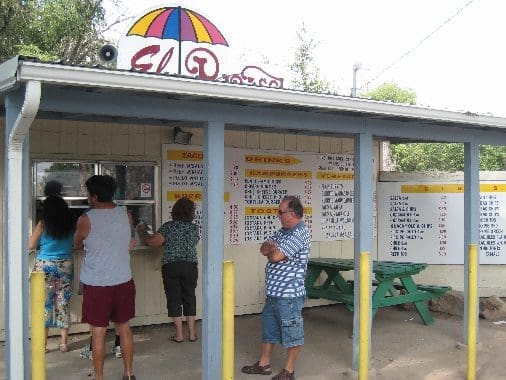
If you were in a hurry, driving through Española on a hot summer day in the early 1980s might have raised the diastolic level (the lower number) of your blood pressure to the level of the temperature gauge. That’s because on Sunday afternoons, Española’s main thoroughfares were the domain of the lowriders, elaborately painted late-model cars (many with intricate religious murals on the hood) whose suspension is replaced with hydraulic cylinders to allow the car to be drastically lowered when parked and raised back up for travel. Española etiquette dictated that no one, not even the law, interfered with the low-and-slow (sounds like barbecue) pace these sparkling cars set as they hugged the pavement on both lanes for the entire length and breadth of the city limits. The lowered late-model cars with their custom paint jobs, tiny steering wheels and chrome wheels were in no hurry; attracting attention was a major aim of lowriding. As a result, it might take an hour or more to drive through Española. Because of its tradition of highlighting the cars as part of local culture and the high number of lowriders per capita, the city earned the sobriquet of the “lowrider capital of the…

Al’s #1 Beef – Chicago, Illinois

Assume the position!  It’s been called the “Chicago Lean,” the “Italian Stance” and simply “The Stance.”   It’s  the time-tested, traditional art and science of eating Italian beef sandwiches, a Chicago specialty.  Trust me, it’s not the same as eating an ordinary sandwich.  If you don’t follow the process, you’re bound to spill shards of beef, bits of giardiniera and drippings of spice-laden beef gravy onto your clothing.  Italian beef sandwiches are as messy as they are delicious.  Some Italian beef sandwich shops don’t even offer seating.  Instead, they provide high, thin counters with or without stools where you’ll park yourself and proceed to assume the position.  I’ll let the professionals take over from here.  Courtesy of Italianbeef.com: (1)  Put your sandwich on the counter and stand in front of it, with your chest about 12 inches from the edge of the counter (2)  Lean forward so your chest is at a 45-degree angle to the counter (Note: if you’€™re wearing a tie, make sure it’s tucked inside your shirt) (3)  Pick up your sandwich, resting your elbows on the counter (4)  Angle the sandwich at a 45-degree angle to the counter, with the top end towards your mouth. (Imagine…

Mariscos Altamar – Albuquerque, New Mexico

“Forget what you thought you knew about Mexican food!” That should be a cardinal rule for unacculturated diners when traveling to Mexico–or visiting Mariscos Altamar–for the first time. Many of the dishes some Americans commonly believe typify Mexican cooking are either not Mexican at all (chimichangas and fajitas, for example), or are prepared using inauthentic techniques and ingredients (such as “nachos” crafted from melted Velveeta heaped over a dish of corn chips, a recipe I’ve actually seen on a cookbook published by a charity for which I almost withdrew support based on such recipes). Because Mexico spans several climatic zones and a diverse topography, its cuisine varies from region to region.  The favorite foods of the Mexican coast may not even be available further inland.  Inland foods may not be as commonly served on the coasts.  Ah, those coasts!  Mexico’s beautiful and varied coastal waters are not only pristine in their azure purity, they yield an abundant and unsurpassed assortment of deliciously prepared delicacies from the sea. When Hector Hernandez moved to Albuquerque from Ronald Reagan country (Orange County, California), it didn’t take him long to determine that the Duke City restaurant scene lacked traditional Mexican seafood (mariscos) restaurants–the type…

The Chill Zone Frozen Yogurt – Rio Rancho, New Mexico

Returning to the United States in 1985 after my first year in England, there were two things that surprised me.  The first was the difficulty of getting used to driving on the “Yank” side of the road again.  Driving on the “wrong” side had required a high state of alertness and conscious thought until it had become a habit.  Expecting to transition easily upon my return to the fruited plain, my concentration waned until I found myself driving toward several cars on their side of the street (talk about road rage).  The second surprise was the sheer volume of frozen yogurt shops in Chicago and Las Vegas where I spent three weeks before returning to England.  Frozen yogurt was no stranger to me.  I lived in Massachusetts in 1978 (where some of the country’s very best ice cream is made) when the very first packaged frozen yogurt was introduced.  At its inception yogurt was marketed as a healthier, less caloric alternative to ice cream, but it wasn’t an immediate hit because of its lip-pursing tartness.  Manufacturers went back to the drawing board, modified their recipes to include more sugar and yogurt began to take off.  By 1986, sales of yogurt…