K Style Kitchen – Albuquerque, New Mexico

If you’re susceptible to the power of suggestion–especially as it pertains to ear worms (recurring tunes that involuntarily pop up and stick in your mind)–you’re probably going to hate me (or you can skip this paragraph and continue to love me).  That’s because if you do read this paragraph you’re going to be humming to yourself one of the most annoying songs of all time–Gangnam Style.  Arguably, Gangnam Style is not as annoying as La Macarena or My Humps (which Rolling Stone declared “the most annoying song ever”). The more you try to suppress Gangnam Style, the more your impetus to hum it increases, a mental process known as ironic process theory.  By the way, those most at risk for “stuck song syndrome” are females, youth, patients with OCD and anyone reading this paragraph. Unless you can speak Korean you’re going to have to hum Gangnam Style and not sing it.  The only lyrics in English are “Eh, sexy lady.”  Korean rap singer Psy who took Gangnam Style all the way to number one describes the song as “a tribute to the ladies of the wealthy district.”  He’s talking about the affluent Gangnam district in Seoul Korea which Psy describes…

Asian Pear – Albuquerque, New Mexico

“Careful Father, this stuff will melt your beads.” ~Lt Colonel Henry Blake, MASH 4077 Just as Hogan’s Heroes helped establish the perception many Americans (at least of my generation) had about German food, the television show MASH was the first introduction many of us had to Korean food. Set in South Korea during the Korean War, the series centered around a group of resilient doctors, nurses and support staff in an isolated hospital compound which saw more than its share of wounded. Not only did each half hour episode depict–sometimes rather graphically–the horrors of war, it painted a rather poignant and entirely accurate picture of sacrifice and hardship. Some of the sacrifice and hardship came at the hands of the kitchen staff which concocted some of the most unsavory fare conceivable (imagine a restaurant today serving creamed turnips, spam lamb and cream of weenie soup). Indigenous cuisine was apparently even worse because no matter how bad chow hall food was, the MASH team didn’t walk down to the nearby village for a meal of Korean food. And, as the quote above illustrates, when they did partake of Korean food, the impression given was that it was almost lethally piquant. Compared…

East Asian Kitchen – Albuquerque, New Mexico

Perhaps more than anyone I’ve ever met, my Singaporean friend Ming Lee (God rest his beautiful soul) regarded people by the content of their character, not by physical characteristics.  So, it surprised me to hear him joke “we all look alike.”  It was an unsolicited admission that even he couldn’t always discern the cultural genesis of Asian people he met.  He also joked “at least I can always tell where an Asian restaurant’s food comes from.”  Ming was a bona fide gastronome who introduced me to the cuisine of Singapore and Malaysia.  Like me, he disliked restaurants in which overt homogenization of Asian food was apparent.  Sure, different culinary cultures across Southeast Asia have borrowed from one another over the millenia, but most adapt to cultural tastes rather than copy exactly. Ming was wary of Asian restaurants that purported to serve the cuisine of more than one Southeast Asian nation.  To him, the concepts of global cuisine and multicultural restaurants “dumbed down” what is best about each culinary culture.  We disagreed on the concept of fusion cuisine, the blending of elements from different cultures, creating new dishes that offer several cultures on a plate.  I like the concept when executed…

I Grill Korean BBQ & Hotpot

You hear it very time a seismic event or devastating conflagration strikes California.  Doomsayers seem to come out from under the rocks to proclaim it “divine castigation.”  That’s also their argument when the Golden State’s elections don’t go as they would like.  These very same people don’t seem to like much about California.  Such negativity makes me wonder if these fatalists have ever spent much time in this fabled  land of opportunity and adventure.  There’s got to be a reason California is the most populous state in the union.  Surely the forty-million residents would be leaving in droves if it was that bad. Although the Air Force took me to most of the contiguous states in the country, it was Intel which first sent me to California.  Back when Intel was flush with cash, I was dispatched to Santa Clara for weeks at a time.  These business trips were not only highly productive, they  introduced me to the uniquely wonderful “California cuisine” and its emphasis on fresh, local and seasonal ingredients.  As a movement, California cuisine’s embrace of diverse culinary cultures and innovative approaches reflected the state’s own diversity and commitment to high-quality, sustainable and healthy foods. Asian restaurants are…

Birdies by Chef Kevin Lee – Edmond, Oklahoma

My Kim and I regard ourselves as ambassadors for the great state of New Mexico, especially when we travel.  We’re often asked where we’re from.  Invariably we run into people whose perceptions about the Land of Enchantment are far from kind.  Some actually believe Breaking Bad is a documentary about the condition of life in New Mexico where wild west lawlessness is rampant.  If only perceptions of New Mexico were as gracious and kind as those of Oklahoma.  Throughout our week-long sojourn in the Sooner State, state pride was palpable.   You would expect that from locals, but some of the nicest things we heard about Oklahoma were from visitors like us.  Most visitors were genuinely touched by just how nice veryone was.  Some commented about not being cut off in traffic and not being greeted with a one-finger salute for some unforgiveable traffic transgressions (like not going 20 miles over the speed limit).  Others spoke about the personable service they received at hotels and restaurants. The niceness of Oklahomans didn’t really come as a surprise.  Two of my very favorite people–my Air Force colleague John Holmes Bennett and fellow culinary scribener Steve Coleman–were raised in Oklahoma.  You won’t find two…

Kokio Chicken – Albuquerque, New Mexico

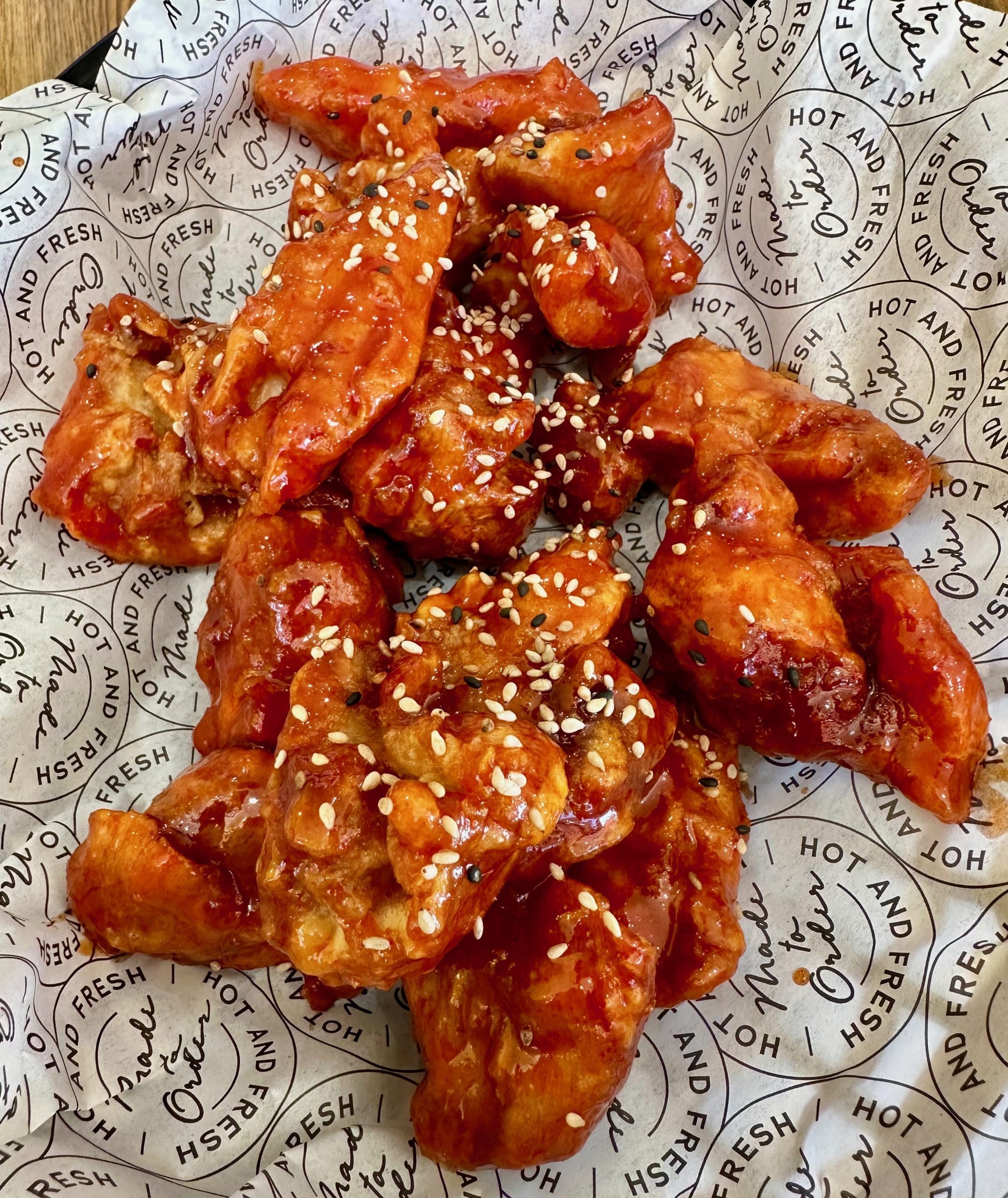
Most culinary historians agree that black American soldiers stationed in Korea during the Korean War (June 25, 1950 – July 27, 1953) taught the Korean soldiers with whom they fought side-by-side how to make fried chicken.  Popular theory holds that black American soldiers wanting to celebrate American Thanksgiving feasted with fried chicken. (Apparently not even scrounge-master Radar O’Reilly could find a turkey in the entire Korean peninsula).   The fried chicken was shared with their Korean compatriots. Before that memorable Thanksgiving celebration, chicken in Korea was commonly served boiled in stews.   Eating it  fried was an entirely new experience for the Korean soldiers. Though fried chicken was an instant hit, the war thoroughly devastated the Korean economy.  Essential ingredients for fried chicken – such as chicken and cooking oil – were extraordinarily scarce and beyond most people’s financial reach. In fact, cooking oil was not even commercially available until the 1970s.  During the 1960s, whole rotisserie chicken became a coveted luxury dish served on special occasions in Korea. The commercialization of inexpensive cooking oil in 1971 coupled with a period of economic boom and incredibly rapid industrialization which gave Korean people more disposable income, and made chicken far more…

Hanmi Korean-Chinese Fusion – Albuquerque, New Mexico

Popular culture is defined as “commonly known information that briefly holds the public interest. It is typically discussed in various mass media, including TV and the Internet, and becomes a topic of everyday conversation (what used to be called a “water cooler conversation” before that term fell from popularity).  Apparently you’re out of touch with pop culture when you believe Game of Thrones is a video game and that Taylor Swift is a sprinter, the female equivalent of Usain Bolt. Approaching forty years of youth, I’d probably be completely out of touch with pop culture were it not for our interns at UNM Information Technology.  They do their best to educate this old fogey on what’s lit, cool, on fleek or whatever their generation’s version of groovy may be.  My lack of pop culture knowledge puts me in the same company as their parents and grandparents, all of whom are clueless as to what’s important.  While they might be less patient with their parents, they find my ignorance humorous.  For example, when I walked in on a conversation they were having and overheard the term K-Pop, I asked if it was a Korean dish similar to bibimbap.  I still haven’t…

Urban 360 Pizza, Grill and Tap House – Albuquerque, New Mexico

Babu: Our specials are tacos, moussaka and franks and beans. Jerry: Well, what do you recommend my good fellow? Babu:Oh, the turkey. ~”The Cafe, Seinfeld, Season 3, Episode 7 While perusing the menu at Urban 360 Pizza, Grill and Tap House, my ever-witty friend Ryan “Break the Chain” Scott commented that the menu reminded him of The Dream, the very eclectic restaurant owned and operated by Pakistan emigrant Babu Bhatt in an uproariously funny episode of Seinfeld. As Jerry Seinfeld observed about The Dream’s menu, “he’s serving Mexican, Italian, Chinese. He’s all over the place.” Urban 360’s menu is similarly diverse, a melange of Asian, American and European dishes splayed temptingly onto three pages. That the menu is so “all over the place” makes great sense in that the term “360” itself represents a complete circle as in the shape of planet Earth itself. Okay, the Earth is actually an oblong spheroid, but that’s close to round. Unlike The Dream, Urban 360’s menu has a rhyme and reason, a cohesion. Moreover, Urban 360 succeeds a similarly named and similarly eclectic restaurant, the aptly named Eclectic Urban Pizzeria and Tap House, a magnificent shooting star which fizzled away much too quickly,…

Soo Bak Seoul Bowl & Soo Bak Foods – Albuquerque, New Mexico

Announcer: “The story you are about to read is true. The menu has been changed to showcase the delicious mashup of Korean and Mexican cuisines. Roy Choi: “This is the city: Los Angeles, California. I work here. I’m a chef.” Since 2008, there’s been a dragnet in progress across the city of Los Angeles. Instead of a coordinated attempt by police to catch criminals, this dragnet is a coordinated attempt by four mobile food kitchens (that’s food truck to you, Bob) to attract hungry diners. Those mobile food kitchens are named Kogi Korean BBQ-To-Go and have pioneered a technological approach for enticing eager eaters by announcing its location on social media. Diners have since been lining up like flash mob of bees to a honey-coated hive, prompting Newsweek to hail Kogi as “the first viral eatery.” Kogi is widely acknowledged as the forerunner of the gourmet truck phenomenon, the catalyst which elevated the food-truck concept from “roach coach” to legitimate destination rolling restaurant. Founder-chef Roy Choi even made Time Magazine’s list of the 100 Most Influential People for 2016. Kogi’s “Seoul meets Mexico City” concept has spawned a phalanx of flatterers…er, imitators across the country. And why not? Unlike so…

Sushi & Sake – Albuquerque, New Mexico

“If white wine goes with fish, do white grapes go with sushi?“ – George Carlin A reader once asked Washington Post humorist Gene Weingarten what he was a snob about. His reply, “I am also a snob about food. The other day, in Baltimore, I passed a sign outside a restaurant that said “Sushi Buffet!‘ and laughed out loud because it occurred to me that “sushi” and “buffet” are two words that should never appear together.”  His sentiment resonates strongly with sushi aficionados who adhere to the strict rules of etiquette which governs the way in which true sushi snobs enjoy sushi. It’s a given that a true sushi snob would never eat at an all-you-can-eat sushi restaurant nor would such a snob ever be found mingling with the rabble who sit in booths or receive table service.  Sushi snobs will only sit at a sushi bar in as close proximity to the sushi chef as possible.  They like to converse with the sushi chef, hoping to ingratiate themselves by asking the right questions to demonstrate they are savvy connoisseurs and not “trough-divers” like most of the crowd.  They treat the sushi chef like Magellan, their esteemed navigator on a…

Bonchon – Albuquerque, New Mexico (CLOSED)

Hawkeye Pierce had a very unique (and very sarcastic) take on the Korean War: “I just don’t know why they’re shooting at us. All we want to do is bring them democracy and white bread. Transplant the American dream. Freedom. Achievement. Hyperacidity. Affluence. Flatulence. Technology. Tension. The inalienable right to an early coronary sitting at your desk while plotting to stab your boss in the back. That’s entertainment.” History has shown there was prophecy in his words. After thousands of years of civilization, South Korea now has donuts, quesadillas, pizza, cheeseburgers, fried chicken nuggets and all the fast foods which have wreaked havoc on America’s gut microbiome.  Hawkeye might term this cynically as the realization of the American dream. To say there’s a “trade imbalance” between the number of American restaurants in Korea and the number of Korean restaurants in America is an understatement. Many of the ubiquitous fast food chains found throughout the fruited plain can also be found across the Land of the Morning Calm. Very few Korean chains of any genre, but specifically fast food, can be found under the spacious skies. Almost all Korean restaurants in the United States are independent mom-and-pop eateries, including a couple…