Blog

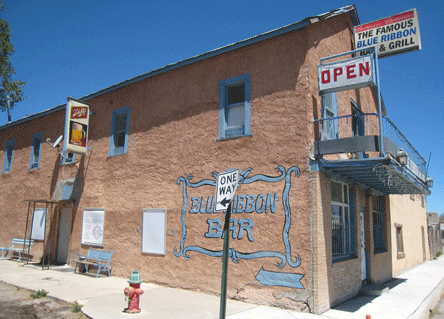
Blue Ribbon Bar & Grill – Estancia, New Mexico (CLOSED)

Unlike diners throughout New Mexico, bears in the Sandias and Manzanos  have found food in their mountain habitats very scarce, forcing them to forage populated areas for their fill.  As of August 25th, 2011, the New Mexico Game and Fish Department had received 141 reports of bear sightings from Placitas to Belen, communities west of the mountains.  In 2010, food shortages resulted in 467 reports of bear sightings in the Sandias and Manzanos, 251 of them west of the mountains. Visit Estancia, New Mexico and you’re likely to encounter more Bears in one hour than residents along the Sandias and Manzanos will see in an entire year. So many, in fact, that you’d think they own the town.  Bears walk around brazenly, proudly sporting seasonal reddish hues.  They stride into restaurants and shops where they’re welcomed like the old friends and neighbors they are.  That’s what life in a small community is like. The Estancia Bears varsity sports teams are the only game in town and every resident of this close-knit community about half an hour east of Albuquerque’s Big I interchange is a fan.  Local businesses carry Estancia Bears merchandise–shirts, baseball caps, beverage cups, coasters and more.  Bears schedules…
Zia Diner – Santa Fe, New Mexico (CLOSED)

In the year 1880, La Villa Real de la Santa Fé de San Francisco de Asís” (“The Royal Town of the Holy Faith of St. Francis of Assisi”) bore little semblance to the popular vacation destination and tourist town it is today.  In fact, it was still pretty much a dusty frontier town of the old west with statehood more than a quarter century away.  Despite a population growth of nearly forty percent over the previous decade, Santa Fe was hardly considered a burgeoning center for commerce, much less tourism.  That would all change with the arrival of the Atchison, Topeka and Santa Fe Railway Company, an event which heralded a new period of prosperity and growth. The railroad facilitated trade between the New Mexico territory and the United States.  In addition to trade in dry goods, foodstuffs, clothing and books, the railroad ferried materials such as bricks and galvanized tin which paved the way for architectural diversity.  The facade of the Santa Fe Plaza, for example, would be transformed from a Spanish-Pueblo architectural style to a hybrid Spanish-Pueblo-Territorial style that persists today.  Victorian style brick buildings became very much in vogue throughout the town.  The arrival of the railroad …

Saffron Tiger Indian Cuisine Express – Albuquerque, New Mexico (CLOSED)

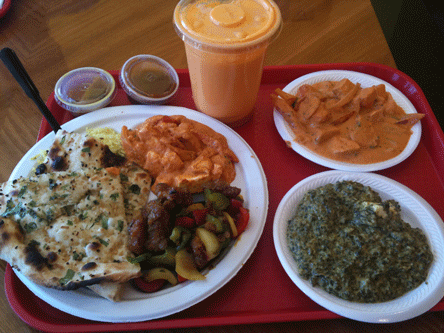
Is there anything that screams monotonous, tedious homogeneity louder than the typical food court at any mall in cosmopolitan America?   “But,” you might argue, “the food court is a paragon of diversity where you can get your fill of pizza, sushi, burgers, cinnamon rolls, sweet and sour mystery meat and a veritable United Nations line-up of ethnic foods all in one place.”  While that might be true, my argument is that the same boring sameness you find in Albuquerque’s mall food courts can be found at any food court in any mall.  Only airports have a similarly comparable array of uninspiring food-court-type selections. Despite the “culinary diversity” in food courts, there is an almost general scarcity of local culinary representation.  At least that’s the case in the contiguous area shared by multiple food vendors; small private vendors are usually relegated to outlying areas of the mall.  Food courts are, by and large, the haven of fast food chains which can afford the steep rent commanded in the premium heavily-trafficked area. Typical food court tenants may include McDonalds or Burger King, Edo Japan, Sbarro, China Wok, Cinnabon and others of that ilk. An argument could be made that food courts make…

Lucia – Albuquerque, New Mexico (CLOSED)

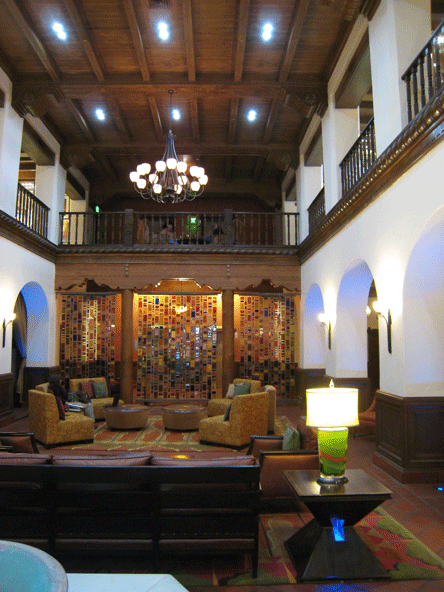
There was a time the name “Hilton” didn’t conjure up images of a ditzy blonde airhead whose celebrity is based largely on promiscuity. On second thought, maybe not. More than 50 years ago, another ditzy blonde temptress, Zsa Zsa Gabor honeymooned at Albuquerque’s Hilton Hotel with her then husband Conrad Hilton, a New Mexico native and founder of the historic downtown hotel.  It was Hilton’s fourth hotel and the very first modern high-rise hotel in the Land of Enchantment. The ten-story hotel, launched in 1939, was an example of New Mexico Territorial style architecture, showcasing earth tone stucco and southwest woodwork, furnishings and artwork.  Its imposing two-story lobby, stately arches, hand-carved beams and balconies overlooking the lobby made it one of the finest hotels in the Duke City.  Being within easy walking distance of the city’s transportation hubs–the Atchison, Topeka and Santa Fe Railroad Depot and America’s mother road, historic Route 66, made it convenient for weary sojourners and well-heeled travelers. Though the hotel’s guest registry was signed by a veritable who’s who in celebrity and politics–many of whom came for the hotel’s Spanish colonial charm, opulent ambience and impeccable service–the Hilton Hotel chain eventually outgrew its classic downtown hotel,…

Village Subs – Los Ranchos de Albuquerque, New Mexico (CLOSED)

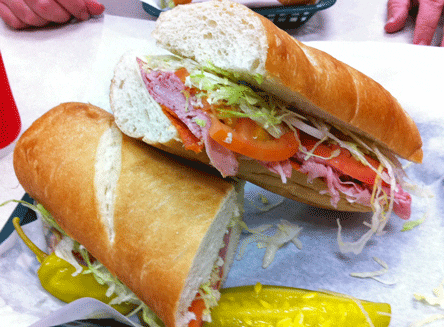
To paraphrase John 15:13, “No greater love a man has than this, that a man give up his life for a….sandwich?” In an uproariously funny episode of the television show Friends, Joey, Chandler and Ross go on a ride-along with Phoebe’s policeman boyfriend. Believing a back-firing muffler was actually a gunshot, Joey (sitting in between his two friends) dives, seemingly to protect Ross from harm.  Naturally Chandler was upset that Joey would choose to protect Ross instead of him…until he learns that Joey was actually trying to protect his sandwich.  In the finest tradition of Dagwood Bumstead, Joey Tribbiani loved sandwiches; they were his favorite food. I don’t know how many Americans would “take a bullet” for their sandwich, but America is most definitely a nation of sandwich lovers. According to one of my favorite books, American Sandwich by the fabulous Becky Mercuri, Americans consume more than 45 billion sandwiches per year, with the average American consuming 193 sandwiches per year. That’s a lot of sandwiches! One restaurant that has serving a lot of sandwiches is Village Subs, appropriately situated in the village of Los Ranchos De Albuquerque.  Allow me another paraphrase, this time of an African proverb: “it takes…

Señor Dog – Albuquerque, New Mexico (CLOSED)

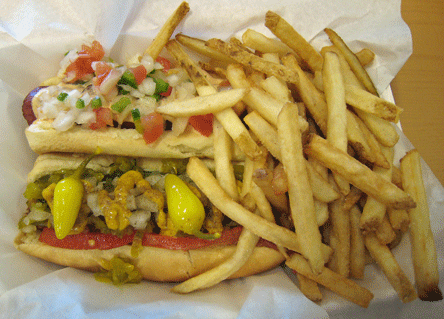
H. K. Duff VIII:  Why not break your fast with our brand-new Isotope Dog Supreme? [Homer sniffs the hot dog.] Homer Simpson:  Oh, so hard to resist. Mesquite-grilled onions. Jalapeño relish. … Wait a minute, those are Southwestern ingredients. … Mango-lime salsa? That’s the kind of bold flavor they enjoy in … Albuquerque! Lenny: He’s right. Moe:  Yeah … and the wrapper says “Albuquerque Isotopes”! Within three months after the Duke City’s Triple-A baseball team, the Albuquerque Isotopes, co-opted its team name from The Simpsons animated television series, it sold more merchandise than the city’s previous Triple-A team, the Albuquerque Dukes, had sold in any entire season.  That was even before a single game had even been played. In that magical, inaugural year of 2003, the team led all of minor league baseball in merchandising revenue. Unfortunately, the Isotopes moniker wasn’t accompanied by the fictional Isotope Dog Supreme.  Who wouldn’t love a hot dog with mesquite-grilled onions, jalapeño relish and mango-lime salsa?  It certainly would be oh, so Albuquerque.  Alas, the  Isotopes Park concession menu doesn’t include a hot dog nearly as imaginative or, ostensibly, as delicious as the Isotope Dog Supreme.  A case could easily be made that there…

Viet Rice – Rio Rancho, New Mexico

In Vietnamese, “an com”‘ translates as “eating rice,” but it’s a phrase that more accurately implies the act of partaking of food. At Viet Rice, they know rice and they make the act of partaking of food a memorable one! The motto “We Know Rice” is declared on the menu and it’s part of the restaurant’s logo. It’s even on the restaurant’s entrance. More importantly, it’s obvious in the way Rio Rancho’s very first Vietnamese restaurant operates. True to its name, well crafted rice dishes are a specialty, but there’s so much more than rice at this small gem operating out of a sprawling shopping center. Viet Rice is one of the more visually appealing Vietnamese restaurants in the Duke City area with a decorous style and color scheme (lime green is very prominent) very similar to Viet Q and Viet Taste.  The counter at which you’re greeted and take-out orders are placed and picked up is under a bamboo awning.  Walls are festooned with inspired large, framed black and white photographs depicting life in Vietnam. Viet Rice’s opening day, March 23rd, 2005, is a day that will live on my taste buds and olfactory memories for a long time.…

Jo’s Place – Albuquerque, New Mexico (CLOSED)

By their fruits ye shall know them. Grapes are not gathered from thorn bushes nor figs from thistles, are they? -Matthew 7:16 As Americans are often prone to judge fruit by the pleasingness of its appearance, the fragrance of its bouquet and the sweetness of its flavor, huitlacoche may not stand a chance.  A fungus which forms on the ears of corns, huitlacoche resembles a malignant tumor with postulous  black secretions  Worse, its name translates from Nahuatl, the ancient language of the Aztecs, to raven shi…er, excrement. In more pleasant company it’s called corn smut.  As if that isn’t bad enough, it’s created from a disease formed by a pathogenic plant fungus.  Is it any wonder persnickety Americans have been slow to accept that huitlacoche could possibly be considered a delicacy? Perhaps Americans would be wise to remember that the ancient Aztecs were one of the world’s most advanced civilizations in medicine, math and science and they incorporated huitlacoche into their cooking as have generations of their descendants.  Perhaps if American farmers understood its potential as a culinary delight, they wouldn’t work so hard to eradicate it.   Perhaps if nutritionists recognized that huitlacoche is replete with unique proteins, minerals…

Weck’s – Rio Rancho, New Mexico

Arguably the very best programming all year long on KNME, Albuquerque’s Public Broadcasting Station (PBS) comes during its four annual fund-raising campaigns.  For sandwich lovers all over New Mexico, no PBS feature is more greatly appreciated than Sandwiches That You Will Like, a documentary by Rick Sebak of television station WQED in Pittsburgh, Pennsylvania. The documentary showcases unique sandwich offerings from throughout America. Voracious viewers like me practically salivate at the scrumptious sandwiches on display and lament the fact that most of them can’t be found within the borders of the Land of Enchantment. Watching the documentary is torture of the most delicious sort, no doubt prompting a rush to the refrigerator for even the least tortured among us.  One of the sandwiches featured, a staple in the Buffalo, New York area, is called a “Beef on Weck.” Weck is a colloquial diminutive of Kummelweck, a salty roll topped with pretzel salt and caraway seeds. The first time I passed by an Albuquerque restaurant named “Wecks,” the sandwich fanatic in me hoped against hope, the menu would showcase the fabulous Beef on Weck sandwich, but it wasn’t meant to be. The name Weck’s is a shortened form of the original…

El Farolito – El Rito, New Mexico

The most contentious seasonal difference of opinion between Northern and Southern New Mexico residents isn’t whether Chimayo produces better chile than Hatch (though this will forever be in dispute). The great civil debate dividing the Land of Enchantment has all to do with semantics. More specifically, it has all to do with the appropriate name for the little paper bag lanterns which house a votive candle and light the way for the Holy Family on Christmas Eve. Misguided citizens of New Mexico’s lower half (just about anywhere south of and including Albuquerque) mistakenly call those lanterns luminarias while their more enlightened Northern brethren call them farolitos. Luminarias–stacked and crossed piñon boughs ignited on Christmas Eve to light the Holy Family’s path to shelter–were brought to the new world from Spain, first to Mexico then to the American Southwest.  When delicate paper lanterns made their way from China to the Southwest via Mexico, they were called farolitos, or little lanterns. No one seems to know for sure how farolitos came to be called luminarias and even a children’s book by Rudolfo Anaya, one of New Mexico’s most prolific novelists, didn’t illuminate the truth.  His book “The Farolitos of Christmas” is a…

Maria’s New Mexican Kitchen – Santa Fe, New Mexico

In 1712, the provincial governor for the kingdom of New Mexico decreed that henceforth, an annual reenactment of Diego De Vargas’ triumphant reentry into Santa Fe would be celebrated every year. Santa Feans have dutifully obeyed the proclamation ever since, making the Fiesta de Santa Fe the oldest civic celebration of its kind in North America.  Approaching its 400th year, the Fiesta is renown not only for its pageantry and pomp, but for its respectful reflection on a significant historical event. By 1951, however, the Fiesta as we know it today, had degenerated into a parody of its former self, a victim of crass commercialism which Santa Fe’s Pulitzer Prize winning writer Oliver La Farge called “a shabby commercial carnival.”  Incensed that the Fiesta was overrun by concessionaires who turned the Fiesta into “a hot dog and popcorn affair,” La Farge recruited a contingent of Santa Fe’s movers and shakers in the business, religious and arts communities to restore dignity to the Fiestas.  Both the Museum of New Mexico and the Catholic Church sided with La Farge’s group. It took the ouster of several Fiesta Council members who had fostered the circus-like atmosphere wrought by deep pocketed concessionaires before the…