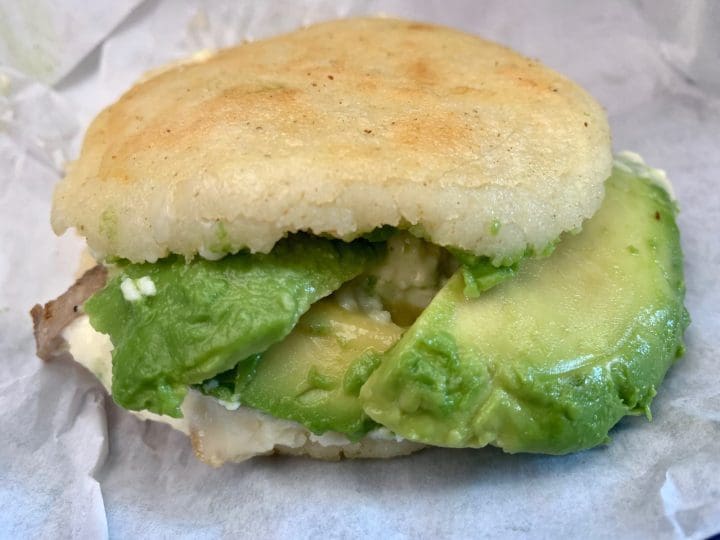
Guava Tree Cafe – Albuquerque, New Mexico

A few years ago, my friend Bill Hanson, a gastronome of the first order, was hosting several of his Costa Rican employees at Intel’s Ocotillo (Arizona) plant. Like me, Bill delights in introducing his friends to new culinary adventures. Unfortunately, not all our colleagues were similarly inclined (despite one of Intel’s corporate values being “risk-taking”). One of them convinced the “Ticos” that the restaurant they should not miss for a “true American dining experience” was Claim Jumper, a regional chain (and slight upgrade from Chili’s). Ever the gracious host, Bill acquiesced to the Ticos’ request. I’ll let him describe the rest (from his gastronomic blog The Tao of Chow): “As each dish was produced and delivered to the table I sank further into my chair as the American decadence of over indulging was displayed in glorious Sysco provided plates heaping with food. Each dish could have easily have served three people as I sat and wondered how much food was actually consumed versus how much went into the dumpsters out back.” If the Ticos were disappointed in any way with the cavalcade of calorie-laden comestibles brought to the table, you’d never know it. To break bread (or arepas) with a…
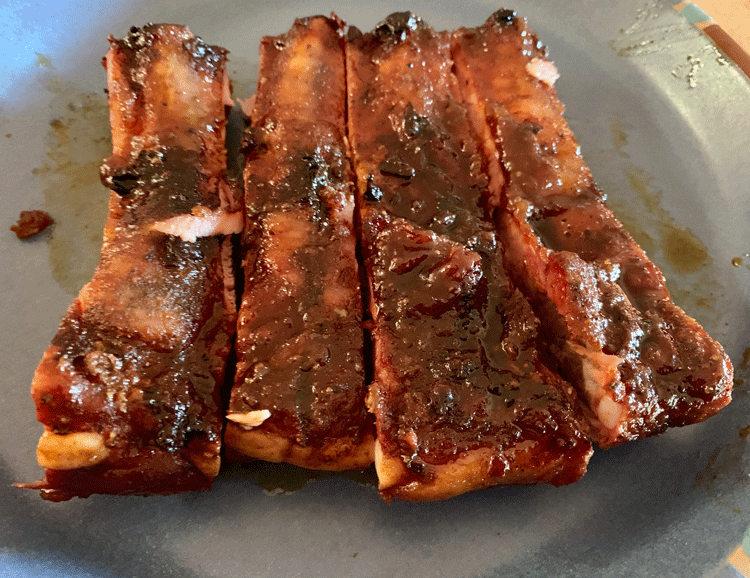
Steam Q – Albuquerque, New Mexico

“I don’t know why men like to barbecue so much. Maybe its the only thing they can cook. Or maybe they’re just closet pyromaniacs.” ~Cecelia Ahern, P.S. I Love You >Whether or not the dubious and persistent stereotype about men and their grills has any veracity is a topic oft debated.  It’s been discussed anecdotally and it’s been analyzed scientifically.  In a 2010 article for Forbes, Meghan Casserly explained why men love grilling: “Grilling is sort of dangerous (there’s fire!), it lets dudes hang out together while also providing some sort of neutral entertainment (getting to watch one guy do stuff and possibly also criticizing him while he does it), and requires minimal cleaning (self-explanatory).” >In his 1993 essay “Why Do Men Barbecue?,” an article more about gender roles than about meat, anthropologist Richard Shweder expounded on the origins of male and female spaces in different cultures.  He posited that contemporary men and women throughout urban America don’t consider themselves tied to traditional gender roles.  So, where the men among our troglodytic ancestors brought home the mastadon for women to prepare (and bring them a beer or six), today’s men are just as likely to prepare the daily bread with…

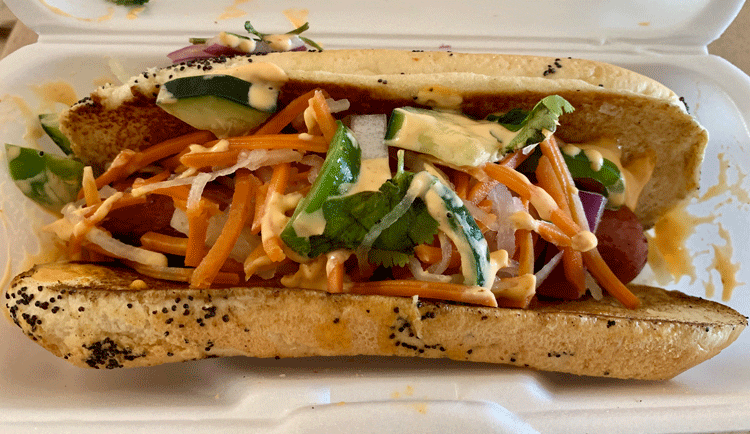
Urban Hotdog Company – Albuquerque, New Mexico

Fat kids, skinny kids, kids who climb on rocks Tough kids, sissy kids, even kids with chicken pox love hot dogs. Armour Hot Dog Commercial, 1960s Advertising standards in the 1960s were quite a bit more lax than they are today. In today’s culture of American political correctness and woke idealogy, there’s no way an earworm-inspiring jingle such as the Armour Hotdog commercial would ever see the light of day, but back then it helped sell a lot of hot dogs. Even in the 1960s, Armour’s savvy ad agency undoubtedly understood the influence children had on the family’s food consumption budget. In addition to catchy jingles designed to appeal to children, Armour’s advertising agency enticed children with prizes to be had for a monetary pittance and a coupon cut out from the back of a package of its hot dogs. Not even parents were immune from Madison Avenue’s charms. They were swayed by assurances that hot dogs were actually good for children because they were “made from lean meat” and were “protein rich.” The 1963 United States census reported the production of 1.11 billion pounds of frankfurters and wieners, constituting thirty percent of all sausages made that year. Two years…

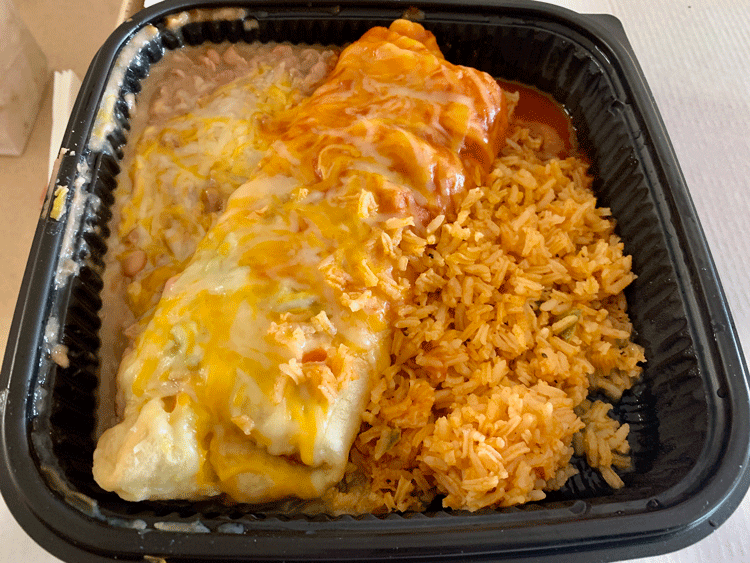
Burrito Express – Rio Rancho, New Mexico

In an article entitled “Ode to the Handheld” in the April, 2020 edition of New Mexico Magazine, writer Alicia Inez Guzman noted that when her dad was growing up in the sixties, “the idea of plating a burrito for a sit-down meal was unheard of, laughable even.  That’s because the humble tortilla-as-envelope filled with protein and starch was tailor-made for eating in the fields and long the companion of the farm worker.” Google “burrito” and the results returned will almost invariably ascribe the same adjective used by Alicia Inez Guzman to describe the burrito–humble.  That’s fitting considering burrito translates from Spanish to “little donkey,” also a companion of the farm worker and perhaps the most humble and hard-working of all pack animals.  Etymologists believe the burrito is so named not because tortillas were ever stuffed with donkey meat or because a well-constructed burrito resembles a donkey, but because a rolled, tightly packed burrito looks like a bedroll or the packs on either side of a burrito’s haunches. Catch my friend Carlos on a day in which he’s waxing philosophical and you’ll get an earful about how a savvy dining public staved off the cultural appropriation of the humble burrito by…

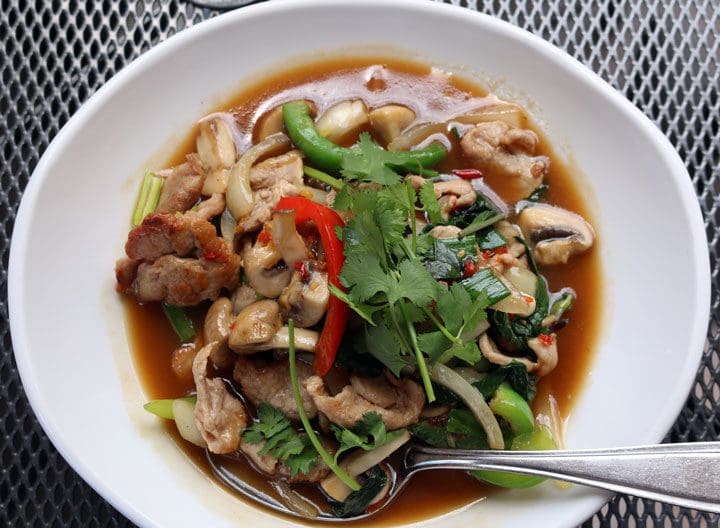
Thai Kitchen – Albuquerque, New Mexico

“There is no good meat that their stupid cooks do not spoil with the sauce they make. They mix with all their stews a certain paste made of rotten prawns…which has such a pungent smell that it nauseates anyone not accustomed to it.” No, that’s not a review published by a disgruntled diner on Zomato or Yelp. Nor is it Gil describing a chile dish to which liberal amounts of cumin were added. This scathing indictment was written in 1688 by Gervaise, a Catholic missionary from France. It was his tactless way of describing a Siamese meal at a diplomatic function he attended. Much has changed since Gervaise disparaged and insulted the cuisine of what is today Thailand, the only Southeast Asian country never to have been colonized by a European power. Gervaise, who would probably attribute the failure to conquer Thailand to the food, was probably not the first and he certainly wasn’t the only person to have criticized Thai food, but few have expressed it with such derision. Gervaise would no doubt be very surprised to discover how popular Thai food has become in the three centuries since his unsavory encounter. Thai food ranked sixth in a recent…

New Mexico Eateries Dishing Out Great Grub During Lockdown

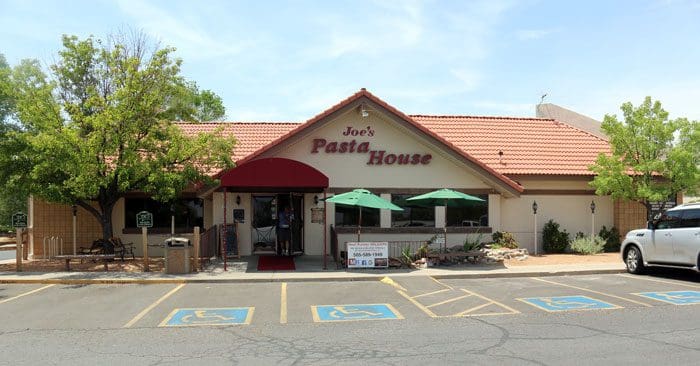
Several years ago after waging a lengthy and courageous battle, my friend Larry’s beloved bride of nearly four decades succumbed to the ravages of cancer. It was a devastating loss for her family, friends and community who loved her. Among the very first people who reached out to Larry were Joe and Kassie Guzzardi, the affable proprietors of Joe’s Pasta House, a Rio Rancho institution and one of the family’s favorite restaurants. Joe and Kassie ferried over trays of food to feed all the well-wishers.   Not even a year later, our friend Brian passed away at 48, far-too-young for someone who had so much to give.  When his parents from Fort Worth asked us to help them find a restaurant in which to host a celebration of Brian’s life, the first and only restaurant we thought of was Joe’s Pasta House.  Joe, Kassie and their terrific staff extended the gracious hospitality and kindness for which they’re widely known, helping make the celebration a worthy tribute to someone so well-loved.  These are only two of the many occasions in which we’ve witnessed Joe and Kassie perform heart-felt acts of kindness. Over the years we’ve known them, they and dozens of…

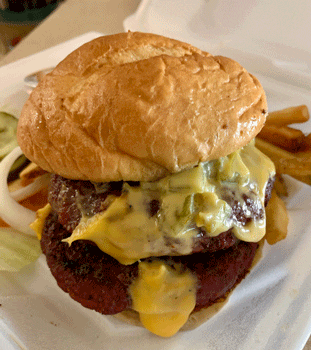
Triple B’s Bar-B-Que Burgers & Burritos – Rio Rancho, New Mexico (CLOSED)

Archaeologists in Spain claim to have unearthed the original man cave. What is most remarkable about this finding is how very similar Neanderthal man and contemporary man are. Men, it could be said, have not evolved much. Neanderthals were hairy and brutish in appearance, very much like the New York Giants and Philadelphia Eagles. They spoke in guttural grunts, similar to today’s politicians. Neanderthals scrawled their art on cave walls; contemporary man expresses himself artistically on bridges, underpasses and walls. Neanderthal man used tools: hammers, clubs and axes; contemporary man uses tools: television remote controls, joy sticks and iPhones. Cultural anthropologists (and Barbara Streisand) have long posited that throughout evolutionary history, man has had an inherent need for belonging to a social group. We are driven to form and maintain at least a few lasting, positive and significant interpersonal relationships. For many men, the two most powerful bonding agents are sports and what we like to call “barbecue” even though what we’re doing is “grilling.” We derive a sense of belonging through our affiliation with the sports teams we like–to the extent that we wear team apparel which encases us like engorged sausages. We like to get together to cheer…

California Pastrami & More – Albuquerque, New Mexico (CLOSED)

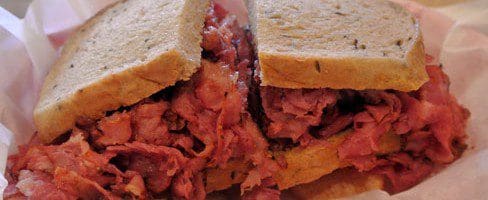
During a 1997 episode of Seinfeld, the “show about nothing,” George Costanza and his girlfriend du jour discussed the possibility of incorporating food into their lovemaking–not as a post-coital meal, but in flagrante delicto. George listed as potential food candidates: strawberries, chocolate sauce, honey and…pastrami on rye with mustard. Yes, that’s pastrami on rye. His girlfriend, unfortunately, failed to appreciate the erotic qualities of pastrami and thus, their relationship terminated. Ultimately George met up with a woman who echoed his sentiments when she declared pastrami to be “the most sensual of all the salted cured meats.” With that proclamation, their lustful appetites took over and they succumbed to the pastrami inspired throes of passion, albeit also incorporating television watching. It’s no wonder George Costanza’s face grew flush when he ate with friends at their favorite neighborhood diner; the association of food with pleasure became a sensual one. I don’t know about pastrami being the most sensual of all salted cured meats (sounds like a bit of double entendre here), but do know there are few sandwiches quite as wonderful as a pastrami sandwich. Alas, not all pastrami is created equal. The perfect pastrami finds its genesis as brisket given a…

The Jealous Fork – Albuquerque, New Mexico (CLOSED)

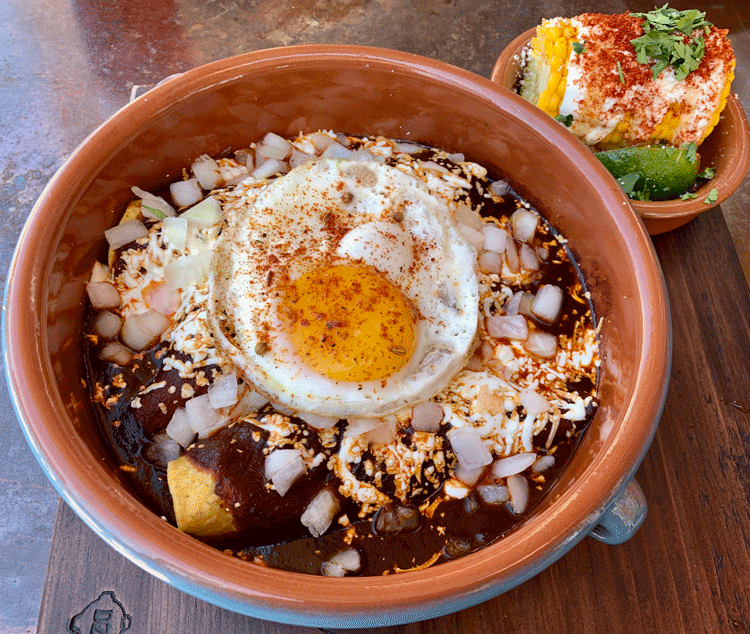
In December, 1997, two-time James Beard award-winning author Deborah Madison penned a memorable article for Sunset Magazine.  Its  provocative title “Land of Enchiladas” certainly resonated with me.  Before relocating to the Santa Fe area where she now lives, Deborah would visit New Mexico quite regularly.  As with most New Mexicans returning home–whether from vacation or relocating permanently–the incomparable cuisine of our enchanted state was a priority even before she crossed into our sacred borders.  She always looked forward to that first plate of flat enchiladas smothered with red chili sauce. One bite and I knew I was in New Mexico. It tasted like home cooking, It tastes like home.  That’s a sentiment to which many of us can relate.  No matter where my Kim and I vacation or where I may be sent on a business trip, within three days I start to crave New Mexican food–the incomparable flavors of home.  Despite those cravings, I won’t succumb to the spangled wiles of restaurants purporting to serve similar food.  My friend and former Intel colleague Steve Caine once fell prey to a pretender and will forever rue the day.  Upon returning from a business trip to Portland, he asked me to…

The Shop Breakfast & Lunch – Albuquerque, New Mexico

In the 60s and early 70s, movies and television programs would have you believe all spies were hard-drinking, fast-driving, woman-chasing playboys as good with their fists as they were with a gun. They were worldly, sophisticated and charming, but could just as easily use guile and deception to get the job done. Bob Ayers, who worked in intelligence for 30 years in the U.S. Army and Defense Intelligence Agency counters those stereotypes: “All of that stuff about James Bond, that’s Hollywood. You don’t want anyone standing out in the intelligence business. You want someone nondescript. The ideal spy is 5-foot-6 and kind of dumpy.” That ideal—nondescript and dumpy—just wouldn’t work in the restaurant business…or would it? Restaurants, especially those which are generously bankrolled by corporate megaliths, tend to have a lot of cash, flash and panache to create the illusion of glamor and allure which brings in customers (and most of us are easily entertained). In addition to all the pristine veneer and effusive, over-the-top flamboyance money can buy, these restaurants tend to have catchy, memorable names which help in the establishment and proliferation of brand identity. They’re capacious, swanky, memorable and largely successful. Anyone who thinks this formulaic approach…

Seasons Rotisserie & Grill – Albuquerque, New Mexico

To everything there is a season, and a time to every purpose under the heaven: A time to be born, and a time to die; a time to plant, and a time to pluck up that which is planted. – Ecclesiastes 3:1-2 Despite America’s oft vascillating economic situation, new restaurants continue to sprout faster than New Mexico’s unofficial state flower (no, not the ubiquitous orange traffic cone; the almost as omnipresent tumbleweed). Rarely does a week go by without some sparkly and shiny new restaurant opening up somewhere in the Duke City. Though most start off with much promise and potential, many restaurants are destined to suffer a fate similar to the dreaded and accursed tumbleweed. The average lifespan of most independent restaurant concepts is less than five years. In 1995, Seasons Rotisserie & Grill was one of the shiny new restaurants with lots of promise and potential. A quarter of a century later, it continues to thrive against the onslaught of rigorous competition from newer, shinier and prettier new restaurants, outlasting many restaurants anointed the “next best thing” by the cognoscenti. Year after year, Seasons continues to be mentioned as one of the city’s very best restaurants and not…