Little Anita’s New Mexican Food – Albuquerque, New Mexico

My friend Scott Pacheco may never forgive me for dining at Little Anita’s New Mexican Food in Old Town. Scott hates Little Anita’s, but not because of its food, ambiance or service.  He hates Little Anita’s for what he considers a traitorous act on the scale of Benedict Arnold and Judas Iscariot. To understand why Scott hates Little Anita’s so much, it might help if you know that there are two things in life he’s passionate about–the Denver Broncos and New Mexican green chile. If this isn’t making sense yet, recall that on February 2, 2014, the Seattle Seahawks demolished the Broncos 43-8 in Super Bowl XLVIII. Not only was this the largest margin of victory for an underdog, it was tied for the third largest point differential (35) in Super Bowl history. Scott was (and still is) incensed at the “dirty” Seahawks, the “blind mice” referees and “biased” announcers.  His beloved Broncos had no chance against such a stacked deck.  So what did Little Anita’s have to do with the Broncos loss?  Actually nothing, but in Scott’s mind Little Anita’s still committed an unforgivably (albeit unwitting) traitorous transgression.  As is  Super Bowl tradition, dignitaries from competing cities engaged in…

Stripes Biscuit Co. – Albuquerque, New Mexico

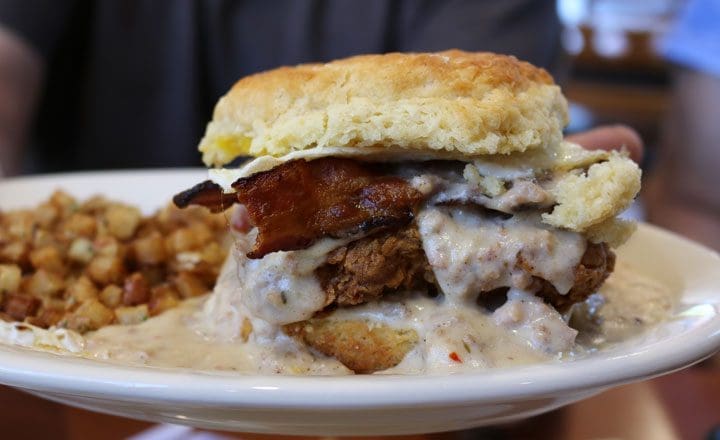
NOTE: While the Gibson location of Strips Biscuit Co. has closed. Stripes Biscuit Co. can still be found at 8050 Academy Rd NE # 101. Additionally, there are a number of Stripes Burrito Co. throughout the city and in Rio Rancho. Southern humorist Jerry Clower once quipped “One of the saddest things is the sound of them whomp biscuits being opened in more and more houses these days. Whomp! Another poor man is being denied homemade biscuits. No wonder the divorce rate is so high.” There’s more than a bit of underlying truth to Clower’s humor. Southerners take their biscuits seriously. “Whomping” or “whacking” biscuit cans on the kitchen counter to open them is akin to parents letting their children answer their Memaw with “yeah” and “nope” instead of “Yes, ma’am,” and “No, ma’am.” It just isn’t done! Southerner Belinda Ellis, author of Biscuits: A Savor the South Cookbook expresses it succinctly: “I learned that deep in the soul of a biscuit, there’s more than the flour, fat, and milk. A hot biscuit embodies a memory of place and family.” Her heartfelt tribute to the biscuit is one with which anyone raised or who has lived in the South can…

Las Ristras Restaurant – Corrales, New Mexico (CLOSED)

Based on interviews conducted with Hollywood luminaries who’ve starred in movies or television shows shot in New Mexico, you might think our state either doesn’t have a symbol of hospitality or that symbol is something as poorly representative of the Land of Enchantment as crack (Josh Brolin), tire stores (Jonathan Banks), shirtless drivers (Seth McFarlane), Walmart (Jessica Alba) or loudness (Tommy Lee Jones). With all the tax breaks and enticements afforded film production companies, shouldn’t its most visible beneficiaries at least have something nice to say about New Mexico? While New Mexico doesn’t have an official (as in legislatively decreed) symbol of hospitality, most of us recognize a ristra hanging on a doorway as an invitation to visitors, ergo a symbol of hospitality. It’s as much a symbol of hospitality as the pineapple is in Hawaii and the fleur de lis is in Louisiana. Moreover, the ristra has come to represent the state of New Mexico, maybe not quite as much as the Zia sun, but to a large extent. Now, if you want your texts to reflect New Mexico hospitality, download an app called “New Mexico Emojis” for your iPhone or iPad. Among the emojis you can add to…

Casa Chimayo – Santa Fe, New Mexico

Chimayó is one of the most mythologized, misunderstood— and, some would say, maligned—places in New Mexico. On one hand, it holds a place in popular imagination as the Lourdes of America, a reference to the annual Good Friday pilgrimage to the Santuario de Chimayó, a nineteenth-century church. New Mexicans and visitors from afar also celebrate Chimayó’s weaving tradition, the potently flavorful chile grown there, and the local restaurant, where margaritas compete with the church’s holy dirt as a tourist draw. ~ Postcard From New Mexico: Don Usner’s Chimayo Named for the Tewa Indian word describing one of four sacred hills overlooking the verdant valley on the foothills of the Sangre De Cristos, Chimayó may be only 26 miles from Santa Fe and 52 miles from Taos, but in some ways seems further removed by time than by distance. While its aforementioned counterparts have transitioned to artsy and cosmopolitan service and tourism economies, Chimayó has had a harder time moving away from its pastoral-agricultural sustenance roots. Where Santa Fe and Taos may be imbued with rustic sophistication and urbane trappings, Chimayó moves at a slower pace. At the end of the day, neighbors still meet at the fence for some serious…

Teofilo’s Restaurante – Los Lunas, New Mexico

Several years ago award-winning Albuquerque Journal columnist Leslie Linthicum (since retired) penned a wonderfully evocative column entitled “Spanish Names Fade into History.” Leslie observed that if you frequent the obituaries, especially those published on the Journal North and Journal Santa Fe, you may have observed and lamented the passing of another great Spanish name. The lyrical names with which the scions of Coronado were christened–Leocaida, Elfido, Trinidad, Pacomio, Seralia, Evilia, Amadea, Aureliano and others– have become increasingly rare in the Land of Enchantment. Leslie noted that “just about every day in New Mexico, another great old Spanish name passes on as a family loses a viejo.” Former state historian Estevan Rael-Gálvez believes the disfavor which has befallen once-honored given names can largely be attributed to “the stigma against the use of the Spanish language, which stretched from the 1940s into the 1980s.” It’s a shameful stigma that “extended into many families as they welcomed babies into the world.” Today, instead of bestowing their children with such culturally-rooted names as Prudencio, Malya, Natividad, Onofre, Celso, Andreita, Ramoncita and Piedad, young New Mexican parents tend to favor more “homogeneous” names as Noah, Elijah, Jacob, Aiden, Daniel, Jayden, Josiah, Ethan and Michael for…

Chile Time Restaurant – Albuquerque, New Mexico (CLOSED)

“For everything there is a season, a time for every activity under heaven. A time to be born and a time to die. A time to plant and a time to harvest.” ~Ecclesiastes 3 Autumn in New Mexico is indisputably chile time. The high mountain air is at its most crisp and salubrious. Foliage is adorned in a vibrant panoply of color. Magnificent cottonwoods and aspens gleam in the evening sun like the fabled cities of gold sought by Spanish explorers. Hazy smoke plumes waft upward from giant rotating drums. These irresistible smoke signals beckon hungry masses to roadside stands where flame-licked chile tumbles in steel-meshed drums. Those chiles blister then seem to hiss and spit in protest as their skins blacken, leaving their fleshy insides intact and imbued with an intoxicating aroma and addictive flavor. Winter in New Mexico is indisputably chile time. The salient aromas of piñon burn in kiva fireplaces, perfuming a night air swathed in a canopy of stars. Glowing rows of farolitos perched on adobe-hued rooftops and sidewalks light the way for the Christ child. Glissading down precipitous mountain slopes during the day gives way to sedentary evenings in the company of friends and family.…

Matanza New Mexico Local Craft Beer Kitchen – Albuquerque, New Mexico (CLOSED)

“At school, whenever I heard the word matanza, hog butchering, My face warmed up with joy and my heart beat a happy sound. It was a heavenly time for me. Images of sizzling chicharrones, crisp, meaty cracklings and Fresh, oven-baked morcillas, made my mouth water.” ~Hoe, Heaven and Hell by Dr. Nasario Garcia For young boys growing up in rural New Mexico in the 60s, one of the rites of passage signifying our transition from childhood to young adulthood was being asked to participate in the matanza. As one in a succession of life’s progressions, working a matanza was an even more important milestone than being allowed to order the “Teen Burger” instead of the “Mama Burger” at A&W. Among other things, it meant adults now trusted us not to get in the way, to follow orders to the letter and perhaps more importantly, not to shed tears for the “guest of honor” we helped raise from suckling piglet to fatted hog. It would be disingenuous of me to say I ever got over the gory sights and smells of slaughtering what were essentially pets we’d nurtured just for that purpose. Fortunately those memories don’t haunt me as much as…

Lollie’s New Mexican Food – Albuquerque, New Mexico (CONVERTED TO FOOD TRUCK)

NOTE:  Lollie’s New Mexican Food is now operating out of a food truck.  In the frontier wilderness of New Mexico–long before the advent of culinary schools and home economics classes–a cook’s credentials weren’t bestowed by some accredited institution of higher learning. Instruction in the culinary arts was most often imparted lovingly by mothers. Recipes were passed on from one generation to another, using ingredients often grown in the family farm and livestock raised locally. “Credentials” were earned by reputation and the word of mouth of satisfied diners (most often family members, neighbors and visitors). A good cook was known about far and wide. Lollie Padilla can relate to the New Mexican culinary traditions of yore, having worked next to her mother (to whom the restaurant is dedicated) in learning to cook homemade, wholesome New Mexican dishes at a very young age. On April 3rd, 2013, Lollie launched the eponymous Lollie’s New Mexican Food restaurant in the Barelas-South Valley area in which she was raised as were generations of her family. Two things are immediately obvious: Lollie was a very good student and her mother was a very good cook. Don’t let the restaurant’s motto “Proudly Serving The Southwest” confuse you.…

Pana’s Cafe – Albuquerque, New Mexico (CLOSED)

The term “red or green” has connotations beyond New Mexico’s sacrosanct chile. For restaurateurs across the Duke City, red or green can spell the difference between a good or bad reputation and even success or failure. All food service establishments across the city must display the results of the most recent restaurant inspection conducted by the Albuquerque Environmental Health Department. Those results are displayed on a “current grade” sticker in a visible inspection, typically the front door. Savvy diners look for a green sticker which signifies that a food establishment received a passing grade at their most recent inspection. It means the restaurant staff has demonstrated skills and knowledge that create a safe and sanitary food service environment. A red sticker, on the other hand, means the food service establishment has been downgraded for non-compliance with the Food Sanitation Ordinance. The dreaded red sticker can be the proverbial kiss of death. Although food service establishments are given the opportunity to correct critical violations, sometimes the damage to reputation is done. For years, the “red or green report” was a weekly staple of KOAT Action 7 News with appropriate dramatic emphasis accorded restaurants earning red stickers. As with inspections of any…

Casa de Benavidez – Los Ranchos de Albuquerque, New Mexico

There are restaurants throughout the Duke City that have seemingly always been “there.” They’re as much a part of the fabric of the city as the neighborhoods they serve. Casa de Benavidez is one of those restaurants, a familiar part of the landscape on North Fourth Street, some would say an institution. Despite the notion of permanence, this venerable treasure has, in fact, been around only since 1984–at least under its current name. Before there was a Casa de Benavidez, there was, just a mile or so away, a tiny little eatery with only three tables and a bustling take-out business. There was also a dream, the shared ambition of Paul and Rita Benavidez to serve their hometown with the food they loved and prepared so well. At El Mexicano, a diminutive eatery they operated with their children, that dream began the transformation from monochromatic to technicolor with every one of their trademarked sopaipilla burgers sold. While the family was selling more and more sopaipilla burgers, they were also stockpiling used restaurant equipment in hope and anticipation of an expansion that would allow them to more fully realize their dreams. Not far from their diminutive digs, Paul found a nearly…

Burritos Alinstante – Albuquerque, New Mexico

A couple of days before my Kim and I were to be married (some three decades plus ago), my mom flew to Chicago to teach her how to prepare some of my favorite dishes (is it any wonder my sisters call me “consentido” (spoiled)?). A quick study, Kim learned how to make tortillas, lasagna, fried chicken, red chile and other favorites just the way mom makes them. Among the wedding presents my mom gave Kim were a cast-iron comal (griddle) and a rodillo (rolling pin) of her own. In short order Kim began making tortillas as if she’d been making them all her life, in the process contributing significantly to my adulthood struggle with caloric overachievement. The time-honored, traditional art of making tortillas on a sizzling cast-iron comal is truly one of the defining elements of both New Mexican and Mexican cuisine. Tortillas are a simple, round flatbread partaken with just about every meal in many a New Mexican household. They are a staple available in most New Mexican restaurants and certainly in the Garduño household. With the widespread availability of plastic-wrapped, store-bought pretenders, however, the art of kneading dough and shaping orbs for preparation on a griddle is slowly…