528 Sushi & Asian Cuisine – Albuquerque, New Mexico (CLOSED)

“No lady likes to snuggle and dine accompanied by a porcupine.” “He lit a match to check gas tank. They call him skinless Frank.” “A man, a miss, a car, a curve. He kissed the miss and missed the curve.” “Within this vale of toil and sin, your head goes bald but not your chin.” “Henry the Eighth sure had trouble. Short-term wives, long-term stubble.” Some of the more seasoned among us might remember that one of the best ways to break up the drudgery of traveling long distances on monotonous two-lane highways was to look for Burma Shave billboards. Humorous five-line poems adorned red signs one line at a time, each line in white capitalized blocked letters about 100-feet apart. The last line of each poem was the much anticipated punchline followed by a sign bearing the obligatory name of the then-popular shaving cream. New Mexico was one of a handful of states not to benefit from this highly visible and very successful advertising medium. Apparently our highways and byways were deemed to have insufficient road traffic to warrant the billboards. As a precocious child yet to revel in hours-long explorations of the family encyclopedias, my limited knowledge of…

Nori Ramen & Sushi Bar – Rio Rancho, New Mexico

From our home in northeast Rio Rancho, it’s about thirteen miles to the Nori Ramen & Sushi Bar on Southern Boulevard. It would have been safer to run with the bulls at Pampalona than it was driving the half hour it took me to get to Nori. In those thirty minutes, an impatient tailgater blasted her horn at me for having the audacity to come to a complete stop at a stop sign in our subdivision. As she roared passed me on a 25 miles-per-hour street, she contemptuously extended her middle finger out the window (in the same way drivers espying the Dallas Cowboys plate on my car acknowledge the Cowboys are number one). Once on Highway 528, I witnessed drivers running red lights, exceeding the speed limit by at least warp five, turning from the wrong lane and not using turn signals (even though the season of lights is approaching). “Phew,” I thought “at least we don’t live in any of the other 48 states whose drivers are more impolite.” Yep, you read that correctly. A June, 2017 survey conducted by Kars4Kids ranked New Mexico as the second-most polite state in which to drive. At this point you’re probably…

Fareast Fuzion – Albuquerque, New Mexico (CLOSED)

A Journal of Consumer Research study published in 2012 revealed that consumers equate eating meat with their concept of masculinity. To the dismay of spinach-lovers like Popeye, respondents indicated meat has a more masculine quality than vegetables. Study participants considered male carnivores to be more masculine than their vegetarian counterparts (ostensibly Bill Clinton was more masculine when he scarfed up Big Macs than he is now that he’s a vegetarian). “To the strong, traditional, macho, bicep-flexing, all-American male, red meat is a strong, traditional, macho, bicep-flexing, All-American food,” wrote the researchers. “Soy is not. To eat it, they would have to give up a food they saw as strong and powerful like themselves for a food they saw as weak and wimpy.” Researchers acknowledged that with a diet rich in manly meats, equally manly health conditions such as heart attacks are inevitable. So, if we shouldn’t eat meat, what should we paragons of masculinity eat? Certainly not quiche or kale! Bruce Feirstein told us in 1982 that “Real Men Don’t Eat Quiche.” Sure, that title was a tongue-in-cheek satire of masculine stereotypes, but could there be a grain of truth there somewhere? More recently, an author who goes by the…

Amerasia & Sumo Sushi – Albuquerque, New Mexico (CLOSED)

Carpe Diem Sum–“seize the dim sum” at AmerAsia, the Alibi’s perennial selection for best dim sum in the city honors (diem sum, as spelled on AmerAsia’s menu is also a correct spelling). Dim sum, a Cantonese word that can be translated to “a little bit of heart,” “point of heart” and “touch the heart” has its genesis in the Chinese tea houses of the Silk Road. Weary sojourners would stop at tea houses for tea and a light snack (ergo, touch the heart). Over time, the popularity of the tasty little treasures offered at these tea houses led to larger restaurants serving dim sum meals until mid-afternoon, after which other Cantonese cuisine was made available. Today, dim sum buffets are a popular offering throughout the United States. Albuquerque’s most venerable practitioner of the traditional culinary art of dim sum is AmerAsia which has been serving Albuquerque since 1978. Though AmerAsia has been around for nearly thirty years, out of blind loyalty to Ming Dynasty we avoided trying it, reasoning there is no way anyone could serve dim sum quite as good as the popular Cantonese restaurant. Thankfully AmerAsia’s diem sum captured the unfettered affections of a Chowhound poster from Phoenix…

Sakura Sushi Thai & Laos Cuisine – Albuquerque, New Mexico (CLOSED)

Opinions vary as to what the next “hot” cuisine in America will be. As an independent observer of the New Mexico culinary condition, I’m more interested in how long it will take for that heat to make its way to the Land of Enchantment…and whether its sizzle will wow Duke City diners or pass us by. In 2005, Bon Appetit declared Peruvian the next hot cuisine. Apparently Albuquerque didn’t think it was so hot because Perumex, the city’s first and only Peruvian restaurant at the time both opened and closed the year of Bon Appetit’s proclamation. Thankfully in 2011 Rene and Monica Coronado opened Pollito Con Papas to give the Duke City a second chance at a taste of Peru. In 2013, Sara Correa launched Sara’s Pastries which gives Duke City diners a sweeter perspective on Peruvian cuisine. If history repeats itself, perhaps Lao cuisine, the cuisine of Laos (officially the Lao People’s Democratic Republic) will follow Thai and Vietnamese cuisines as the hot cuisine embraced by ethnic-food ravenous American diners. That would be my wish and my prediction. Laos is a landlocked country in Southeast Asia bordered by Myanmar (formerly Burma), China, Vietnam, Cambodia and Thailand. The influence of…

Magokoro Japanese Restaurant – Albuquerque, New Mexico (CLOSED)

Emeril Lagasse, the jovial master of the culinary catchphrase, has been known to exhort his studio audience to “feel the love” as he adds a dash or two of something special to a dish. Indeed, love is that extra ingredient many chefs say they add to make everything they prepare taste better. To these chefs, cooking with love is not a labor of love because the gratification they receive is as intrinsically nourishing and pleasing as their cuisine is pleasurable and fulfilling to the diners who partake of it. Asian cultures have known for time immemorial that cooking is more than providing sustenance to sate hunger. They believe cooking and eating can create spiritual awareness and foster community as well as inspire the heart. The Chinese term dim sum, in fact, translates to “touching the heart.” In Japan, there’s a similar term–“Magokoro,” which is translated as “heart of truth” and is considered the basic attitude toward life. Magokoro is used to convey “sincerity, pure heart, uprightness.” It is, generally, the sincere attitude of a person in doing his or her best. Doing her best is precisely what Takako Bowen, the owner and chef of Albuquerque’s Magokoro Japanese Restaurant has done…

Loving Vegan – Albuquerque, New Mexico (CLOSED)

My adovada adoring amigo Ruben likened the irony to an episode of Seinfeld. Two weeks into his experiment with an ostensibly healthier vegan diet, he was craving sushi and needed his sushi-specific pangs of hunger sated. No sooner had we finished a very satisfying sushi soiree at Albuquerque’s only vegan sushi restaurant than our waitress apprised us the restaurant would be closing for good two days later. “Serenity now,” we cried, mimicking Frank Costanza when faced with a stressful situation. It just didn’t seem fair that we would make such a delicious discovery only to have plans for future meals dashed. Loving Vegan gave it the “old college try,” initially launching in June, 2012 on Coors Blvd before relocating in November, 2013 to a much more heavily trafficked Nob Hill location. In its relatively short life, Loving Vegan garnered a loyal following and a very prestigious honor. Within a year of opening, PETA (People for the Ethical Treatment of Animals) named Loving Vegan the “top restaurant for vegan sushi” in the United States and Canada. The citation from PETA read: “Loving Vegan earned our top prize because it truly proves that any food can be made deliciously and healthfully without…

Nagomi Japanese Restaurant – Albuquerque, New Mexico

Everyman philosopher Homer Simpson once posed the profound existential question “Donuts. Is there anything they can’t do?” One thing at which donuts seem especially adept is ensnaring the hearts and affections of youth—and not just American youth. The Huffington Post reported recently that in Japan, “the younger generation is increasingly eating Krispy Kreme doughnuts and McDonald’s, not rice.” Fast food chains such as the aforementioned Krispy Kreme and McDonald’s as well as Kentucky Fried Chicken, Domino’s Pizza and others have become ubiquitous in Japan—much to the detriment of traditional Japanese culinary traditions, many of which are closely linked to family relations. The popularity of fast food is the likely culprit for the steep decline in annual rice consumption across the Land of the Rising Sun. In recent decades, rice consumption has fallen 17 percent, from 9.44 million tons to 7.81 million tons per year. According to the Post, the fast food diet and its “spicy oily food” has also largely decimated the ability of young people to discern “umami,” a fundamental taste in the Japanese palate along with sweet, sour, salty and bitter. The exodus from Japanese culinary traditions has also had an esthetic impact. While Japanese food and its…

Gen Kai Japanese Restaurant – Albuquerque, New Mexico (CLOSED)

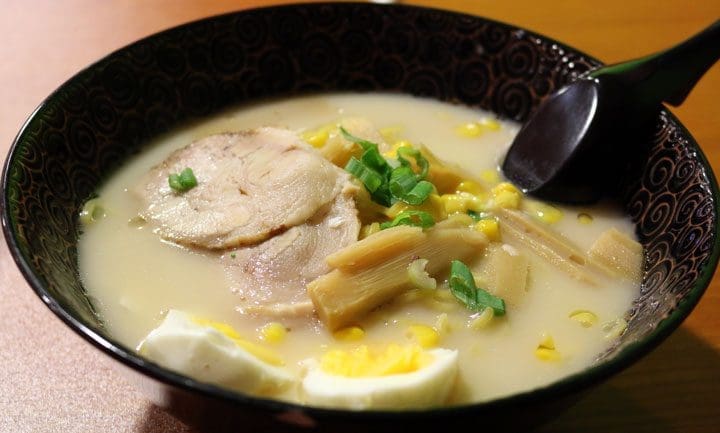
In Japan, ramen is so revered that diners line up, sometimes for hours, at ramen houses for homemade noodles tangled with such ingredients as dried fish, pork and chicken. Connoisseurs make pilgrimages to a popular ramen museum in Yokohama, not the only museum dedicated to ramen, by the way. If you’re wondering how the ramen noodle product you purchased as a collegiate at the rate of ten bricks for ten dollars warrants such reverence and respect, you’re in the right ballpark, but not in the right seat. Although extremely popular throughout Japan where you can find it even in vending machines, it’s not the ubiquitous low-brow instant ramen found in Styrofoam packages which warrants such adulation and enthusiasm. That adulation is reserved for ramen which is fresh and handmade with rich, creamy, opaque broths lovingly tended for hours, if not days. It is the consummate comfort food in the Land of the Rising Sun. In fact, comparing instant ramen to the ramen found in restaurants is akin to comparing the burger on a McDonald’s Happy Meal to a wagyu steak at a posh steakhouse. While the packaged ramen is ready in an instant, it’s teeming with sodium and suspect-sounding ingredients.…

Ahh! Sushi – Rio Rancho, New Mexico (CLOSED: 2015)

The year was 1997. Recently thawed from a thirty year cryogenic state, Dr. Evil addressed the United Nations about his diabolical scheme to hold the world ransom: “ In a little while you’ll notice that the Kreplachistani warhead has gone missing. If you want it back, you’re going to have to pay me…one million dollars.” After the United Nations officials erupted in laughter, Dr. Evil quickly corrected himself “sorry…one hundred billion dollars.” When our mere pittance of a bill arrived after my friends Paul, Bill, Fred and I had polished off a boatload of all-you-can-eat sushi at Ahh! Sushi, the 1997 movie Austin Powers: International Man of Mystery, quickly came to mind. Considering all we had eaten, we half expected an evil sushi chef to come out from behind the curtain and say “sorry…one thousand dollars.” We didn’t add up what the sushi would have cost had we not availed ourselves of the all-you-can-eat offering, but suffice to say, we ate our money’s worth and then some. The only sticker shock visitors to Ahh Sushi in Rio Rancho receive is shock (and maybe a little bit of awe, too) at how inexpensive all you can eat can be. I won’t…

Clancy’s Pub – Farmington, New Mexico

Characterized by writer Tom Wolfe as the “Me Decade” and derided by cynics as the “Disco Era,” the 1970s witnessed an explosion of copycat fast food chain restaurants and the birth of innovative fusion cuisine in many contemporary restaurants. Fusion cuisine is the inventive combination of diverse, sometimes disparate culinary traditions, techniques and ingredients to form an entirely new genre. In large metropolitan areas, particularly throughout California, the fusion of different cuisines became commonplace. Restaurants featuring the melding of French and Chinese cuisine were especially popular. Still other restaurants had their own ideas as to what constituted fusion cuisine. Instead of intermixing ingredients, they featured menus showcasing the cuisine of several genres. One such restaurant is Clancy’s Pub in Farmington, New Mexico. Though its name practically screams “Irish pub,” Clancy’s Pub is so much more. Founded in 1978, Clancy’s offers one of the most diverse and comprehensive menus you’ll find anywhere in New Mexico. It’s East meets West, surf meets turf, vegetarian meets meat lover, sweet meets savory, and so much more. Now, if you’re wondering if Clancy’s Pub is just another one of those restaurants which endeavors to “be all things to all people” and falls woefully short of…