Pacific Paradise Tropical Grill & Sushi Bar – Albuquerque, New Mexico (CLOSED)

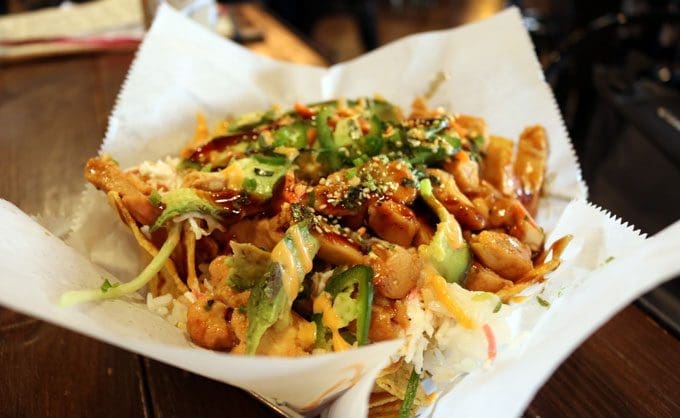
Shangri-La. Eden.  Paradise. Heaven on Earth.  The concept of a remote and exotic utopia, a faraway haven or hideaway of idyllic beauty and tranquility, has long intrigued mankind.  Paul Gauguin, the famous French post-impressionist artist thought his persistent pilgrimage for Paradise was over when he moved to Tahiti in the tropical South Pacific.  Alas, his picturesque paradise, as with anything that seems too good to be true, was also discovered by French colonists who quickly transformed Tahiti into the antithesis of the “sensual loafer’s paradise” he had envisioned. For aficionados of Asian cuisine, paradise might be defined as a restaurant from whose kitchen emanates the culinary diversity of the Pacific: time-honored and traditional delicacies, contrasting yet complementary flavors, exotic and…

O Ramen – Albuquerque, New Mexico

“Food, like a loving touch or a glimpse of divine power, has that ability to comfort.” ~Norman Kolpas According to most online definitions, the term “soul food” defines the cuisine associated with African-American culture in the southern United States. In wide use since the 1960s, the term originated and came into heavy use with the rise of the civil rights and black nationalism movements. Though still most widely associated with the African-American culture, over the years “soul food” has become synonymous with basic, down-home cooking, especially of comfort foods…and as Cracked magazine puts it, soul food is “the real reason why white people like Cracker Barrel.” While the term “soul food” has, by definition, been culturally limiting and exclusive, in…

Sushi & Sake – Albuquerque, New Mexico

“If white wine goes with fish, do white grapes go with sushi?“ – George Carlin A reader once asked Washington Post humorist Gene Weingarten what he was a snob about. His reply, “I am also a snob about food. The other day, in Baltimore, I passed a sign outside a restaurant that said “Sushi Buffet!‘ and laughed out loud because it occurred to me that “sushi” and “buffet” are two words that should never appear together.”  His sentiment resonates strongly with sushi aficionados who adhere to the strict rules of etiquette which governs the way in which true sushi snobs enjoy sushi. It’s a given that a true sushi snob would never eat at an all-you-can-eat sushi restaurant nor would…

Iron Cafe – Albuquerque, New Mexico (CLOSED)

“Ramen is a dish that’s very high in calories and sodium. One way to make it slightly healthier is to leave the soup and just eat the noodles.” ~Iron Chef Masaharu Morimoto America may be a multicultural melting pot, but thriving within its most populous metropolises are ethnic neighborhoods–pockets of diversity residing in two worlds, retaining many of the cultural and culinary traditions of their motherland while integrating into and pursuing the American dream. Cities such as San Francisco, Los Angeles and even Las Vegas, Nevada have long realized that these ethnic enclaves offer a treasure trove of cultural and culinary experiences. Most of these neighborhoods welcome culinary tourism–the opportunity to showcase the cuisine of their homelands. Obviously Albuquerque doesn’t…

Asian Pear – Albuquerque, New Mexico

“Careful Father, this stuff will melt your beads.” ~Lt Colonel Henry Blake, MASH 4077 Just as Hogan’s Heroes helped establish the perception many Americans (at least of my generation) had about German food, the television show MASH was the first introduction many of us had to Korean food. Set in South Korea during the Korean War, the series centered around a group of resilient doctors, nurses and support staff in an isolated hospital compound which saw more than its share of wounded. Not only did each half hour episode depict–sometimes rather graphically–the horrors of war, it painted a rather poignant and entirely accurate picture of sacrifice and hardship. Some of the sacrifice and hardship came at the hands of the…

Ohana Hut – Albuquerque, New Mexico

In horse racing, the Triple Crown signifies winning all three of the sport’s most challenging thoroughbred horse races—The Kentucky Derby, Preakness Stakes and Belmont Stakes. This is considered the greatest achieved in thoroughbred racing, a feat accomplished only twelve times. The thespian community considers as its Triple Crown, winning a competitive Academy Award, an Emmy Award and a Tony Award in acting categories. Only twenty-two actors or actresses have earned this rare distinction. What makes winning a Triple Crown in any competitive event so exciting for fans is its rarity. It happens so infrequently that fans clamor for it to happen. At the 2015 Taste of Rio Rancho event, Street Food Blvd pulled off a Triple Crown of sorts, earning…

528 Sushi & Asian Cuisine – Albuquerque, New Mexico (CLOSED)

“No lady likes to snuggle and dine accompanied by a porcupine.” “He lit a match to check gas tank. They call him skinless Frank.” “A man, a miss, a car, a curve. He kissed the miss and missed the curve.” “Within this vale of toil and sin, your head goes bald but not your chin.” “Henry the Eighth sure had trouble. Short-term wives, long-term stubble.” Some of the more seasoned among us might remember that one of the best ways to break up the drudgery of traveling long distances on monotonous two-lane highways was to look for Burma Shave billboards. Humorous five-line poems adorned red signs one line at a time, each line in white capitalized blocked letters about 100-feet…

Nori Ramen & Sushi Bar – Rio Rancho, New Mexico

From our home in northeast Rio Rancho, it’s about thirteen miles to the Nori Ramen & Sushi Bar on Southern Boulevard. It would have been safer to run with the bulls at Pampalona than it was driving the half hour it took me to get to Nori. In those thirty minutes, an impatient tailgater blasted her horn at me for having the audacity to come to a complete stop at a stop sign in our subdivision. As she roared passed me on a 25 miles-per-hour street, she contemptuously extended her middle finger out the window (in the same way drivers espying the Dallas Cowboys plate on my car acknowledge the Cowboys are number one). Once on Highway 528, I witnessed…

Aya’s New Asian Japanese Cuisine – Albuquerque, New Mexico (CLOSED: 2018)

There’s an unspoken reciprocal arrangement between restaurant guests and the restaurant personnel with whom we interact. As guests, we show our appreciation for a dining experience well executed by tipping generously and maybe complimenting the kitchen and wait staff during and after the meal. Representatives of the restaurant– whether they be chefs, maître ds, servers or owners—typically thank their guests and invite them to return. All too often these interactions seem trite, maybe even rehearsed or expected. It’s what we all do because it’s what we’ve always done and it’s what’s expected to be done. Only during and after exceptional (or exceptionally bad) dining experiences do interactions between guests and restaurant personnel become more effusive…or so we thought. During our…

Fareast Fuzion – Albuquerque, New Mexico

A Journal of Consumer Research study published in 2012 revealed that consumers equate eating meat with their concept of masculinity. To the dismay of spinach-lovers like Popeye, respondents indicated meat has a more masculine quality than vegetables. Study participants considered male carnivores to be more masculine than their vegetarian counterparts (ostensibly Bill Clinton was more masculine when he scarfed up Big Macs than he is now that he’s a vegetarian). “To the strong, traditional, macho, bicep-flexing, all-American male, red meat is a strong, traditional, macho, bicep-flexing, All-American food,” wrote the researchers. “Soy is not. To eat it, they would have to give up a food they saw as strong and powerful like themselves for a food they saw as weak…

Amerasia & Sumo Sushi – Albuquerque, New Mexico (CLOSED)

Carpe Diem Sum–“seize the dim sum” at AmerAsia, the Alibi’s perennial selection for best dim sum in the city honors (diem sum, as spelled on AmerAsia’s menu is also a correct spelling). Dim sum, a Cantonese word that can be translated to “a little bit of heart,” “point of heart” and “touch the heart” has its genesis in the Chinese tea houses of the Silk Road. Weary sojourners would stop at tea houses for tea and a light snack (ergo, touch the heart). Over time, the popularity of the tasty little treasures offered at these tea houses led to larger restaurants serving dim sum meals until mid-afternoon, after which other Cantonese cuisine was made available. Today, dim sum buffets are…