Maine Diner – Wells, Maine

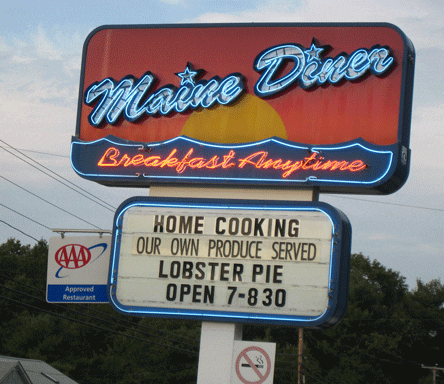
How do you know when a restaurant has really made it?  Is it when that restaurant is recognized by national publications as one of the very best diners in the country?  Or when celebrities go out of their way to dine at its tables?  Is it when more than five-million people have been warmly welcomed at its doors?  When neither rain, nor sleet nor the most stern and frigid of Maine winters can dissuade visitors? The Maine Diner has achieved all of this and so much more.  Richly deserving of all the accolades bestowed upon it, the telltale sign that it’s made it–at least from a pop culture perspective–is when it’s recognized as the restaurant after which Flo’s Offshore Diner is patterned.  If you’ve never heard of Flo’s Offshore Diner, it might be because the Albuquerque Journal isn’t one of the 700 newspapers across America in which Non Sequitur is syndicated. Non Sequitur is simply one of the most creative and honored comic strips in syndication today, winner of four National Cartoonists Society divisional awards, the most prestigious accolade in cartooning.  It is creator Wiley Miller’s vehicle for sharing his wry observations about the absurdities of everyday life.  There are…

Antonio’s: A Taste of Mexico – Taos, New Mexico

A traditional corrido from the Mexican coastal state of Veracruz recounts the story of a smiling woman with magic hands.  The kitchen is the world of Maria Chuchena and the intoxicating aromas and incomparable flavors she concocts in that world are utterly unforgettable.  With her cooking, Maria fills the world with surprises.  If corridos have sequels and characters in folk songs bear offspring, Maria Chuchena’s progeny might well be Antonio Matus, chef and owner of the eponymous Antonio’s: A Taste of Mexico in Taos, New Mexico.  Like the corrido, Antonio is from Veracruz and like Maria Chuchena, the kitchen is his world.  It is where he has been filling Taos with utterly unforgettable surprises for more than a decade. After working in several dining establishments in the Taos area, Antonio launched his self-titled restaurant at the historic El Torreon Hacienda in El Prado, just north of Taos.  The hacienda which dates back to 1847 sits on acreage given to the Valdez family by the famous and infamous Padre Antonio José Martínez, the ecclesiastical leader of northern New Mexico whose unique style of Catholicism was in direct opposition to Archbishop Lamy, the French archbishop who reorganized the Catholic Church in the Southwest. In 2005, Antonio’s…

The Shed – Santa Fe, New Mexico

In the culinary world, the name James Beard is revered perhaps above all others. Considered the “Dean of American Cookery,” Beard established a legacy of culinary excellence and became a household name to generations of home cooks and professional chefs. The cookbooks he authored between 1940 and 1983 are considered “a slice of American history” because those tomes span America’s culinary regions and served as a premonition of the global epicurean expanse to come. Today, the James Beard Foundation, a national not-for-profit organization is dedicated to celebrating, preserving, and nurturing America’s culinary heritage and diversity in order to elevate the appreciation of our culinary excellence. Earning a James Beard award signifies the pinnacle of achievement in the culinary world. It’s the restaurant world’s equivalent of the Academy Award. In 2003, The Shed restaurant earned the Foundation’s “America’s Classics Award,” a prestigious accolade honoring locally owned and operated regional restaurants that have withstood the test of time and are beloved in their communities. The Foundation’s Web site describes The Shed as “A restaurant begun in a burro shed on a dusty alley in a then-sleepy little town might not sound as if it would be – 50 years later – hailed…

Tomasita’s – Santa Fe, New Mexico

The decade following America’s Civil War was one of burgeoning expansion westward with railroads leading the way.  Railroads helped open up the Wild West which included the then territory of New Mexico.  They transported wool, hides, piñon, lumber, coal, chile and other agricultural products.  They served as “connectors” between villages, towns and pueblos.  They bridged cultures and transcended distance, traversing through rocky promontories, barren mesas and fecund river valleys.  Railroads spread the news, enlightened the culture and introduced modern amenities to outposts separated by miles and time. The long defunct Denver and Rio Grande Western Railroad (DRGWR) even had grandiose plans to connect Denver, Colorado and Mexico City  with its narrow-gauge railroad.   During its halcyon days, the 125-mile, seven-hour branch from Antonito, Colorado to Santa Fe, New Mexico earned the sobriquet “The Chile Line” in recognition that much of the freight it hauled was chile peppers. The railroad reached Santa Fe in 1881, but never went further south.  By the 1930s, the decline in the demand for lumber and competition from buses and trucks reduced traffic on the line greatly and on September 1st, 1941, the Chile Line departed Santa Fe’s Guadalupe Station on its final northbound run. The southern terminus…

Aqua Santa – Santa Fe, New Mexico (CLOSED)

“But the moment I saw the brilliant, proud morning shine high up over the deserts of Santa Fe, something stood still in my soul, and I started to attend. There was a certain magnificence in the high-up day, a certain eagle-like royalty, so different from the equally pure, equally pristine and lovely morning of Australia, which is so soft, so utterly pure in its softness, and betrayed by green parrot flying. But in the lovely morning of Australia one went into a dream. In the magnificent fierce morning of New Mexico one sprang awake, a new part of the soul woke up suddenly, and the old world gave way to a new.” In a 1928 essay called “New Mexico,” prolific writer D.H. Lawrence wrote that “New Mexico was the greatest experience from the outside world that I have ever had.”  Lawrence believed New Mexico liberated him from the present era of civilization.  In a sense, the Land of Enchantment healed his spirit. There is so much about New Mexico that is salubrious to the health of mind. body and spirit.  What spirit wouldn’t be buoyed by our cobalt skies with their endless depth of  graduating color intensity as they are…

Guadalupe Cafe – Santa Fe, New Mexico (CLOSED)

1974, Mexico’s Nobel laureate Octavio Paz wrote that “the Mexican people, after more than two centuries of experiments, have faith only in the Virgin of Guadalupe and the National Lottery.” Though perhaps not to the same degree of reverence as people of Mexican descent have for Our Lady of Guadalupe, many diners literally make pilgrimages to Santa Fe’s Guadalupe Cafe. You might say they trek to this beloved institution with a type of fervor which could be considered almost spiritual. The Guadalupe Cafe, long removed from Santa Fe’s Guadalupe District and Guadalupe Street, does indeed inspire a fierce devotion. It is one of the most popular restaurants in Santa Fe, a venue often included in discussions about the best New Mexican restaurants in Northern New Mexico. It’s not uncommon to find yourself seated next to families who drove from Albuquerque or Taos (as has been our experience) just for breakfast at this institution. It’s not uncommon for tourists to make this the first restaurant they visit when they return to Santa Fe (and the City Different always inspires return visits).a During a return visit to Santa Fe for her Tasty Travels show, the effervescent kitchen diva Rachael Ray touted the…

Leona’s Restaurante de Chimayo – Chimayo, New Mexico

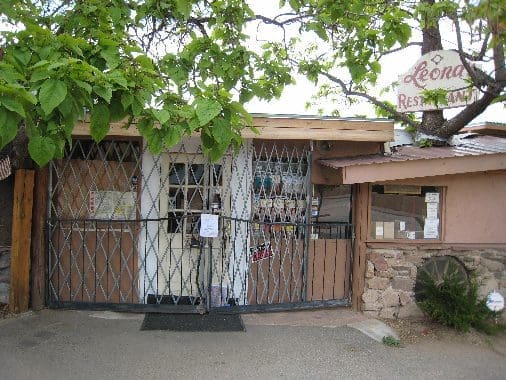
In his book Authentic Happiness, Dr. Martin Seligman posited that there are two kinds of smiles. The first is called the Duchenne smile, named for its discoverer, French neurologist Guillame Duchenne. This is considered a genuine smile in which the corners of the mouth turn up and the skin around the corners of the eyes crinkle (ala crow’s feet). This type of smile may sometimes begin with laughter that generates a wide smile which causes the skin around the eyes to crease. The Duchenne smile is very hard to fake and is therefore often used to detect sincerity. The other type of smile, called the Pan American smile, is named after the smile airline stewardesses (or at least those on television commercials) supposedly gave their passengers. The Pan American smile is considered a courtesy or perfunctory smile. It is deliberately formed by contorting one’s mouth into the shape of a smile. It’s both easy for most people to slap on or to detect a Pan American smile. You get the impression that when Leona Medina smiles, it’s as warm and genuine as the chile she prepares in her small restaurant situated just feet from the world famous Santuario de Chimayo.…

Cloud Cliff Bakery & Cafe – Santa Fe, New Mexico (CLOSED)

In the 1880s, Northern New Mexico was a prolific wheat growing region. More than 250 varieties of wheat grew in its rocky but fecund soil. Thanks to a rural revitalization program called the Northern New Mexico Organic Wheat Project, the region’s wheat production is becoming genetic diverse once again. Today under the program’s auspices, more than 20 families are growing several heirloom wheat varieties which are marketed under the very popular Nativo label. The driving force behind the program is Willem Maltem, a former Zen monk who arrived in Santa Fe in the mid 1980s. To earn bread, Maltem sold bread, in 1984 founding the Cloud Cliff Bakery, Cafe and Artspace. The artisan Bakery now produces 35,000 loaves of bread a month, but the staff of life is but one of the many things that makes Cloud Cliff truly unique and special. Grace, beauty and harmony–hallmarks of Zen–are immediately obvious when you stride into the sprawling 8,000 square-foot complex whose distressed oak floor was recycled from a high school gymnasium. The walls are adorned by intricate paintings and weavings, the work of the Shipibo-Konibo people of the Peruvian Amazon. The patterns are said to have spiritual healing properties, and indeed…

Embudo Station – Embudo, New Mexico (CLOSED)

Few things in life are as romantic as dining on the banks of the slowly trickling, mocha-colored Rio Grande on a crisp early autumn night with only a hint of moonlight to illuminate your partner’s visage–unless maybe it’s dining by that same river as it rages murkily, carrying off the Sangre De Cristo’s winter ablutions during its spring runoff. Located 25 miles south of Taos and 41 miles north of Santa Fe on Highway 68, the Embudo Station offers patio dining with unforgettable vistas and memorable meals. The Embudo Station is steeped in history, having served as a narrow gauge railroad station for the Denver & Rio Grande Western Railroad (affectionately called the “Chile Line”) from the 1887 until 1941 when it was abandoned. In 1983, the Embudo Station was purchased by Preston and Sandy Cox, tax accountants who left Santa Fe’s rat race for the peaceful village life of Embudo. After spending two years renovating the rundown property, the Coxes launched a sprawling complex that includes a restaurant, brewery, smokehouse, rafting company, a smoked goods mail-order catalogue company, an arts and crafts store, and an overnight cabin. The old station house was converted into a brewery in which more…

Joseph’s Table – Taos, New Mexico (CLOSED)

When chef and owner Joseph Wrede launched Joseph’s Table several years ago in Ranchos De Taos,dining patrons and pedantic critics alike were ready to beatify him (a culinary Saint Joseph). In 2000, Food & Wine magazine named him one of the top ten chefs in America, extolling his use of locally grown organic produce in “surprising, sensual ways.” The London Times called him “the voice of modern American cuisine.” Even Food Network luminary Bobby Flay came calling during a visit to Taos. On June 28, 2002, Wrede closed his restaurant to contemplate the lucrative lure of a corporate chef position. The Taos culinary world breathed a collective sigh of relief when he launched his new restaurant in December, 2003. Housed in the historic La Fonda Hotel, his new dining room is artistically inspired and bathed in vivid colors on which enormous hand-painted tulips and butterflies crafted by his wife provide a whimsical refrain. Flowing, elegant tapestries reminiscent of a Sultan’s tent titivate the walls. Along the back wall are several semi-private chambers the wait staff refer to as “love shacks.” As artistic as the ambience is, it is the congruence of the chef’s menu items that are the true masterpieces–at…