Hot Pink Thai Cuisine – Albuquerque, New Mexico

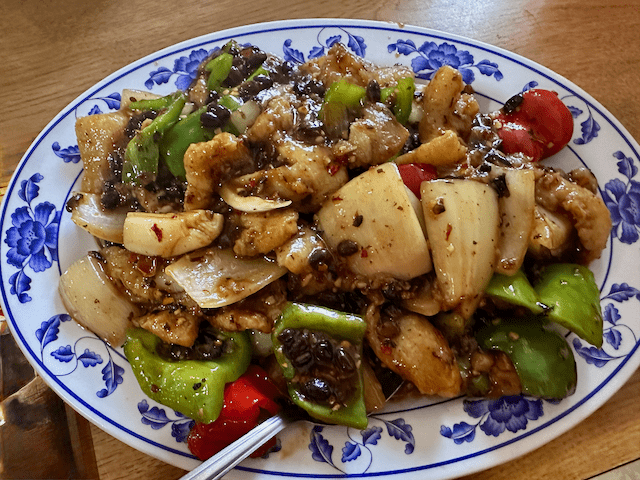
Black socks and sandals, mixing plaids and polka dots, middle-aged men wearing trousers up to their nipples, T-shirts that accentuate the “spare tire” look, fat guys wearing culottes… If there’s a fashion faux-pas out there, you can bet some of us XY-chromosome-enabled fashion Luddites have committed it and then some. When it comes to fashion, many of us are as clueless as a pirate wearing two eye patches. There is, however, one fashion statement we won’t make. Among the six to seven shirts hanging (wrinkles and all) in our closets, none will be the color pink. Nor will they be salmon, carnation, rose, Amaranth or any other shade of pink fashionistas invented in an effort to get us to wear pink. For men, the only pink thing that’s really cool (despite what we tell our wives and girlfriends about their pink “unmentionables”) is the Pink Panther. You know, the Pink Panther…the “one and only, truly original, Panther-pink (panther) from head to toe.” Men have a very special affinity for the “rinky-dink” Pink Panther. “He really is a groovy cat and what a gentleman, a scholar, what an acrobat!” He’s everything we want to be, but aren’t cool enough to pull…

Delicias Cafe – Albuquerque, New Mexico

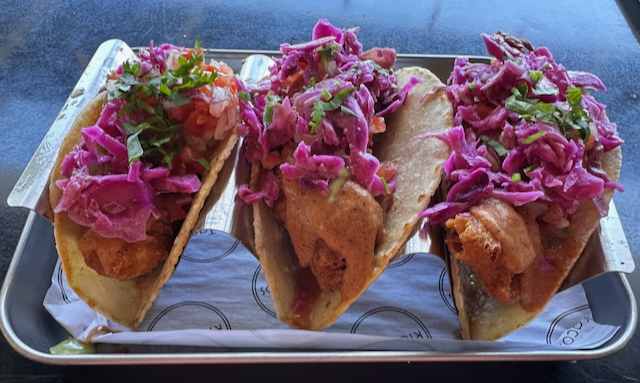
There’s no denying the ever-increasing popularity of Mexican food across America, but it may surprise you to learn that in the estimation of some sources, it has supplanted Italian food as the favorite ethnic cuisine in the land. Marketplace, a nationally syndicated business oriented radio program with more than nine-million listeners a week, says there’s no bones about it, calling Mexican food “the most popular ethnic food in the U.S., bigger than Italian or Chinese.” Askmen.com confirms only that “Mexican has become one of the three most popular cuisines in the U.S., with nearly 90% of the total population having tasted it.” According to Marketplace, there are some 90,000 or so Mexican restaurants across the fruited plain. The loose categorization of “Mexican restaurants” not only includes our incomparable New Mexican cuisine and our neighboring state’s Tex-Mex, but such “Americanized” chains as Chipotle, Taco Bell and others of the ilk. Lest you become agitated that such Mexican “in name only” restaurants would be thrown in along with the authentic Mexican restaurants, the truth is that even among restaurants owned and operated by Mexican immigrants you’ll find pretenders serving less than authentic Mexican cuisine. Sometimes they do so to remain competitive in…

That’s My Rez Sandwich – Rio Rancho, New Mexico

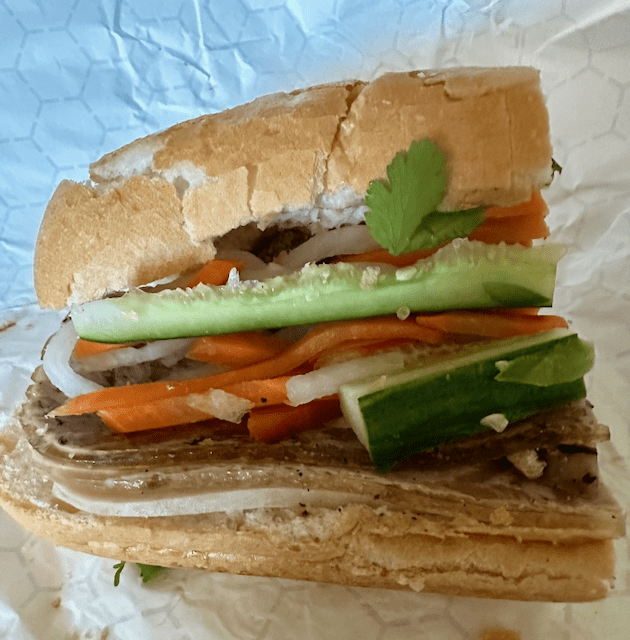
Has life on the rez suddenly become mainstream? Increased exposure certainly seems to indicate that may be the case. In 2023, the novel Rez Ball received prestigious literary recognition, including the American Indian Youth Literature Award.  PowWows.com described the novel as “rooted in the reservations, Rez Ball is a fast-paced and fiercely competitive form of basketball that showcases the spirit of Indigenous identity. Its aggressive defense and quick transitions reflect the strength and pride of Native American players, making it a powerful expression of culture.” In 2024, the subsequent movie, also titled Rez Ball, also earned accolades. Centered in New Mexico, the movie follow the Chuska Warriors, a Navajo high school basketball team, as they overcome personal challenges in pursuit of a state championship. “Without Reservations,” a popular daily comic strip by Santo Domingo artist Ricardo Caté has been featured in the Santa Fe New Mexican and Taos News since 2006. It’s the only Native American cartoon in a mainstream newspaper, using humor and satire to highlight Indigenous life, culture, and issues. Caté has been creating six cartoons a week, teaching, revealing and explaining the Native American experience to people one panel at a time.  Caté’s impact goes beyond the…

Dulce River Bakery & Coffee – Rio Rancho, New Mexico

“Siblings in an ancient tradition Who take time, temperature and love And bring them together To make something that brings people together. You make more than just food You make friendships. You make joy.” ~Thank You Bakers According to legend, the city of Vienna, Austria has bakers to thank for its existence.  Those legends have it that in 1683, Vienna was under siege by over a hundred thousand Ottoman Turks. After months of trying to starve the city into submission, the Turks attempted to tunnel underneath the walls of the city. Fortunately for the “City o Dreams,” some bakers hard at work in the middle of the night heard the sounds of the Turks digging and alerted the city’s defenders. This advance warning gave the defenders enough time to do something about the tunnel before it was completed. Just in time, King John III of Poland arrived at the head of an army that defeated the Turks and forced them to retreat. To celebrate the end of the siege and the part they had in repelling the Turks, several bakers in Vienna made a pastry in the shape of the crescents they had seen on the battle standards of the…

Rudy’s Country Store & Barbecue – Albuquerque, New Mexico

In 1983, country crooner Ed Bruce released a song titled “My First Taste of Texas,” the first line of which was “My first taste of Texas was her blue eyes and golden hair.” Some ten years later, I experienced my first taste of great Texas barbecue when visiting Rudy’s Country Store & Barbecue in Leon Springs, Texas, a San Antonio suburb on the fringes of the magnificent Texas Hill Country. At the time Rudy’s was just beginning to make inroads toward becoming a significant barbecue presence in Texas where beef and brisket are king. Back then Leon Springs appeared to be a test ground for new restaurant concepts–and in fact, it is the site of the first Romano’s Macaroni Grill and the first Rudy’s Country Store & Bar-B-Q (as well as a concept called Nacho Mama’s which might have been the best of the lot.) Before it was Rudy’s Country Store & Bar-B-Q, however, it was just Rudy’s Country Store. The country store was opened in 1929 by Rudolph “Rudy” Aue, the son of the founder of Leon Springs. The country store included a gas station, garage and grocery store. In 1989, Rudy’s added Bar-B-Q to its country store’s name.…

El Guero Canelo – Tucson, Arizona

If asked to participate in a word association exercise, any well-traveled foodie undergoing psychoanalysis would find it easy to name the first food that comes to mind when a city is mentioned: Philadelphia – the Philly cheesesteak sandwich; Boston – baked beans; Chicago – Italian beef sandwiches; San Francisco – sourdough bread; Milwaukee – butter burgers; San Antonio, New Mexico – green chile cheeseburgers.  You get the point.  Some foodies might not know that Philadelphia is the birthplace of liberty, but they know about Geno’s and Pat’s King of Steaks and their decades-long battle for Philly cheesesteak supremacy. You might find it strange that seemingly pedestrian foods would be the defining cuisine of burgeoning cosmopolitan cities, historically significant metropolises and tiny hamlets in the desert, but it’s not solely foodies who associate foods with places. Anthropologist Maribel Alvarez of the University of Arizona says the “quintessential food of Tucson” is the Sonoran hot dog, explaining that instead of taking guests to high-end restaurants, locals will bring their out-of-towners to one of the city’s purveyors of Sonoran hot dogs. Hot dogs, like baseball and barbecue, aren’t exclusively the domain of Americans any more.  In fact, they never were. Before you call…

Mick’s Chile Fix – Albuquerque, New Mexico

Addicts are all too familiar with the symptoms, especially the insatiable cravings that can only be quelled by a fix. There’s nothing like the high you get from the addictive mistress that is New Mexican chile. That’s why we willingly singe our tongues and scald our taste buds to get that fix. What gives chile its intense fire and creates the need for a fix is a chemical called capsaicin, a natural ingredient that stimulates the mouth’s nerve endings, causing a burning sensation. In response to this burning sensation, the brain releases endorphins, natural painkillers that may produce a temporary “high.” So, the more of a fiery chile you eat, the stronger the soothing effect. Even though chile isn’t medically addictive, some chile lovers may be hooked on the high they get…just ask anyone in New Mexico who loves the stuff. Better still, ask a chile addict who no longer lives in New Mexico and can’t get the stuff everyday. The withdrawal is painful. In dreams they are plagued by the unrequited yearning which can be fulfilled only by a satisfying bowl of red or green. They wake to drool soaked and chewed up pillows. New Mexicans are fortunate indeed…

Pho Nho – Albuquerque, New Mexico

Foodies are a passionate–some would say even snobbish–lot. The most passionate among them are sticklers for authenticity and provenance of ingredients and preparation methods.  The plebeian among us who don’t know quite as much had better not represent inaccuracies as truths (much as politicians do) or even use culinary terms incorrectly lest we be excoriated.  Tieghan Gerard, a well-intentioned blogger, learned just how passionate savvy foodies can be. Tieghan, the creator of the popular food blog Half Baked Harvest found herself in hot water when she had the audacity to misrepresent a quick noodle soup recipe. More specifically, she dubbed her recipe “chicken pho,” a faux pas on may levels and for many reasons.  Readers were quick to point out the recipe was NOT pho, a dish that should never be prepared quickly.  Strictly speaking, they pointed out, pho is a soup made with beef (although increasingly chicken and vegetarian versions are being made).  Several steps in the recipe (such as caramelizing the chicken) would never be done in a traditional pho recipe.  For the most woke among her  readers, Tieghan’s most grievous mortal sin was in calling her soup “pho,” an unforgivable misappropriation of Vietnam’s most popular and famous…

Señor Murphy Candymaker – Santa Fe, New Mexico

There’s an ancient New Mexican cuento one of the Land of Enchantment’s most sacred traditions.  The cuento recalls a Texan and his family driving through one of New Mexico’s piñon-studded forests.  Seeing New Mexican families kneeling under piñon trees, he  commented about how devout New Mexicans are.  What he perceived as New Mexicans kneeling in prayer was actually New Mexicans kneeling on the ground to pick piñon.   All across Northern New Mexico, piñon pickers can be seen on their hands and knees, taking part in a tradition spanning generations.  It’s a laborious activity that brings entire families together. In the Land of Enchantment, piñon is as valuable as gold if not more, particularly in recent years when drought conditions have ravaged acres of piñon forests.  Piñon trees produce good harvests every two to seven years or so with the best bounties being found at elevations between six and eight thousand feet.  The roasted flavor of good piñon is intense–sweet with a subtle hint of pine that will transport your mind and taste buds to New Mexico’s pine forests.  The rewards of a family’s efforts and the soreness of kneeling on the ground all day long are tiny nuts which will…

Chopstix – Albuquerque, New Mexico

And I find chopsticks frankly distressing. Am I alone in thinking it odd that a people ingenious enough to invent paper, gunpowder, kites and any number of other useful objects, and who have a noble history extending back 3,000 years haven’t yet worked out that a pair of knitting needles is no way to capture food? ~Bill Bryson The precise date in which chopsticks were first used has been lost in time. Archaeological evidence found in burial plots indicates they are at least 3,200 years old though some scholars believe they’ve been around even longer than that. Even the evolution of chopsticks is in debate. Some surmise that chopsticks evolved from the practice of using wooden sticks to stir food as it cooked on large pots over an open fire. Others believe that hasty eaters broke twigs from trees to retrieve food as it cooked. Whenever their origin and whatever its genesis, chopsticks have, for thousands of years, been the main tableware of the Chinese. By the Fifth Century A.D., the use of chopsticks had even spread from China to present day Japan, Korea and Vietnam. The dualistic philosophies of Yin Yang that seek universal balance and harmony even posit…

Hello Deli – Albuquerque, New Mexico

HELLO DELI (to the tune of Hello Dolly) “Hello Deli, this is Joe, Deli would you please send up a nice corned beef on rye. A box of RITZ, Deli and some Schlitz, Deli Some chopped liver and a sliver of your, apple pie. Turkey Legs, Deli hard boiled eggs, Deli and a plate of those potatoes you french fry, oh Don’t be late, Deli I just can’t wait Deli, Deli without breakfast, I’d just die.” ~ Frank Jacobs (Writer for MAD Magazine) In 2016, BBC Travel lamented the imminent demise of the New York City deli.  “Not the corner markets or bodegas that appear on nearly every New York block,” but “the true New York City delicatessen: the brick and mortar expression of the American immigrant experience, the very culinary soul of the city. “Some 80 years ago, New York City was home to three or four thousand delis. Today, there are less than 24.”  That true New York City delicatessen of which BBC Travel wrote showcased “the food of the Eastern European peasantry – smoked sausages and cured meats, smoked cabbage and offal stews and dark bread, salted fish and boiled dumplings.”  The primary draw to the New York…