Taos Pizza Out Back – Taos, New Mexico

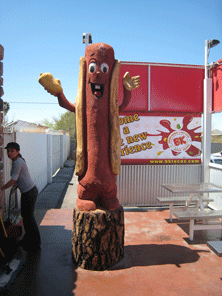
“Come to Me, all who are weary and heavy-laden, and I will give you rest.” – Matthew 11:28 It’s unlikely the Taos Chamber of Commerce ever used that New Testament passage to lure visitors to Taos, but it would have made an excellent tourism slogan.  Taos, New Mexico seems to have a mollifying effect on weary souls.  It has been easing burdens and removing the yoke of the heavily laden for more than a millennium. Taos calls its visitors to spiritual odysseys, to commune with incomparable beauty and serenity, to imbibe the exotic melting pot of cultures.  It has inspired dazzling creativity and intoxicated legendary artists such as D.H. Lawrence, Georgia O’Keefe, Mabel Dodge Luhan and Willa Cather. Some have, in fact, described Taos as being more a state of mind than it is a location.  That state of mind would be a little unconventional–relaxed and informal with a “live and let live” element.  It’s that element which has made Taos a haven for counter-culture, an accepting habitat for hippies.  Taos does not follow the normal rules of society.  It is Bohemian in every respect. You’ll experience that Bohemian spirit as you turn off Paseo del Pueblo onto a gravel…

Bravo! Cucina Italiana – Albuquerque, New Mexico

Perhaps the most memorable slogan to surface during the politics “dirtier than usual” Presidential campaign of 2008 was the frequently used American idiom “you can put lipstick on a pig, but it’s still a pig.” That expression is intended to mean something akin to putting a fresh coat of paint on a piece of junk and selling it for full price. In other words, it aptly describes most political campaigns which tend to be exhaustingly negative repeats of previous campaigns. I promised myself not to ever let my blog slink and slither into the unappetizing muck and mire of politics and with the exception of the previous paragraph, I won’t. The expression “you can put lipstick on a pig, but it’s still a pig” ties in nicely with my inaugural visit to Bravo! Cucina Italiana. “How so,” you ask. It’s been my experience that you can adorn Italian themed chain restaurants with a pristine veneer and over-the-top flamboyance, but they’re still chains in all their homogeneous fungibility. For the most part, that’s come to mean a stereotypically Italian (Tuscan is a current favorite) ambiance complete with faux artifacts and cheesy murals designed to appear priceless and genuine. So that the…

Bouchon – Las Vegas, Nevada

Thomas Keller is the owner and chef of one of the world’s most highly acclaimed and famous restaurants, but despite all the accolades and honors the French Laundry has garnered over the years, he isn’t nearly as famous or popular as his celebrity protégés. One protégé is a provincial rat named Remy whose aspirations to become a great chef despite a lack of formal culinary training mirror Keller’s own path.  Remy’s focus and fastidious attention to detail are known to be patterned after Keller.  To make the restaurant scenes as realistic as possible, the film’s producer interned in the French Laundry kitchen.  Other members of the film’s creative braintrust studied at length to channel the master’s style and passion.   Keller served as the key consultant for all cooking done in the movie, hence the authenticity. Keller was also the creative genius behind the “world’s greatest sandwich” as prepared by another celebrity protégé, Adam Sandler in the film Spanglish.  The sandwich is an embellishment of the BLT, but the way Keller taught Sandler to prepare it, it is far from a pedestrian BLT.  It would seem that Keller is a celebrity chef behind the celebrities, but it might be more accurate…

Ping Pang Pong – Las Vegas, Nevada

The complaint I hear most often about the Duke City dining scene is that we have a lamentable lack of quality Chinese restaurants. This is a sentiment that’s been echoed ad-infinitum on Chowhound and other restaurant blogs. In my years of reviewing Duke City restaurants, I’ve deemed only nine Chinese restaurants worthy of taking up space on my Web site. Considering Chinese restaurants outnumber those of any ethnicity other than New Mexican, that’s not a good sign. I’ve tried dozens of Chinese restaurants in New Mexico (and continue to try them in hopes of finding a rare hidden gem), but only a few have the qualities I like in Chinese restaurants. Fewer still are those which execute consistently from visit to visit. Now, it would be easy (and fun) to wax mean about the things I didn’t like about each of those Chinese restaurants–and it might even be a service to my readers, but that negativity could be summed up in a few points. What I dislike most about Chinese restaurants–not just in New Mexico–is their homogeneity–the boring, stereotypical “sameness” that seems to typify each restaurant. It’s as if a sole template was created that defines how each Chinese restaurant…

Sushi King – Albuquerque, New Mexico

Two roads diverged in a wood, and I– I took the one less traveled by, And that has made all the difference. – Robert Frost The path to becoming a sushi aficionado is, in some ways, an assertion of individualism. You might also consider it an expression in audacity. Sushi, as most of us know, is not for everyone. Even the decision to try it the first time can be daunting. Some otherwise intrepid diners will never even get that far, the notion of consuming “raw fish” being too extreme for them. Some will take the safe path and partake primarily or exclusively of “cooked” sushi, grilled fish enrobed in tempura batter and served warm. Others, like my friend Maui Brian, take almost masochistic pleasure in dousing their sushi with wasabi incendiary enough to stream tears down their cheeks and leave them coughing and sputtering at every bite. Still, others like Duke City Food’s adventurous blogger Andrea Lin are absolutely fearless, delighting in sampling sushi only the most broad-minded sushiphiles can appreciate. Think uni, the edible part of the sea urchin, a spiny echinoderm. I also know sushi lovers who are base traditionalists. They shutter at the “spurious” nature of…

Osteria d’Assisi – Santa Fe, New Mexico

Historians have characterized the discovery, exploration, and colonization of the Americas in the late fifteenth and sixteenth centuries as having had three express purposes: glory, gold and God. This holds true in New Mexico where Spanish Explorers may have come for glory and gold, but finding neither, stayed for God.  Believing the large population of native peoples needed to hear the Gospel, the Spaniards established New Mexico first as a colony then as a mission. The effort to Christianize the native peoples was led by Franciscans, known then as the Sons of St. Francis of Assisi.  The sandal-shod Franciscans carried the Gospel throughout the Indian pueblos, indelibly imprinting Franciscan spirituality into the fabric and soul of New Mexico’s Catholicism. Evidence of their spirituality remains in the large population of Roman Catholics in New Mexico today, but also in the names given to villages throughout the state. One example is La Villa Real de la Santa Fe de San Francisco, translated from Spanish to The Royal Village of the Holy Faith of Saint Francis of Assisi, shortened to Santa Fe. In addition to being the patron saint of Santa Fe, Saint Francis is the patron saint of animals, birds and the…

Blue Heron Restaurant at Sunrise Springs – La Cienega, New Mexico

Fewer than ten miles separate the historic Spanish village of La Ciénega from Santa Fe, and though both have largely retained vestiges of their storied and proud histories, the differences that set them apart are as vast as El Camino Real, the Royal Road that has connected them for centuries. While Santa Fe has entered the 21st century as a burgeoning cosmopolitan city, La >Ciénega remains a rural enclave, parts of which have remained unchanged for generations–that despite becoming somewhat of a bedroom community for Santa Feans. Once a rural Indian pueblo outpost, La Ciénega  was abandoned in the seventeenth century only to be resettled by the Spanish after Don Diego de Vargas’ celebrated reconquest of New Mexico. During the second Spanish colonial period (1692-1821), haciendas and ranchos dotted the Rio Grande valley.  Dons (landlords) and their peones (workers) cultivated the fertile alluvial soils, raised livestock and tended orchards of fruit.  Hard work was a way of life.  It had to be! Ranchos HAD to be self-sufficient.  The tremendous distance from Mexico City coupled with the laborious and perilous 2,000-mile trek made visits from supply caravans infrequent.  Even when they did arrive, rarely did they transport the necessities of daily…

315 Restaurant & Wine Bar – Santa Fe, New Mexico

>Compared to the extraordinarily perceptive 19th-century detective Sherlock Holmes, his best friend and confidante Dr. John H. Watson was an ordinary man, a perfect “foil” for the brilliant Holmes. Though lacking his friend’s deductive abilities and almost prescient ability to solve problems, Dr. Watson was, however, prone to occasional observations of brilliance and statements of profound eloquence. For example, in the 2004 novel Sherlock Holmes and the Hapsburg Tiara, Dr. Watson describes a three-hour French meal: “Each dish was more fantastical than the last. One can only conclude that it is the special purpose of French cookery to dissolve the entire substance of a dish into polish, so that no trace of the primeval beef, pork, or chicken remains, converting the whole into a sort of puree raisonne that can then be shaped and reshaped by an abstract and extravagant fancy far closer to architecture than cookery, a fancy whose sole intent is to remove from its creations all taint of the hearth and kitchen, not to mention pasture and field.” Juxtaposed against the fluidity and clarity of Watson’s vivid appreciation for his meal, my review of 315 Restaurant & Wine Bar (formerly known as Bistro 315) may seem provincial…

El Tovar – Grand Canyon National Park, Arizona

When Spanish explorer García López de Cárdenas first laid eyes on the Grand Canyon, surely his reaction wasn’t “it’s just a great big hole in the ground.” That was the reaction of a friend of mine, who much like other modern Americans is so caught up in the trappings of pop culture and “technolust” that he’s lost the ability to be impressed by what it has taken nature millions of years to produce. It took some six million years for the Colorado River to create the multi-hued, steep-sided gorge that is today considered one of the natural wonders of the world.  The incomparable magnitude of the Colorado River’s handiwork certainly wasn’t lost on the Fred Harvey Company, the West’s most prolific hospitality providers during the great era of the Atchison, Topeka and Santa Fe Railway (ATSF). In 1905, the Fred Harvey Company opened El Tovar Hotel a mere 30 yards from the south rim of the Grand Canyon.  Today, the hotel remains the premier lodging facility at the Grand Canyon, having been most recently renovated in 2005.  It is at the northern terminus of the Grand Canyon Railway, formerly a branch of the ATSF. El Tovar is elegant and charming,…

Puerto Peñasco – Santa Fe, New Mexico

Mexico’s Sea of Cortez has been likened to an enormous net for its capacity to support more marine life than any other body of water on Earth.  Over 3,000 marine species, including more than 900 species of fish, call its azure waters home.  The bounties of the Sea of Cortez sustained the indigenous tribes of pre-Colombian times and today delight aficionados of mariscos with delicious oysters, clams, scallops and shrimp.  It’s no wonder the Mexican Coast is a favorite destination  of seafood lovers throughout the world. Situated on the edge of a rocky promontory in the Sea of Cortez is the aptly named Puerto Peñasco which translates in English to Rocky Point.  In recent years, the humble fishing village of Puerto Peñasco has burgeoned into a popular beach resort favored by Arizonans.  It’s only a four and a half hour drive from Phoenix to this mushrooming marine resort. Puerto Peñasco offers miles of pristine white sand in beaches strewn with millions of tiny shells.  It embraces its visitors in warm waters and gives them respite in comfortable accommodations. This seaside resort is renown for beautifully plated and fresh mariscos which literally go directly from the nearby sea to the kitchen…

Mariscos La Playa – Espanola, New Mexico

Even though it seems most women celebrate it every year in perpetuity, a woman’s 29th birthday actually occurs only once. On my mom’s umpteenth 29th birthday we wanted everything to be perfect so we took her to her favorite mariscos restaurant for a fabulous meal of Mexican seafood served impeccably. We baked her favorite cake, a rich, moist carrot cake with homemade frosting. We had the restaurant play her favorite birthday songs–Las Mananitas (a stirring rendition by Vicente Fernandez whose soulful voice plumbs the depths of the emotional scale) and Mananitas Tapatias by Pedro Infante (the undisputed greatest idol in Mexican cinematic history). Knowing what a great sport she is, we even asked the wait staff fete her with flan and photograph her in one of those colorful sombreros. There was only one problem. When the wait staff came to our table bearing celebratory accoutrements, my mom had just stepped away to the restroom. There we were–music blaring, wait staff in tow and no guest of honor. We had to do the whole thing all over again minutes later. Mariscos La Playa is the perfect restaurant for a birthday celebration. Moreover, it’s the perfect restaurant for a great meal. There…