La Sirenita – Albuquerque, New Mexico (CLOSED)

Our friends, John Martin and Lynn Garner and I couldn’t help but laugh. There before our very eyes was the depiction of a meme come to life. In the dining room of la Sirenita was a papier Mâché reproduction of the bottom half of a mermaid. It reminded us of a meme we recently shared.  That meme depicted a grizzled sailor marooned on a desert island.  On the first panel of the meme the sailor smiled lasciviously as a beautiful and buxom mermaid approached the island.  The second panel shows the sailor cooking the bottom half of the mermaid on a rotisserie.  Yeah, it’s gruesome, but come on, it’s funny, too. The bottom half of a mermaid wasn’t the only unique art on La Sirenita’s walls.  One framed painting depicted a rather disfigured Marilyn Monroe.  Another portrayed a black woman in the throes of a foodgasm.  More conspicuous than the artwork was the absence of other diners.  While the bar was packed, the only other diners in the capacious dining room were two eight-year old brothers, one of whom innocently asked if The Dude was a poodle.  Though our debonair dachshund was insulted (rightfully so), he has too much class…

Poké Serrano Asian-Latin Fusion – Rio Rancho, New Mexico (CLOSED)

Ask most people what comes to mind when they think about Hawaiian food and the likely answer is Spam®.  No matter how much the Aloha State’s tourism department does to showcase the state’s diverse and exciting culinary culture, the stereotype that Hawaiians eat Spam® for breakfast, lunch, dinner and snacks in between meals is engrained in many of us.  Because Hawaiians do consume seven-million cans of  Spam® per year (with a population of 1.42 million residents in the Islands), it begs the question “Is it really a stereotype if facts bear out the fact that Spam® is so immensely popular in Hawaii.” Not everyone who spends time on the sandy beaches is as svelte as portrayed by media.  Widespread obesity plagues the Islands.  Some of that may be attributable to the quintessential canned ham product proudly made in Minnesota, a processed food  replete with salt and other “bad for you” things. Spam® became a vital part of the Hawaiian diet during World War II when rationing was a fat of life for its citizenry.  Hawiians figured out how to incorporate Spam® into their diet and figured out it’s a pretty versatile product.  Note: If you’re from Northern New Mexico and…

Cocina Chiwas – Tempe, Arizona

Chef Armando Hernandez is my new hero.  In an interview with the Phoenix New Times, he was asked about “authentic Mexican cuisine.”  His retort was scathingly brilliant: “It’s very difficult for me to have these conversations, especially among our own people, about what’s considered authentic.  “They’ll be like, ‘Well, my Grandma-’ and I’m like, yeah, I’m not your Grandma though.”  Those of us who grew up in the Land of Enchantment when our distinctive cuisine was widely labeled “Mexican” remain somewhat in the dark about differences between New Mexican cuisine and that of our Southern neighbor.   It was only rather recently that cognoscenti determined New Mexican cuisine is different enough from Mexico’s to warrant its own label–New Mexican. Perhaps because of the mislabeling, commonly held misperceptions persist as to what constitutes Mexican food. Most New Mexicans insist virtually every one of our sacrosanct dishes has to include red and (or) green chile.  That brownish-red stuff Mexican restaurants serve doesn’t look or taste like the “real stuff” that comes from Hatch, Chimayo, Deming, Lemitar and other communities whose sacred earth bestows its blessings on us every autumn.  New Mexicans tend not to know what mole is.  Chile that’s gone bad?…

Burger Bro’s – Albuquerque, New Mexico

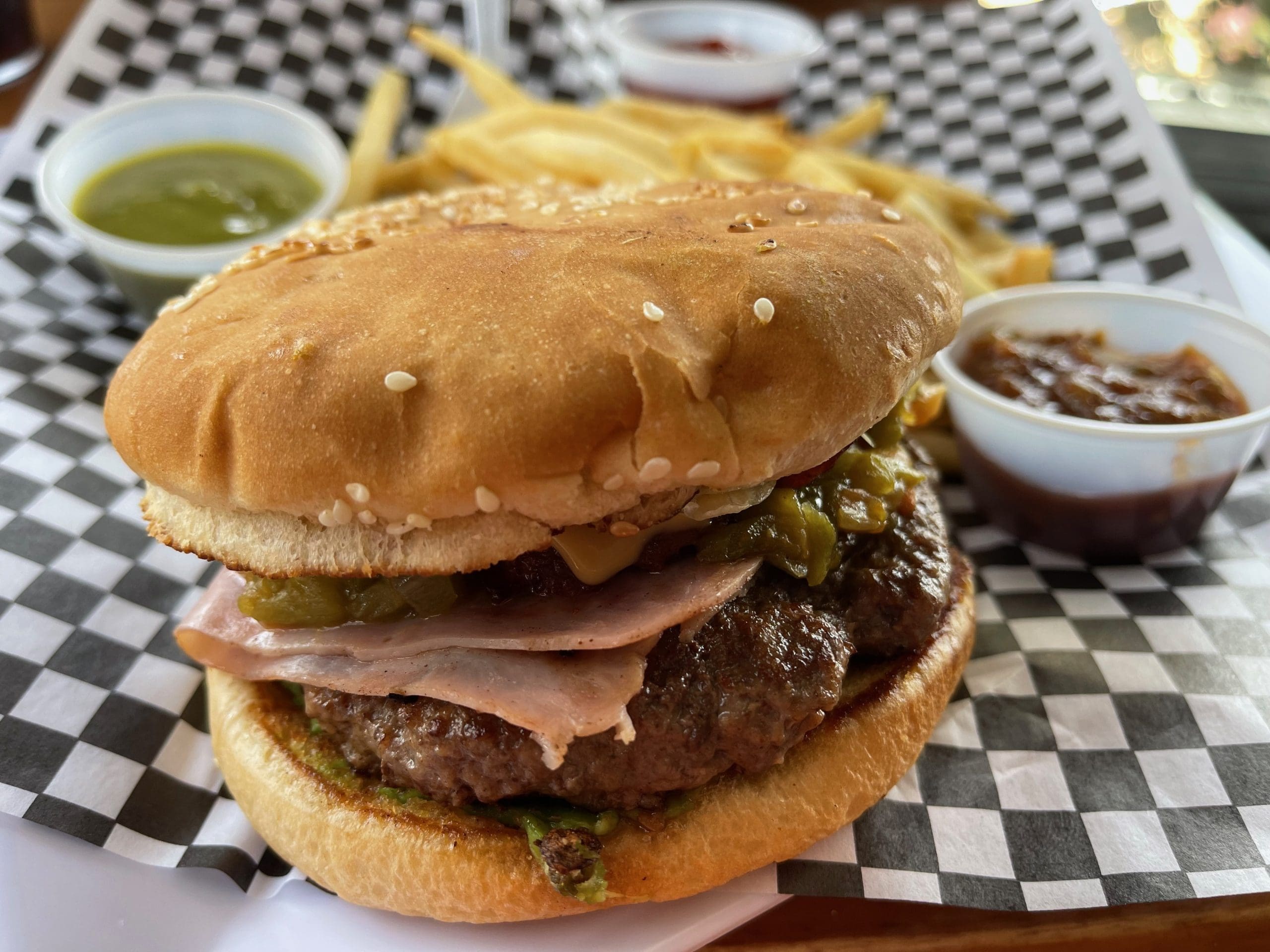
Such advanced human traits as complex symbolic expression, art as an aesthetic visual form and elaborate cultural diversity emerged mainly during the past 100,000 years or so.  That’s more than four-million years after humans gained the ability to walk on two legs. By comparison, the ubiquitous All-American burger has evolved in the blink of time.  Most culinary historians believe the burger as we know it today was invented somewhere between 1885 and 1904. Even most of us who have lived three or more decades have seen significant changes in the burger.  Many of those changes have occurred during the 21st century–the last twenty years or so. Think about it.  For the most part, the predominant burger many “seasoned” eaters across the fruited plain enjoyed until recent years was relatively unadorned save for the burger’s essential and defining elements: a soft, toasted bun (sesame seed buns were popularized by the Golden Arches in the 60s); sweet, vine-ripened tomatoes; crisp, cool, crispy lettuce; a smear of pungent yellow mustard; maybe some chopped white onions and in the middle of it all, a juicy, seasoned all-beef patty.  To be sure, additional ingredients–cheese in the 1920s or 1930s and in New Mexico, green chile in the 1940s–eventually…

Los 6 Hermanos – Bernalillo, New Mexico

Once upon a time (how many of you remember when seemingly all ancient fables and stories began with these four words?) there was a family of six Chinese brothers, each with a unique and amazing power. One of the brothers committed an infraction against Chinese law and was sentenced to death by the emperor. By asking for one last night at home the brothers were able to take each others place and thwart the king’s executioner’s attempt to kill them.  Eventually the executioner ran out of ways to run the execution and had to call it off. There are no cuentos or corridos, sagas or stories in Mexico involving six siblings imbued with exceptional abilities.  In fact, just about the most remarkable fact about “seis hermanos” is the number of small villages in the Land of Montezuma with that name.  On 23 February 2019, 6 Hermanos Fresh Mexican Kitchen opened its doors on Camino Del Pueblo in Bernalillo.  Not surprisingly, the restaurant is named for a family of six brothers who share ownership and cooking duties.  It’s not just another Mexican restaurant.  There are more than six reasons it’s a special place. One of the more than six reasons this…

The Skillet – Las Vegas, New Mexico

A man comes home after a long day.  His wife then hits him in the back of the head with a frying pan.  He clutches his head in pain asking her, “Honey why? Why did you do that?” She answers, “When I was doing your laundry I found a receipt in your pocket with a woman’s name on it.” He responds, “That’s why you hit me? Honey, Mary-Ann is a horse I bet on.  That’s the receipt for my bet.” She accepts that and apologizes and they make up.  Next week the same thing happens. He comes home and is struck in the back of his head with a frying pan. The husband asks, “AGAIN? You hit me in the head with a frying pan again, why?!”  The wife looks at him and says, “Your horse called.” Believe it or not, in the 50s and 60s (long before my time), wives bashing their husbands on their heads with frying pans passed for humor.  Banner Graphic confirms this gallows humor trend: “The image of an angry woman hitting her uncooperative husband over the head with a frying pan is usually a cartoonishly laughing matter.  After all, it’s a staple of comic…

Tio’s Kitchen – Bernalillo, New Mexico

I may not have much respect for the national media or for politicians, but I sure do respect the elderly (unless they’re members of the media or politicians).  My parents engendered among their six children, respect for our elders.  None of us would ever consider addressing an elder by their first name.  We would never use the pronoun “tu” (you) when speaking with someone older than us.  We always use “usted,” also a Spanish term for “you,” but used in a formal manner for people we respect and always for our elders.  We were raised with the type of respect for seniors that is practiced in India, Thailand, Somalia, Indonesia and other nations who venerate their elderly.   Being raised in Peñasco (which is within the confines of the Picuris Pueblo reservation), we witnessed respect for seniors quite often. Similar to the aforementioned nations, many Native American cultures across the fruited plain are exemplars in how to treat their elders.  In the Lakota culture, grandfathers are viewed as “the elders of the tribe and in many ways personify the sacredness of the goodness and wisdom of the Great Spirit. Grandfathers carry the spirit of the people. Grandmothers are even more…

Zacatlán – Santa Fe, New Mexico

As a naive and impressionable child with a vivid imagination, my most frightening weekly ordeal was walking home from Catechism, especially when teachings centered around the devil and his demons. For some reason we weren’t taught about a loving God. Instead it was drilled into us that if we’re not “good” we’d go to Hell.  Strangely such concepts as forgiveness and goodness were described rather abstractly while the devil (undoubtedly a progenitor of today’s elected officials) and sin were made real enough to traumatize us all.  The devil was everywhere waiting to ensnare us into sin and drag us (wailing and gnashing our teeth) into Hell. Walking home at twilight after another fire and brimstone lesson made me long for the safety and security of home.  It made me quite unhappy that Adam and Eve were expelled from Eden for disobeying God.  Eden is described in Genesis as “the garden of God.”  Our Catechism teachers taught us Eden was a peaceful place in which we were all intended to live contented and innocent lives.  Unfortunately, rather than focus on the beauty and serenity of Eden, we were petrified by descriptions of the serpent who tempted Eve to partake of the…

¡Ay Mi Mexico! – Albuquerque, New Mexico

One syllable, one word, one simple expression…yet there probably is no more expressive interjection,  heart-rending cry or honest exclamation in the Spanish language than the simple word “Ay.” This–one of the most  diminutive among all words–can say and mean so much.  Depending on the context, “Ay” is used to express such emotions as: <happiness: think “¡Ay, Chihuahua” when Despicable Me patriarch Gru espies a black villain suit he covets; surprise: ¡Ay, Cabron! what are you doing home in the middle of the day?; exasperation: ¡Ay, Que Lastima! <pain or dismay: Bart Simpson’s ¡Ay, caramba!” when he saw his parents having sex. The versatility of “ay” is virtually unparalleled (though you can usually tell what meaning or mood a speaker is ascribing to that oh, so simple and powerful expression). Informally, “ay” may preface other words in place of curse words in order to make a phrase sound less harsh.  In essence “¡Ay, caramba!” and “¡Ay, Chihuahua!” are Mexican equivalents of “oh, shoot,” “darn” or “shucks.”  Perhaps the most famous use of the term is in the immortal Mexican song Cielito Lindo whose refrain exhorts “Ay, ay, ay, ay, canta y no llores.”  Some English dictionaries translate this as “oh, oh,…

CubaMex – Albuquerque, New Mexico

Because Columbus sailed the ocean blue in 1492 and a succession of Spanish explorers followed suit, you might expect that Spanish cuisine would have proliferated across the new world.  Instead, Spanish discoveries included indigenous cooking techniques and ingredients that forever altered the way scions of Spain ate. At the time of conquest, the European diet was principally comprised of bread, olive oil, olives, “meat,” and wine.   The “new world”–Mexico in particular–was rich, fecund, and replete with such crops such as beans, pumpkins, chilies, avocados, tomatoes, cocoa, cotton, tobacco, corn, and cassava, foods that could not be found in Mother Spain. All the territories explored and conquered by the Spaniards had their own bounty of unique and delicious culinary offerings.  Because traditional Spanish foods were an ocean away, it made sense the Spaniards would adopt indigenous foodstuff.   Many of those foods were ultimately introduced to the European continent.  It was the advent of eating not just for survival, but for pleasure.  To some extent, the vast variety of new ingredients and techniques were also shared among conquered lands.  Solely from the perspective of culinary diversity and deliciousness, it was a win-win.  The uniqueness of foods among such Spanish-held territories…

El Molcajeton – Albuquerque, New Mexico

Molcajetes have become so commonplace on many a Mexican restaurant’s decor that we sometimes forget molcajetes are the traditional Mexican version of the mortar and pestle…that they have both form and function.  As we gawk in admiration at the symmetry and fine craftsmanship of a well-made molcajete, we don’t always reflect on the fact that throughout Mexico and some parts of the Estados Unidos molcajetes are still used to crush and grind spices and to prepare guacamole, moles and salsas.  In restaurants and homes in which molcajetes are used for their intended functional purpose, the guacamole, moles and salsas created within them are said to taste better, much better. As James Beard Award-Winning Writer and Chef Patti Jinich says “A wonderful thing about molcajetes, is that since they are so porous they have a remarkable memory. They store within them, the essences, oils, smells and flavors of all that has been served or made in them. Maybe that’s why it is said that molcajetes season with time and use. Maybe that’s also why it is said that making a sauce or rub or paste in a molcajete makes it taste better.”  Patti’s theory has credibility.  The rough surface of molcajetes…