Blog

Rancher’s Club of New Mexico – Albuquerque, New Mexico

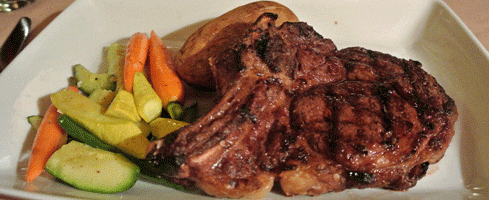
While the Ranchers Club of New Mexico may evoke images of J. R. Ewing holding court with fellow oil barons and business magnates in Dallas, this magnificent milieu is, at its core and essence, unabashedly New Mexican in its attitude and spirit. Don’t let its ostentatious trappings–a sophisticated big city opulence meets a decidedly westernized look and feel–fool you. Sophisticated doesn’t mean haughty and ostentatious doesn’t mean exclusive. The Land of Mañana’s well-renowned inclusiveness means more than just the one-percenters will feel at home. It’s been that way since the Ranchers Club opened in 1985. More than half the dinner reservations made at the Ranchers Club are made by locals, not by tourists and visitors staying at the steak palace’s home, Albuquerque’s Crowne Plaza Hotel on the northeast corner of the Big I interchange. Not every diner will “put on the dogs” when they visit. In fact, blue jeans are almost as common as business casual. The dress code calls for men to wear collared shirts and prohibits beach sandals, shorts, tee-shirts and work-out clothes. How much more New Mexico can you get for a fine-dining, high-end restaurant? Inspired by the rustic elegance of ranch house comfort, the Ranchers Club…
Paco’s International Smoked Cuisine – Albuquerque, New Mexico (CLOSED)

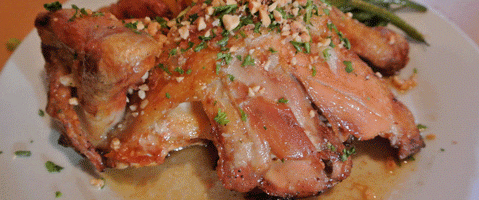
“If salt is the odorless spice, smoke is the ephemeral magical invisible spice. You can’t feel it, you can’t touch it, but you can taste it.” ~Chef Seamus Mullen, Tertulia Restaurant, New York City. Have you ever wondered why some people drool when they pass by a computer displaying a fireplace screen saver? They’re not thinking about romance. They’re thinking about barbecue. There’s just something about smoked foods that has excited humans across the millennia. It’s been that way since a lightning bolt struck a mastodon and rendered its flesh delicious. Since then humans have been genetically predisposed to crave the flavors created by the penetration of smoke. We associate fire and the fragrant bouquet of wood smoke with grilling, barbecues and mostly, eating things we love. When my friend Ryan “Break the Chain” Scott told me of an Albuquerque chef incorporating the element of smoke into virtually every ingredient of every dish he creates, my initial inclination was to think Ryan had been smoking something. It hadn’t surprised me to read in Around the World in 80 Dinners that Bill and Cheryl Jamison ate smoked zebra carpaccio in South Africa as much as it did to learn that the…

Horseman’s Haven – Santa Fe, New Mexico

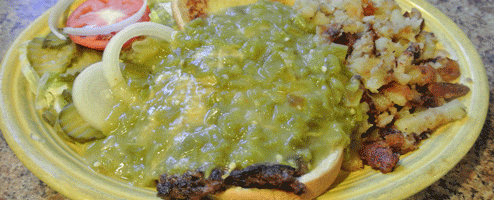
I know several native New Mexicans who have accepted the dumbing down of political office in America as a consequence of living in these times and who have shrugged apathetically at the attenuation of educational standards. These same individuals, however, become as agitated and vociferous as scalded cats when served chile that has been “Anglicized”–that is, chile which doesn’t bring sweat to their brows, tears to their eyes and blisters to their tongues. Pepper spray has nothing on chile for these capsaicin addicted masochistic diehards. I spoke with one of these chileheads several days after the January, 2006 airing of the Food Network’s “The Secret Life of Fiery Foods.” He was still laughing at the segment in which host Jim O’Connor thought he was man enough to try the green chile burrito locals call “the devil” at the world famous Horseman’s Haven in Santa Fe. One bite had O’Connor red faced and sputtering, an experience shared by many people, including many locals weaned on incendiary chile. According to O’Connor, the “devil” is the hottest burrito in the world with a chile that rivals the habanero, a pepper at the extreme level of the Scoville scale. For New Mexicans frustrated with…

Milton’s Cafe – Albuquerque, New Mexico (CLOSED)

“Where we love is home – home that our feet may leave, but not our hearts. ~Oliver Wendell Holmes You might think that a world-famous cookbook author and New York Times food writer who dines at four-star white-tablecloth restaurants and routinely drops $200 or more for a meal would be ecstatic about his culinary opportunities. Instead, Mark Bittman appears to have had too much of a good thing and longs for, of all things, a restaurant which feels like home (ostensibly without having to do the dishes). Bittman laments “I want “my” place, don’t you? A place with a working chef, not a cookie-cutter spinoff and certainly not a circus. A place where the food is at least as good as what I can do at home and preferably better, and consistently so; one that’s pleasant; one where I’m vaguely known as a repeat customer, but not falsely fawned over; one where I can pay without thinking about what that chunk of money might have gone to instead.” New Mexico’s dining options aren’t nearly as diverse and plentiful as those in New York City and my dining budget is a modicum of Bittman’s, but quite frequently I’m completely simpatico with…

The Corn Maiden – Santa Ana Pueblo, New Mexico (CLOSED)

First cultivated in Mexico around 5000 BC, corn has since been a ubiquitous staple among American Indians throughout the fruited plain. A resilient, versatile and nourishing crop also known as maize, corn allowed Indians to develop the complex social structure and village life which unfolded from the parched valleys of the southwest to the lush eastern woodlands. Along with squash and beans, corn constituted the three main agricultural crops among Indians and was considered the most sacred of all foods. Throughout the millennia, corn has been the focus of countless rituals and legends among Native Americans, all of whom associate corn with the fertility of women through a corn maiden. According to a Keresan creation story, a corn maiden named Iyatiku led human beings on a journey from underground to the surface of the Earth. To provide food for them, she planted bits of her heart in fields in each of the four directions: north, west, south and east. The pieces of her heart grew into fields of life-sustaining corn. To the people of Santa Ana, a Keresan speaking Pueblo, the corn maiden remains a revered symbol. The corn maiden symbol flanks the large wooden door to The Corn Maiden,…

Street Food Asia – Albuquerque, New Mexico (CLOSED)

What is street food? An informal poll of friends and colleagues generated some interesting answers. One colleague equates street food to road kill– the flattened fauna, car-crashed carrion and furry Frisbees found on and along the highways and byways throughout the fruited plain. (Hmmm, that answer might explain his halitosis.) To another, street food is synonymous with hot dog carts while yet another colleague answered simply “roach coaches” (a pejorative for food trucks). The most interesting answer, provided by a geriatrically advanced friend not quite contemporaneous with Charles Dickens, was “chestnuts” with which not everyone in my focus group was even acquainted. By definition, all of those answers could probably be considered at least partially correct. The term “street foods,” as defined by the Food and Agriculture Organization (FAO) of the United Nations, describes “a wide range of ready-to-eat foods and beverages sold and sometimes prepared in public places, notably streets.” The FAO further stipulates that “the final preparation of street foods occurs when the customer orders the meal which can be consumed where it is purchased or taken away.” While New Mexico, and for that matter, the United States, has a burgeoning street food culture, it pales in comparison…

El Milagro New Mexican Restaurant – Santa Fe, New Mexico

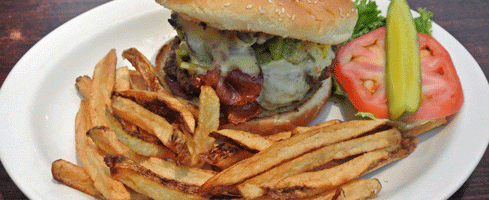
Believing “there was a void in our menu vis-a-vis the adult who wanted a higher ratio of meat to bun,” a former Vice President of product development for McDonald’s invented The Quarter Pounder in 1971. As a marketing ploy, the name Quarter Pounder quickly became a resounding success. Clever advertising campaigns convinced American consumers they were purchasing a large, beefy burger they would be challenged to finish. Had the burger been given the far less formidable christening of “Four Ouncer” we wouldn’t be talking about this McDonald’s staple forty-some years later. When it comes to burgers across the fruited plain, size does matter. Despite the caloric overachieving revelations of Supersize Me, supersized Americans seem to gravitate toward larger, meatier burgers. Burgers tipping the scales at a half-pound or more are now considered puny. In fact, according to the Centers for Disease Control, since the 1950s, the weight of the average fast-food burger has grown more than threefold, from 3.9 ounces to 12 ounces. That’s three times the size of the Quarter Pounder. The burgers at El Milagro New Mexican Restaurant in Santa Fe would kick sand in the face of the Quarter Pounder. They’re the proverbial musclebound bodybuilder to the…

The Pantry Restaurant – Santa Fe, New Mexico

“Although the skills aren’t hard to learn, finding the happiness and finding the satisfaction and finding fulfillment in continuously serving somebody else something good to eat, is what makes a really good restaurant.” In 1948, just three years removed from the second “war to end all wars” Santa Fe was hardly the sophisticated and cosmopolitan tourist haven Conde Naste Traveler magazine readers have named one of their favorite travel destinations for 21 consecutive years. With a population of around 25,000 citizens, Santa Fe’s art, cultural and architectural attractions weren’t nearly as well known as they are today, but then, the world wasn’t nearly as interconnected and small as it is today. For a bit more perspective on life in Santa Fe in 1948, consider that the state capital was yet to observe daylight savings time. 1948 was a leap year with 366 days and February 29th falling on a Sunday. The hottest day of the year was July 14th when Santa Fe hit a high temperature of 94 degrees. February 12th saw the coldest day of the year with a low temperature of -10, about 35 degrees below average for the day. Santa Fe saw 55 consecutive days with no…

Chillz Frozen Custard – Albuquerque, New Mexico (CLOSED)

“Custard: A detestable substance produced by a malevolent conspiracy of the hen, the cow, and the cook.” Ambrose Bierce, American writer (1842-1914) The Devil’s Dictionary (1906) Ambrose Bierce’s scathing definition of custard is not necessarily an expression of his disdain for the popular frozen dessert, but an example of his lampooning of American culture and especially its lexicon. Starting in 1881, the American satirist began writing The Devil’s Dictionary in which he published alternate and usually quite acerbic definitions of common words. His biting wit and sardonic views earned him the nicknames “cackling king of cynics” and “Bitter Bierce.” There are parts of the Midwest (the Milwaukee and St. Louis areas in particular) in which Bierce’s definition of custard would be considered sacrilege. Midwesterners feel so strongly about their custard, that an utterance of such blasphemy would be an occasion for a noose, a tall tree and a short drop. Their passion for frozen custard is akin to the love New Mexicans have for chile and never mind that winter temperatures throughout the Midwest can drop to near Arctic levels, custard is an year-round obsession. Just as most New Mexicans have a strong antipathy toward “chili” from Texas, Midwesterners abhor…

Terra Bistro Italiano – Albuquerque, New Mexico (CLOSED)

To some extent, people watch Anthony Bourdain for the same reasons they tune in to infamous shock-jock Howard Stern–to see what he’ll say next. Though Bourdain, the best-selling author, world traveler, renown chef and “poet of the common man” is hardly the potty-mouthed bane of the Federal Communications Commission that Stern is, his incisive comments are oft peppered with pejoratives and references to genitalia. They’re also laden with insightful, well-reasoned, highly intelligent and well articulated thoughts uncommon in the world of food television currently dominated by pretty faces with Ultra Brite smiles. In the 2010 season premier of his No Reservations show, the first words Bourdain uttered were “the optimist lives on a peninsula of infinite possibilities; the pessimist is stranded on the island of perpetual indecision.” It’s not every culinary celebrity who can quote William Arthur Ward, or even know who he is, but Bourdain is not only a fellow sybarite, he is well-read and highly intelligent. His introduction gave me pause to reflect on Ward’s words, one of my very favorite inspirational maxims. Just hours earlier, I was transformed from an eternal optimist to someone mired in indecision. What caused this transformation was nothing less than the perusal…

Chin Shan Chinese Restaurant – Albuquerque, New Mexico

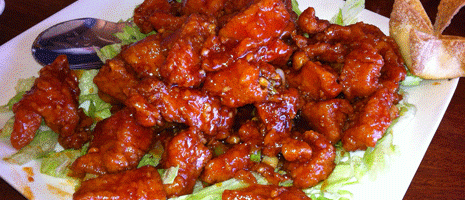
According to the trade magazine Chinese Restaurant News, as of January, 2007, there were 43,139 Chinese restaurants in the United States. That’s three times the number of McDonalds franchise units and more than the total number of McDonalds, Burger King and Wendy’s in America combined. More than 80 percent are family-owned with nation-wide chains such as Panda Express and PF Chang’s accounting for only five percent of all Chinese restaurants across the fruited plain. Raking in nearly $17 billion in annual sales, Chinese restaurants are nearly on a profitability par with the behemoth burger chain, too. Until recent years, many (if not most) Chinese restaurants specialized in inexpensive all-you-can-eat buffets, most of dubitable quality. Today, buffets are the bailiwick of behemoth supermarket-sized Chinese restaurants, some of which can accommodate hundreds of hungry patrons. Chinese buffet restaurants remain very popular, perhaps as much because of economic considerations as for their prolific portions. Prodigious portions do not, however, transformative meals make. Few, if any, people who frequent Chinese buffets will admit to visiting because the food is so good it’s memorable. Urbanspoon shows there are nearly 100 Chinese restaurants (or Asian fusion restaurants featuring Chinese food) in the Duke City. Only a…