Blog

El Bruno Restaurante Y Cantina – Albuquerque, New Mexico

At about 75 miles each way, Cuba, New Mexico is almost equidistant between Albuquerque and Farmington. Regardless of starting point, the drive to and from Cuba is one of the Land of Enchantment’s most spectacular. A preponderance of scenic vistas and an otherworldly, multi-hued topography make the drive a sightseer’s delight. The stratification of multi-hued earthen layers, will remind you of colorful Navajo sand paintings while hulking hoodoos (columns or pillars of bizarre shape caused by differential erosion on rocks of different hardness) will inspire awe, none more so than the nipple shaped Cabezon Peak, a dramatic 7,785 foot volcanic formation that commands the skies. I must admit that most of my enjoyment of those incomparable vistas has been on the return trip from Cuba. For some reason, I always seem to be in a hurry to get there with a single-mindedness of purpose only a seeker with a yen to be sated can truly understand. In my quest to fulfill that longing, I’ve even resorted to corrupting the innocent, once convincing my friend Sandy that her new Prius could reach speeds of over 100 miles-per-hour on the long, straight stretches of U.S. Highway 550. So what would drive two…
Tio’s Kitchen – Bernalillo, New Mexico

I may not have much respect for the national media or for politicians, but I sure do respect the elderly (unless they’re members of the media or politicians).  My parents engendered among their six children, respect for our elders.  None of us would ever consider addressing an elder by their first name.  We would never use the pronoun “tu” (you) when speaking with someone older than us.  We always use “usted,” also a Spanish term for “you,” but used in a formal manner for people we respect and always for our elders.  We were raised with the type of respect for seniors that is practiced in India, Thailand, Somalia, Indonesia and other nations who venerate their elderly.   Being raised in Peñasco (which is within the confines of the Picuris Pueblo reservation), we witnessed respect for seniors quite often. Similar to the aforementioned nations, many Native American cultures across the fruited plain are exemplars in how to treat their elders.  In the Lakota culture, grandfathers are viewed as “the elders of the tribe and in many ways personify the sacredness of the goodness and wisdom of the Great Spirit. Grandfathers carry the spirit of the people. Grandmothers are even more…

Big Mike’s Burgers & More – Belen, New Mexico

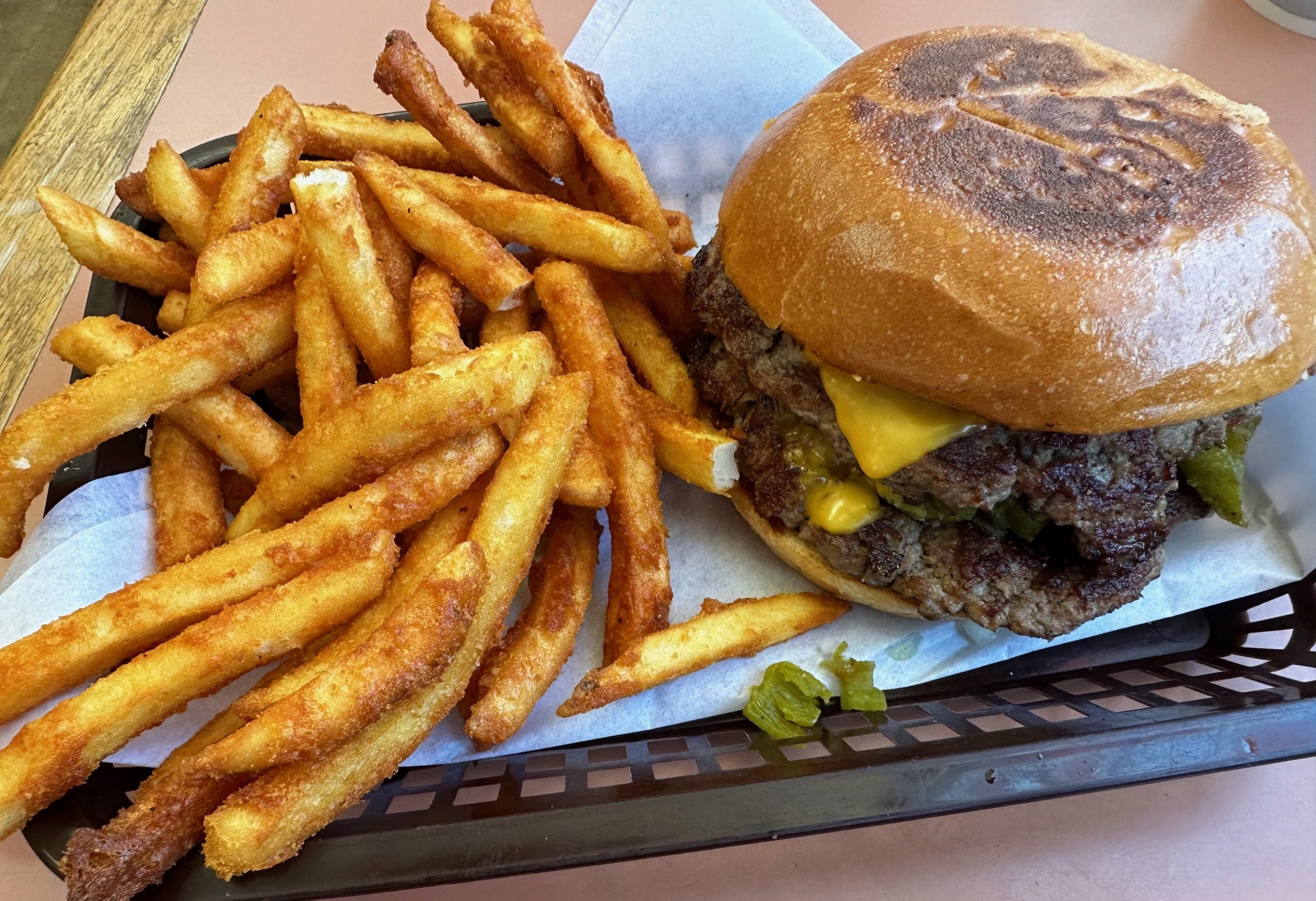
In 2014, Epicurious compiled a list of  crimes against burgers:  Hockey-puck patties, pressing down with a spatula, over-flipping, unmelted cheese and hard-as-a-rock buns.   For decades most burger aficionados followed these commandments as if their souls depended on them.  We cringed and bristled when burger flippers smashed down burger patties on a grill.  “There goes all the juices” we bemoaned.  “Here comes another dry as a New Mexico dust devil burger” we lamented.  Of all the felonious assaults against our beloved burger, pressing down the spatula was the most grievous, a crime that should be punishable by years of hard labor. Then in the 1970s a Kentucky restaurateur “invented” something we know today as a “smash burger.”  To hasten the preparation time and sate the throngs queued up to be fed, he placed a large bean can atop the beef patties.  By “smashing” the burger with a heavy object, he discovered the meat had greater contact with the griddle.  Not only did this lead to a better flavor, the resultant beef patties developed a “crust” that sealed in juices.  Smash burgers are super model thin compared to thick quarter- or half-pound beefy behemoths.   The thinner burger has a much darker,…

Knead Dough Bar & Eatery – Albuquerque, New Mexico (CLOSED)

“I don’t talk about politics, religion or sports, because all three will divide people. That’s why I talk about food, because food brings people together. That’s right! Unless you’re vegan!” ~Gabriel Iglesias Not even glass half full optimists can disagree that America has accelerated into a warp speed devolution from George H. W. Bush’s vision of a “kinder, gentler nation.”    Replace kinder and gentler with snarky and sniping and you’ve got a more accurate picture.  Not only are there widening schisms between political ideologies, there are deep fissures between values of all types (as comedian Gabriel Iglesias astutely pointed out).  It’s not enough to disagree any more.  In modern America, we don’t tolerate differences of opinion.   We take them personally and go on the offensive.  Take Chef Gordon Ramsay’s proclamation: “If the kids ever came up to me and said, ‘Dad, I’m a vegetarian,’ then I would sit them on the fence and electrocute them.”    There doesn’t seem to be a middle ground. Or so I pondered when my Kim and I made our way to Knead Dough Bar & Eatery, a plant-forward cafe on Gold Avenue.   From among my friends and my acquaintances, only my…

Red Rock Deli – Albuquerque, New Mexico

America may be a multicultural melting pot, but thriving within its most populous metropolises are ethnic neighborhoods–pockets of diversity residing in two worlds, retaining many of the cultural and culinary traditions of their motherland while integrating into and pursuing the American dream. Cities such as Chicago have long realized that these ethnic enclaves offer a treasure trove of cultural and culinary experiences. Most of these neighborhoods welcome culinary tourism–the opportunity to showcase the cuisine of their homelands. One such example is the city of Chicago which boasts of the largest Polish population outside of Warsaw (as many as 183,000 by some estimates) in the world. Storefronts and restaurants in “Little Poland” on Chicago’s far Northwest side are bedecked in the white and red flag of Poland. They offer everything from pierogies to kielbasa. Every Labor Day weekend Chicago celebrates its Polish heritage at the Taste of Polonia festival where Polish cuisine and culture are showcased. Obviously Albuquerque doesn’t have the population to support a “Chinatown” or a “Little Poland,” but the Duke City does offer multicultural dining diversity. Although several of the city’s ethnic restaurants are clustered throughout the International District, many others are strewn throughout the metropolitan area where…

Zacatlán – Santa Fe, New Mexico

As a naive and impressionable child with a vivid imagination, my most frightening weekly ordeal was walking home from Catechism, especially when teachings centered around the devil and his demons. For some reason we weren’t taught about a loving God. Instead it was drilled into us that if we’re not “good” we’d go to Hell.  Strangely such concepts as forgiveness and goodness were described rather abstractly while the devil (undoubtedly a progenitor of today’s elected officials) and sin were made real enough to traumatize us all.  The devil was everywhere waiting to ensnare us into sin and drag us (wailing and gnashing our teeth) into Hell. Walking home at twilight after another fire and brimstone lesson made me long for the safety and security of home.  It made me quite unhappy that Adam and Eve were expelled from Eden for disobeying God.  Eden is described in Genesis as “the garden of God.”  Our Catechism teachers taught us Eden was a peaceful place in which we were all intended to live contented and innocent lives.  Unfortunately, rather than focus on the beauty and serenity of Eden, we were petrified by descriptions of the serpent who tempted Eve to partake of the…

Nio Szechuan – Albuquerque, New Mexico

Several years ago Mike Muller, my friend and former colleague at Intel was sent to Chengdu, the capital of the providence of Szechuan in Southwest China.  It was an assignment I would have loved.  Unfortunately I could barely spell the name of the enterprise asset management application Mike would be training our Chinese counterparts how to use.  From an application and business knowledge perspective, Mike was the perfect man for the job.  From the perspective of culinary culture, Intel should have sent me.  Our counterparts may not have learned much about the asset management tool, but we would have had a great time feasting on the incendiary delights for which the Szechuan region is famous. Mike is “bizarro Gil,” my polar opposite when it comes to dining.  He’s absolutely brilliant, hilariously funny and a great family man, but to him adventurous dining would be using honey mustard on his chicken nuggets instead of barbecue sauce.  Mike often joked about creating a blog in which he would publish reviews of all his favorite chain restaurants:  Olive Garden, Applebee’s, Mimi’s and the like.  He nearly broke my heart when he told me about a trip to Santa Fe which culminated in a…

¡Ay Mi Mexico! – Albuquerque, New Mexico

One syllable, one word, one simple expression…yet there probably is no more expressive interjection,  heart-rending cry or honest exclamation in the Spanish language than the simple word “Ay.” This–one of the most  diminutive among all words–can say and mean so much.  Depending on the context, “Ay” is used to express such emotions as: <happiness: think “¡Ay, Chihuahua” when Despicable Me patriarch Gru espies a black villain suit he covets; surprise: ¡Ay, Cabron! what are you doing home in the middle of the day?; exasperation: ¡Ay, Que Lastima! <pain or dismay: Bart Simpson’s ¡Ay, caramba!” when he saw his parents having sex. The versatility of “ay” is virtually unparalleled (though you can usually tell what meaning or mood a speaker is ascribing to that oh, so simple and powerful expression). Informally, “ay” may preface other words in place of curse words in order to make a phrase sound less harsh.  In essence “¡Ay, caramba!” and “¡Ay, Chihuahua!” are Mexican equivalents of “oh, shoot,” “darn” or “shucks.”  Perhaps the most famous use of the term is in the immortal Mexican song Cielito Lindo whose refrain exhorts “Ay, ay, ay, ay, canta y no llores.”  Some English dictionaries translate this as “oh, oh,…

CubaMex – Albuquerque, New Mexico

Because Columbus sailed the ocean blue in 1492 and a succession of Spanish explorers followed suit, you might expect that Spanish cuisine would have proliferated across the new world.  Instead, Spanish discoveries included indigenous cooking techniques and ingredients that forever altered the way scions of Spain ate. At the time of conquest, the European diet was principally comprised of bread, olive oil, olives, “meat,” and wine.   The “new world”–Mexico in particular–was rich, fecund, and replete with such crops such as beans, pumpkins, chilies, avocados, tomatoes, cocoa, cotton, tobacco, corn, and cassava, foods that could not be found in Mother Spain. All the territories explored and conquered by the Spaniards had their own bounty of unique and delicious culinary offerings.  Because traditional Spanish foods were an ocean away, it made sense the Spaniards would adopt indigenous foodstuff.   Many of those foods were ultimately introduced to the European continent.  It was the advent of eating not just for survival, but for pleasure.  To some extent, the vast variety of new ingredients and techniques were also shared among conquered lands.  Solely from the perspective of culinary diversity and deliciousness, it was a win-win.  The uniqueness of foods among such Spanish-held territories…

El Molcajeton – Albuquerque, New Mexico

Molcajetes have become so commonplace on many a Mexican restaurant’s decor that we sometimes forget molcajetes are the traditional Mexican version of the mortar and pestle…that they have both form and function.  As we gawk in admiration at the symmetry and fine craftsmanship of a well-made molcajete, we don’t always reflect on the fact that throughout Mexico and some parts of the Estados Unidos molcajetes are still used to crush and grind spices and to prepare guacamole, moles and salsas.  In restaurants and homes in which molcajetes are used for their intended functional purpose, the guacamole, moles and salsas created within them are said to taste better, much better. As James Beard Award-Winning Writer and Chef Patti Jinich says “A wonderful thing about molcajetes, is that since they are so porous they have a remarkable memory. They store within them, the essences, oils, smells and flavors of all that has been served or made in them. Maybe that’s why it is said that molcajetes season with time and use. Maybe that’s also why it is said that making a sauce or rub or paste in a molcajete makes it taste better.”  Patti’s theory has credibility.  The rough surface of molcajetes…

Foodtopia – Albuquerque, New Mexico

When a restaurant with the curious name “Foodtopia” surfaced in 2022, long-suffering readers of Gil’s Thrilling… probably realized an etymology lesson would soon be in order.   If the suffix “topia” intrigued you as much as it did your grandiloquent blogger, hang on.  First, a review of what we all know.  Utopia is “a seemingly perfect society, one without flaws, where everyone is content and conflict and strife are unknown.”  One example of a Utopian society is the movie Zootopia in which animals live in harmony and lions sing kumbaya with antelope.  More common than movies about Utopian societies are movies and literature about dystopia, “societies that are either extremely chaotic or extremely authoritative, a hellish place where most people suffer.”  No, it’s not your place of employment, but rather something like Planet of the Apes or George Orwell’s 1984. The common element in these two opposite societal types is the suffix “topia,”  a Greek word meaning “a place with specified characteristics.”  An imaginary society with both good (Utopian) and bad (Dystopian) features might be called a “mixtopia.” Some posit an imaginary place where everything (especially the government) is as bad as it can be.  Fittingly, the term for this…