Real Food Nation – Santa Fe, New Mexico (CLOSED)

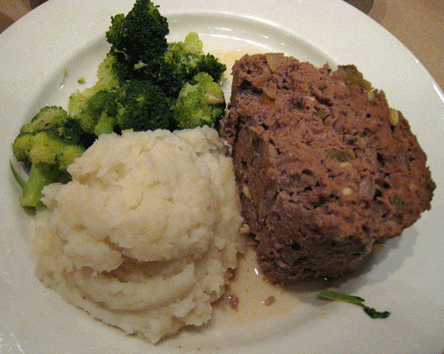
“Come on, you know you want it!”  Television commercials, movies and especially cartoons frequently depict temptation as a battle being waged by two miniature versions of the person being tempted. Faced with a crisis of conscience–doing the right or the wrong thing–a devil-self (complete with horns and a pitchfork) suddenly pops up on the left (or sinister) shoulder and an angel-self on the right.  Quite naturally, the devil-self prods and prompts for the person to do the wrong thing while the beatific angel-self implores the person to resist temptation. When waging an internal conflict as to whether or not I should have some unhealthy dessert, a greasy burger or another slice of pizza, my muse, angel and conscience is often Kate Manchester, the brilliant and beautiful publisher of Edible Santa Fe.  For more than five years, Kate has been educating the readers of her fabulous publication about the virtues of actually paying attention to how and where our food is raised, processed and how it arrives at their tables.  In the process she’s introduced us to such concepts as “locavorism,” “sustainable,” “slow foods” and “organic.” With my benevolent angel over my right shoulder during times of caloric trial, I’m prompted…

Atrisco Cafe & Bar – Santa Fe, New Mexico

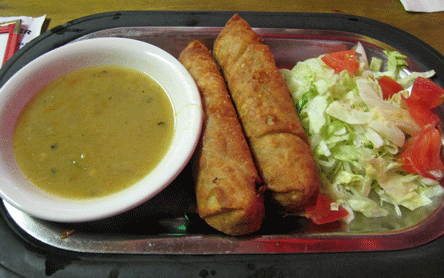
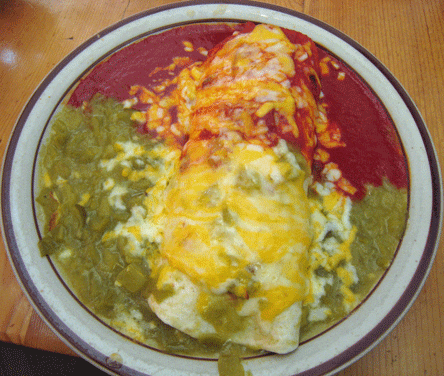
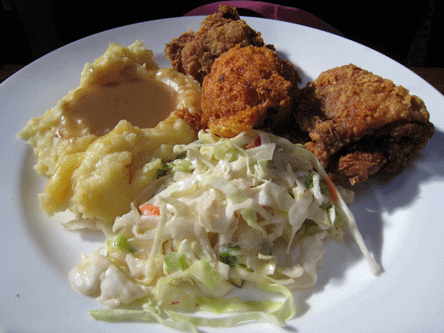
From the snow-capped mountains to the coral shores You’re the only one my heart adores You’ve only got three competitors Tacos, enchiladas and beans From the Mississippi to the Amazon There’s not much we don’t agree upon Wish we could get together on Tacos, enchiladas and beans Love ’em, dozens of ’em I consume them by the score And when I’m through, what do I do I stamp and holler for more You can have the fourth position on my list Must admit your kisses would be missed But how in the world could I exist Without tacos, enchiladas and beans Doris Day In the dark ages when I was growing up in the high mountain community of Peñasco, the world wasn’t nearly as connected as it is today.  My siblings and I thought we were deprived by being subjected to  such unsophisticated foods as tacos, enchiladas and beans. We didn’t know any better.   The three television stations (KOB, KOAT and KGGM) which piped  seventeen hours  of programming per day (7AM through 12AM) through our rooftop antenna into the  static-prone black-and-white television in our den depicted only families who ate such elegant food as pot roast, fried chicken and…

Josh’s Barbecue – Santa Fe, New Mexico (CLOSED)

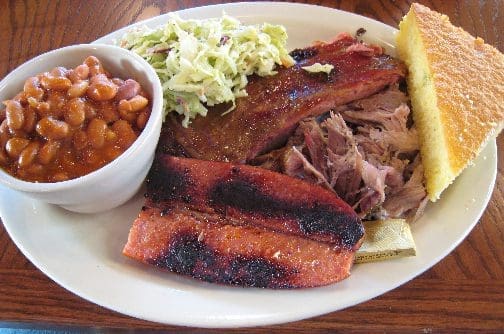
Perhaps indicative of the world becoming more broad-minded and accepting, “peasant food” (which usually includes traditional foods of specific regions) is now looked upon as a culinary art form in which skillful cooks are celebrated for employing the wisdom of the ages to prepare wonderful meals using inexpensive, generally home-grown, ingredients. In France, the term peasant food is actually translated as “food of the country” because it is usually associated with poor rural farmers.  In Laos, Vietnam and Thailand, peasant food is regarded as a visible tribute to the inherited knowledge culled by generations of peasant food producers honing the ideal cuisine of their regions. In the United States, three of the most obvious examples of down-home, regional peasant food are our own New Mexican cuisine, Louisiana Creole and of course, barbecue.  To generations, this is comfort food at its very best, the delicious bounty of a rustic life. Alas, as a commercial enterprise, barbecue restaurants often seem to perpetuate a bumpkinly stereotype.  The “template” seems to include red and white checkered cloth tablecloths adorning oak tables, cute ceramic pig figurines on the counters and country music blaring from a tinny stereo.  At the extreme end of this stereotype, you might…

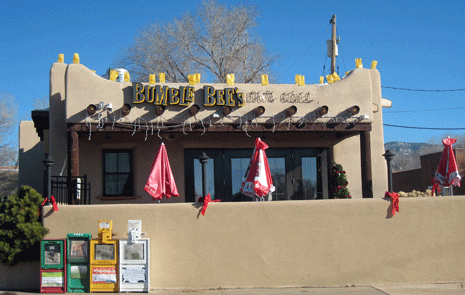
Bumble Bee’s Baja Grill & Burgers – Santa Fe, New Mexico (CLOSED)

The economic malaise of recent years has prompted Americans to become more judicious on how they spend their disposable income (the little that’s left after all the usual bills, expenses and taxes are paid off).  Instead of splurging on gourmet meals at high-end restaurants, Americans are going to those same high-end restaurants for a reliable old favorite that in years past would not have graced their menus.  More than ever, Americans are turning to an American original,  our ultimate comfort food and favorite sandwich–the hamburger–and not the “gobble and go” burgers proffered by the bastions of fast food. American consumers have made it known through their wallets and purses that despite the current economic environment, the one luxury they are not willing to cut back on is a premium burger.  Technomic, a food service industry consultant, confirms that “consumers are willing to pay more for a specialty burger, especially a premium burger, than they are for a standard burger, regardless of restaurant segment.”  That’s why even high-end restaurants and classically trained chefs make sure there’s a premium burger on their menu. In recent years, when restaurant traffic has consistently experienced quarter-after-quarter declines, the  NPD Group, a market research expert, reports…

La Boca – Santa Fe, New Mexico

In a 1997 episode of Seinfeld, the “show about nothing,” George Costanza declared food and sex to be his two passions, reasoning that “it’s only natural to combine them.”  Jerry’s retort, “Natural?  Sex is about love between a man and a woman, not a man and a sandwich.” George Costanza may actually have gotten it right!  The mouth is actually considered an erogenous zone, an area of the body with heightened sensitivity, the stimulation of which may result in a sexual response. While most people don’t get sexually stimulated by eating, the mouth does host very sensitive taste receptors, including 10,000 taste buds on the tongue.  Perhaps that’s why so many people derive so much pleasure from the act of eating. It may have been with this realization that chef and proprietor James Campbell Caruso named his restaurant venture “La Boca,” which translates from Spanish to “the mouth.”  La Boca launched in the summer of 2006. Formerly executive chef at El Farol, Caruso is renown for melding Spanish and Mediterranean cuisines to create a unique cuisine that’s both traditional and contemporary.  It’s also extraordinary in its ability to tantalize the mouth with inimitable taste sensations. La Boca specializes in tapas,…

La Casa Sena – Santa Fe, New Mexico

He was an academic prodigy, one of the first two persons admitted to the Bar of the Supreme Court of the Territory of New Mexico. He had a distinguished military career in the Union Army before being mustered out with the rank of Major. He served as sheriff of Santa Fe county for more than ten years and was a political power broker for both the Republican and Independent parties. Despite such an impressive pedigree, Civil War-hero Major Jose Sena might have been forgotten by the annals of history had it not been for his fabulous Territorial-style adobe house a block east of the Santa Fe Plaza. A prime example of a Spanish hacienda, the stately home has 33 ground-level rooms arranged as a square around a garden patio with towering shade trees and a gurgling fountain. Today Casa Sena is owned by prominent Santa Fe gallery owner Gerald Peters who has transformed what was once called home by Major Sena into a veritable art gallery with museum-quality landscapes on the walls, spectacular watercolor paintings in the outer rooms and hand-crafted Taos-style furniture throughout. Casa Sena abounds in ambience, exemplifying “old Santa Fe” style. Replete with shops, offices and one…

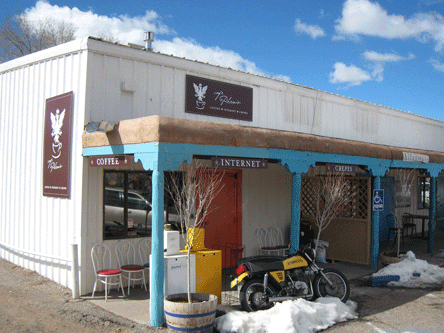
Cafe Phenix – Santa Fe, New Mexico (CLOSED)

“A mythical bird that never dies, the Phoenix flies far ahead to the front, always scanning the landscape and distant space. It represents our capacity for vision, for collecting sensory information about our environment and the events unfolding within it. The Phoenix, with its great beauty, creates intense excitement and deathless inspiration.” – Feng Shui Master Lam Kam Shuen, The Feng Shui Handbook It’s only appropriate that a cozy little restaurant named Cafe Phenix would be part and parcel of a neighborhood revitalization effort being spearheaded by a close-knit community of artists. Much like the advent of Soho, a New York City neighborhood regenerated by a community of Bohemian artists and activists, Santa Fe’s “Triangle District” is emerging as a destination for dining and a sense of community. Geographically defined as the triangle formed by St. Francis Drive, St Michael’s Drive and Cerrillos Road, the Triangle District is the antithesis of Santa Fe style and its Anasazi inspired adobe facade. In fact the Triangle District seems to be an architectural hodgepodge of neo-industrial warehouse structures, studios, cafes and galleries. It does not fit the stereotypical Santa Fe template that seems to preternaturally draw so many seekers to “The City Different.”…

The Pink Adobe – Santa Fe, New Mexico

Culinary historians credit the advent of the modern Santa Fe fine dining scene to a painter who moved to Santa Fe shortly after World War II to join the burgeoning art community. Having to support herself and a young daughter, Rosalea Murphy turned to something else at which she excelled–the culinary arts. As with most rags to riches success stories, Rosalea did not immediately set the Santa Fe dining scene on its ear, but then this wasn’t the “City Different” now widely recognized as a tourist Mecca. Good things take time. Great things take longer. When she first launched the restaurant she christened the Pink Adobe after the hue of its facade, her humble menu consisted solely of French onion soup and apple pie. As her business grew, so did her menu. She added “Pink Dobeburgers” to the menu and sold them for twenty-five cents each. Chicken enchiladas followed suit, the first of several New Mexican specialties she would add to the menu. Eventually her Pink Adobe became the first restaurant in Santa Fe to serve seafood, then a novelty in what was, in her words, “a lazy, sleepy town.” By the 21st century, the ambitious menu featured variety unlike…

Cafe Pasqual’s – Santa Fe, New Mexico

Pasqual Baylon’s devotion to the Mass and the Holy Eucharist was so fervent that when assigned kitchen duty, angels had to stir the pots to keep them from burning.  It’s ironic therefore that San Pasqual is the recognized patron saint of Mexican and New Mexican kitchens, a beloved saint whose smiling countenance in the form of various art forms graces many a kitchen, including Katharine Kagel’s kitchen in the world famous Cafe Pasqual, one of Santa Fe’s most popular restaurants. Cafe Pasqual is a very small cafe with seating for only 50 patrons sitting in very close quarters. Prospective diners place their names on a waiting list then typically wait half an hour or more to be seated, usually longer if they want a “private” table (where you’re still elbow-to-elbow with your neighbors). Quicker seating is usually available if you’re willing to share space in the large community table where you can break bread with diners from all walks of life. Located one block southwest of the plaza in the heart of downtown, the split-level dining room is one of the most colorful venues in the City Different with a festive ambience that includes multi-hued, hand-painted Mexican tiles and murals.…

Tabla De Los Santos – Santa Fe, New Mexico

Professor Larry Torres, the brilliant historian, linguist and writer From Arroyo Seco is incomparable at spinning a yarn, especially when doing so in “Spanglish,” the without-a-pause blending of Spanish and English so prevalent among Latinos in the Land of Enchantment.  A few years ago in the Taos News, he told the story of a little South American boy staying with a family in Northern New Mexico who called home rather frantically begging to return home.  The little boy explained that New Mexicans are barbaric after overhearing that they cook and eat “chicos. Obviously the little boy didn’t know that chicos is not only the literal translation of little boys, but a delicious favorite food of Latinos throughout Northern New Mexico and Southern Colorado.  Chicos begin as an ear of field corn which is tied into ristras (strings) and hung to dry or alternatively roasted in an horno.   The kernels are then removed and stored until cooking time.  When cooked (boiled in water), they swell up to their former size and taste like freshly smoked corn.  In combination with pinto beans, they are magnificent! Chicos were a staple in bucolic Peñasco in Taos county where I grew up.  Much of…

Mangiamo Pronto! – Santa Fe, New Mexico (CLOSED)

At first browse of a directory listing Santa Fe restaurants, the entree “Mangiamo Pronto!” (an Italian term which translates to “Let’s eat now!) might elicit the impression that the City Different has an eatery offering Italian fast-food: post-haste pasta, accelerated antipasto, insalata al instante.   You get the picture. At Mangiamo Pronto! you certainly won’t find desiccated pizza slices seared to a leathery sheen under heat lamp infernos just waiting for the next drive- or walk-up victim, er…customer, nor will you see a nattily uniformed wait staff running amok trying to fill orders even as new ones come in at a breakneck pace. Mangiamo Pronto! is, in many ways, the antithesis of a fast-food restaurant–even though entrees are prepared in advance then heated upon order.  In fact, one of the first things you see as you walk in is a glass case displaying the gustatory bounty d’giorno.  It’s almost as if the Roman deity Bacchus himself laid out a sumptuous feast of engorged panini sandwiches crafted on crispy crusted focaccia, artisanal piadini arrayed with gourmet ingredients, diet-devastating desserts, soul-comforting soups, crisp salads and so much more. True to its name, Mangiamo Pronto! won’t keep you waiting long.  Only scant minutes will elapse…