Barelas Coffee House – Albuquerque, New Mexico

Quick, name the oldest neighborhood in Albuquerque. Most people would say Old Town which was settled in 1706 near the banks of the Rio Grande. Most people would be wrong. The oldest neighborhood in Albuquerque is actually the Barelas neighborhood, formally established as a ranching settlement in the late 1600s. The history of the central Rio Grande region began at and expanded from Barelas, once a thriving hub of commerce bustling with activity. Both the Camino Real, the royal road to Mexico City and Route 66, America’s mother road passed through the Barelas neighborhood. Barelas was the seat of a flourishing railroad enterprise which facilitated a burgeoning economy.  The neighborhood began a precipitous decline in the 1950s when odoriferous emanations from an area sewage treatment plant drove people away. Then in the 1960s, shopping mall developments proved too formidable competition for long-established mom and pop businesses, the economic heart of the community. Before long, the federal government was calling Barelas a “pocket of poverty” and what was once a thriving neighborhood languished. By the 1970s, Barelas was all but forgotten–perhaps a blessing in disguise because that allowed the preservation of historic buildings for which the community is best known today.…

Tikka Hut – Albuquerque, New Mexico (CLOSED)

The cynosure of Tikka Hut, an Indian Fusion restaurant on First Street, is a colorful mural that pays tribute to the extraordinary and constantly evolving history of Mexican cuisine.   The mural depicts the mesmerizing countenance of a beautiful indigenous maiden, maybe even the infamous Malinche herself.  Immediately below the maiden is a Muslim Dhow sailing the azure waters of the ancient world.  The mural was commissioned when the name on the restaurant’s marquee read “Urban Taqueria.”   It’s an evocative spray-painted masterpiece that should inspire contemplation and discussion. It certainly will if you ask owner Hanif Mohamed about it.   Hanif is not only a restaurant impresario who’s owned an extraordinary portfolio of diverse restaurants, he’s quite a culinary historian.  To him and other savvy cognoscenti of contemporary cuisine, the roots of Mexico’s food extend far beyond the influence of the Spanish conquistadores.    Chat him up and he’ll explain how Spanish cuisine itself evolved significantly under the 800 years of Moorish rule of the Iberian Peninsula. He relishes discussing the trade routes that introduced exotic spices and seasonings  which dramatically changed (and improved) the flavor profile of that region’s cuisine that (let’s face it) would otherwise be fairly bland.…

Kitsune – Albuquerque, New Mexico (CLOSED)

FROM THE BITE: Albuquerque’s Asian-inspired Kitsune slipped out of its Old Town location with nary an announcement last year, and now the rumors about their new fling with Sister Bar are official. This will be happening Mondays, but maybe not every Monday; the next one looks to be slated for February 26. Here are a few tips if you’ve got  a trip planned to Japan and would like to practice terms to convey your enthusiasm for the delicious meals you’re sure to experience,    After your first bite, use the term “umai” to express how delicious that first bite was. As you continue to eat, use the term “oishii” frequently to convey with alacrity that the food you’re eating is fantastic.  Because it’s considered good manners in Japanese culture not only to finish every single morsel on your  plate but to ask for a second serving, the phrase “okawari” will come in handy.  And to make it even more polite, postface the term with “kudasai” which means “please.” On the last Sunday of October when our planned lunch excursion was to Kitsune, a Japanese term for “fox,” I had hoped to be able to display this gaijin’s (foreigner’s) mastery of Japanese…

Salt and Board – Albuquerque, New Mexico

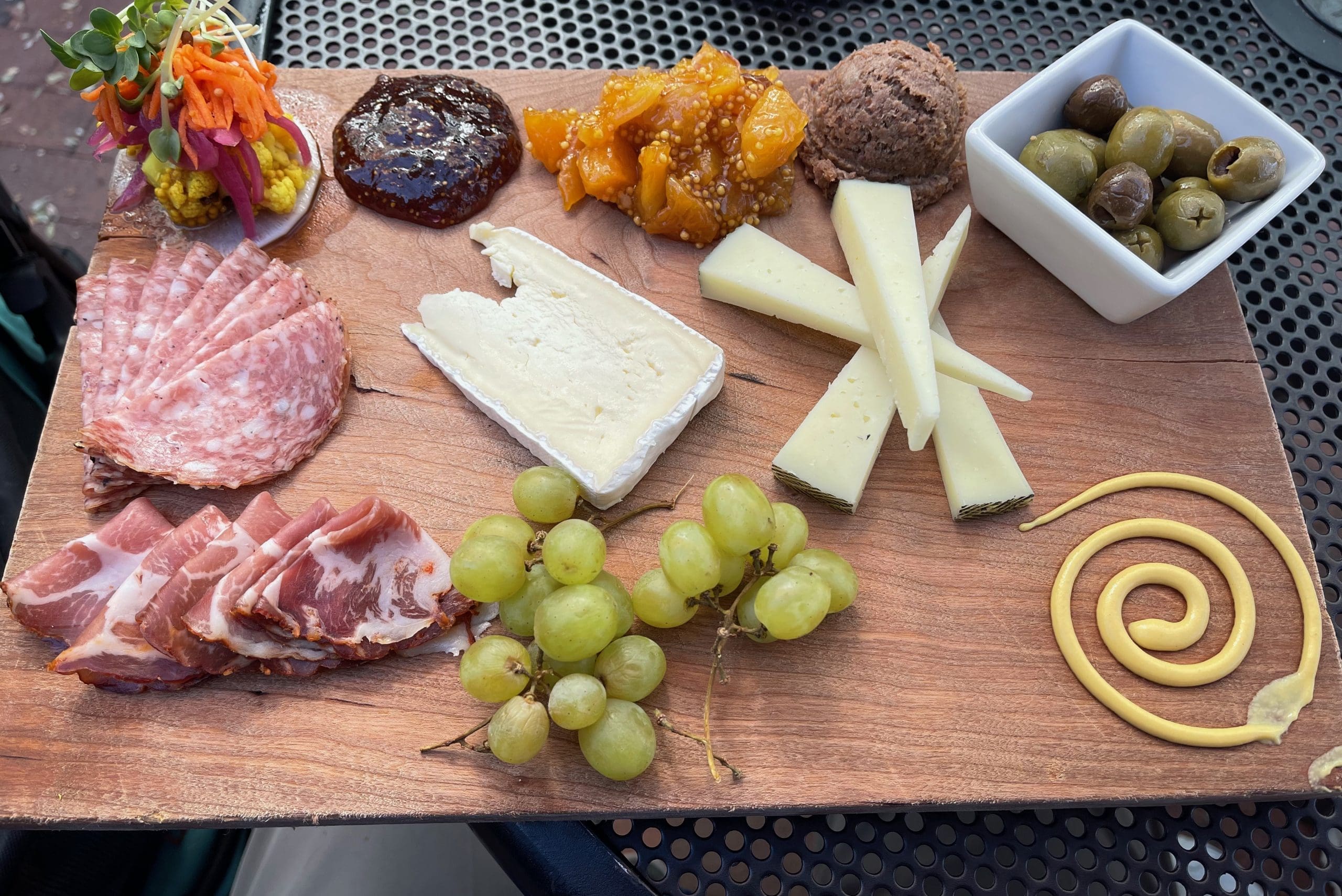
“Five years ago, everyone was making beer in their bathtubs, and now everyone’s making charcuterie in their garage!” ~Brian Malarkey, Chef When my friend Carlos, a punctilious polyglot conversant in four languages, asked what my Kim and I ate over the weekend, my poorly-pronounced beginner’s French response was “une assisette de charcuterie et de fromages.” “Oh, you had cold-cuts and cheese,” he responded. “No, we had charcuterie!” I emphasized, slowly pronouncing each syllable of the term: “char-cu-te-rie.” “Only the French,” he retorted “could convince you a plate of bologna and slices of cheese is a gourmet dish worth thirty dollars.” Carlos was only kidding, of course, but beyond his flippancy was a veiled challenge. He wanted me to figure out what distinguishes “charcuterie” from any other plate of cold-cuts and cheeses thrown together. It could be argued that charcuterie’s historical roots extend hundreds of years back when early civilizations figured out how to cure and preserve meats. The term “charcuterie,” which is derived from the French words for flesh (chair) and cooked (cuit), finds its genesis in fifteenth-century France. Charcuterie was essentially born out of the necessity for foods to have a long shelf life. Because pork vendors were prohibited…

Fork & Fig – Albuquerque, New Mexico (CLOSED)

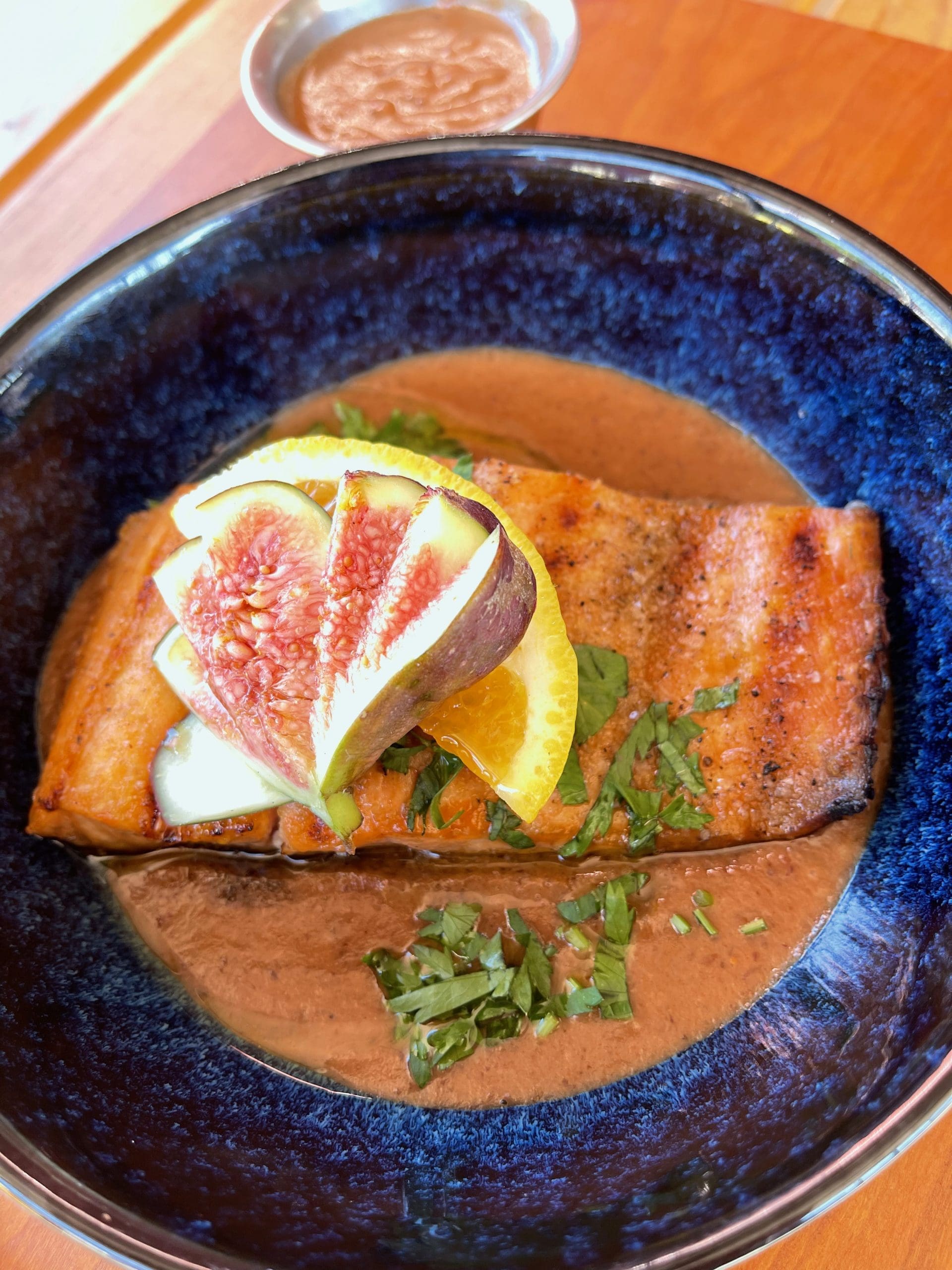
FROM THE FORK & FIG FACEBOOK PAGE (November, 2024): Thank you Albuquerque for 10 wonderful years! Skyrocketing rent and food costs have really impacted us. We have loved serving you. We are moving to a private chef/catering model. Stay tuned for our next adventure. Listen to Billy Joel’s 1983 doo wop hit Uptown Girl and you’ll probably get the impression that uptown is synonymous with uppity or at least upscale. The lyrics describe a working-class downtown man (ostensibly Joel himself who’s originally from blue-collar Long Island) trying to win the heart of a wealthy, white bred uptown girl (Joel’s future wife Christie Brinkley). The perception of uptown’s haughtiness were reenforced in “The Contest” episode of Seinfeld in which John F. Kennedy, Jr. lived in trendy uptown. When they finally came into money, the Jefferson’s moved on up, too. Until just a few years ago, the Albuquerque neighborhoods around which conversations typically centered were Old Town, downtown, Nob Hill and even EDo (East Downtown). Uptown was solely where the Coronado and Winrock Malls were. With the closure of the Winrock Mall and subsequent launch of ABQ Uptown, a pedestrian-friendly, open-air lifestyle center, Albuquerque’s uptown area seemingly became “the heart of the…

Damacio’s Bar & Tapas – Albuquerque, New Mexico

“I wanna open a Jamaican/Irish/Spanish small plate breakfast restaurant and call it Tapas the Morning to Ja.” ~Harris Wittels (Comedian) It wasn’t Wittel’s humorous quip that came to mind as we approached Damacio’s Bar & Tapas but rather something legendary raconteur and television host Anthony Bourdain once said.  During a 2013 episode of his CNN television show Parts Unknown filmed in Granada, Spain, he declared “We will never have tapas culture in America.”  Calling tapas “that greatest of Spanish traditions,” Bourdain added “You may think you know what a tapa is.  Like if you’ve had small bites at some fusion hipster bar where they do a whole lot of little plates. Yeah, that ain’t a tapa. Quite naturally Boudain’s comments got me to thinking: what exactly is a tapas culture and what are we doing wrong here in the Land of Plenty. Accompanied by his longtime Director of Photography Zach Zamboni and his fiancé, who live part-time in Granada, Bourdain was told by the fiancé that “Tapa is for free.  That’s the main issue of the tapa.”  Bourdain liked the concept: “So, you’re just paying for the wine. So if I were like a degenerate wino I could still eat…

Papa Nacho’s – Albuquerque, New Mexico

“No one who cooks, cooks alone. Even at her most solitary, a cook in the kitchen is surrounded by generations of cooks past, the advice and menus of cooks present, the wisdom of cookbook writers.” ~Laurie Colwin, Novelist The notion of cooking alone is unthinkable to Ignacio and Brigette “BeBe” Lopez, founders of Papa Nacho’s. Since they launched their popular Mexican restaurant in 1995, the restaurant has embodied the aphorism “the family that cooks together, stays together.” Papa Nacho’s is and always has been a family affair, with daughters Gloria and Marcial practically having grown up in the kitchen. Today Marcial and her husband Richard Jimenez own the restaurant and Gloria is living in California.  The gracious Gloria once reminded me, “it wouldn’t be a family restaurant if it wasn’t about family.” More than most restaurants in Albuquerque which promote themselves as being “family owned and operated,” Papa Nacho’s lives it. Some of Gloria’s most cherished times were when she and her dad come in at four in the morning to begin the extensive preparatory work it takes to serve their patrons. At Papa Nachos, there are no short-cuts. Vegetables are hand-cut and all sauces are meticulously prepared. Pinto beans…

Tako Ten – Albuquerque, New Mexico

Gustavo Arellano, author of Taco USA: How Mexican Food Conquered America, wasn’t kidding when he quipped “The Taco Bell taco is dead. Long live the taco.”  Boomers like me may not have grown up heading for the border, but we did grow up with the Taco Bell “taco template”–a crunchy hard-shell tortilla crammed with seasoned ground beef, chopped tomato, lettuce, a fistful of shredded yellow cheese and a large dollop of sour cream.  We’ve long since joined enlightened millennials and generation Z diners in railing against what Chef Rick Bayless calls Taco Bell’s “near-laughable caricature” of authentic Mexican tacos.   So just what are authentic Mexican tacos? Travel throughout the Land of Montezuma and whether you get your tacos from upscale restaurants, market stalls or street vendors, you’ll quickly discover their versatility, diversity and deliciousness.  Adventurous diners can, for example, enjoy palm-sized tortillas filled with virtually every part of the pig, cow, or chicken.  These proteins can be stewed (as in a guisado), barbecued (for barbacoa), roasted on a vertical spit (al pastor), cooked atop a griddle (a la plancha), or served campechano (a mélange of chopped meats). Tacos de mariscos (seafood), pescado (fish) and chapulines (grasshoppers) are also pretty popular…

CAFE DA LAT – Albuquerque, New Mexico

While the term “Vietnamese cuisine” is broad and overarching, any attempt to pigeonhole this very diverse and eclectic culinary culture is a failure to consider its complexities and nuances.  Even when culinary taxonomists compartmentalize Vietnamese cuisine regionally into “Northern,” “Southern” or “Central,” these wide-ranging generalizations fail to take into account the variations–often influenced by socioeconomic factors–that occur not only between villages, but often within small neighborhoods.  James Nguyen, proprietor of Albuquerque’s Cafe Da Lat is very cognizant of those variations.  That’s why he takes it in stride when a compatriot visiting his restaurant contends “this isn’t like the Vietnamese food I grew up eating.”  Obviously, he says, they didn’t grow up with his mother’s cooking.  His mother’s recipes are at the heart of Cafe Da Lat’s menu, but like every successful restaurateur, he understands that in order to grow business year-upon-year, the menu has to remain interesting. Though wholesale changes aren’t necessary, over the years he has continued to introduce amazing new items we now can’t live without.   Every year James travels to Little Saigon in Orange County, California where he takes the pulse of innovative new trends in Vietnamese cuisine.  When he discovers something he believes Duke City…

Vintage 423 – Albuquerque, New Mexico

My friend Bill Resnik, a professional stand-up comedian for more than two decades, performs a bit in which he “translates” Spanish terms for linguistically challenged audiences.  “Paseo del Norte,” for example, translates to “Paseo of the Norte.” For Duke City residents, the “Northern Route” is no joke.  It’s the corridor from the Northeast Heights to Albuquerque’s burgeoning West side, ferrying nearly 100,000 vehicles a day.  Paseo del Norte is widely credited with the rapid development–from 30,000 residents in 1980 to more than 85,000 in 2006–of the city’s growth north of Interstate 40 and west of the Rio Grande.  What most city residents don’t realize is that the official Department of Transportation designation for the 25-mile passage is State Highway 423. It makes sense therefore that a restaurant in which people connections are made daily would incorporate into its name the highway designation for the bridge (figuratively and literally) between Albuquerque’s residents.  Because of its extensive wine offerings, the word “Vintage” (as in the year or place in which wine of high quality was produce) also makes sense, ergo Vintage Four Twenty-Three, a sophisticated and trendy milieu unlike any in the Duke City.  Launched in January, 2012, Vintage has since been…

D. H. Lescombes Winery & Bistro (Old Town) – Albuquerque, New Mexico

There are varying accounts as to the genesis of wine-making in the United States. While it is widely acknowledged that as early as the 1500s Spanish and French Huguenot settlers in Florida began making wine with a native grape known as muscadine, efforts to plant the classic grapes used to create the great wines of Europe failed because of pests prevalent in wet climates. It wasn’t until Spanish Missionaries discovered the dry climate of New Mexico in 1629 with its sandy soils that the first European Mission grapes brought over from Spain were planted in what is now the United States.  The original grape stocks supposedly remain the source of many of New Mexico’s vinters to this day. Sources relates that in 1629, Franciscan friars planted the first vineyard (for sacramental wine) in New Mexico in defiance to Spanish law prohibiting the growing of grapes for wine in the new world. Those first wines were planted on the east bank of the Rio Grande slightly north of the village of present day San Antonio by Fray Gracia de Zuniga, a Franciscan monk. Despite conflicting accounts, one fact appears incontrovertible–New Mexico is among the oldest wine-making regions in the country. Today the…