Rude Boy Cookies – Albuquerque, New Mexico

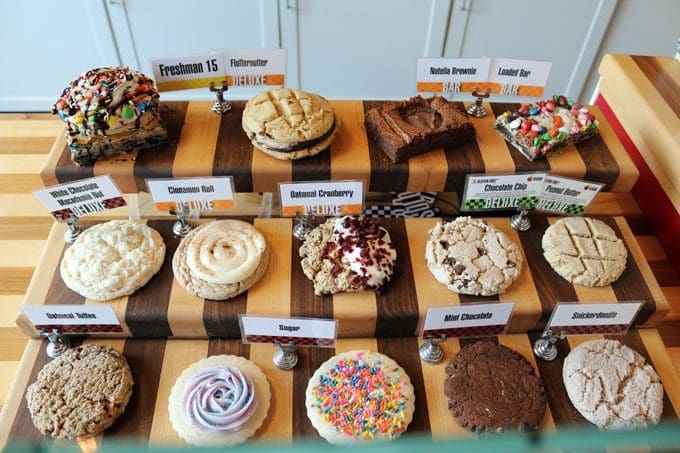
Sometimes me thinks ‘what is a friend.’ And then me say “Friend is someone to share the last cookie with.” ~The Cookie Monster NOTE:  In November, 2024 Rude Boy Cookies closed its doors at its central location across from the University of New Mexico after dealing with a series of problems including break-ins, vandalism, and even armed robbery.  Owners indicate they are looking for a new location to open up their bakery.  In the meantime, cookie aficionados can visit the Rude Boy Cookie location at 2500 12th St NW, Unit E, Ste 3. With whom would you share your last cookie? For me the answer is easy. I’d share my last cookie with my friend Darren, the delightful younger brother of Dazzling Deanell. During Larry “the professor with the perspicacious palate” McGoldrick‘s most recent 39th birthday celebration, there were party favors galore on every table including biscochitos from Celina’s Biscochitos (review upcoming). While all eyes were turned to the dance floor where Larry gaovtted with a lovely lady, someone stealthily sneaked all the biscochitos at our table onto Darren’s plate and even under his hat. Darren denied culpability, but the trail of crumbs to his plate may have given him…

Bricklight Dive – Albuquerque, New Mexico (CLOSED)

If we really are what we eat, I’m fast, cheap and easy. Fast, cheap and easy. That would certainly describe the stereotypical college diet, especially for freshmen. On their own for the first time, freshmen eat what they want when they want it. They load up their trays with junk food in heaping helpings so mountainous it would make Dagwood Bumstead envious. They fuel marathon study sessions with sugary snacks. Exercise consists of sixteen-ounce curls, clicking the remote and fork lifts. It’s no wonder the “freshman fifteen” myth–the belief that many college students pack on 15 pounds during their first year at school–exists. A study out of Oregon State University concluded that college students are not eating enough fruits, vegetables and fiber in their diets (not even close) and that both male and female students derived more than 30 percent of their calories from fatty foods. Not since an internet security company revealed that the most common computer password is “123456” has such an obvious nugget been divulged. Anyone who’s attended college knows that students pretty much survive on anything they can get their hands on. It’s also much easier to drive through the nearest grab and gobble emporium than…

Piatanzi – Albuquerque, New Mexico

“Italy is an illusion, indeed, a mirage, the stuff of wishes.” ~Mario Luzi In the 1996 motion picture Big Night, two Italian restaurants across the street from one another operate in diametric opposition to one another both philosophically and in practice. One is enormously successful because it gives customers what they want and expect (even though savvy diners would consider the culinary fare mediocre and uninspired). In the other restaurant, the chef is a perfectionist who will labor all day to create a perfect dish and becomes exasperated when diners don’t recognize the authentic culinary art he creates, preferring “Americanized” Italian food instead. You might think the American dining public would prefer the latter and reject the former. Our inaugural visit to Piatanzi seems to indicate the opposite may be true in Albuquerque. Our route to Piatanzi took us past an Olive Garden where throngs of patrons lined up to get their fill of mediocre Americanized Italian food. When we arrived at Piatanzi, we practically had our choice of seating. The cavernous restaurant was nearly empty on a Saturday at noon. We could only hope this was an anomaly because diners should be beating down the doors to dine at…

Cervantes Restaurant & Lounge – Albuquerque, New Mexico

In 1706, a group of Spanish colonists were granted permission by King Philip of Spain to establish a new villa on the banks and in the valley of the Rio del Norte. The colonists chose a spot “in a place of good fields, waters, pastures, and timber, distant from the villa of Santa Fe about twenty-two leagues.” They named the new settlement La Villa de Alburquerque in honor of the Viceroy of New Spain, Fernandez de la Cueva, Duque de Alburquerque.” A portrait of el Duque de Alburquerque hangs prominently just above the mantle at Cervantes Restaurant & Lounge in the southeast quadrant of the city named for him. Though there is a lot to see throughout the restaurant, the portrait of El Duque is the cynosure to which all eyes are inevitably drawn, a commanding presence with a quiet air of dignity and regal bearing. One wonders what El Duque de Alburquerque would think of the city bearing his name and of the lively cuisine that prompted Livability.com to name that city one of America’s “10 most surprisingly vibrant cities for foodies to flex their taste buds” and for the Huffington Post to declare it “one of the ten…

Pasion Latin Fusion – Albuquerque, New Mexico (CLOSED)

“In my experience, food and passion always intertwine. Passion is food for the soul’s mood at any particular time.” Tammy Mollai Robert Irvine, host of the Food Network’s Restaurant: Impossible show has some nerve! In an episode which first aired in March, 2014, the tough-talking British mesomorph had the audacity to tell America that Pasion Latin Fusion wasn’t the beautiful, graceful swan with which many of us had fallen in love. Although he didn’t directly call Pasion an ugly duckling paddling about aimlessly, Irvine certainly intimated that things at Pasion weren’t as rosy as some of us may have thought. The premise of Restaurant: Impossible is that within two days and on a budget of $10,000, Irvine will transform a failing American restaurant with the goal of helping to restore it to profitability and prominence. To make the show entertaining, any existing dysfunction or drama in the restaurant’s day-to-day operations is spotlighted in the fashion of all reality shows. If you’ve ever been to Pasion Latin Fusion, words like failure, dysfunction and drama won’t ever come to mind. Since its launch in 2011, reviews have been overwhelmingly positive, much moreso than reviews for other “failing” restaurants featured on Restaurant: Impossible.…

Sadie’s Dining Room – Albuquerque, New Mexico

Albuquerque and Sadie’s Dining Room have come a long way since 1950. Back then the Duke City’s population was 96,815, up 173% from 1940. Sadie Koury, the oldest child of Lebanese immigrants, was four years away from launching her first Albuquerque restaurant. Located on Second and Osuna, the first Sadie’s was housed in a Lilliputian edifice not much bigger than the restrooms at the Fourth Street restaurant which today bears her name. The Duke City was much more pastoral in the early 50s and Sadie’s restaurant was but a diminutive nine-stool diner on what was then one of the city’s most busy thoroughfares (though not quite as busy as Fourth Street which in 1954, was already seventeen years removed from having been part of historic Route 66). Sadie opened her eponymous eatery for breakfast every morning at 5AM and served lunch late into the afternoon. Standing room only crowds often included truckers who deviated from their Route 66 throughway and who would park their diesel rigs around the tiny edifice. Sadie greeted her customers with a friendly “hi honey” and got to know many of her regulars as well as how they liked their favorite meals prepared. In 1973 after…

Le Troquet Bistro – Albuquerque, New Mexico

Pope Gregory the Great was a prolific writer canonized as a saint and recognized as a “doctor of the church.” Among musicians, singers, students and teachers, he is revered as a patron saint, a heavenly advocate who intercedes on their behalf. Among gluttons of the Middle Ages, however, the supreme pontiff was reviled. In his treatise Morals on the Book of Job, Pope Gregory essentially condemned them to Hell, a denouncement reflecting the strict austerity of the times. For gluttons, the unpardonable sin was in deriving too much pleasure from eating. Eating, or more precisely the pleasurable overindulgence in food, was viewed as an ungodly preoccupation with temporal and corporeal pleasures at the expense of spirituality. Church leaders of the Middle Ages didn’t just denounce the derivation of pleasure from eating in a general sense. They listed five specific ways in which gluttony was a sin: eating too soon, eating too expensively, eating too much, eating too eagerly, eating too daintily and eating wildly. By Middle Age standards, many Americans are gluttons and would be condemned to an eternity in Hell for our enjoyment of food. Fortunately the provincial dogma regarding the enjoyment of food has been replaced by more…

Bosque Brewing Company – Albuquerque, New Mexico (CLOSED)

NOTE: The Bosque Brewing Company has six locations including two in Las Cruces and one in Bernalillo.  Only the location in San Mateo reviewed here has closed. In 1978, the number of breweries across the fruited plain had fallen to an all-time, post-Prohibition low of 89. That year President Jimmy Carter signed into law, a bill that legalized home brewing on a national level. Since the craft brewing market began to pick up steam in the mid- to late-1980s there has been no surcease in sight. Today, there are more than 2,500 breweries operating across the United States with another 1,500 breweries in the planning stage. According to the Brewers Association, as of 2013 the craft beer industry experienced double-digit growth four straight years in both dollar sales and volume. So what accounts for such growth in popularity of local beer? Experts theorize that similar to the locavore trend in the culinary world, cervisaphiles (aficionados of beers and ales) have grown tired of being subjected to industrially brewed swill (anyone remember the “skunky” beer commercials?) and have discovered the pleasures of carefully crafted beer flavors made under the same roof where it’s consumed. A similar evolution among consumers also transpired…

DG’s Deli – Albuquerque, New Mexico

“There are sandwich shops in New York which offer the nobility and gentry a choice of no less than 100 different sandwiches, all of them alluring and some of them downright masterpieces.” H.L. Mencken In conversations with trusted gastronomes about what the Albuquerque area dining scene is most direly lacking, it’s not Basque cuisine, Russian food, Low-Country cooking or the food of any other race or ethnicity that’s most often mentioned. Surprisingly, what my esteemed colleagues believe is most desperately needed in the Duke City is a big city deli–and not just any kind of deli. My colleagues lament the absence of a true Kosher-style deli, the type of which were born in the Jewish enclaves of New York City in the 1930s. While the short-lived Nosh Jewish Delicatessen & Bakery quelled some of those longings, it still wasn’t the quintessential kosher deli my urban sophisticate colleagues wanted. Kosher-style delis are not true practitioners of traditional Kosher dietary laws, meaning the food they produce is not deemed “fit” for consumption by Jews in accordance with standards for cleanliness, spotlessness and for being “intact.” As an example, Kosher practices forbid the consumption of meat and milk together while Kosher-style delis break…

Laguna Burger (66 Pit Stop) – Albuquerque, New Mexico

In 2016 and 2017 my review of the Laguna Burger was the most frequently visited post on Gil’s Thrilling…  In 2015 and 2014, only one restaurant (Down N’ Dirty Seafood Boil) received more blog visits than Laguna Burger.  If even a small number of the visitors to the review actually also visited the restaurant, that’s thousands of visitors to Laguna Burger.  It’s probably safe to assume hundreds of thousands of visitors who haven’t read Gil’s Thrilling review have made their way to one of the four Laguna Burger locations, three of which are definitely off-the-beaten path.  In November, 2017, Laguna Burger established a presence at a 3,000 square-foot space on Avanyu Plaza on 12th Street near the Indian Pueblo Cultural Center in Albuquerque.  You can read my review of the 12th Street location here. The history of New Mexico is fraught with tales of hardship and peril. Enchanting as it may be, New Mexico is a land which can be harsh and unforgiving as early settlers found out when, amidst the ravages of climatic extremes, they traversed austere terrain in search of wealth and a better life. There were no interstate highways nor high-speed motorized conveyances to ferry them across…

Arirang Oriental Market – Albuquerque, New Mexico

“Cuisine is the tactile connection we have to breathing history. History and culture offer us a vibrant living society that we taste through cuisine. All cuisine is a reflection of the society from which it emanates … in the end cuisine is the result of culture” – Clifford Wright If cuisine is the result of culture, then it can certainly be stated that music is the expressive language of that culture. Well before the advent of the written word, music was used to tell stories, impart wisdom, express ideas, share emotions and convey the history and culture of the civilization. Until the 20th century and the rapid cultural changes wrought by the postmodern period, music also bridged the generations. Family members of every generation typically listened to the same music. In Korea, there may be no song as beloved–even in North Korea–as Arirang, an iconic folk song often considered an unofficial national anthem. Its plaintiff lyrics convey a traveler’s agony and anguish while crossing a mountain pass named Arirang with a heartfelt longing to return home. After its service in Korea during the Korean War, the South Korean government designated Arirang as the official march of the United States Army’s…