Johnny’s Pizza – Albuquerque, New Mexico

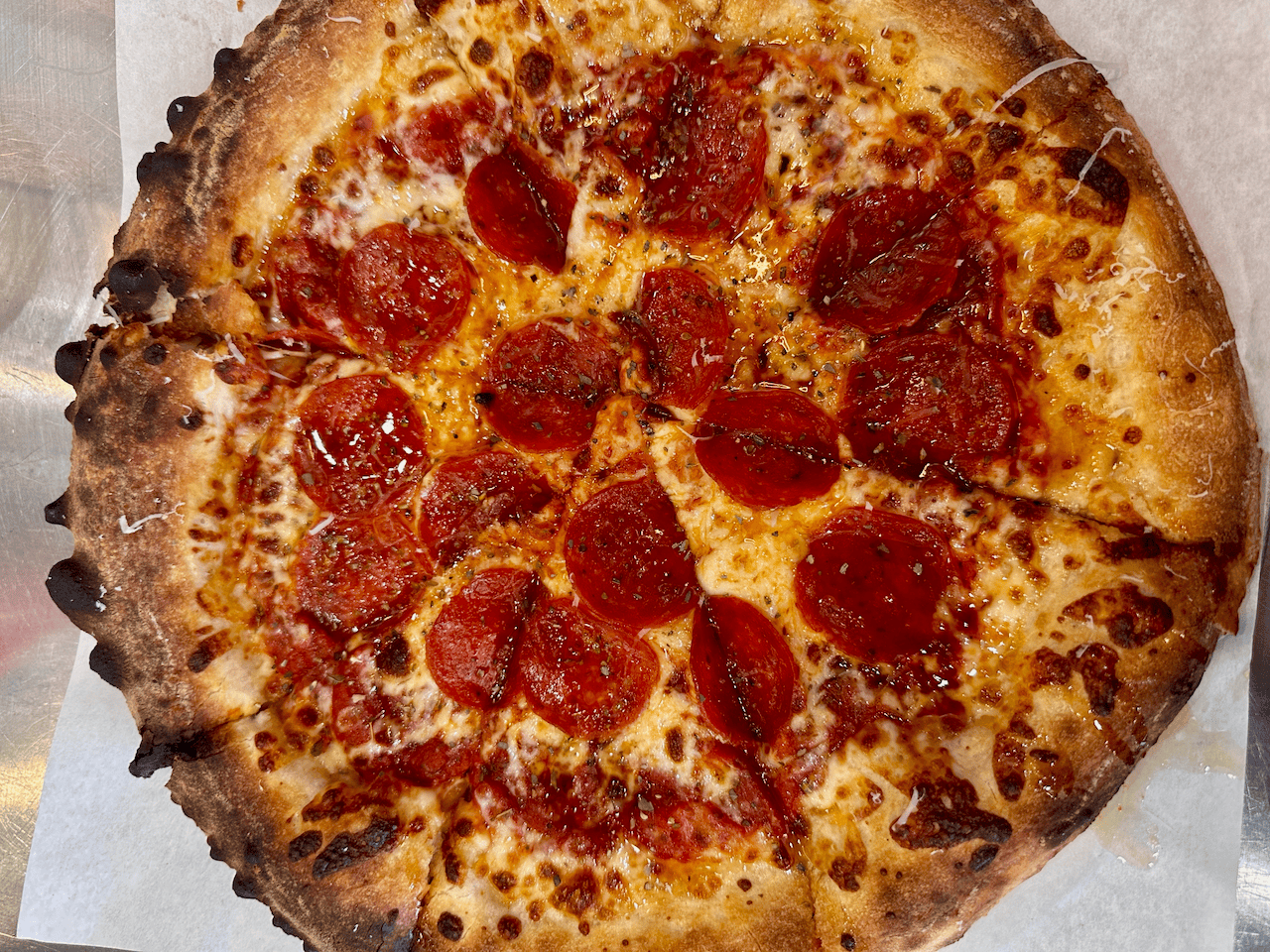
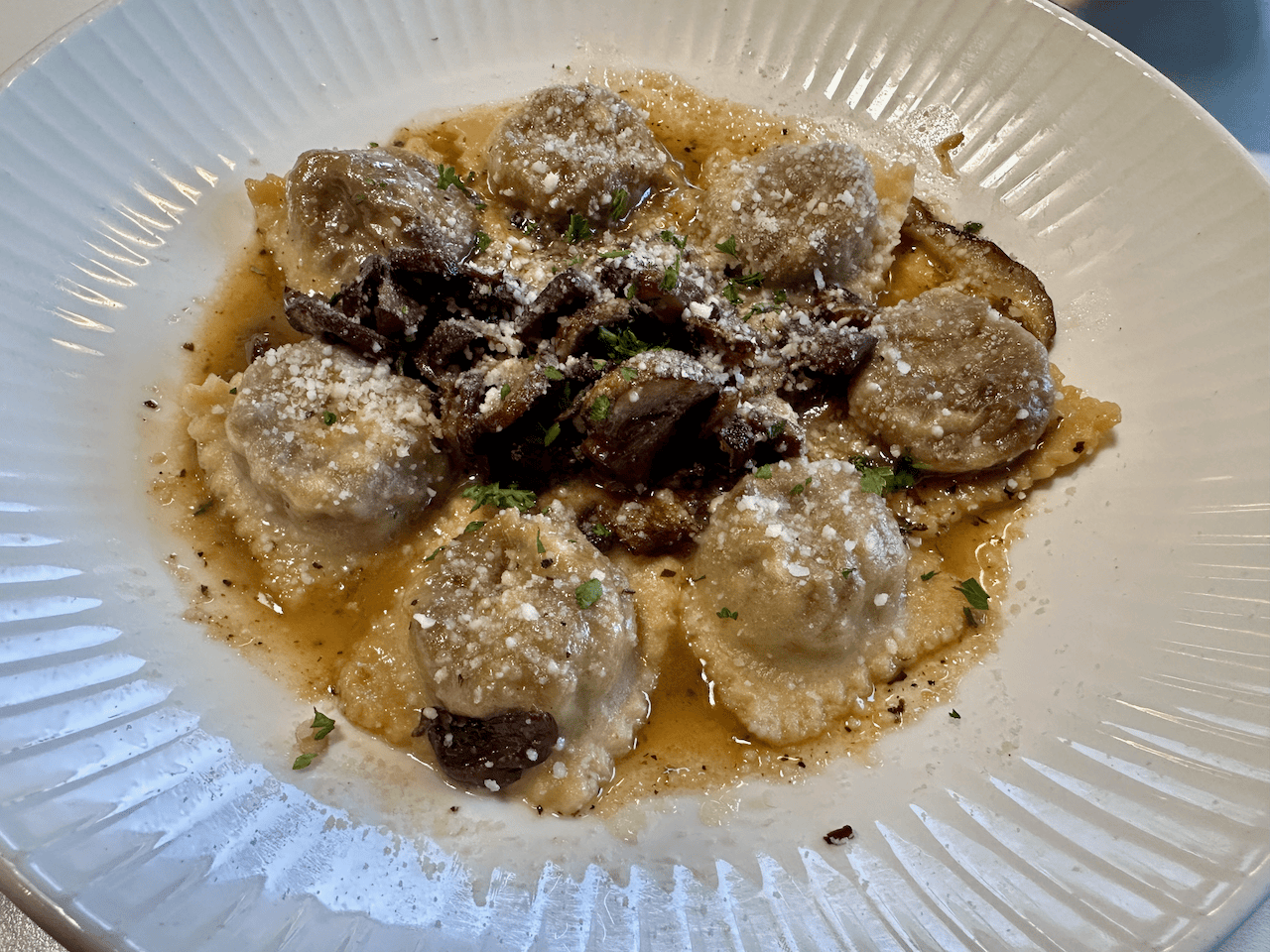
“He’s been helping make pizza since he was three.”  Johnathan Khalil’s mom beamed as she confirmed she’s not the “Johnny” for which Albuquerque’s newest New York style pizzeria is named.  Johnny is her soon-to-turn-18-year-old son.  Can you imagine how cool it would be to be a teenager with a pizza parlor named for him?  Johnny must very popular.  The pizzeria named for him certainly is.  On the day of our inaugural visit–two weeks and one day–after its 29 May 2026 launch, the line was literally out the door.  Johnny’s is scantly 1,200 square-feet so accommodating throngs of diners will be a challenge.  Five two-top tables set against the walls are all the seating currently available though there is a slightly shaded (at times) patio which the Khalil family plans to expand and provide misters for. Two things were in evidence when we visited.  First, those of us who live in Rio Rancho or Albuquerque’s burgeoning northwest quadrant are jonesing for more great pizza options.  Much as we love Thicc Pizza Co., Davido’s, Dion’s, Aldo’s NY Pizzeria and the Turtle Mountain Brewing Company, we like variety and crave more options.  Coincidentally, Johnny’s launch day was just about a month after Richie…

Little Europe – Albuquerque, New Mexico

Few natural wonders are as awe-inspiring and spectacular as  the chalky White Cliffs of Dover on the English coast.  Only for a short while are those bright white, natural geological formations visible at night as you’re sailing away toward France on a cross-channel ferry.  Instead, as you depart from Dover’s busy port, you’re treated to an increasingly receding facade as the 350-foot chalk faces dim, their bright white geological features vividly reflecting moonlight.  That’s the view I remember most from my first English crossing some 21 miles away from France.  Along with a busful of eager passengers, we were bound for Calais, the closest point in France to Great Britain. For the Germans, that made it the most logical and heavily fortified location for an Allied invasion. Our “invasion” wasn’t to visit wartime sights most of which are some 230 miles east at Normandy D-Day landing beaches (such as Omaha and Juno). Our excursion was much more peaceful (although not necessarily quiet). We were bound for Auchan, a well-stocked hypermarket (a massive retail establishment that combines a supermarket and a department store under one roof) in Bolulogne-Sur-Mer.  Auchon was reputed to be the ideal place to purchase French wines, cheese…

Calavida Cantina – Albuquerque, New Mexico

At Calavida Cantina, you’re invited to “party like the dead.”  If you haven’t partied like the dead, you’re probably not well acquainted with the Mexican tradition of “El Dia De Los Muertos,” the Day of the Dead.  During this Mexican holiday, the profusion of skeletons of all sizes performing day-to-day activities signifies the return to this world of the dead who remain who they were when they lived, doing what they did.  For example, skeletal figures depicted on the artwork at Calavida Continue would have been party animals when they graced this earthly plane.  Therefore in death, they remain party animals–eating, drinking and being merry.   At Calavida, the party animals of a past life mingle with party animals of today in a milieu that’s the antithesis of a morgue or mortuary. When we first espied the Calavida Cantina, I worried my Spanish vocabulary was diminishing with age (I’m 39) and lack of practice.  It was a relief to learn that Calavida isn’t an actual word, but a portmanteau blending calavera (skull) with vida (life), “a nod to the Día de los Muertos belief that joy and remembrance can—and should—coexist.” Calavida “toasts to the past, celebrates the present, and crafts liquid stories for the…

Fei’s Cafe – Albuquerque, New Mexico

Some say the map of China looks like a chicken.  The province of Sichuan in Southwest China would be right in the stomach of that chicken.  That’s fitting because the cuisine of Sichuan is internationally renowned for its liberal use of spice.  What characterizes Sichuan from the other regions of China is its use of Sichuan peppercorn, chilies, and the ability to take even the most mundane of ingredients to create fabulous dishes.  There’s a term for the flavor profile associated with Sichuan cuisine.  It’s the word “mala” which translates to “numbing spice.”  The “ma” portion of that term comes from the use of Sichuan Peppercorns (which are actually in the same botanical family as citrus, not chilies).  Sichuan peppercorns create a tingly, electric, buzzing, salivating, sensation on the palate. Sichuan peppercorns  are not spicy. The heat in Sichuan cuisine comes from la – or spicy. A variety of chilies are used in Sichuan cuisine. When long-time reader Nathaniel recommended Fei’s Cafe, he explained “It’s by far the best Chinese food I’ve had in ABQ, comparable to Boston or LA. It’s a real hole in the wall and really authentic. They don’t seem to be getting a lot of business, for…

Clay Pot Restaurant – Albuquerque, New Mexico

“This stuffing of food in your fellow diners’ face is called gursha, and that’s what you do to show your affection and respect. Try this at the Waffle House some time and prepare for awkwardness.” ~Anthony Bourdain, Season 6 of Parts Unknown Eating Ethiopian cuisine involves eating with your hands. That can also be said about eating pizza, sandwiches, tacos, gyros and a number of other foods common to the American palate. But what about being fed from someone else’s hand?  In Ethiopia, that practice is called gursha.  Gursha is a term for the Ethiopian tradition of hand-feeding a bite of food, wrapped in injera, to someone else as a gesture of love, friendship, and respect. It signifies hospitality, often extended to guests or loved ones, with larger bites symbolizing a stronger bond.  Bourdain noted that hospitality is a way of living in the “Land of Origins” (signifying  Ethiopia’s status as a cradle of humanity and civilization): “Here, as in much of Ethiopia, Muslims and Christians live side by side. … It’s a peculiar history of peaceful coexistence here, of which Ethiopians are quite proud. .” In the handful of times I’ve dined at Ethiopian restaurants, I’ve never been compelled to engage…

Kaufman’s New York – Albuquerque, New Mexico (CLOSED)

“I’ll have what she’s having.”  Can it really be 35 years since Meg Ryan and Billy Crystal created their famous fake orgasm scene from When Harry Met Sally?  The scene was filmed at New York City’s Katz’s Delicatessen where sumptuous sandwiches are skyscraper tall and absolutely delicious (my sole visit was in 1978).  Unlike Meg’s character, most of us wouldn’t have to fake our “excitement” with one gander of the sheer size of Katz’s pastrami sandwich.  A Katz’s, the world-famous pastrami sandwich is enormous, featuring about one pound (12–16 ounces) of hand-carved meat stacked between rye bread. The sandwich stands roughly five-inches tall and is often considered large enough for two people to share.  Obviously that doesn’t include me; I wouldn’t share it with anyone. When my friend and frequent dining companion Bill Resnik invited me for lunch at Kaufman’s New York Diner, we hoped for some facsimile of the excitement and size of Katz’s .   We’re both realists, however, and recognize that parsimonious portions are standard at most New Mexico sandwich shops.  We did, however, hope and expect that the pastrami be imported from New York City or, even better, made on the premises in the tradition of Jewish sandwich…

Si Señor – Las Cruces, New Mexico

Much as New Mexicans would like to think our sacrosanct red and green chile is resultant from God’s infinite grace, there’s more than divinity at work.  Would you believe science?  Even before it became known as New Mexico State University (NMSU), the state’s second largest university has played a crucial role in chile production by leading breeding programs for disease-resistant, higher-yielding varieties. It started with Fabian Garcia, a member of the first graduating class in 1894.  In 1898, Garcia became director of the agricultural experiment station. His research focused on helping farmers transition away from grain production. He became known for developing improved chile pepper varieties, a contribution that shaped New Mexico’s agricultural identity. The principal objective of NMSU’s Chile Pepper Breeding and Genetics Program is improvement of chile pepper production through genetically superior germplasm. New Mexico’s chile pepper production can be separated into five major commodities: green chile, red chile, paprika, cayenne, and jalapeno. The overall production value of chile hovers around $40-50 million annually in recent years (e.g., $41.5M in 2023), with most sold for processing into salsas and sauces Chile has long been the Land of Enchantment’s number one cash food crop. Its overall economic impact (including…

Jollibee – Chandler, Arizona

One visit to Jollibee might convince you you’ve visited yet another American chain restaurant.  You’d be half right.  Jollibee is a chain, but it’s a chain based out of the Philippines.  Apparently the many islands comprising The Philippines developed a taste for fried chicken and burgers during its years as a U.S. colony.  My Uncle Fred, a career Navy man stationed several times at Subic Bay (on the west coast of Luzon Island in the Philippines northwest of Manila), raved that the fried chicken, in particular, was far better than fried chicken anywhere in the United States.  Apparently he’s not the only person with that opinion. USA Today and Eater both recently named Jollibee fried chicken as the best in the country among fast-food restaurants, beating out brands such as Popeyes, Chick-fil-A, Church’s and KFC (not that you can consider that much of accomplishment considering how bad American fried chicken chains have become).  Jollibee now has about eighty locations across the fruited plain.  With my Kim hankering for fried chicken, we managed to find the only Jollibee in all of Arizona.  It’s located in Chandler, not too far from the Intel plants which I once visited for eighteen years.  Chandler,…

Fry Bread House – Phoenix, Arizona

The James Beard America’s Classics Award honors locally owned restaurants with timeless appeal, beloved in their region for serving quality food that reflects the character and cultural traditions of their community, and must have been operating for at least 10 years, recognizing enduring, community-rooted establishments over flashy new trends. While the America’s Classic award is presented annually, only six of the twelve James Beard regions are eligible each year.  That means every other year, each region is represented.  This ensures broad coverage over time.  The most recent New Mexico recipient of the America’s classic award is the incomparable Mary & Tito’s. In 2012, the Fry Bread House, a beloved Phoenix institution since 1992, earned the America’s Classic award, becoming the very first Native American restaurant in the United States to earn that distinction.  The Fry Bread house was started by Cecelia Miller, a member of the Tohono O’odham Nation.  After she passed away in 2020, her children Jennifer and Richard continue the tradition.  According to the restaurant’s website “Tohono Oʼodham people are known throughout the southwest for their red chili beef, large, hand-stretched flour tortilla and fry bread.”   Over the years, the restaurant has garnered many “Best of the City”…

All Pierogi Kitchen – Mesa, Arizona

Not surprisingly, culinary historians aren’t in complete agreement regarding the origin of pierogi.  Most believe dumplings likely traveled from Asia along the Silk Road to Eastern Europe.  Perhaps they were even brought over by Marco Polo or Turkish traders.  That’s the more likely origin story.  The more popular Polish origin story credits St. Hyacinth of Poland for the pierogi.  In fact the Polish exclamation “St. Hyacinth with his dumplings!” is a call for help during hopeless circumstances (much like St. Jude being asked to intercede in the resolution of hopeless causes). There are two legends involving St. Hyacinth and pierogies.  During a visit to a village in Poland, a hailstorm broke out, destroying crops and leaving people with the prospect of famine. Hyacinth told them to pray. The next day, the crops were miraculously restored. As a token of gratitude, the people then treated Hyacinth to pierogi made from those crops. The second legend mentions Hyacinth feeding people with pierogi during a famine caused by the Mongol invasion of 1241.Whatever the true origin of pierogies may be, you can’t dispute that divine intervention was involved in the creation of one of the most universally popular foods throughout Eastern Europe. They…

Buck & Rider – Gilbert, Arizona

If you believe you can’t find great seafood in Phoenix because it’s landlocked and nine months out of the year its temperature rivals that of the sun, you would be mistaken.  As my friend Steve Coleman reminded me recently, 200 years ago, passenger trains in England made fish and chips possible throughout the country by facilitating the transport of fish to interior cities.  Similarly, advances in air travel and refrigeration have made seafood much more available to those of us whose only fresh seafood is the Rio Grande minnow.  Sure, you can catch some fish in the rivers and canals throughout Arizona, but you won’t find lobster, crabs, oysters, mussels, stone crab and other “real” seafood. For years, my dear friends the Plata Brothers Bruce and Loren have been singing the praises of Buck & Rider. Though the name sounds like a children’s cowboy cartoon, Buck & Rider offers a soiree of fresh fish and seafood sourced daily from coastal regions.  Those coastal regions aren’t solely within the fruited plain, but even New Zealand where fresh hamachi comes straight from the net to shipping containers designed to preserve its freshness.  There are three Buck & Rider restaurants in the Valley…