Blog

Jerry’s Cafe – Gallup, New Mexico

The Land of Enchantment is bisected north to south by the murky and mucky Rio Grande which meanders some 700 miles through the state.  Throughout the millennia, the fourth longest river in America has been the often tenuous lifeline upon which New Mexico’s citizenry has relied for sustenance and for recreation.  Its precious waters are multifarious in their use–from human and animal consumption to the sustainment of agricultural systems and so much more.  Depleted over time by human dependence and a perpetual drought condition, it is nonetheless a linchpin for New Mexico’s future even as demand for its resources increases and stresses on the river grow. The Rio Grande Corridor is where the vast concentration of New Mexico’s urban centers exist and more than half of its population (over one million) resides.  The four most populous cities in the state–Albuquerque, Las Cruces, Rio Rancho and Santa Fe in that order–are all within this riverine corridor.  It’s been that way for the estimated 10,000 years in which New Mexico has been inhabited.  The arable lands near the Rio Grande, for example, is where a vast concentration of the indigenous peoples the Spaniards named “Pueblos” chose to live.  Considering their dependence on…
Delgadillo’s Snow Cap – Seligman, Arizona

The quirky small town of Seligman, Arizona, is home to the longest surviving and preserved stretch of Route 66, an expanse which runs 160 miles to Topock, Arizona.  Almost equidistant between Kingman and Flagstaff, Seligman is considered (by Arizona legislative decree) the “birthplace of Historic Route 66.”  Credit that designation to Angel Delgadilla, a  soft-spoken Seligman barber and his brother Juan, a railroad worker who led efforts to preserve Route 66. When the town was bypassed by Interstate 40 in 1978, the brothers formed the Historic Route 66 Association of Arizona. Soft-spoken though the brothers might have been, the Delgadillos became activists determined to keep their beloved hometown viable.  Before Interstate 40 bypassed Seligman, the town had twelve gas stations to accommodate all the traffic that used to come through. That changed in 1978 when Interstate 40 opened just two miles from town.  It took a major toll on communities like Seligman along Route 66.  Businesses were shuttered and people moved away. With Route 66 on life support, Angel and Juan lobbied local, state and national lawmakers and groups and by 1987, the State of Arizona designated the road as historic, securing Seligman’s future. The Seligman story was the inspiration…

Cafe Del Rio – Virginia City, Nevada

Some of the most treasured moments of my childhood involved visiting Grandpa Max on Sunday nights when we would tune in for a formidable line-up of westerns.  We loved Daniel Boone and The Virginian, but our favorite was Bonanza.  Concurrent with the opening notes of Bonanza’s theme song, the screen displayed a map which depicted the sheer scale of  The Ponderosa, the Cartwright family ranch.  The brobdingnagian ranch was bordered on the south by Lake Tahoe, an aquatic body the ranch dwarfed.  According to the map, The Ponderosa was bordered by Carson City, Reno and Virginia City.  Many of the show’s episodes outside the ranch seemed to be centered around Carson City.  As a precocious lad already iterested in cartography, I was determined to someday visit the area surrounding The Ponderosa. It took a few decades, but my Kim and I finally got there.  Our favorite Bonanza landmark was probably Virginia City.  Established in 1859–a time period almost contemporaneous with that of the fictional Bonanza (roughly 1861 to 1867)–Virginia City is akin to taking a step back in time.  “Thar’s gold in them that hills,” was the rallying cry that brough fortune-seeking prospectors to Virginia City.  When all was said…

Two Chicks – Reno, Nevada

The history of slang records that the term “chick,” was first recorded in black slang as far back as 1927.  Along with the terms “dame” or “skirt,” the term “chick” was used informally (mostly by men) to describe young women.  It wasn’t until the 1970s during the height of the women’s liberation movement that women lashed out against that term.  Women decried the word “chick” as offensive and belittling, a demeaning diminutive depicting independent women as delicate, helpless creatures.  Even worse was the term “girl” which infantalized grown women. A generation or two later, both “girl” and “chick” have experienced a rebirth.  This time it’s women themselves who revived the previously objectionable term.  It’s become social zeitgeist for women to use the terms to convey solidatity with other women.  It’s about “girl power”  as exemplified in the phrase “You go, girl?”  To the extreme, some women even use the pejorative “bitch” and even “cow” (especially in England) to refer to one another, but I caution any man stupid enough to follow suit.  The terms “chick” and “girl” have become uncoupled from such adjectives as “hot” or “smart.”  In fact, chick has become an adjective itself: chick lit, chick flick, chick…

Kwok’s Bistro – Reno, Nevada

While some foodies chase restaurants featured on Diner’s, Drive-Ins and Dives, I’m not a Fieri Fanatic (or Guy Groupie, if you prefer).  Not every restaurant featured on his Food Network program ranks very high on my list.  I am, however, an unabashed follower of restaurants which earn James Beard Foundation (JBF) honors.  Over the years the JBF judges have selected truly worthy restaurants and chefs for accolades.   Strict criteria and a diligent vetting process ensures awards are granted only to those exemplifying the JBF mission:  “to recognize exceptional talent and achievement in the culinary arts, hospitality, media, and broader food system, as well as a demonstrated commitment to racial and gender equity, community, sustainability, and a culture where all can thrive.” Reno, Nevada happens to fall in JBF’s Southwest region, the same as New Mexico, Arizona and Oklahoma.  It’s a very tough region in which to compete for regional and national honors.   Within its own state, Reno has to compete with Las Vegas, a  bastion of formidable restaurants and world-class chefs.  Other populous metropolitan areas consistently in contention for regional and national honors are Phoenix, Tucson, Oklahoma City and Tulsa…not to mention New Mexico’s own Albuquerque and Santa…

Pine State Biscuits – Reno, Nevada

In 2020, Ted Lasso burst onto the pop culture scene.  Not long thereafter my friend Alonna Smith, the brilliant owner of My Indian Stove practically begged me to watch it.  She realized that with my penchant for British comedies, I’d love the laugh-out-loud show about an American soccer coach who assumes the help at a Premiere League soccer team in the United Kingdom despite not knowing anything about soccer.  Lasso is the master of the one-liner as well as the bringer of balm during heart-warming scenes.  He’s warm and fuzzy…and as usual, Alanna steered me in the right direction. On the second episode of season one, Ted began the practice of bringing freshly baked biscuits to the football club’s owner Rebecca Welton.  “Biscuits with the boss” quickly became one of the show’s most endearing gags.  Moreover, it’s essential to the relationship Ted wants to build with his stoic, business-like boss.   Over the time, the daily biscuit fix defrosted Rebecca’s cold heart and she embraced Ted not only as integral to her team’s future, but more importantly as a friend. Bringing biscuits to his boss also displays Ted’s efforts to assimilate with British culture.  What Americans like Ted would call…

all’Antico Vinaio – Las Vegas, Nevada

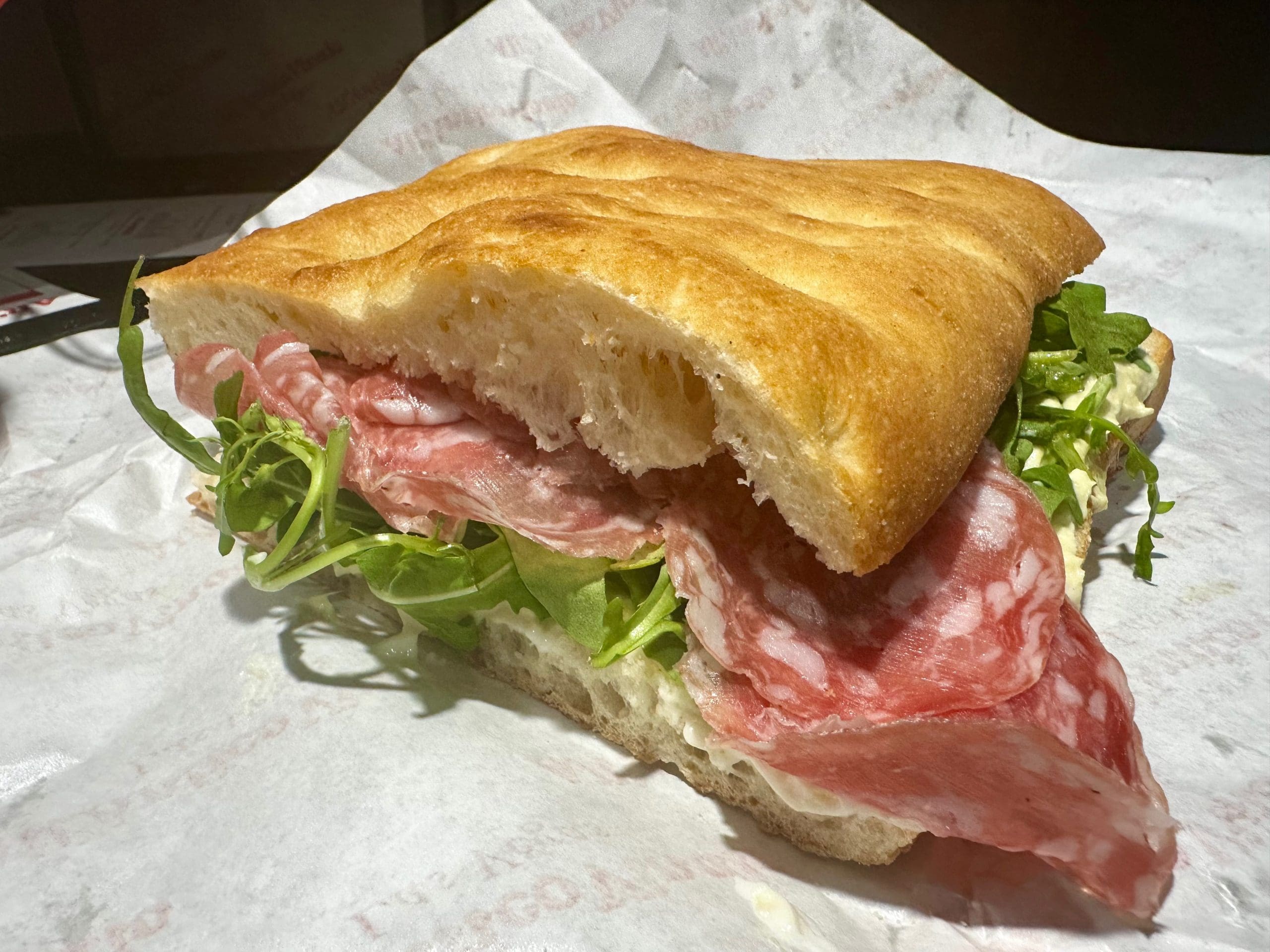
Whether a sandwich shop calls its bill of fare a submarine, hoagie, po’ boy, grinder, hero, bomber or just plain “sandwich,” one commonality is that most sandwich shops have an “Italian” sandwich.  Beyond that, the actual Italian sandwich varies in composition as well as in preparation.   Typical ingredients include layers upon layers (especially on the East coast) of paper-thin capicola, salami, pepperoni and ham often drenched in a vinegar, mayo or mustard and  topped with shredded lettuce, fresh tomatoes, sliced onions, and cherry peppers.  There is no one standard as to what constitutes an “Italian,” not that most of us would care much. Also falling under the purview “Italian sandwich” are panini which are constructed with grilled Italian bread, usually made using a sandwich press. Panini are replete with delicious ingredients such as melty, molten cheese with complementary meats. The perfect panini is crispy on the outside, warm and gooey on the inside, and entirely delicious.  Most culinary historians agree that the panini originated in Italian sandwich shops called “paninoteche” sometime during the 1960s.  From there, Americans quickly picked up on the trend, and paninis became widely available in the States starting from the 1970s. You can’t mention Italian…

Hell’s Backbone Grill – Boulder, Utah

“I’m going to hell! The worst place in the world! With devils and those caves and the ragged clothing! And the heat! My God, the HEAT!” ~Elaine Benes (Seinfeld: Season 9, Episode 16) Most of us would describe Hell in similarly terrifying terms (albeit without the humor) as Elaine Benes did during a memorable episode of Seinfeld back in 1998.  The Hell that existed in Elaine’s mind  was indeed “the worst place in the world!”  If Hell can be so nightmarish, can Hells Backbone be any better?  Are there devils wearing ragged clothing and living in caves in Hells Backbone?  Not in the Hells Background we visited in June, 2024. Hells Backbone in Southwestern Utah is a spectacularly rugged area bridging the towering Boulder Mountain on the north and the breathtaking canyons to the south cut by the Escalante River over millions of years.  The Hells Backbone Road meanders through and past ridges and unearthly mountain contours that stagger the imagination. It winds from juniper and sage desert high up into the lush pine and aspen forest on Boulder Mountain and the highest plateau in North America.  The Hells Backbone Road is one of the most scenic–albeit trecherous during stormy…

Johnny O’s Spudnuts – Farmington, New Mexico

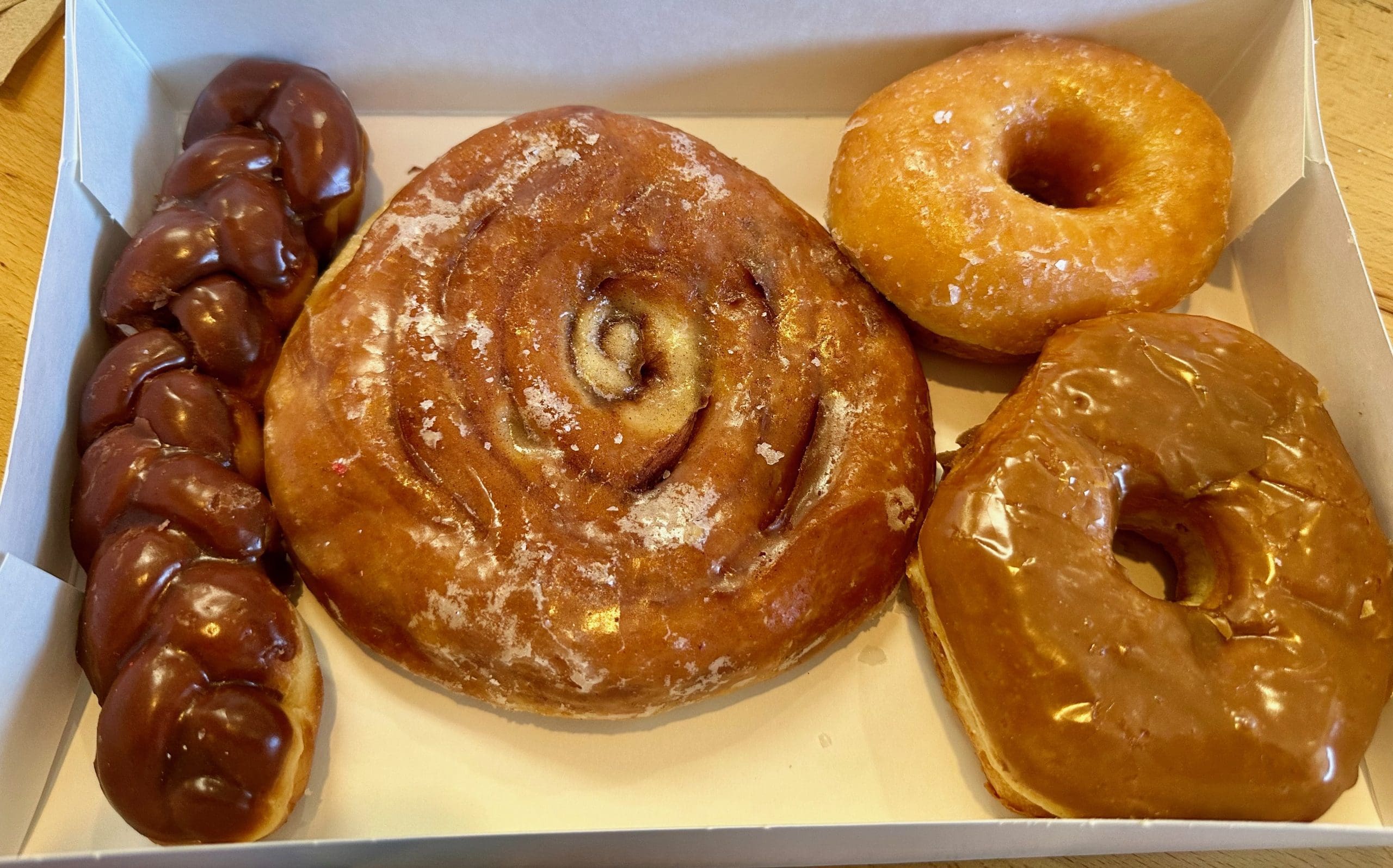
When we tell fellow New Mexicans we lived in Mississippi for eight years, they look at us like we’ve lived in Mars.  Mississippi is not a dichotomy to many people in that they can’t think about anything good about it.  Most dredge up the Magnolia State’s ignominious past or they bring up stereotypes about the state’s literacy and education (despite Missisissipi’s public schools ranking higher than New Mexico’s).   We often feel we have to defend all that is good and wonderful about Mississippi…and there is a lot to love.  Foremost are the people.  We befriended and have remained friends with so many people along the Mississippi Gulf Coast.  Most of them are God loving, God fearing people who love their country.  I stood with Mississippi when most of the rest of the country was protesting the Libyan invasion.  Throughout the Magnolia State, the American flag waved proudly. Okay, this blog is about celebrating food, not about politics.  Mississippi excels in the former department.  Contrary to the stereotype, not every food in the state is fried though we grew to love fried pickles, fried alligator, fried catfish, fried pickles…and of course, donuts made from potato flour.  To the detriment of…

Fuddruckers – Albuquerque, New Mexico

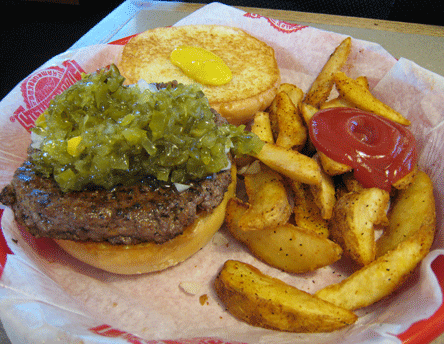
The audacious proclamation on Fuddruckers door, logo and Web site, “The world’s greatest hamburgers available” may not be quite complete. Add the words “somewhere else” and most will agree, you probably have a more accurate description of this tremendously popular restaurant chain which actually trademarked the “world’s greatest hamburgers” logo.  Trademarks, much like speeches made by politicians, television commercials and magazine ads aren’t always completely truthful.  Only the internet can be believed. Founded in 1980 by restaurant impressario Phil Romano (of Romano’s Macaroni Grill fame), Fuddruckers has expanded to more than 250 locations across the world including such purveyors of American culture as Saudi Arabia, Egypt and Kuwait.  The theme at most of the fast casual franchises is 1950s and 1960s rock and roll.  The ambience is Disneyesque, both from the sense that it’s family-friendly and that it’s loud (as in blaring, ear-splitting music loud) and fun (unless you want to hear a conversation with your dining companions).  Others might describe it as tacky, gaudy and over-the-top.  Ostensibly, Fuddruckers also serves good burgers. Duke City diners have been heavily patronizing Fuddruckers since day one, so much so that there are now three Fuddruckers restaurants in the city (as well as…

377 Brewery – Albuquerque, New Mexico

Could have.  Would have.  Should have.  These are perhaps the three saddest statements a coach can utter about the team he or she leads.   Essentially, that coach is saying “we’re not good enough,” “having potential is not enough” and “moral victories don’t count.”  In 1987, Jim Mora, coach of the perpetually woeful New Orleans Saints addressed the media after a close loss to the San Franciso 49ers.  “Could’ve, should’ve, would’ve,” he declared, “I’m tired of saying “could’ve..”  His fiery diatribe lit a fire under his Saints which proceeded to go on a nine game winning streak. Could have.  Would have.  Should have.  These are sad statements, too, for restaurant owners whose chef or wait staff have an off day.  Sure, it happens, but the very best restaurants–those whose guests return strive to minimize–or eliminate off days.  They realize it only takes one bad day to lose a potential loyal guest.  Not all guests are forgiving.  Many will weaponize social media to vent against that restaurant.  They’ll dissuade friends and colleagues from visiting.  I’ve always contended that no restaurateur or chef sets out to serve bad food, but sometimes it does happen. I try not to let Gil’s Thrilling… become…