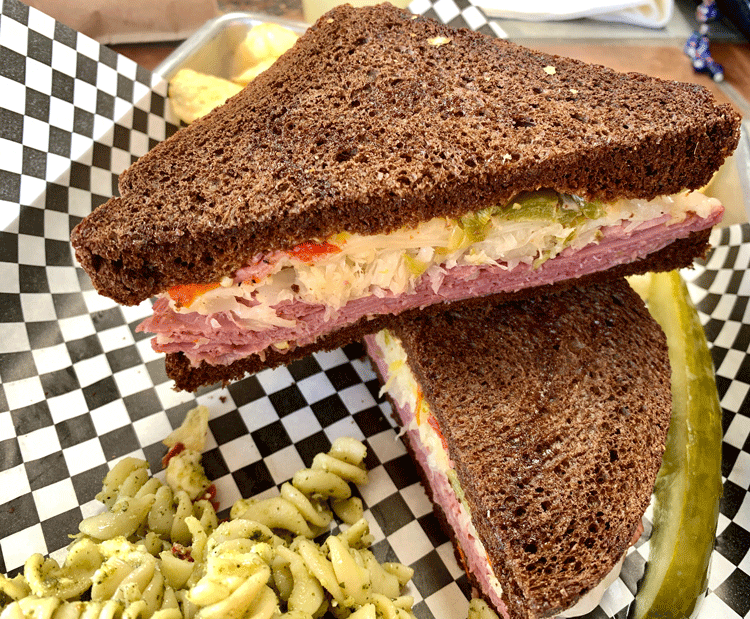
Swiss Alps Bakery – Albuquerque, New Mexico (CLOSED)

Admit it. The second thing that comes to mind when you hear the term “Swiss Alps” is the scene from one of cinema’s most heartwarming movies. It begins with a distant camera drawing closer to a verdant mountainside backdropped by steep, snow-capped peaks. Soothing music grows louder as the camera pans in on a lone figure with arms outstretched. The chappeaued figure twirls and looks skyward as a voice in the background sings “The hills are alive with the sound of Griswolds.” Never mind that Clark Griswold’s dream sequence for the comedy classic European Vacation was actually filmed in the Austrian Alps, not the Swiss Alps. The first thing that comes to mind, of course, is the Swiss Alps Bakery & Cafe, a Duke City mainstay for more than three decades. If you don’t remember Swiss Alps being around for that long, the bakery actually got its start as the Black Forest Bakery. For nearly the first two decades of its existence, the Black Forest Bakery was ensconced in a strip mall on Menaul. In 2012, Jessica Espat-Johnson bought the bakery and relocated it to a larger location on the northeast corner of San Pedro and Candelaria. The move allowed…
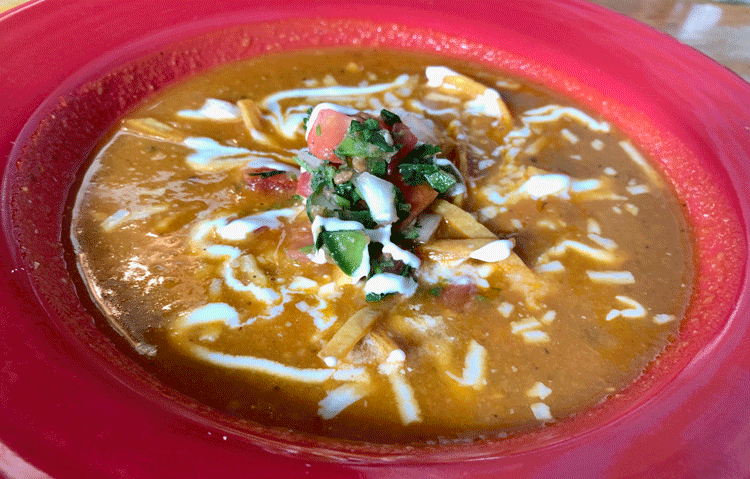
Tesuque Village Market – Tesuque, New Mexico

The most successful Indian revolt in North American history occurred on August 10th, 1680. On that day, more than 8,000 warriors from the various Native American pueblos in New Mexico put aside deep historical differences and banded together to drive the Spaniards from their ancestral lands. This event is celebrated each year in Tesuque Pueblo. Tesuque Pueblo played an integral role in the rebellion. Two Tesuque runners were dispatched by pueblo leaders to enlist support for the revolt. The runners carried knotted deer hide cords to the various pueblos, each knot signifying a day. On each successive day, one knot was untied. When the final knot was untied it signified the day of attack.The annual celebration of this event includes a relay run reenacting the famous run. Runners depart from Tesuque plaza carrying a knotted cord made of yucca and an ear of corn. The yucca cord symbolizes the spirit of the people and the ear of corn their physical body. It is an inspiring event. Led by Diego Jose de Vargas, the Spanish returned to New Mexico in 1692 and within a year regained full political control of New Mexico. Their return marked a significant change in Spanish policy…

Mac’s Steak in the Rough – Albuquerque, New Mexico

In Mark 6:4, Jesus instructs his disciples that “a prophet is not without honor except in his own town, among his relatives and in his own home.” Theologists and Bible scholars have translated this to mean “A prophet is honored everywhere except in his own hometown and among his relatives and his own family.” While certainly not as venerated as prophets, this verse could also apply to some of our local restaurants. If ever you’ve heard a disparaging word about one of our local restaurant institutions, you’ll know of what I speak. Think of all the times you’ve heard such august Duke City institutions as Lotaburger and Mac’s Steak in the Rough disparaged by locals who didn’t grow up with these sacrosanct traditions. For every one of us who revere and frequent these local treasures, there may be as many (if not more) nay-sayers with antipathy toward those lionized local treasures. Some yearn instead for such big city sophisticates as In-N-Out-Burger and others of that ilk. Forgive me if my retort and admonishment to locals who would deprecate our local treasures sounds too much like the jarring and insensitive statements used by some parents to get persnickety children to eat.…

Sushi & Sake – Albuquerque, New Mexico

“If white wine goes with fish, do white grapes go with sushi?“ – George Carlin A reader once asked Washington Post humorist Gene Weingarten what he was a snob about. His reply, “I am also a snob about food. The other day, in Baltimore, I passed a sign outside a restaurant that said “Sushi Buffet!‘ and laughed out loud because it occurred to me that “sushi” and “buffet” are two words that should never appear together.”  His sentiment resonates strongly with sushi aficionados who adhere to the strict rules of etiquette which governs the way in which true sushi snobs enjoy sushi. It’s a given that a true sushi snob would never eat at an all-you-can-eat sushi restaurant nor would such a snob ever be found mingling with the rabble who sit in booths or receive table service.  Sushi snobs will only sit at a sushi bar in as close proximity to the sushi chef as possible.  They like to converse with the sushi chef, hoping to ingratiate themselves by asking the right questions to demonstrate they are savvy connoisseurs and not “trough-divers” like most of the crowd.  They treat the sushi chef like Magellan, their esteemed navigator on a…

AK Deli – Albuquerque, New Mexico (CLOSED)

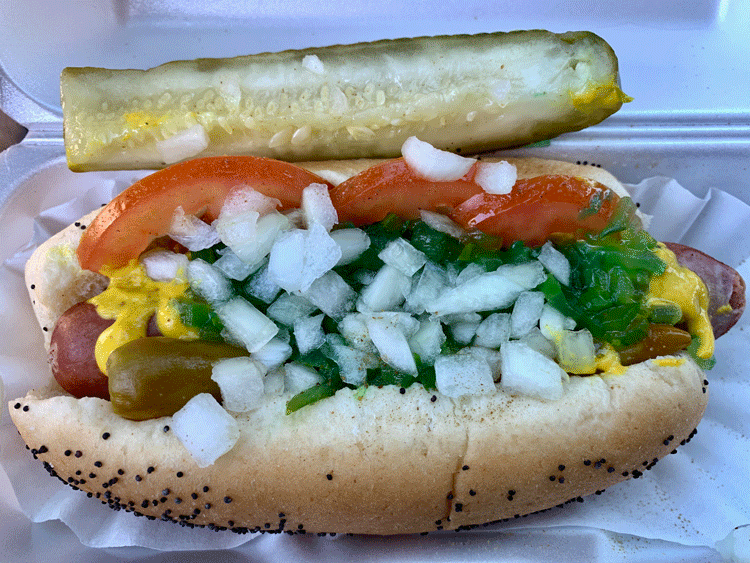
NOTE: Although AK Deli shuttered its doors in 2020, you can still have many of its wonderful sandwiches at AK Pizza. “You’ll never be one of us,” my brother-in-law Chuck quipped in his best Baron von Trapp voice. He wasn’t talking about me being part of the family. He was talking about me being a Chicagoan. Chuck wasn’t being mean-spirited or condescending in any way. The only person not born in the Windy City whom he considers a true Chicagoan is da coach Mike Ditka. “He’s the embodiment of Chicago. It’s in his soul. It’s his attitude.” he explained. Michael Jordan? “Nah, his Royal Airness probably has never even had a real Italian beef sandwich.” Oprah? “Too Hollywood. Not a real person.” Barack Obama? (Surely a former President for whom Chuck voted twice would have to be given a pass). “Politicians are what make Chicago the “Windy City,” he joked. “To be a Chicagoan, you have to have been born here, not transplanted here in your 20s,” Chuck qualified. He isn’t alone in his thinking. A lot of people in the Windy City feel that way and they’re not xenophobic in the least. Throughout Chicago the walls at many small…

Iron Cafe – Albuquerque, New Mexico (CLOSED)

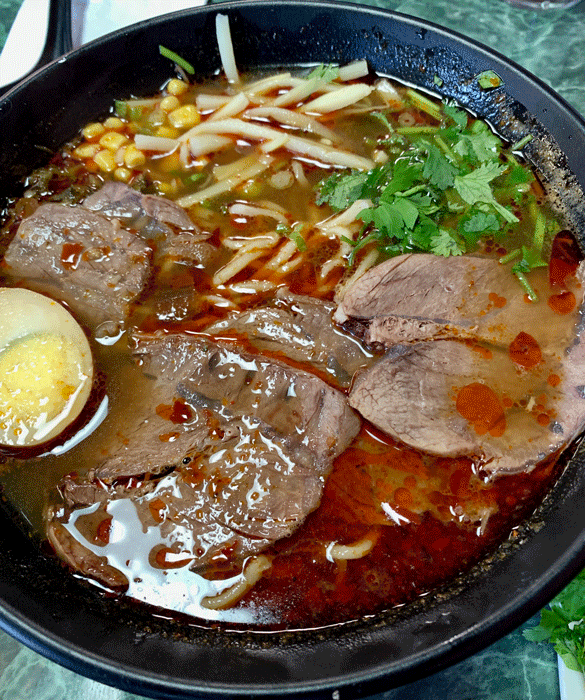
“Ramen is a dish that’s very high in calories and sodium. One way to make it slightly healthier is to leave the soup and just eat the noodles.” ~Iron Chef Masaharu Morimoto America may be a multicultural melting pot, but thriving within its most populous metropolises are ethnic neighborhoods–pockets of diversity residing in two worlds, retaining many of the cultural and culinary traditions of their motherland while integrating into and pursuing the American dream. Cities such as San Francisco, Los Angeles and even Las Vegas, Nevada have long realized that these ethnic enclaves offer a treasure trove of cultural and culinary experiences. Most of these neighborhoods welcome culinary tourism–the opportunity to showcase the cuisine of their homelands. Obviously Albuquerque doesn’t have the population to support a “Chinatown” or a “Little Seoul,” but the Duke City does offer multicultural dining diversity representing many of the world’s cuisines. Most of the city’s ethnic restaurants are strewn throughout the metropolitan area where they’ve integrated into the fabric of neighborhoods which may or may not have an ethnic population base.  With few exceptions–a small cluster of Mexican restaurants in the South Valley, for example–you don’t see clusters of ethnic restaurants from the same country…

The Safari Grill – Albuquerque, New Mexico (CLOSED)

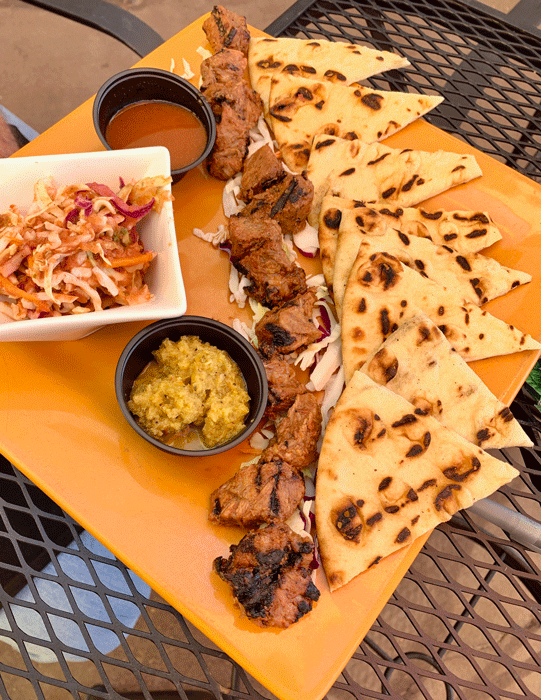
“The wild dogs cry out in the night As they grow restless longing for some solitary company I know that I must do what’s right Sure as Kilimanjaro rises like Olympus above the Serengeti I seek to cure what’s deep inside, frightened of this thing that I’ve become.” ~ Africa by Toto Shrouded in mist and steeped in myth and mystery, Mount Kilimanjaro attracts visitors from all over the world. Often called “the roof of Africa,” the towering, snow-capped, conically-shaped mountain is the crown jewel of the United Republic of Tanzania. At 19,340 feet, the magnificent freestanding peak commands the skies, looming over the plains of the bushveld savannah like a majestic sovereign keeping vigilant watch over her people. Majestic as it may be, Mount Kilimanjaro is far from Tanzania’s sole travel destination. The country boasts of dozens of beautiful white sandy beaches such as those found in the island of Zanzibar. A number of national parks, conservation areas and game reserves allow visitors to get up close and personal with lions, leopards, elephants, cheetah, giraffes, zebras, jackals and thousands of migratory birds. Tanzania is also one of Africa’s most popular safari destinations. Now, safaris need not entail hunting animals…

The Cooperage – Albuquerque, New Mexico (CLOSED)

Reading my sisters’ Archie comic books on the sly 30 plus years ago taught me two things. First, it taught me that teenage boys shouldn’t admit to ever reading Archie much less admit to preferring the girl next door Betty over the siren Veronica. Secondly, Archie comics taught me that a “cooper” (as in Betty’s last name) is a barrel-maker. Everything a cooper produces–casks, barrels, buckets, tubs, butter churns, pipes and more–is referred to collectively as a “cooperage.” In 1976, a barrel-shaped building called the Cooperage appeared in a Lomas Boulevard area dominated by car dealerships. Armed with knowledge provided by Archie comic books, I impressed those very same friends who had teased me about reading Archie comics by explaining the meaning of this strange building (they thought it had something to do with the Roswell alien invasion). Later on we discovered that the barrel motif encompasses not just the restaurant’s exterior, but the interior as well. Some complain that not only does the restaurant look like a barrel, at times it may sound as if you’re in a barrel. The acoustics aren’t always optimal for quiet dining, particularly on the nights in which live music is provided. The Cooperage…

Freight House Kitchen & Tap – Bernalillo, New Mexico (CLOSED)

Many of us look at an unused and timeworn historical building and a wave of nostalgia sweeps over us as we imagine what life was like when that building teemed with activity. Some see such a building as a pig in need of lipstick, nothing a coat of paint and a few nails can’t fix up. Others see that same edifice as having served its purpose, a structure which should be razed to make room for a modern complex. Still others view a weathered building as a thing of beauty from which they draw inspiration. For restaurant impresario Matt DiGregory, driving by the Santa Fe Freight House nearly two decades ago planted the seed for an idea that took years to germinate. The long-time owner of The Range Café and Standard Diner drew inspiration from the two story Mission-Revival façade, envisioning it as the potential site of a restaurant with the thematic look and feel of the railroad industry which once thrived in Albuquerque. Because of the historical nature of the building, DiGregory was unable to realize that particular dream at that particular location. In 2015, he did the next best thing, launching The Freight House Kitchen & Tap Room,…

Rutilio’s New Mexican Foods – Albuquerque, New Mexico (CLOSED)

Although its nickname may be “The Hub City,” Belen actually translates from Spanish to “Bethlehem,” which itself is a Hebrew word for “House of Bread.” Meander through the city and it’s not the aroma of freshly baked bread that will waft toward you. During  autumn, hazy smoke plumes drift upward from rotating steel-meshed drums, alerting your nostrils to the the smoky-sweet-pungent perfume of green chiles being roasted. Much of that chile is grown in nearby farms throughout Valencia County. At any other time of year, it’s the fragrant bouquet of red and green chiles being simmered on restaurant and home kitchen stoves that will enrapt your olfactory receptors. It seems almost unfair that Belen doesn’t translate to “House of Chile.” Belen is justifiably proud of its culinary culture, boasting on its Tourism website that “some of the best traditional New Mexican food in the Albuquerque area comes from Belen, where year-round you can walk into any restaurant and get your fix of green and red chile.” Annual “best of Valencia County” reader’s polls on Valencia County’s News-Bulletin,  celebrate the very best red and green in the county.  Venerable institutions such as Pete’s Cafe (circa 1949) and Teofilo’s (1986) compete with…

Duran’s Station – Albuquerque, New Mexico

Homer Simpson: “Five-alarm chili, eh? (Takes a bite) One…two…Hey, what’s the big idea?” Ned Flanders: “Oh, I admit it. It’s only two alarm, two and a half, tops! I just wanted to be a big man in front of the kids.” One-alarm, two-alarm, three-alarm…since the 1850s, American fire departments have relied on alarm systems to alert firefighters to the severity of a fire and the staff required to battle the conflagration. Typically the higher the number of alarms, the more severe the fire and the greater the complement of firefighters required to fight it though the precise meaning of an “alarm” varies, depending on the fire department. It stands to reason that a multi-alarm designation also be used to designate the “heat” generated by chile (or “chili” if you’re a foreigner; i.e., from Texas). In 1964, Wick Fowler, a journalist from Austin, Texas founded a company to sell his “two-alarm chili,” the cumin-laden recipe he followed in winning the international chili championship cook-off in Terlingua, Texas. Since then, chile (or chili) cooks have often used a one-alarm, two-alarm, three-alarm, etc., designation to denote piquancy. Duran’s Station, a popular New Mexican restaurant, is a rather unique convergence of the two entities…