Bodega Burger Co. & Lounge – Socorro, New Mexico (CLOSED)

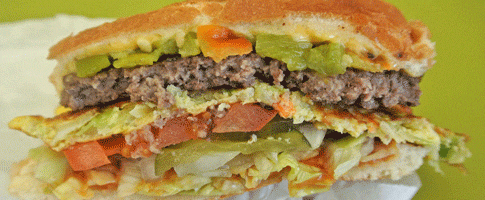
“A Hamburger is warm and fragrant and juicy. A hamburger is soft and non-threatening. It personifies the Great Mother herself, who has nourished us from the beginning. A hamburger is an icon of layered circles, the circle being at once the most spiritual and the most sensual of shapes. A hamburger is companionable and faintly erotic: the nipple of the Goddess, the bountiful belly-ball of Eve.” ~Tom Robbins Hamburgers have long been the apotheosis of comfort food deliciousness and the favorite food of the masses. Regardless of socioeconomic strata, burgers are enjoyed by nearly one and all–to the tune of some 38 billion per year in the United States alone. That’s three per week on average for every man, woman and child. Add in the burger consumption outside the fruited plain and burgers are in rarefied company, placing them among the most popular food phenomenon in the entire world. Culinary experts will tell you the reason for the popularity of burgers can be attributed to three factors: simplicity, convenience and diversity (there’s no limit to how you can dress a burger, if you choose to dress it at all). Shouldn’t great taste factor in there somewhere? Apparently we don’t love…

NM Rodeo Burgers – Rio Rancho, New Mexico (CLOSED)

“Traveling with the rodeo It’s the only life I’ll ever know I started in New Mexico Must have been a thousand years ago.” ~Lyrics to “Ride ‘Em Cowboy” by Paul Davis Although my friends and I were all fairly accomplished horse riders in the svelte and carefree days of our youth, Peñasco didn’t have a high school rodeo team so we couldn’t show off our skills in the arena of competition. Instead we entertained ourselves with such non-sanctioned “rodeo” events as hand-fishing for bottom-feeding suckers and tossing them into a chicken coop where a frenzied take-away melee would ensue with feathers and fish entrails flying. We also enjoyed tossing wet bailing wire into electrical wires overhead. if done right, the bailing wire returned to earth a smoldering ashen heap reminiscent of snake fireworks. Risking life and limb with thousands of volts of electrical current was child’s play compared to riding rambunctious young bulls who would invariably toss us to the ground with impunity. My days of bull riding ended when a recalcitrant bull was spooked by a horse who aimed a kick at my flank, leaving me no recourse but to jump off into a fresh, fetid pile of horse…

The Alley Cantina – Taos, New Mexico

In April, 2014, Gallup conducted a poll to determine state pride across the United States. More precisely, the Gallup poll surveyed people in all 50 states to find out what percentage of residents say their state was the very best or one of the best places to live. Sadly, New Mexico was rated the six worst state to live with only 28 percent of respondents indicating the Land of Enchantment was one of the best places to live. New Mexico was the only state among the bottom ten either not bordering or not East of the Mississippi River. In recent years it seems every quality of life survey conducted lists New Mexico near the very bottom where we compete with Mississippi and Arkansas for “worst” in virtually every aspect of daily life. So, what does it say about New Mexico when it is rated number one…that’s first…in the auspicious category of being “absolutely absorbed by the abnormal?” To arrive at this rating, the Moveto Real Estate Blog actually used Facebook data to determine what percentage of each state’s population had an interest in the paranormal, psychic phenomena, conspiracy and shadow organizations and mythical creatures and mysterious beings. Research indicated that…

Stray Dog Cantina – Taos Ski Valley, New Mexico

There’s a rather ominous sign on the base of the Taos Ski Valley. In bold red uppercase print, the sign reads “DON’T PANIC!,” a preface for somewhat more reassuring text: “YOU’RE LOOKING AT ONLY 1/30 OF TAOS SKI VALLEY. WE HAVE MANY EASY RUNS TOO!” To novice skiers, the steepness of the ski runs visible from the base may as well be the “I’d turn back if I were you” sign Dorothy and her friends encountered when they entered the Haunted Forest on the way to the castle of the Wicked Witch of the West. No doubt the less skilled schussers turn tail like the Cowardly Lion and head for flatter topography. There’s another boldface type warning at another Taos Ski Valley landmark. This one is for the meek of taste bud and gastrointestinal system. The menu at the Stray Dog Cantina warns “Caution: Our chile is not for amateurs. It’s extra tasty, but it can be spicy – it is serious chile.” It’s obvious this warning is intended primarily for out-of-state visitors unaccustomed to their food biting back. For citizens of the Land of Enchantment, such a warning is akin to a red flag being waved at a charging…

Zinc Wine Bar & Bistro – Albuquerque, New Mexico (CLOSED)

Albuquerque’s Nob Hill district largely owes its emergence as the city’s first “suburb” to Route 66, the great Mother Road which carried Americans westward. Because of Route 66, the Nob Hill area has been, since before World War II, a thriving residential community replete with restaurants, motels, a modern movie theater, pharmacies and restaurants. Today it remains the city’s cultural heart and, thanks to the preservation of Route 66 era architecture, retains much of the charm that captivated west bound sojourners. New tenants such as Zinc Wine Bar & Bistro which launched in 2003 hold court in well preserved brick buildings and seem completely at home. Antique mirrors, distressed wood floors, stained glass and warm colors coalesce with intoxicating aromas to make this classy bistro one of the city’s best launches (and lunches) of the new millennium. The French rotisserie, visible from the main floor and the open mezzanine above, turns out some of the best meals in the city. While considered a premium fine dining destination, Zinc’s generous portions are comparatively value priced–your bill may approach three figures, but you’ll feel you got your money’s worth. Meals are well paced with appetizers and entrees brought to your table at…

Delish – Albuquerque, New Mexico (CLOSED)

Rachael Ray may be the most reviled celebrity cook or chef on network and cable television. While adoring fans admire her perkiness and down-to-earth approachability, it’s those traits grumpy detractors (including other celebrity chefs and food writers) seem to find most offensive. Well, that and the way she punctuates sentences with one of her many trademark catchphrases. Entire blogs are dedicated to disparaging her use of “Rachael Rayisms” with heated discussions revolving around the most annoying of her cutesy (or not so very much, depending on your perspective) catchphrases. It’s a true testament to her popularity that one of those catchphrases was selected for inclusion on the 2007 edition of the Oxford American College Dictionary. Thanks largely to the effervescent phenom, EVOO (short for extra-virgin olive oil) is now officially part of the American lexicon. In a list of the seven most annoying Rachael Rayisms compiled by the Huffington Post, EVOO ranked only seventh for “annoyingness.” At the top of the list as the most cringe-worthy catchphrase was “yummo” (which has been used on this blog three times and no, I’m not a Rachael Ray clone). When Mary Ann Spencer, a long-time friend of this blog, told me about a…

Bouche – Albuquerque, New Mexico (CLOSED)

Career paths do not always unfold as stereotypes might dictate. Heavily recruited out of Mission, Texas, a high school football hotbed, Frans Dinklemann, a 6’6″ 241-pound defensive end, signed with the University of New Mexico where his Lobo teammates included perennial National Football League (NFL) All-Pro Brian Urlacher. By his senior year, Frans had grown to 6’7″ and 270 pounds and moved to the offensive line where he set the team weight room record for offensive linemen with a 33-inch vertical leap. The stereotype of the offensive lineman is of a brutish behemoth heavy on brawn and light on brain, a misanthrope with very little personality or charisma. In his inimitable manner, Hall of Fame NFL coach and longtime television analyst John Madden stereotypes the offensive lineman as a “big ol’ mean and nasty guy who tries to knock the snot out of the guy across from him.” With these stereotypes, you might surmise that after his Lobo career ended, Frans Dinklemann would become a nightclub bouncer or pursue some other similar profession requiring muscle and mass. Coach Madden, however, also pointed out that offensive linemen tend to be neat and precise, to be polite and have well-ordered lockers. This…

The Spot Cafe – Corrales, New Mexico (CLOSED)

Big Bang Theory wunderkind Sheldon Cooper has a spot he describes as the “singular location in space around which revolves my entire universe.” That spot is the left side of his couch, a location he has placed “in a state of eternal dibs.” In scientific terms, Sheldon relates his spot as “a single point of consistency in an ever-changing world.” His attachment to that one spot borders on obsession, but he’s not the only television character that possessive of his spot. In television comedies, characters have always had their favorite spots and show little tolerance for anybody who tries to sit in them. Cheers barflies Norm Peterson and Cliff Claivin had their favorite bar stools. Jerry Seinfeld, George Costanza and Cosmo Kramer always sat at their favorite table at Monk’s Diner. Heaven help anyone who sat on Archie Bunker’s favorite chair, the most famous and only one of the aforementioned spots on display at the Smithsonian Museum of American History in Washington, D.C. Television personalities are often based on and mimic real life characters. As such, it will be interesting to see what Corrales resident will develop an attachment to a favorite spot at its newest eatery (as of May,…

Magdalena Cafe – Magdalena, New Mexico (CLOSED)

In 1863 during the height of the Civil War, soldiers on leave from Fort Craig staked claims to silver strikes in the Magdalena Mountains. Within a few years, the boom towns of Kelly and Magdalena had sprung up, eventually achieving a population surpassing even Socorro, the county seat. The first veins of metal ore given up by the rocky promontories were lead and zinc, but ultimately silver became the principal source of wealth. With the arrival of the railroad in 1884, Magdalena became a rowdy frontier mining town and one of the Southwest’s largest cattle shipping centers with its stockyards processing thousands of cattle and sheep. Magdalena became known as the “Trails End” because the spur line which originated in Socorro had its terminus in the town named for the likeness of Mary Magdalene on a nearby slope. The railroad transported cattle, sheep, wool, timber and wool. It also transported carloads of ore to a smelter outside of Socorro. No vestiges of the railroad remain, but it’s easy to imagine how spectacular the 20 meandering miles from Socorro to Magdalena must have been by train. That’s because Highway 60 approximates the route of the railroad line nicknamed “the elevator” because…

Opal Restaurant and Bar – Santa Barbara, California

We’re all familiar with premise of Iron Chef America in which accomplished chefs are pitted against the veritable pantheon of culinary giants who have earned the title of Iron Chef. Can you imagine if one of the vaunted Iron Chefs, or even one of the challengers for that matter, failed to present the judges a variety of ways in which the “secret ingredient” is used? How, for example, would the oft-haughty judges react if during “battle rice” Iron Chef Morimoto presented seven different sushi rolls? Though not led by Iron Chefs, there are a number of fusion restaurants across the fruited plain where you’d swear all the dishes served have a “one-note” flavor profile (usually cloying), the only significant difference being the plating. Conceptually the dishes sound fabulous, but their execution leaves a lot to be desired. Such fusion restaurants perform a tremendous disservice not only to their guests, but to the cuisines they are purporting to showcase in creative manners. Perhaps that’s why Santa Barbara, California resident and former Iron Chef Cat Cora loves Opal Restaurant and Bar so much. Opal actually lives up to the promise of culinary diversity and creativity with one of the most interesting and…

Whole Hog Cafe – Santa Fe & Albuquerque, New Mexico

While the etymology of the expression “whole hog” appears to be American, its progenitor is actually an English slang word. Americans in the new world employed the slang use of hog as a word for dime, intending the term to mean “spend the entire coin at once.” The word hog had been previously used in the Mother Country as slang for a shilling and came from the depiction of a hog on one side of the English coin. To barbecue fanatics, however, the term “whole hog” can only mean one thing–the whole hog category in Memphis in May, the annual world barbecue championships in Memphis, Tennessee, an event which has been called the “Superbowl of Swine.” If you win the whole hog category in Memphis, you have every right to call yourself the very best in the world. It means you’ve mastered ribs, pulled pork and sausage–virtually snout to tail. When we saw a restaurant on Cerrillos Road billing itself as the “Whole Hog Cafe,” we wondered if it was an audacious pretender to the pinnacle of pork or the real deal. The restaurant’s trademark image of a portly porker subtitled “World Championship BBQ” cued us in to the fact…