Panchito’s Restaurant & Bakery – Albuquerque, New Mexico (CLOSED)

“Let’s get one thing straight: Mexican food takes a certain amount of time to cook. If you don’t have the time, don’t cook it. You can rush a Mexican meal, but you will pay in some way. You can buy so-called Mexican food at too many restaurants that say they cook Mexican food. But the real food, the most savory food, is prepared with time and love and at home. So, give up the illusion that you can throw Mexican food together. Just understand that you are going to have to make and take the time.” ~Denise Chavez, A Taco Testimony Despite the title of her book, A Taco Testimony isn’t a celebration of the folded, hand-held treasures of diverse deliciousness enveloping meats, vegetables and condiments. Nor is it a compilation of recipes detailing precisely how to create these homespun, rustic snacks as generations of families have enjoyed them. At a surface level, author Denise Chavez, a Las Cruces resident, writes about the familial and cultural experiences and dramas of growing up in Southern New Mexico. From an allegorical perspective, the underlying message of A Taco Testimony is that if you understand a people’s food, you can understand their culture…

The Cube – Albuquerque, New Mexico (CLOSED)

Timon: [singing] Luau. If you’re hungry for a hunk of fat and juicy meat Eat my buddy Pumbaa here, ’cause he’s a tasty treat Come on down and dine on this tasty swine All you gotta is get in line Are you achin’… Pumbaa: Yup, yup, yup. Timon: For some bacon? Pumbaa: Yup, yup, yup. Timon: He’s a big pig. Pumbaa: Yup, yup. Timon: You can be a big pig, too. Oy. From Disney’s Lion King Succulent swine. Porcine perfection. Bodacious baby backs. Pulchritudinous pulled pork. Every serious barbecue aficionado should go hog wild at least once in their lives and pig out in Memphis, Tennessee, indisputably one of America’s bastions of barbecue and home of the “Memphis in May World Championship BBQ Cooking Competition.” Never mind the great gridiron gala (the championship of the National Football League), the “Superbowl of Swine” is where barbecue addicts want their fill of pigskin and Memphis is where they meat. Although Memphis prides itself on the diversity of its barbecue, traditional Memphis barbecue is primarily about “low and slow” smoked pork served one of two ways: pulled into tender, melt-in-your-mouth pieces or as meaty ribs on a slab. Those righteous ribs are available…

Rey’s La Familiar Restaurante – Albuquerque, New Mexico (CLOSED)

Many similarities exist between writing beautiful lyrics for a memorable song and developing a great recipe for memorable food. Great lyrics involve putting together the right words so that they flow easily around a meaningful topic. Great recipes involve putting together the right ingredients so they coalesce into a delicious whole. There are no real rules to writing great lyrics or recipes, but not everybody can do it. You’ve got to have the right combination of talent, dedication and inspiration. Great lyrics and great recipes often require extensive trial and experimentation over a long period of time until they can’t be made any better. Michael “Rey” is blessed with the rare ability to create both memorable lyrics and memorable recipes. A larger-than-life personality with a mellifluous voice, Michael always made the time to regale guests at Rey’s Place with the soul-touching, poignant and beautiful music he’s written. Some of those songs have reduced grown men to blubbering as my friends will attest after the first time they heard Frame by Frame. Michael’s lyrics resonate life–its vicissitudes and challenges–and they personify William Shakespeare’s astute observation that music is the food of love. Although Michael has been a songwriter for a long…

Rancher’s Club of New Mexico – Albuquerque, New Mexico

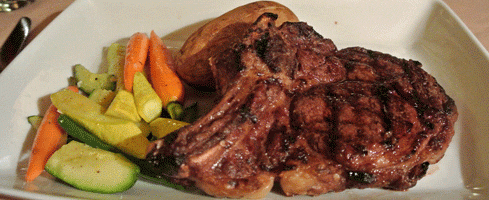
While the Ranchers Club of New Mexico may evoke images of J. R. Ewing holding court with fellow oil barons and business magnates in Dallas, this magnificent milieu is, at its core and essence, unabashedly New Mexican in its attitude and spirit. Don’t let its ostentatious trappings–a sophisticated big city opulence meets a decidedly westernized look and feel–fool you. Sophisticated doesn’t mean haughty and ostentatious doesn’t mean exclusive. The Land of Mañana’s well-renowned inclusiveness means more than just the one-percenters will feel at home. It’s been that way since the Ranchers Club opened in 1985. More than half the dinner reservations made at the Ranchers Club are made by locals, not by tourists and visitors staying at the steak palace’s home, Albuquerque’s Crowne Plaza Hotel on the northeast corner of the Big I interchange. Not every diner will “put on the dogs” when they visit. In fact, blue jeans are almost as common as business casual. The dress code calls for men to wear collared shirts and prohibits beach sandals, shorts, tee-shirts and work-out clothes. How much more New Mexico can you get for a fine-dining, high-end restaurant? Inspired by the rustic elegance of ranch house comfort, the Ranchers Club…

Paco’s International Smoked Cuisine – Albuquerque, New Mexico (CLOSED)

“If salt is the odorless spice, smoke is the ephemeral magical invisible spice. You can’t feel it, you can’t touch it, but you can taste it.” ~Chef Seamus Mullen, Tertulia Restaurant, New York City. Have you ever wondered why some people drool when they pass by a computer displaying a fireplace screen saver? They’re not thinking about romance. They’re thinking about barbecue. There’s just something about smoked foods that has excited humans across the millennia. It’s been that way since a lightning bolt struck a mastodon and rendered its flesh delicious. Since then humans have been genetically predisposed to crave the flavors created by the penetration of smoke. We associate fire and the fragrant bouquet of wood smoke with grilling, barbecues and mostly, eating things we love. When my friend Ryan “Break the Chain” Scott told me of an Albuquerque chef incorporating the element of smoke into virtually every ingredient of every dish he creates, my initial inclination was to think Ryan had been smoking something. It hadn’t surprised me to read in Around the World in 80 Dinners that Bill and Cheryl Jamison ate smoked zebra carpaccio in South Africa as much as it did to learn that the…

Milton’s Cafe – Albuquerque, New Mexico (CLOSED)

“Where we love is home – home that our feet may leave, but not our hearts. ~Oliver Wendell Holmes You might think that a world-famous cookbook author and New York Times food writer who dines at four-star white-tablecloth restaurants and routinely drops $200 or more for a meal would be ecstatic about his culinary opportunities. Instead, Mark Bittman appears to have had too much of a good thing and longs for, of all things, a restaurant which feels like home (ostensibly without having to do the dishes). Bittman laments “I want “my” place, don’t you? A place with a working chef, not a cookie-cutter spinoff and certainly not a circus. A place where the food is at least as good as what I can do at home and preferably better, and consistently so; one that’s pleasant; one where I’m vaguely known as a repeat customer, but not falsely fawned over; one where I can pay without thinking about what that chunk of money might have gone to instead.” New Mexico’s dining options aren’t nearly as diverse and plentiful as those in New York City and my dining budget is a modicum of Bittman’s, but quite frequently I’m completely simpatico with…

Street Food Asia – Albuquerque, New Mexico (CLOSED)

What is street food? An informal poll of friends and colleagues generated some interesting answers. One colleague equates street food to road kill– the flattened fauna, car-crashed carrion and furry Frisbees found on and along the highways and byways throughout the fruited plain. (Hmmm, that answer might explain his halitosis.) To another, street food is synonymous with hot dog carts while yet another colleague answered simply “roach coaches” (a pejorative for food trucks). The most interesting answer, provided by a geriatrically advanced friend not quite contemporaneous with Charles Dickens, was “chestnuts” with which not everyone in my focus group was even acquainted. By definition, all of those answers could probably be considered at least partially correct. The term “street foods,” as defined by the Food and Agriculture Organization (FAO) of the United Nations, describes “a wide range of ready-to-eat foods and beverages sold and sometimes prepared in public places, notably streets.” The FAO further stipulates that “the final preparation of street foods occurs when the customer orders the meal which can be consumed where it is purchased or taken away.” While New Mexico, and for that matter, the United States, has a burgeoning street food culture, it pales in comparison…

Chillz Frozen Custard – Albuquerque, New Mexico (CLOSED)

“Custard: A detestable substance produced by a malevolent conspiracy of the hen, the cow, and the cook.” Ambrose Bierce, American writer (1842-1914) The Devil’s Dictionary (1906) Ambrose Bierce’s scathing definition of custard is not necessarily an expression of his disdain for the popular frozen dessert, but an example of his lampooning of American culture and especially its lexicon. Starting in 1881, the American satirist began writing The Devil’s Dictionary in which he published alternate and usually quite acerbic definitions of common words. His biting wit and sardonic views earned him the nicknames “cackling king of cynics” and “Bitter Bierce.” There are parts of the Midwest (the Milwaukee and St. Louis areas in particular) in which Bierce’s definition of custard would be considered sacrilege. Midwesterners feel so strongly about their custard, that an utterance of such blasphemy would be an occasion for a noose, a tall tree and a short drop. Their passion for frozen custard is akin to the love New Mexicans have for chile and never mind that winter temperatures throughout the Midwest can drop to near Arctic levels, custard is an year-round obsession. Just as most New Mexicans have a strong antipathy toward “chili” from Texas, Midwesterners abhor…

Terra Bistro Italiano – Albuquerque, New Mexico (CLOSED)

To some extent, people watch Anthony Bourdain for the same reasons they tune in to infamous shock-jock Howard Stern–to see what he’ll say next. Though Bourdain, the best-selling author, world traveler, renown chef and “poet of the common man” is hardly the potty-mouthed bane of the Federal Communications Commission that Stern is, his incisive comments are oft peppered with pejoratives and references to genitalia. They’re also laden with insightful, well-reasoned, highly intelligent and well articulated thoughts uncommon in the world of food television currently dominated by pretty faces with Ultra Brite smiles. In the 2010 season premier of his No Reservations show, the first words Bourdain uttered were “the optimist lives on a peninsula of infinite possibilities; the pessimist is stranded on the island of perpetual indecision.” It’s not every culinary celebrity who can quote William Arthur Ward, or even know who he is, but Bourdain is not only a fellow sybarite, he is well-read and highly intelligent. His introduction gave me pause to reflect on Ward’s words, one of my very favorite inspirational maxims. Just hours earlier, I was transformed from an eternal optimist to someone mired in indecision. What caused this transformation was nothing less than the perusal…

Chin Shan Chinese Restaurant – Albuquerque, New Mexico

According to the trade magazine Chinese Restaurant News, as of January, 2007, there were 43,139 Chinese restaurants in the United States. That’s three times the number of McDonalds franchise units and more than the total number of McDonalds, Burger King and Wendy’s in America combined. More than 80 percent are family-owned with nation-wide chains such as Panda Express and PF Chang’s accounting for only five percent of all Chinese restaurants across the fruited plain. Raking in nearly $17 billion in annual sales, Chinese restaurants are nearly on a profitability par with the behemoth burger chain, too. Until recent years, many (if not most) Chinese restaurants specialized in inexpensive all-you-can-eat buffets, most of dubitable quality. Today, buffets are the bailiwick of behemoth supermarket-sized Chinese restaurants, some of which can accommodate hundreds of hungry patrons. Chinese buffet restaurants remain very popular, perhaps as much because of economic considerations as for their prolific portions. Prodigious portions do not, however, transformative meals make. Few, if any, people who frequent Chinese buffets will admit to visiting because the food is so good it’s memorable. Urbanspoon shows there are nearly 100 Chinese restaurants (or Asian fusion restaurants featuring Chinese food) in the Duke City. Only a…

Sushiya Asian Fusion Cuisine – Albuquerque, New Mexico

“I don’t eat anything that a dog won’t eat. Like sushi. Ever see a dog eat sushi? He just sniffs it and says, “I don’t think so.” And this is an animal that licks between its legs and sniffs fire hydrants.”.“ – Billiam Coronel Sushi has come a long way in America.  There was a time–and not very long ago–that many Americans would have agreed with comedian Billiam Coronel’s assessment of sushi.  Fellow funny-man George Carlin certainly did: “I never eat sushi. I have trouble eating things that are merely unconscious.” The attitudinal shift that has made sushi an explosive American phenomenon was at its peak in the ten-year period beginning in 1998.  Ten years later, there were five times as many sushi bars in the fruited plain and there appears to be no surcease to the popularity of what so many people poo-pooed as just “raw fish” just a few years ago.  Sushi has become so popular, so trendy that Food and Wine wrote in 1995 that “America is becoming a nation of sushi connoisseurs.” There are over 330 sushi restaurants in greater Los Angeles, about 335 in New York City and nearly 300 in Dallas.  There are at least…