Blog

Ice Cream Palace and Hot Dog World – Rio Rancho, New Mexico (CLOSED)

Nay-sayers, those nattering nabobs of negativism, have always had it in for hot dogs. First they plied us with horror stories and urban myths about what hot dogs are made of. Essentially, they decried, hot dogs are made of everything from pigs snouts and chicken feet to snips and snails, and puppy dogs tails. Then they ratcheted up our shock and awe by telling us how hot dogs are loaded with artery-clogging, cancer-causing saturated fats, not to mention those nasty nitrates and nefarious nitrites. They’ve even disparaged hot dogs as processed pink slime in a bun. Despite all the brouhaha and rigmarole, hot dogs continue to thrive across the fruited plain as aficionados of the tantalizing tubular treats snub their noses at those who would abolish an American institution. What’s next—motherhood, apple pie, the Dallas Cowboys? Recent statistics reveal that the U.S. population consumes 20 billion hot dogs per year. That’s some 70 hot dogs per person per year (or about as many as Joey Chestnut ate in one sitting during Nathan’s International Hot Dog Eating Contest). In 2012, CNN compiled a list of America’s top fifty foods and the hot dog ranked fourth. That’s a lot of love for…
Taco Shel – Albuquerque, New Mexico

Having left New Mexico in the mid 1980s, the pangs of pining for New Mexico’s incomparable, capsaicin-rich cuisine have left Brian Riordan sleepless in Seattle. I can certainly commiserate, having spent much of 18 years away from the “Land of Enchilement,” (an appropriate sobriquet courtesy of the erstwhile Albuquerque Journal restaurant critic Andrea Lin. After discovering this Web site, Brian e-Mailed me to share his musings on and memories of the Duke City dining scene, many of which we shared in common. We both recall fondly when Taco Sal served some of the best New Mexican cuisine in the city. For Brian, it was the #11, beef burrito plate, that captured his heart to the tune of nearly a visit per week. For me, the stuffed sopaipillas were the prototype New Mexican entree. With more than half a century under the same roof, Taco Sal has pleased a lot of palates during its run. That was before the restaurant (but not the recipes) was sold and went from a restaurant whose name you’d swear was short for “salivating” (because that’s the effect it had on most diners) to a restaurant that has changed hands several times and lost the consistency…

Asian Grill – Albuquerque, New Mexico (CLOSED)

In “My Fair Ernest T. Bass,” one of the most hilarious episodes ever of the 1960s television classic, The Andy Griffith Show, Sheriff Andy Taylor tried to pass off Ernest T. as a cultured gentleman. By teaching him manners, Andy hoped Ernest T., a bumpkinly, rock-throwing, havoc-wreaking hillbilly, would find a girl and learn to behave in polite society. The expectations Andy had for the slovenly Ernest T. were an example of the Pygmalion Effect, a phenomenon positing that the greater the expectations placed upon people, the better they will perform. It’s a form of self-fulfilling prophecy. Could this phenomenon have been in play when Albuquerque city councilor Ray Garduño (no relation) and other civic leaders came up with a new name for an old neighborhood? For years, a section of Southeast Albuquerque stretching roughly from the state fairgrounds area to Kirtland Air Force Base, had been commonly referred to as the “War Zone,” a derogatory sobriquet it gained because of high crime rates at the time. In recognition of the area’s cultural diversity and neighborhood partnerships designed to further the area as a cultural and social hub, the group agreed upon the name the “International District.” The International District…

Jhett’s Restaurant – Rio Rancho, New Mexico (CLOSED)

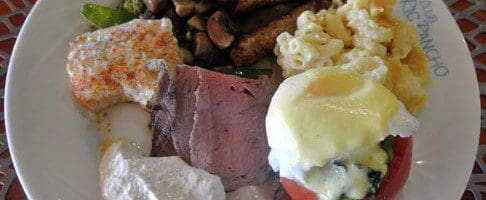
In its halcyon days, the Chamisa Hills golf course and country club in Rio Rancho was considered one of the city’s crown jewels. Its undulating 18-hole championship course with strategically placed deciduous trees and challenging water hazards once hosted the Charley Pride Golf Fiesta, one of the most prestigious tournaments in the state. Built in 1970, the 212-acre development was flanked by upscale gated communities and boasted of magnificent panoramic views showcasing the reddish hues of the Sandias at sunset and the twinkling city lights of Albuquerque at night. Alas, over time escalating water rates made operating the course economically onerous. Soon denuded fairways and eroded bunkers replaced the once verdant grounds. In 2013, the Chamisa Hills golf course and country club was auctioned off to be purchased nearly a year later by visionary entrepreneurs Bob Gallagher and Jhett Browne who immediately began putting into action their plans for restoring the operation to prominence and profitability. The two negotiated significant water rate reduction rates and plan for reduced turf areas to conserve water. At fruition, they hope to revivify the facility into one of the area’s best event centers, not just golf clubs. Rebranded as Club Rio Rancho, the sprawling…

Frost Gelato – Albuquerque, New Mexico

“I believe gelato is meant to be treated as medicine and taken daily as a prescription.” ~Author: Betsy Brandt If you’ve never associated such words as searing, stifling, sweltering, sultry, sticky and sizzling with Italy, you probably haven’t been there during a summer heat wave. During the day, cobbled streets heat up like a pizza oven, radiating heat even through the night. Worse, in much of Italy air conditioning is a rare luxury, especially by American standards. Even at five-star luxury accommodations you probably won’t be able to drop the temperature down to the cool 70-degrees you enjoy at home. Summer’s heat in Italy is probably why Andrew Zimmern, host of the Travel Channel’s Bizarre Foods Delicious Destinations program described gelato as “Italy’s air conditioning,” a phrase coined by Faith Willinger in 1996. More specifically, she called gelato “oral air-conditioning, the only food that Italians will eat on the street.” Aside from its cooling properties, both Zimmern and Willinger wax poetic about the sheer deliciousness of the cool, creamy, refreshing treat Italians have perfected. Tucson natives and lifelong friends Stephen Ochoa and Jeff Kaiserman found out just how hot Italy can be when visiting Lo Stivale, the boot-shaped nation. Now,…

The Library – Albuquerque, New Mexico (CLOSED)

Although my Kim has now lived in New Mexico for more than twenty years, her functional Spanish hasn’t improved much (sadly this places her in the company of many native New Mexicans). She sings Spanish hymns like a songbird in church, perfectly enunciating each nuanced word, even when she has to roll her “R’s.” On rare but well-deserved occasions she can direct a slew of choice Spanish expletives at moronic motorists. She can also order all her favorite dishes at Mexican and New Mexican restaurants with fluency. What she can’t do is carry on or even understand a coherent conversation in Spanish. During her first visit to the Land of Enchantment, my Kim inventoried her vocabulary of Spanish words and terms in anticipation of meeting my mostly Spanish-speaking grandmothers. Interestingly, her limited vocabulary included such tongue-twisting words as “albondigas” (meatballs) and the phrase “donde esta la biblioteca” (where is the library?). Neither would serve her well in discourse with my grandmothers who were as worried about their command of the confounding English language as Kim had been about her Spanish. One early September morning, she asked if i had any suggestions for lunch. My response “vamos a la biblioteca” (let’s…

Thai Tip – Albuquerque, New Mexico (CLOSED)

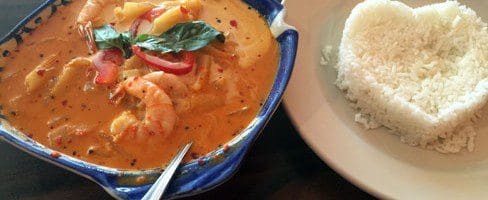
Although short in stature, gregarious Tippewan “Tip” Sherrod, for whom Thai Tip is named, is as dynamic and passionate a restaurateur as you’ll meet in Albuquerque. If she’s not inundated with hungry patrons, she might take time out to recount her background as a midwife in her native Thailand as she extols the healthy qualities of Thai food. While she takes your order she might just tell you about the curative and healthful properties of your particular choice. 30 April 2005: The Thom Kha Kai (a traditional Thai soup based on coconut milk with the sweet scented spicing that comes from lemon grass and galganal, (a root similar to ginger), for example, is good for high-blood pressure. It’s also good for a hearty appetite. Served in a large tureen, you’ll ladle onto a bowl such ingredients as broken lime leaves, coriander, chili peppers, mushrooms and lime juice. The tanginess of the lime juice and the sweet, rich creaminess of the coconut milk are in perfect proportions to make for an aromatic and delectable soup. Tip’s version is among the very best in town and best of all, it’s prepared to order. 30 April 2005: Tip is adamant about fresh food…

300 Club Bar & Grill – Albuquerque, New Mexico

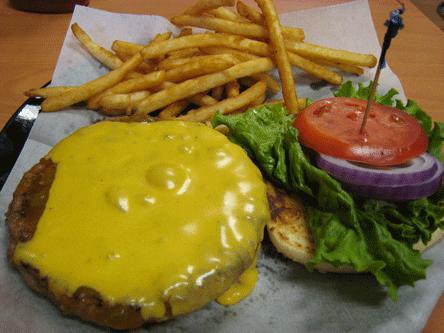
300! In the parlance of the bowler, it signifies absolute perfection, twelve consecutive strikes. According to some trusted foodies, the 300 Club Bar & Grill in Albuquerque’s Skidmore’s Holiday Bowl on Lomas just east of San Pedro serves a mean green chile cheeseburger, a 12-strike masterpiece, a perfect 300. This is a burger so good, it was one of the twenty contestants for the inaugural Governor’s Green Chile Cheeseburger Challenge in 2009. We all know the stereotypes about bowling alley food. When it comes to food, most bowling alleys strike out. Ardent keglers are subjected to such catastrophic “cuisine” as perpetually rotating hot dogs seared to a leathery sheen under a heat lamp inferno, soppy messes of nachos bathed in gloppy processed cheese topped with gelatinous jalapeños and greasy onion rings with the texture of fried rubber bands and as oily as well-slicked lanes. Getting something edible at most bowling alleys is as tough as picking up a seven-ten split. The fact that the 300 Club Bar & Grill has a separate entrance from the rest of the bowling alley is a promising sign. That promise is bolstered by its utterly charming sports bar ambiance which is wholly unlike the…

Gravy – Albuquerque, New Mexico (CLOSED)

“Gravy is the simplest, tastiest, most memory-laden dish I know how to make: a little flour, salt and pepper, crispy bits of whatever meat anchored the meal, a couple of cups of water or milk and slow stirring to break up lumps.” ~Dorothy Allison, American writer Some would say that the discovery (invention?) of gravy is one of mankind’s crowning achievements. Others would deride it as the work of the devil, likening gravy to a beguiling temptress which bends the will to its bidding. Dolly Parton acknowledges that “every single diet I ever fell off of was because of potatoes and gravy of some sort.” It’s no surprise that similar to many of the world’s best tasting foods, gravy is generally fattening. Most commonly, it’s the byproduct of pan drippings and juices derived from cooking meat. Some among us who consider gravy one of mankind’s most glorious achievements (even as it flows through our veins) may salivate involuntarily when turning onto Central Avenue and espying a large sign reading simply “Gravy” subtitled with the three events with which gravy goes so well: “breakfast, lunch, dinner.” One of the most eagerly anticipated restaurant launches in recent memory, Gravy is the brainchild…

Sandia Chile Grill – Albuquerque, New Mexico (CLOSED)

If perspiration is (as the proverbial “they” have declared) the mother of invention, Mickey and Clinton Coker may just be two of the most glistening guys in the Duke City. Since 2004, the Cokers have “reinvented” their restaurant four times. If you’re thinking, they’re just try, try, trying again until they get it right, you couldn’t be more wrong. Mickey Coker, the entrepreneur behind the four make-overs, started with a culinary concept that was so wildly successful, it prompted almost immediate growth. His second effort, a brick-and-mortar operation, also achieved significant acclaim. Some might have considered the third Coker transition strictly a sideline…until it started garnering one award after the other. The fourth step in the evolution of the Sandia Grill may be the most revolutionary of all. For Mickey Coker, the route to entrepreneur was inauspicious. He got his start selling New Mexican food at a gas station-convenience store. Yes, the very notion of a gas station-convenience store food conjures images of salty, cylindrically shaped dry meat snacks with the texture of sawdust and air-filled bags of Cool Ranch Doritos. Now mention New Mexican food and gas station in the same sentence and the likely image would make all…

Coyote’s Rooftop Cantina – Santa Fe, New Mexico

National Geographic Traveler once described Santa Fe as “a hypercultural hybrid–equal parts Wild West and New Age, Native American and Hispanic, old money and old hippie”…a city “used to mixing things up and still creating an oddly seamless whole.” It truly is the City Different, a city with an identity, substance and style all its own. Is it any wonder it has earned acclaim as one of the most popular travel destinations in the world? Yet, to many people, Santa Fe is as much an escape as it is a destination. It is an adobe colored Mecca that preternaturally calls seekers to a spiritual and creative fulfillment they just don’t find elsewhere. Santa Fe draws them with an amalgam of spiritual tranquility, piñon-perfumed air and its accepting, non-judgmental culture. It holds them captive with its beauty and its cuisine. One of the defining elements of contemporary “Santa Fe style” has been the howling coyote, an art phenomenon originated by woodcarver Alonzo Jimenez a couple of decades ago. While the coyote is prevalent in contemporary Native American mythology and generally represents a cunning, treacherous scourge, to New Mexico artisans he has been a blessing, displayed on every conceivable medium. The howling…