Grimaldi’s Pizzeria – Scottsdale, Arizona

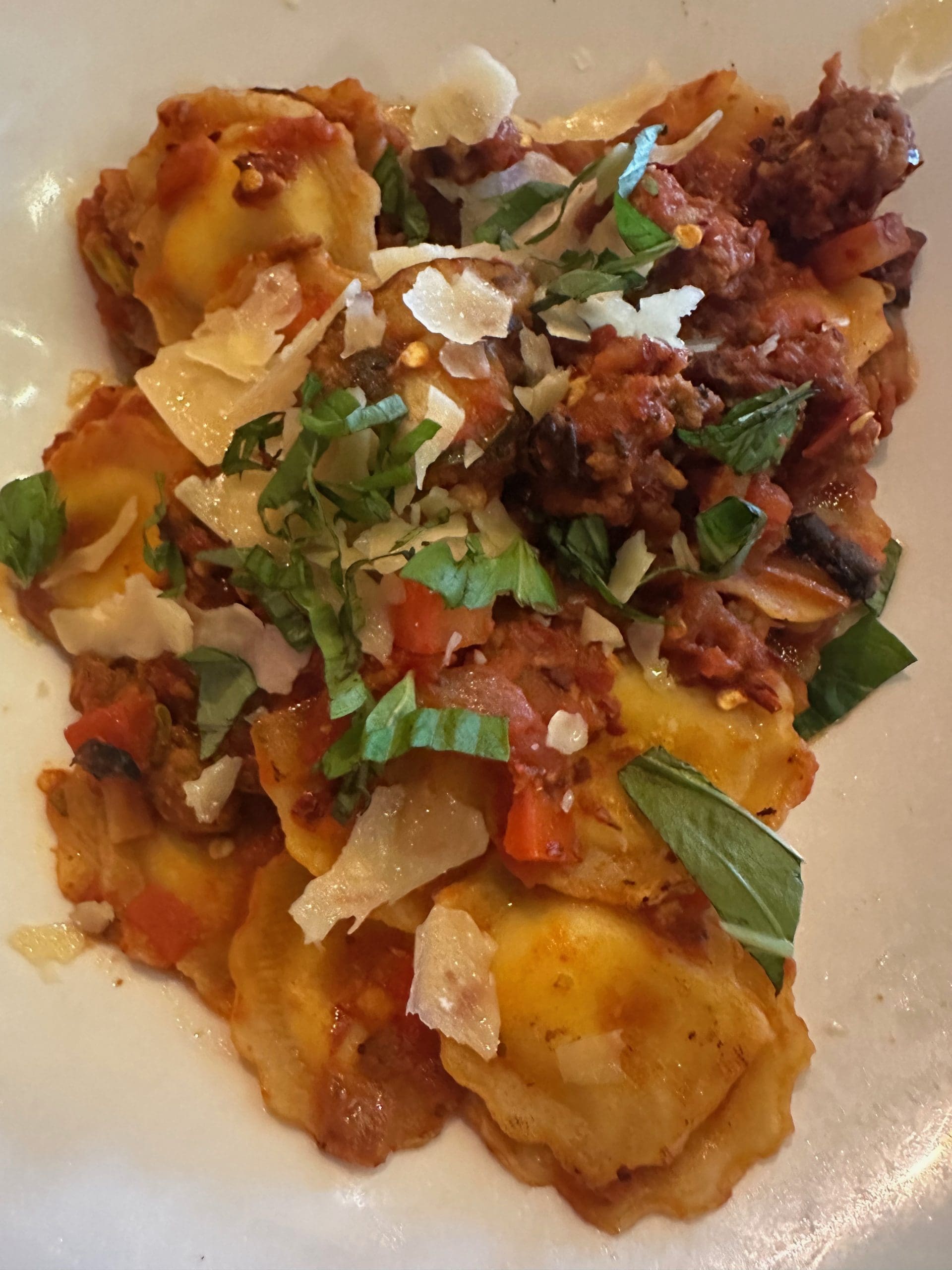
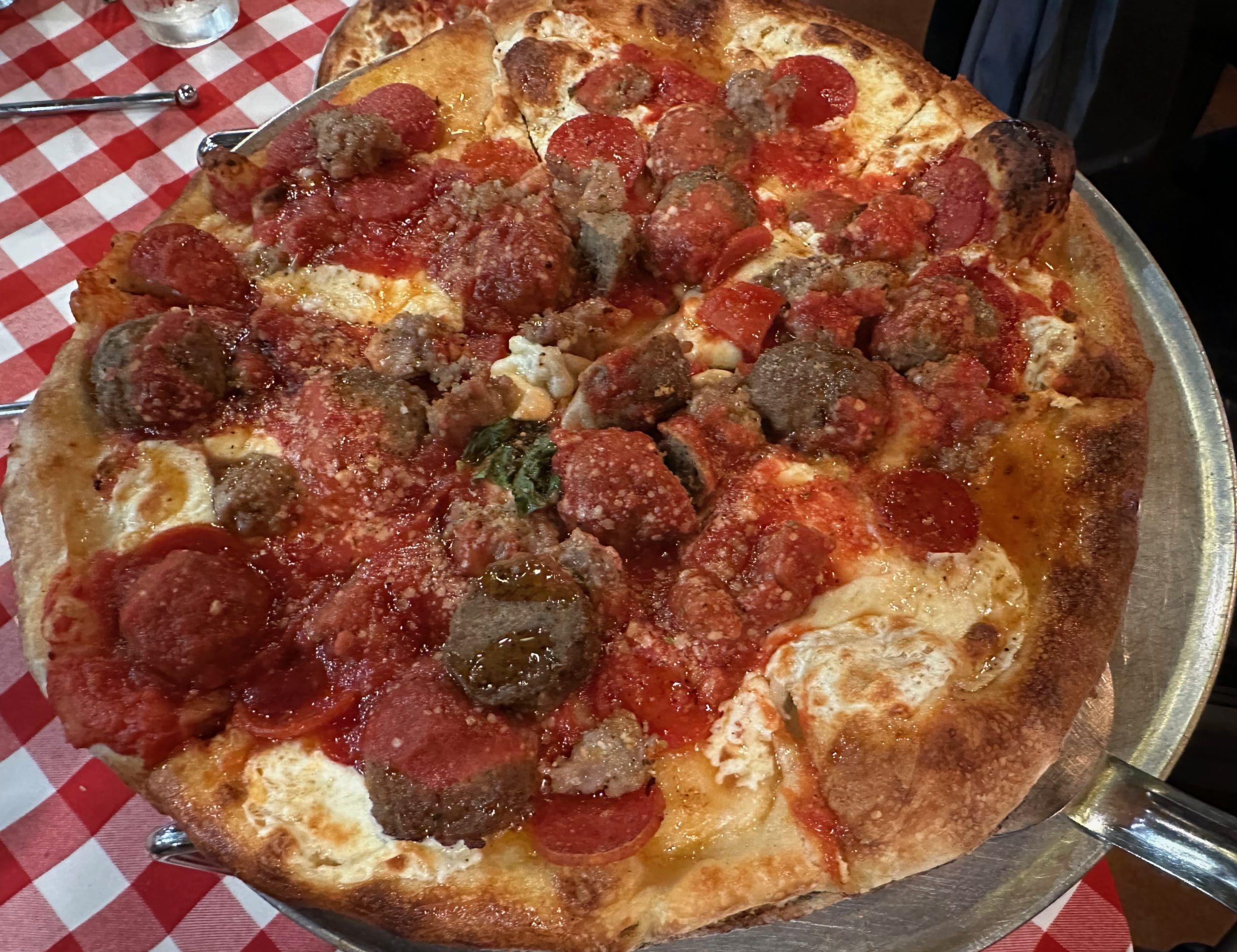
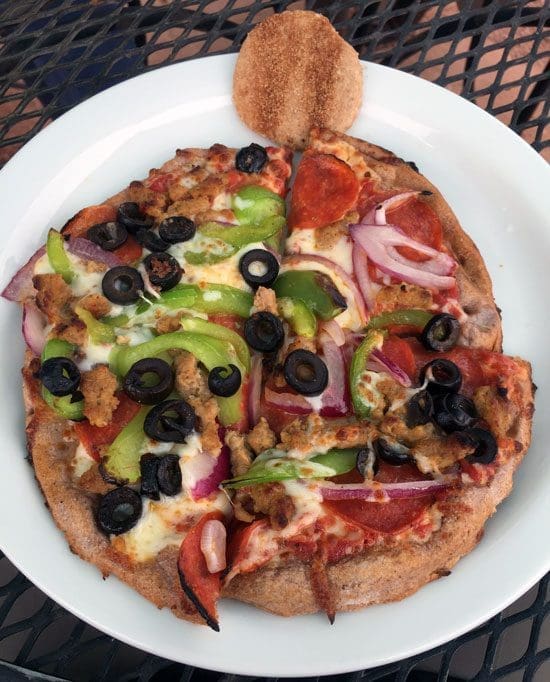
I don’t often refer to myself as a “restaurant critic” or “restaurant reviewer.” My preferred gloss is “observer and essayer on the culinary condition.”   Yep, that’s a high falutin bit of ego-stroking, but it’s accurate.  One of the things I’ve observed during frequent trips to the Phoenix area–both while employed at Intel and while snowbirding over the Christmas and Festivus holidays–is that middling quality chain restaurants tend to find a home in the Valley of the Sun an year or two before figuring out they would be smash successes in Albuquerque. Another salient obseration is that some pretty highly regarded East Coast and Midwest restaurants and chefs don’t like the cold either…or maybe they’re following the exodus of snowbirds wanting to escape the miserable winter weather.  Ted’s Hot Dogs, a Buffalo refugee turned Valley mainstay since the 1980s was among the first.  Grimaldi’s, a New York City institution which can trace its lineage to America’s pizza pioneers, followed suit a few years later.   Strewn across the Valley are such Chicago transplants as Lou Malnati’s, Rosati’s Pizza and the perpetually mispronounced Portillo’s.  Every one of these restaurants has maintained a presence where they got their starts, but are also…

Golden Crown Panaderia – Albuquerque, New Mexico

“Around the world while the city still sleeps, you begin.  Some of you because that’s what your parents did.  Others, you’re the first of your kind.  But all of you are one.  Siblings in an ancient tradition.  You take the time, temperature and love.  You bring them together to make something that brings people together.  You make more than just food.  You make friendships.  You make joy.  And for a hundred years, Dawn has been right there with you.  So this is for you, for bakers everywhere.  Thank you for letting us be part of your story.  Here’s to the next chapter together.  Here’s to bakers.” Albuquerque’s beloved Golden Crown Panaderia was one of five bakeries across the globe selected to be featured in a new spot for Dawn Foods. The advertisement, which showcases the work bakers do each morning, followed the father-son tandem of Pratt and Christopher Morales as they get Albuquerque ready for the day with the best baked goods in town.  It’s a touching tribute to true unsung heroes: Dawn 100 Years | Thank You Although we pride ourselves on keeping a pulse on the local dining scene, it took a nationally syndicated Food Network cable program called Food Finds…

Basil Leaf – Albuquerque, New Mexico

“Do we really want to travel in hermetically sealed Popemobiles through the rural provinces of France, Mexico and the Far East, eating only in Hard Rock Cafes and McDonalds? Or do we want to eat without fear, tearing into the local stew, the humble taqueria’s mystery meat, the sincerely offered gift of a lightly grilled fish head? I know what I want. I want it all. I want to try everything once.” – Anthony Bourdain Genesis 11 recounts a time when the entire world had a common language and dwelt as one people. Alas, hubris overtook the generations of survivors of the great flood who decided, with great unity of purpose, to build a city named Babel with a tower that would reach to heaven itself. Our omnipotent God knew this “stairway to heaven” was essentially a self-aggrandizing monument to the people themselves, calling attention to their own abilities and achievements instead of giving glory to God. Consequently, God confused their language, causing them to speak different languages so they would not understand one another. He also scattered the people of the city all over the face of the Earth. Some Biblical scholars believe this event marks the point in…

TONY CAPUTO’S MARKET & DELI – Salt Lake City, Utah

Most of us know someone like Lucy Van Pelt, the irascible, bossy, highly opinionated diva in the syndicated Peanuts comic strip.   Since her debut in 1952, Lucy has been the perpetrator of two long-running gags.  One involves her holding the football (ostensibly so that Charlie Brown can kick a field goal or extra point) and pulling the ball away because she doesn’t want Charlie Brown to get it dirty.  The second gag parodies the lemonade stand operated by many young children under spacious skies.  Instead of a lemonade stand, she operates a psychiatric booth where she offers advice and psychoanalysis for a nickel.  The “advice” is often worthless though on occasion, she actually dispenses a pearl of wisdom.  Lucy Van Pelt has nothing on Tony Caputo and his friends in Salt Lake City.  Every Saturday morning for years, Tony and his friends, seven sagacious septuagenarians, would meet at Tony’s eponymous deli where they’d solve all the world’s ills.  To amp up excitement in their lives, they decided to share their wisdom with people in dire need.   Caputo got a booth at the nearby farmers market where the seven could dispense their counsel.  He put up a large banner…

JAMBO CAFE – Santa Fe, New Mexico

Growing up in the 60s–the dark ages before the Internet was even a glimmer in Al Gore’s eyes and google–then spelled “googol”– represented an very large number (currently being approached by build back better spending)–even precocious children like me derived most of our knowledge of Africa from National Geographic magazines and Tarzan movies. We thought Africa was one large monolithic country comprised solely of stark, expansive deserts or lush, mysterious jungles. Africa’s indigenous people, we believed, had to compete for food with lions, tigers and hyenas, oh my. Though Africa was called “the Dark Continent,” it was truly our knowledge which was in the dark, obfuscated by stereotypes and misconceptions. The 1966 debut of Star Trek helped eliminate some of those stereotypes with the introduction of communications officer Lieutenant Uhura, a stunning black woman from the United States of Africa who spoke Swahili. By the time Disney’s The Jungle Book premiered in 1967, I had learned enough about Africa to know that save for in zoos, you couldn’t find a tiger in the entire continent. In the intervening years since the naivete of my youth, I’ve also learned that Africa is comprised of 53 very distinct and autonomous nations and…

NOPALITO RESTAURANT – Las Cruces, New Mexico

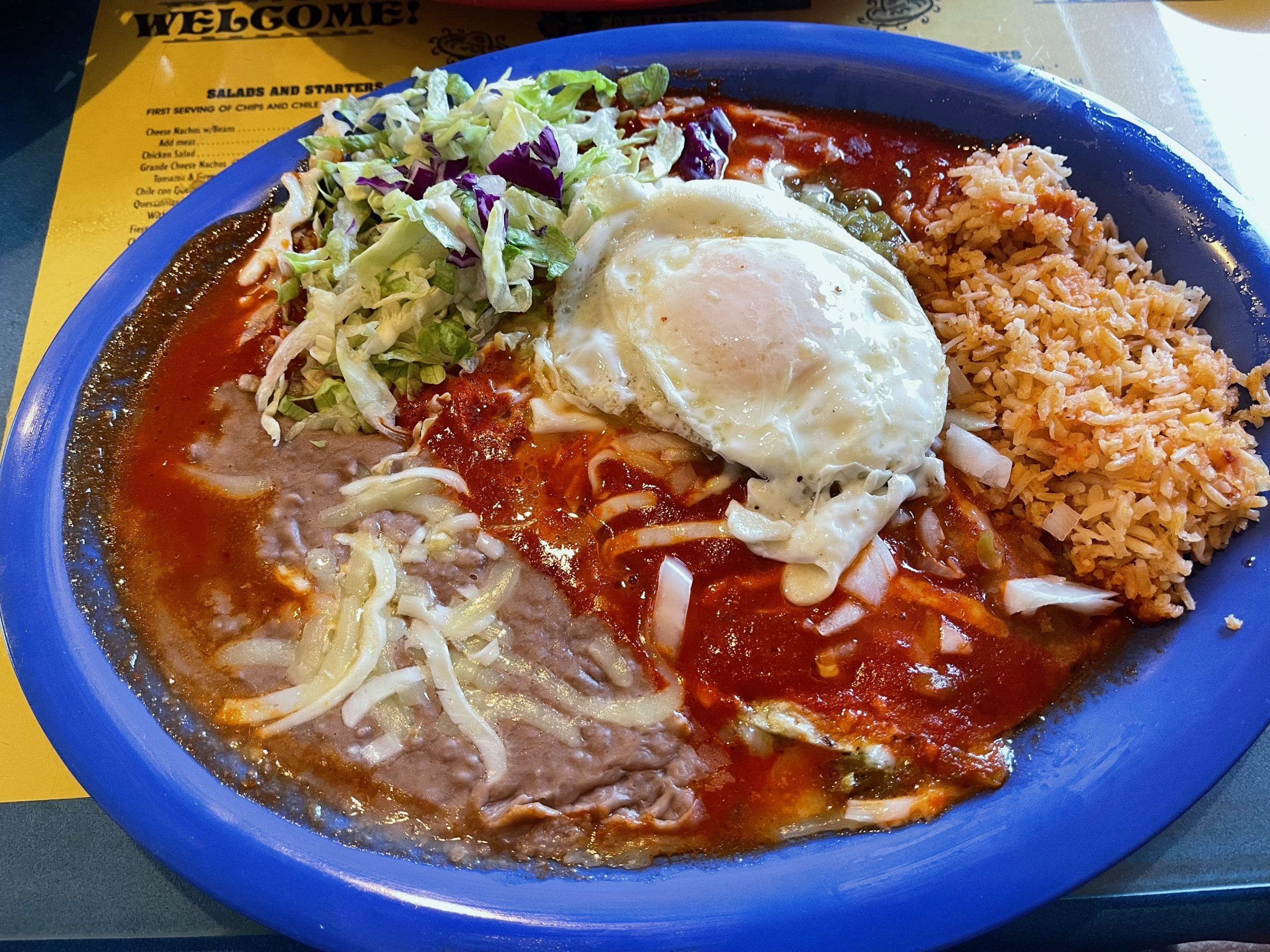
Growing up in rural Northern New Mexico, my siblings and I thought all Mexican food was the same–the way my mom, grandmothers and aunts prepared it (which is to say it was outstanding).  At the time New Mexicans hadn’t universally acknowledged that the genesis of our cuisine wasn’t solely Mexico.  Back then, only the most savvy culinary historians were crediting Spanish and Native ingredients and preparation techniques as differentiating factors that made New Mexican cuisine unique.  It also wasn’t that long ago New Mexicans were spelling our official state vegetable as “chili.”   No, that’s not an episode of the Twilight Zone.  It’s the way it was just a few decades ago when all three of  my sisters matriculated at New Mexico State University. We didn’t know what to think when they’d return home on long weekends and holidays and prepared these strange and different “Mexican” dishes.  Sour cream enchiladas?   Con queso made with muenster cheese?  Green chile salsa?  Rolled enchiladas?  Gorditas?  Those “Mexican” restaurants in Las Cruces were either revolutionizing Mexican food or they didn’t know what they were doing.  It didn’t take long before we all embraced these new dishes and looked forward to sampling other delights from…

Sparky’s Burgers, Barbecue & Espresso – Hatch, New Mexico

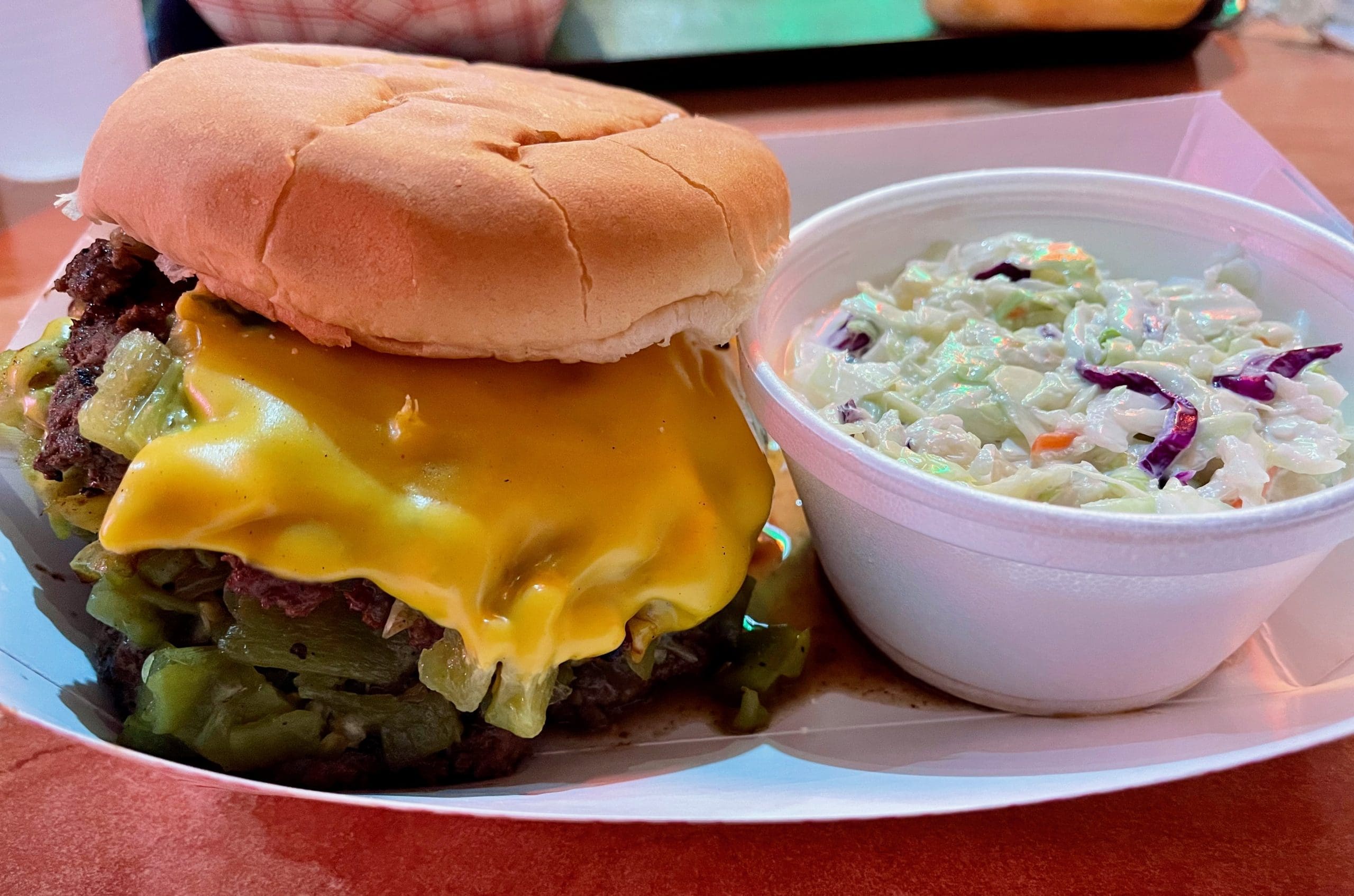
New Mexico’s Green Chile Cheeseburger Trail not only celebrates one of the Land of Enchantment’s most iconic foods, it showcases the restaurants, drive-ins, diners, dives, joints, cafes, roadside stands and bowling alleys which prepare our ubiquitous, incomparable green chile cheeseburger.  To New Mexicans, there is nothing as thoroughly soul-satisfying and utterly delicious! What elevates a burger from the ordinary to the extraordinary is taste bud awakening, tongue tingling, olfactory arousing green chile, New Mexico’s official state vegetable (even though it’s technically a fruit).  In the continually evolving mosaic that describes New Mexico’s cultural intermingling, one constant is green chile, an essential ingredient in many of our recipes and THE centerpiece of any outstanding green chile cheeseburger.  Even such corporate megaliths as McDonald’s and Sonic try their hand at the green chile cheeseburger. It stands to reason that one of, if not THE very best green chile cheeseburger in the Land of Enchantment would be served in Hatch, the undisputed epicenter of New Mexico’s chile production.  Widely regarded as the “chile capital of the world,” the village’s population of around 1,200 citizens increases by twenty times as people from all over the world converge for its annual chile festival.  It’s a…

Taos Cow – Arroyo Seco, New Mexico

As with many foods “invented” before the widespread documentation and dissemination of information, the “origin” of ice cream is in much dispute with several claimants seeking credit.  Several of those origin stories are rather romantic in nature, mired in folklore and legend.  Among the historic people to whom the invention or introduction of ice cream have been incorrectly ascribed are King Solomon, Nero, Catherine de’ Medici, Montezuma and even King Charles II.  These origin stories are early examples of the fake news so prevalent in modern journalism.   Culinary historians agree the progenitor of ice cream as we know it today was based on sweetened water that was iced, ground into little pieces then decorated with various tasting toppings and fruits.  The expensive transportation of ice and snow from often distant mountains to the cities limited the widespread propagation of frozen ice teats.  It took technological advances across the millennia to make ice cream available to the masses. According to the U.S. Census Bureau, Americans consume an average of 23 gallons of ice cream each year (so it’s not just President Biden).  Classic vanilla is the most popular flavor under spacious skies, accounting for more than 26 percent of the…

THE LOVE APPLE – Taos, New Mexico

If the Roman Catholic Church in the 16th century had had its way, the tomato might not be a ubiquitous ingredient in the cooking of many cultures today. So, just what is it about the seemingly innocuous tomato that once earned it a scurrilous reputation in the Church, the type of reputation which made it the Paris Hilton of the nightshade family? Brought to Europe by the Spanish conquistadors, it was initially viewed with apprehension, thought not to be edible but purely decorative–and poisonous. Leave it to the French to change that perception by ascribing aphrodisiac properties to what they called pomme d’amour or love apple. This prompted the Roman Catholic Church of the time to declare the tomato the “fruit of the devil,” a sinful indulgence. >The scandalous tomato, its sensuous red color and sweet-tangy flesh spurting with red juiciness, was even believed to be the fruit Eve offered to Adam. Because of its role in original sin, the Church believed the tomato to have been cast off to the furthest reaches of man (the new world), where it could no longer be the tempting source of transgression (sins of the flesh).  Leave it to the Spanish explorers to…

JOE’S PASTA HOUSE – Rio Rancho, New Mexico

Once a year, despite my protestations and whining, I agree to take my Kim to the Olive Garden. It’s a deal we have, albeit one that makes me feel like Faust in the Christopher Marlowe play. Faust, for the non-English majors among you, was a scholar who sells his soul to the devil in exchange for unlimited knowledge and worldly pleasures. In my case, the deal is a visit to Olive Garden once a year in exchange for all the strange and exotic restaurants I want to visit the rest of the year. I sure got the rotten end of that deal. On a list of things I’d rather do, my annual visit to the Olive Garden for a meal of cheese glop or tomato torture ranks somewhere below visiting a proctologist or watching The View. Kim likes the salad and bread sticks and I suspect derives a bit of sadistic satisfaction in hearing me mutter polysyllabic epithets about the “Evil Garden’s” food. The cultural anthropologist in me finds it both amusing and tragic that teeming masses congregate for pathetic pasta, mediocre marinara and boring bread sticks. It makes me long for a visit to Joe’s Pasta house in Rio…

CAFE DA LAT – Albuquerque, New Mexico

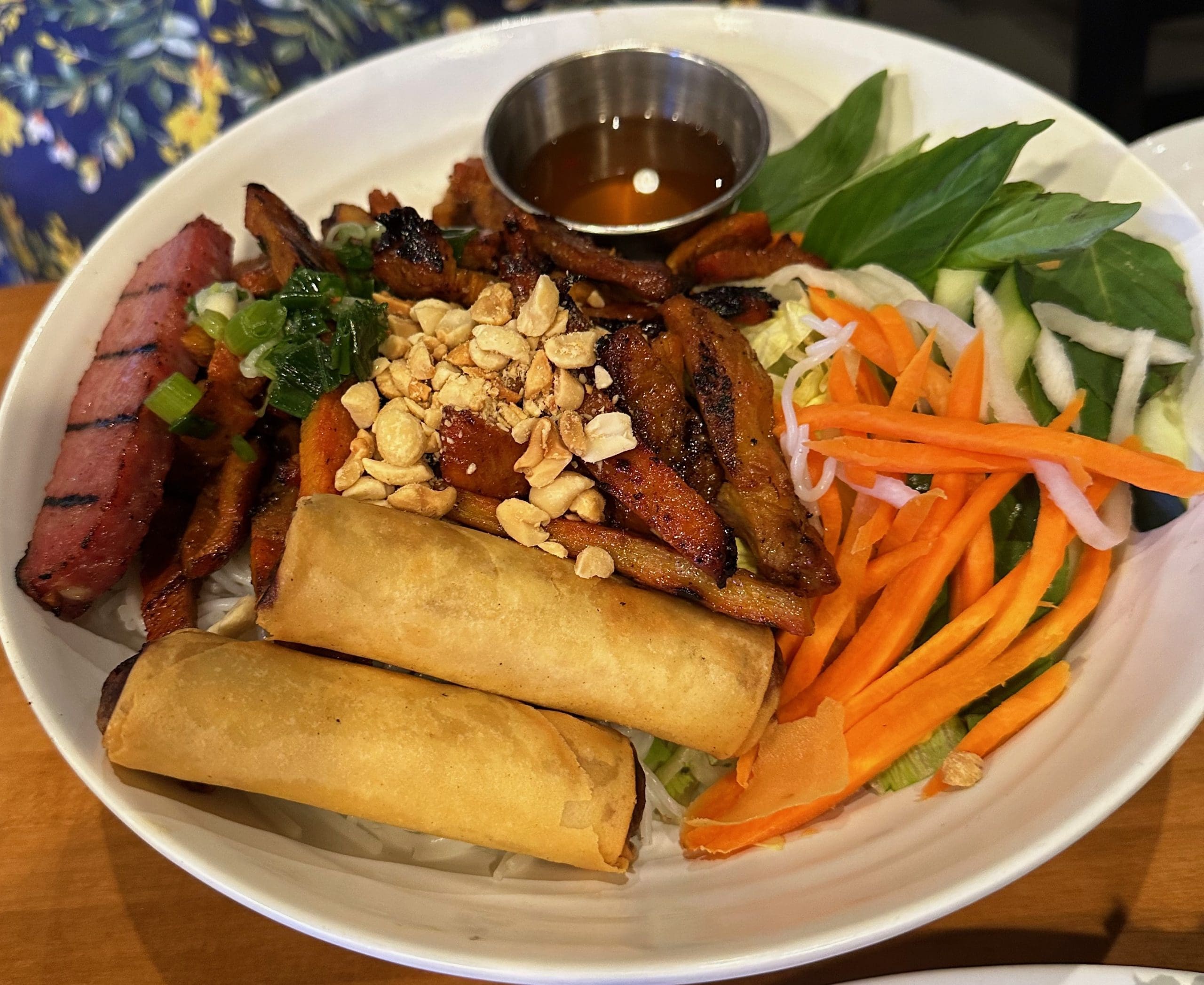
While the term “Vietnamese cuisine” is broad and overarching, any attempt to pigeonhole this very diverse and eclectic culinary culture is a failure to consider its complexities and nuances.  Even when culinary taxonomists compartmentalize Vietnamese cuisine regionally into “Northern,” “Southern” or “Central,” these wide-ranging generalizations fail to take into account the variations–often influenced by socioeconomic factors–that occur not only between villages, but often within small neighborhoods.  James Nguyen, proprietor of Albuquerque’s Cafe Da Lat is very cognizant of those variations.  That’s why he takes it in stride when a compatriot visiting his restaurant contends “this isn’t like the Vietnamese food I grew up eating.”  Obviously, he says, they didn’t grow up with his mother’s cooking.  His mother’s recipes are at the heart of Cafe Da Lat’s menu, but like every successful restaurateur, he understands that in order to grow business year-upon-year, the menu has to remain interesting. Though wholesale changes aren’t necessary, over the years he has continued to introduce amazing new items we now can’t live without.   Every year James travels to Little Saigon in Orange County, California where he takes the pulse of innovative new trends in Vietnamese cuisine.  When he discovers something he believes Duke City…