El Taco Tote – Albuquerque, New Mexico

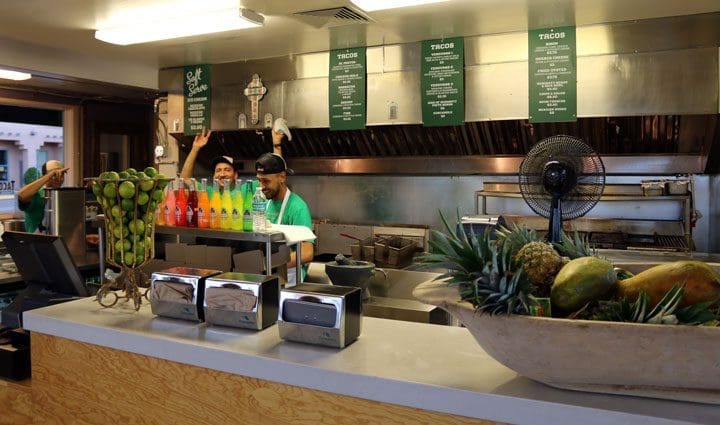
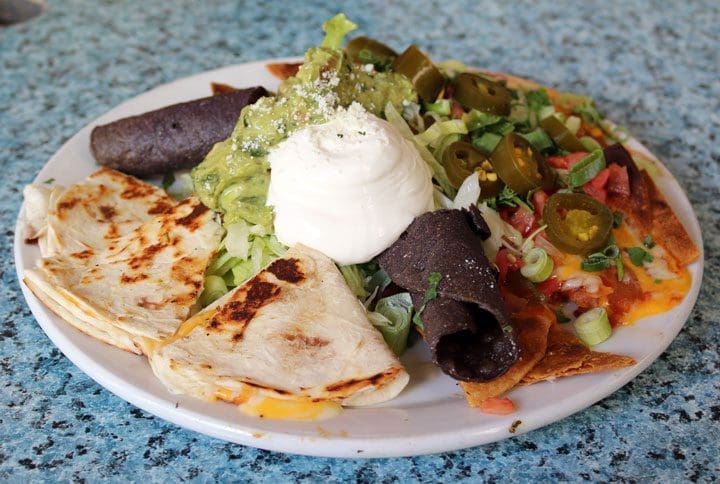
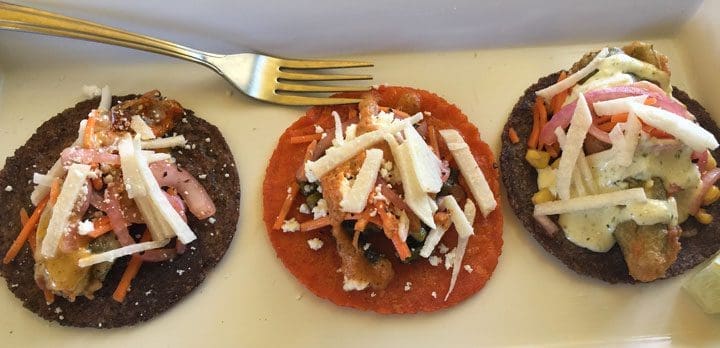
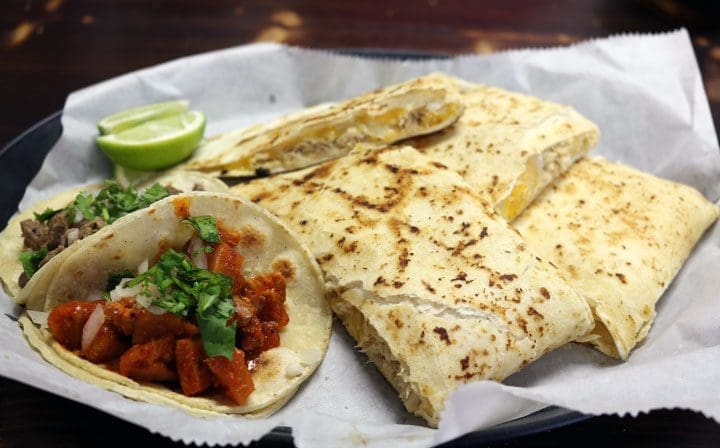
As we perused the colorful menu hanging on the wall at El Taco Tote, my friends Captain Tuttle, Bob of the Village Of Los Ranchos and I pondered the veracity of images depicting gargantuan tacos brimming with glistening meat and sundry toppings. Could these super-sized behemoths possibly be as large as pictured? Perhaps, as in “objects in the mirror may appear closer than they are,” these tacos only appear large in photos. Captain Tuttle, a semi-regular at Taco Tote, confirmed that the truth is somewhere between the perfectly posed tacos portrayed on the menu and those actually served. He recalled from previous visits, being served tacos with as much as four ounces of meat. That’s as much as McDonald’s vaunted Quarter-Pounder. Considering most taquerias nowadays tend to prefer (and proffer) small tacos, we wondered if Taco Tote’s largesse was an accommodation to denizens of the fruited plain who crave and expect Brobdingnagian portions. We’re not the only ones who’ve pondered this Jack Handy level deep thought. In an April, 2010 edition of “Ask A Mexican,” a reader asked columnist Gustavo Arellano “why do those tiny little Mexican tacos exist? Does anyone prefer getting 3 tiny tacos instead of 1 good…
Los Compadres Restaurant – Albuquerque, New Mexico

In the vernacular and tradition of Hispanic Northern New Mexico, few–if any–titles were held in such esteem and reverence by elder generations as “compadre” (male) and “comadre” (female). In his Dictionary of New Mexico & Southern Colorado Spanish, Ruben Cobos defines a compadre as a “ritual co-parent; a term by which godparents address the father of their godchild and by which the child’s parents address the godfather.” With the societal dissolution of the family entity, the term compadre doesn’t hold the same bonding connotation as it once did–at least in terms of raising one another’s families should the need arise. Today the term compadre is frequently used almost interchangeably with “paiser,” a derivative of “paisano” or countryman. Paiser is a Northern New Mexican word addressing a person from one’s hometown or county. When Janice and Roberto Martinez launched Los Compadres in March, 1997, they must have had in mind a homey, family-oriented restaurant in which compadres could gather for delicious Mexican and New Mexican cuisine the way it’s been prepared for generations. Their mission statement as expressed so familially on their Facebook page bespeaks of concepts very important to New Mexicans: “The goal is to serve the best food in…

Maya – Albuquerque, New Mexico (CLOSED)

My precocious niece doesn’t miss a beat. Ever attentive to adult conversation, she often stumps my brother and me with her surprisingly deep and thought-provoking questions. Case in point, when she overheard me telling my brother Mario about the Mesoamerican-inspired cuisine at Maya, she asked what I have against Americans. Perplexed by her assertion, I gently asked what she was talking about. “First you said Americans are ugly (obviously remembering a discussion Mario and I once had about the “ugly American syndrome”) and now you’re calling them messy, too.” From the mouth of babes… Her comment got me thinking about the last time we saw a great chef who wasn’t a bit on the “messy” side. No, not like the Charlie Brown character Pig Pen, but with a light dusting of flour or a splash of sauce bespattered on their white coats or aprons. Hands-on chefs–those who not only conceptualize their menus, they prepare everything themselves—don’t always embody the axiom that cleanliness is next to godliness. These do-it-all chefs are veritable whirling dervishes in the kitchen—chopping, shredding, grating, slicing, dicing, mincing, broiling, boiling, simmering, frying, sautéing, plating… It’s inevitable that a smattering of sauce or a sprinkling of crumbs will…

Taco Fundación – Santa Fe, New Mexico (CLOSED)

Consider it sacrilege if you will, but some pundits believe the taco is poised to become the most ubiquitous and popular dish in the fruited plain. One such heretic is eater.com’s Nick Solares who made the audacious prediction that the taco will replace the hamburger as the American national dish within fifty years. He makes a great case for his conjecture, citing such factors as the rising Hispanic immigrant population, America’s hipster culture, and people in general embracing the taco as a budget alternative to American fast foods. New York City-based chef Alex Stupak is similarly inclined. In recent years, he points out that largely because of the rising cost of beef, chicken has supplanted it as the most consumed protein in America and he believes pork is poised to make a run at beef, too. Tacos have a way to go before catching up with burgers…a long way. According to a 2012 PBS Newshour feature, Americans eat an average of three hamburgers a week. That’s a whopping total of nearly 50-billion burgers per year. By comparison, that same year Americans consumed 4.5 billion tacos, inexplicably including 554-million Jack in the Box tacos (a taco described by one source as…

Gabriel’s – Santa Fe, New Mexico

Located fifteen miles north of Santa Fe, just south of Pojoaque and within minutes of two garish native American casinos, Gabriel’s is a culinary oasis back-dropped by nearby cedar, cottonwood and pine tree-laden hills and the Santa Fe mountains further to the southeast. Gabriel’s entrance is flanked by unpeeled latillas, a “coyote fence” precursor to one of the best restaurant settings in the Santa Fe area. In the early spring and fall, weather permitting, the sprawling dining room and its Spanish colonial theme are often rebuffed in favor of an outdoor dining experience. For al fresco dining, there are few options to compare with Gabriel’s, a restaurant perhaps more renowned for its experiential qualities than it is for its cuisine. You won’t read a single review from a credentialed critic which doesn’t sing the praises of the restaurant’s ambiance. You will, however, read scathing indictments of Gabriel’s cuisine. Alex Heard of the Santa Fe New Mexican, for example, was brutally honest in his assessment: “my takeaway has been that it serves average food and not much more, closer to chain-restaurant quality than what you’re promised in its advertisements.” England’s The Guardian, on the other hand, put Gabriel’s on its list…

B2B Garden Brewery – Albuquerque, New Mexico (CLOSED)

“I’m a uniter, not a divider.” ~ George W. Bush, Governor of the Great State of Texas “No one wants to listen to politicians, but everyone wants to eat tacos. Tacos are the great uniter.” ~ John Fetterman, Candidate for U.S. Senate from Pennsylvania FROM B2B GARDEN BREWERY (October, 2024):  We’re sad to announce that after over 10 years, we are closing our doors. We want to thank all of you for your support and for the great times we’ve shared. Ideologically and politically, denizens of the land of the free and home of the brave seem incapable of agreeing on virtually anything, but turn the topic to tacos and there’s almost consensus. Americans love tacos! We love them to the depth and breadth and height our appetites can reach…and our appetites can reach bottomless depths, expansive breadths, dizzying heights and tremendous distances. In 2012, we loved tacos to the tune of 4.5 billion tacos consumed across the fruited plain. That’s the equivalent weight in tacos of two Empire State Buildings (775-million pounds). Our appetites surmounted the equivalent of 490,000 miles of tacos, enough–as Frank Sinatra might croon–to fly you to the moon and back. No one, it seems, loves…

El Maguey – Rio Rancho, New Mexico (CLOSED)

On a 2010 episode of The Travel Channel’s No Reservations series, host Anthony Bourdain described pulque as “the sap of the maguey cactus” as well as “man juice” and “Mexican Viagra.” That may explain why so many aspiring middle-aged brewers across the fruited plain rushed to their local nurseries in search of the maguey plant. Although maguey may be plentiful even in the Land of Enchantment, extracting pulque is a laborious process involving four distinct steps, the first of which is called castration. The name of this step may also explain why so many middle-aged men quickly lost their enthusiasm for cultivating maguey. In parts of Mexico where the maguey is harvested, native Zapotec, Mixtec and Mixe producers actually ask the plant for permission to harvest it. With the utmost respect, they tell the maguey that its use will primarily be for celebratory rituals and not solely for the sake of profit. Soon after the dawning of 2017, Rio Rancho saw the launch of El Maguey, a Mexican restaurant named for the plant held in such high esteem throughout Mexico. At El Maguey, horchata may be the closest thing to the alcoholic beverage made from the sap of the maguey…

Andele’s Dog House – Mesilla, New Mexico

Put a savvy foodie from Las Cruces and a gastronome from Albuquerque in the same room (preferably not a kitchen well stocked with knives) and you’re bound to start a culinary civil war. Such was the case when I worked at Intel with a colleague who was born-and-bred in the City of Crosses. We were both adamant that the cuisine in our half of the state (mine being the upper half) was far superior to cuisine in the other (lower in her case) half. We debated every nuance that made our preferred cuisine distinctive from the other. We argued about the prominence of Mexican and Native American culinary influences, the preferred degree of piquancy in each region, whether or not cumin has any place in New Mexican cuisine, even whether the biscochito can truly be New Mexico’s official state cookie if it’s not as common in Southern New Mexico. Rather than squabbling like the prickly, contentious British Parliament, we could have spared ourselves hours of rancor by breaking sopaipillas together at restaurants in both Northern and Southern New Mexico. With detente based on a shared meal, we might even have become friends. Think of the missed opportunities to compare the…

Señor Tortas – Albuquerque, New Mexico (CLOSED)

In Albuquerque’s panoply of Mexican fast foods, the torta–despite all its heartiness and versatility–is the “Rodney Dangerfield” of cheap eats. It garners no respect, warranting nary a mention in annual paeans to the “best of” virtually everything else Alibi and Albuquerque The Magazine readers care to celebrate. Long overshadowed and under-appreciated, the humble torta presents a glaring contrast to its culinary cousin, king taco. While the taco has become a pop culture diva, the torta has been relegated to a homely afterthought. It’s become cool to consume tacos, but tortas are the porn of fast food–usually kept wrapped until it’s time to enjoy them. Could it be that there are still people who don’t know what a torta is? That may well be because the name “torta” is often confused for some sort of cake. One wonders if its popularity would have exploded if “Torta Bell” franchises had spread across the fruited plain instead of Taco Bell. Whatever the reason for its relative anonymity, tortas are long overdue recognition and adulation from the mainstream masses in the Duke City. While the culinary cultures in such cosmopolitan and urbane cities such as Los Angeles and Denver have embraced the torta, Albuquerque…

Casa Diaz – Bernalillo, New Mexico (CLOSED)

The siren song of a small town living has always appealed to Irma Rodriguez who just can’t see herself in the big city. Having grown up in Gallup, New Mexico, she appreciates the sense of community–the extended family feeling of really getting to know her neighbors. It’s an attitude she imparts to guests at Casa Diaz Mexican and American Grill, the Bernalillo restaurant she and husband Jesus launched in August, 2016. For her, the term “locally owned and operated” is deeply rooted, a reflection of her upbringing in and around family owned and operated restaurants in Gallup. Irma’s grandmother served for decades as the tortillera at the legendary Jerry’s Cafe in Gallup. Later when Irma herself worked at Jerry’s, she assimilated the day-to-day nuances of running the most popular independent restaurant in the Heart of Navajo Country. In particular, she observed as the restaurant’s staff inculcated a customer-oriented attitude. The lessons she learned are inscribed in her restaurant’s operational model on the Web site’s “About Us” page: “We strive to give you a fresh meal that’s similar to being home cooked. When you are at Casa Diaz we treat you like family because that’s what you are to us. We…

Mariscos Mazatlan – Rio Rancho, New Mexico

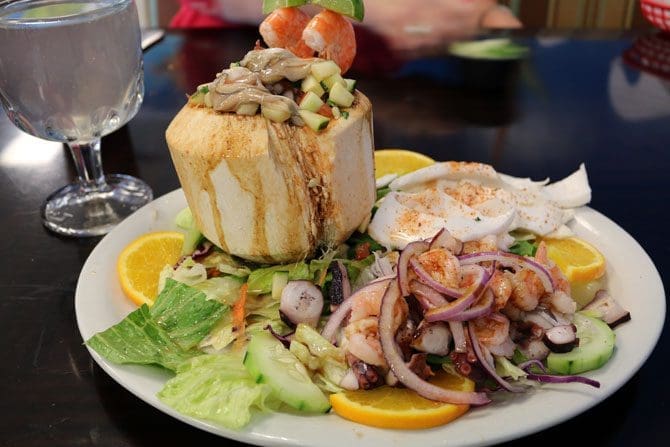
A rotund, ripening, red tomato is featured prominently on license plates issued in the Mexican state of Sinaloa. This is indicative of the state’s prominence in growing the “love apples” from which its rich salsas are made. In 2013, Sinaloa exported nearly one-billion tons of vegetables–primarily tomatoes–across the fruited plain, netting (mostly industrial) farmers nearly one-billion dollars. More than half the tomatoes consumed across the United States during the winter season are, in fact, grown in Sinaloa. While Sinaloan tomatoes are indeed sweet, juicy, meaty and delicious, an argument could easily be made that a more worthy subject for the state’s license plates would be mariscos, the bounty of the sea extricated from the azure waters of the Bay of Cortez. With nearly four hundred miles of spectacular, varied and fecund coastland, Sinaloa is brimming with some of the finest, most delectable seafood available anywhere on Planet Earth. Waters teeming with an assortment of delicacies from the sea are especially bountiful during winter months when pescados y mariscos (fish and shellfish) are at their at their peak of freshness. The variety of seafood options can boggle the mind, especially in the restaurants of Mazatlán, the most popular beach town destination…