Blog

The Cup – Albuquerque, New Mexico (CLOSED)

Back in the mid 70s, anyone in Albuquerque’s southeast quadrant who wanted privacy knew they could find it at the Burger Chef restaurant in the Gibson and San Mateo area. It was the place in which employees from nearby Sandia and Kirtland conducted one-on-one meetings when they didn’t want to be disturbed. Once a burgeoning franchise second only to McDonald’s in the fast food arena, Burger Chef was in a state of rapid decline and even during lunch hours, few diners patronized it. Our inaugural dining experience at The Cup awakened memories of Burger Chef and the sheer feeling of aloneness I once felt when on the receiving side of bad news (the “Dear John” kind). That’s because on a Friday night when every other restaurant along the Pan American frontage road was overflowing with hungry patrons, we were the only diners at The Cup for nearly forty minutes. Considering The Cup is sister restaurant to the popular Gold Street Caffe, the emptiness seemed like something out of the Twilight Zone. We’re talking the Gold Street Caffe here–one of downtown Duke City’s darling dining destinations, the restaurant with the very best bacon (the thick cut honey chile glazed marvel) in…
Sushi Eye – Tempe, Arizona (CLOSED)

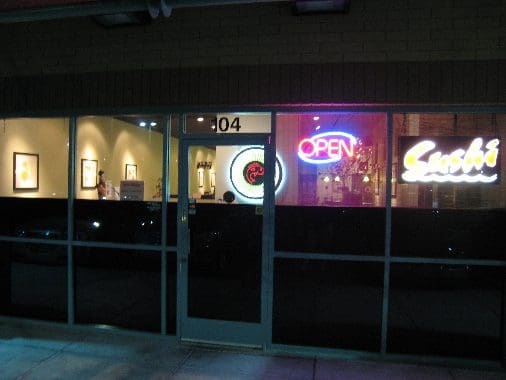
To Western diners used to restaurant ambience defined by an effusive, sensory bombarding, over-the-top flamboyance, many Japanese restaurants feel stark and barren in comparison. That austerity is actually by design. The Buddhist teaching of “wabi” which means “quiet of tranquility” posits a non-attachment to material things. Wabi values the ability to make the most of starkness and poverty by cherishing the subtle beauty found only in a very simple environment. In some sushi restaurants, the minimalist decor is not much more than functional and and nearly as raw as sashimi. Lighting is subtle, perhaps even romantic. The ambience seems to inspire hushed tones and an almost reverent mood, in some cases almost as if you’re at a Buddhist temple. That’s the concept of wabi. In wabi fashion, the not quite wasabi colored walls at Sushi Eye are relatively stark, festooned with but a few framed images. The restaurant’s activity center and heart, the sushi bar, is more brightly illuminated. A single neko cat, symbolizing good luck, sits on that bar. Sushi Eye is situated in a nondescript Tempe strip mall practically next door to the Fascinations Superstore where sensual shopping can precede sushi sampling if you’re so inclined. It opened…

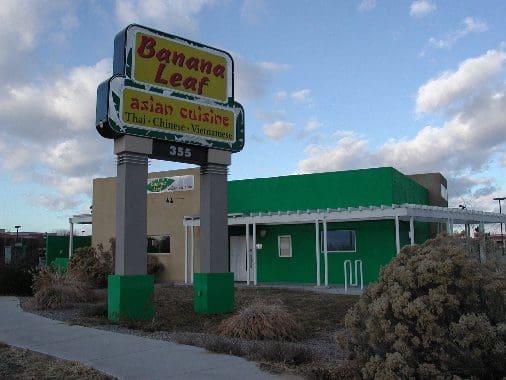
Banana Leaf – Rio Rancho, New Mexico (CLOSED)

Banana leaves, although completely inedible, are used for slow, moist cooking of tough meats as well as for quicker steaming, baking or grilling of delicate ingredients such as chicken and fish. Used while still fresh and green, they lend a very moist quality to any food prepared in them and also imbue foods with a delicious herbal flavor. While Southeast Asian nations have used banana leaves in food preparation for generations, only recently have innovative American chefs begun to explore their infinite possibilities. It’s no wonder there are so many Asian restaurants named for this utilitarian, albeit inedible food ameliorant. Rio Rancho’s Banana Leaf restaurant opened in January, 2005 to some popular acclaim. Bringing you the culinary cuisine of Southeast Asia kitchens to your table, it features Chinese, Thai and Vietnamese items on a diverse, multi-page menu. What it doesn’t feature is any items prepared with the item for which it is named (bummer). Owned and operated by a Vietnamese family which also operates restaurants in Roswell, New Mexico as well as in California, it is another sign that the “city of vision” has arrived with a flourish. Complementary wonton chips are brought to your table while you peruse a…

Hot Diggity – Albuquerque, New Mexico (CLOSED)

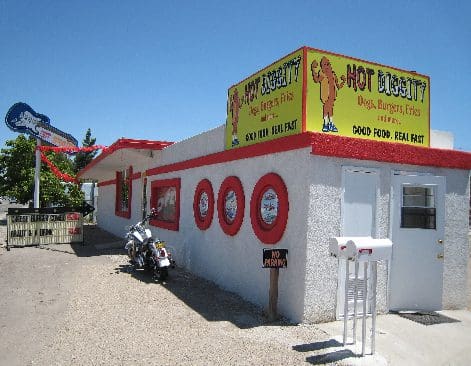
Oh, hot diggity, dog ziggity, boom what you do to me How my future will shine Hot diggity, dog ziggity, boom what you do to me From the moment you’re mine HOT DOG!! In an age of auditory bombardment, we all occasionally experience a phenomenon known as an “earworm.” Earworm is a literal translation of a German term for a song (particularly an annoying one) stuck in someone’s head. For some it’s the Gilligan’s Island theme song. For others, it might be “It’s a Small World” or the Beatles’ “Yellow Submarine.” You can guess what earworm infested me the first time I drove by Hot Diggity, a 60s style diner in Albuquerque’s industrial north valley. I hadn’t thought of Hot Diggity (the number one song in 1956 by crooner Perry Como) in a long time but couldn’t get it out of my head after driving by the Edith Boulevard diner of that name. (Hopefully reading this doesn’t introduce the Hot Diggity earworm into your life, but if it means introducing you to Hot Diggity, the restaurant, it might be worth it.) Brothers Steve and Vince Drouillard launched Hot Diggity in October, 2006 and have been winning over hungry patrons since…

Sabroso – Arroyo Seco, New Mexico (CLOSED)

We’ve all heard the expressions from a jack to a king, from a moth to a butterfly, from a lump of coal to a diamond, but who’s ever heard…from a chicken coup to an elegant gourmet restaurant?  That sounds like more than a bit of a stretch, yet that’s the metamorphosis that transpired decades ago at what is currently the site of Sabroso, one of Taos county’s swankiest dining establishments. Local lore posits that in 1960, entrepreneurs started a restaurant not just on the site in which a chicken coup stood, but from its very walls.  That restaurant was christened Casa Cordova, a name it would proudly bear for years. Over time and with changes in ownership, Casa Cordova became Momentitos de la Vida, a restaurant which would go on to earn AAA’s four diamond rating for four consecutive years (2000-2004).  In 2005, Momentitos closed its doors for good.  Several months later, in August of 2006, Sabroso emerged and is carving out its own niche in picturesque Taos county. Sabroso’s new ownership made a conscious effort not to be as ostentatious as its predecessor, a move intended to create a broader appeal to potential local patrons.  A bar menu featuring…

Asado Brazilian Grill – Albuquerque, New Mexico (CLOSED)

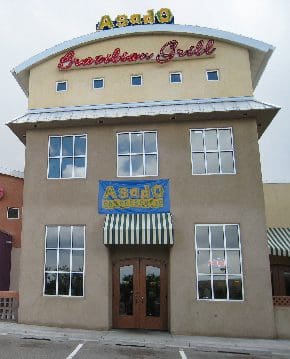
When it comes to diplomatic coups, one of the least known for which President George Herbert Walker Bush is credited is the introduction to the United States of the popular Brazilian Churrascaria (steakhouse) Fogo de Chão (literally Fire of the Ground). During a visit to São Paulo, Brazil, the 41st President of the United States was so impressed by the unique dining concept that he told the owners a restaurant like theirs would go over big in his home state of Texas where as in Brazil, beef is king.  As one of the first Churrascarias to open in the United States, the Dallas Fogo de Chao helped blaze the way for other Churrascarias throughout the country. The first to open in Albuquerque was Tucano’s Brazilian Grill which launched in 2000.  In May four years later, Asado Brazilian Grill opened along restaurant row on Albuquerque’s Pan American Freeway West. Albuquerque’s Asado was actually the second in the state, launching more than a year after its sister Santa Fe restaurant (which closed in late 2005).  Still a third Asado is located in Evanston, Illinois, just outside of Chicago. The Churrasco tradition has its genesis in the Pampas, an extensive grass-covered plain in…

Rice ‘N Roll – Bernalillo, New Mexico (CLOSED)

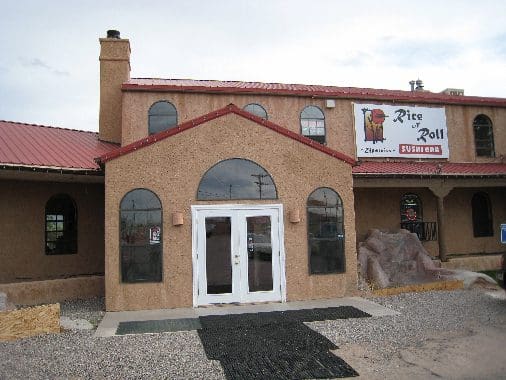
The 1970s have been characterized by writer Tom Wolfe as the “Me Decade” and derided by cynics as the “Disco Era.” It was an era of contrasts: the national crisis of confidence described by President Jimmy Carter as a “malaise” and the ubiquitous yellow smiley face; the melodic, velvety stylings of the Carpenters and the edgy, funky beat of disco; an explosion of copycat fast food chain restaurants and the introduction of innovative fusion cuisine in many contemporary restaurants. Fusion cuisine is the inventive combination of diverse, sometimes disparate culinary traditions, elements and ingredients to form an entirely new genre. In large metropolitan areas, particularly in California, the fusion of different cuisines became commonplace. Restaurants featuring the melding of French and Chinese cuisine were especially popular. Still other restaurants had their own ideas as to what constituted fusion cuisine. The now defunct Maverick Cafe in San Antonio, Texas, became famous for their “East Meets West” dining concept. It wasn’t so much a fusion of cuisines as it was the plating of different cuisines (Mexican and Chinese) on the same salver. The very best lemon chicken I’ve ever had, in fact, was at the Maverick Cafe in 1994, served in a…

Popeye’s Chicken & Biscuits – Albuquerque, New Mexico

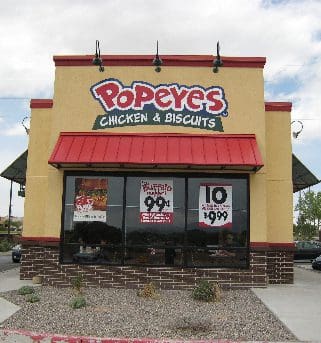
Shortly after Louisiana and Mississippi were ravaged by Hurricane Katrina, one of the local television stations in South Louisiana actually aired an interview with a woman from New Orleans. The interviewer was a woman from a Boston affiliate, so she asked the interviewee how such total and complete devastation of the churches in the area had affected their lives.  The woman replied,” I don’t know about all those other people but we get our chicken from Popeye’s.” The look on the interviewer’s face was priceless.  That anecdote rings with truism Contrary to the images the name might conjure, Popeye’s is not a nautical themed restaurant which serves spinach.  That might be why the restaurant’s full appellation is “Popeye’s Chicken & Biscuits.”  In reality, Popeye’s is named for the irascible character Popeye Doyle from the movie “The French Connection.”   It is the brainchild of restaurant impresario Al Copeland who founded the New Orleans style poultry palace in 1972 after a failed venture featuring mild, Southern-fried chicken. New Orleans style chicken is imbued with the exciting, spicy flavor about which Cajuns are passionate.  In our eight years of living in Mississippi, we rarely dined at Popeye’s, preferring local alternatives with even more…

Consetta’s Green Restaurant – Jemez Springs, New Mexico (CLOSED)

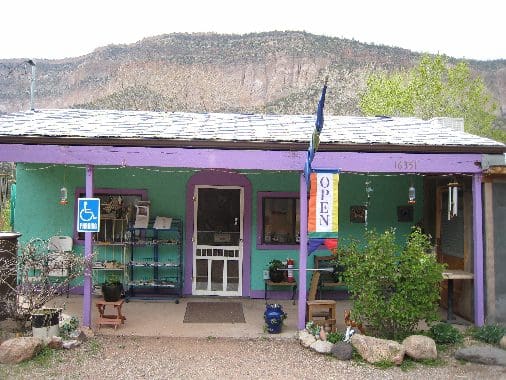
In 1995 Jemez Springs was selected by the National Civic League as the “All America City” in recognition of its citizens’ collective grass-roots efforts to improve their quality of life. Nowhere is that more evident than at the aptly named Consetta’s Green Restaurant on scenic Route 4 which is traversed annually by more than two million visitors. Consetta’s desire is to provide fine dining at reasonable prices. It is committed to decreasing man’s footprint on the Earth by serving as an avenue for ideas which exemplify how to be better stewards of the Earth’s resources. To that end, the sprawling compound on which Consetta’s sits hosts organic gardens in which are grown to the extent possible, the restaurant’s vegetables, herbs and salad ingredients. Solar ovens, a solar hot water heater and other sustainable projects allow the compound to utilize as much renewable energy as possible. Only all natural, range-free chicken and sustainable seafood (seafood products that are prudently managed to provide greater supply and price stability while staving off depletion) are served. At 6300 feet above sea level, Consetta’s is located in the picturesque Jemez River Canyon and is backdropped by majestic red mesas resultant from ancient lava flows more…

Don Yasmany Cuban Restaurant & Bakery – Albuquerque, New Mexico (CLOSED)

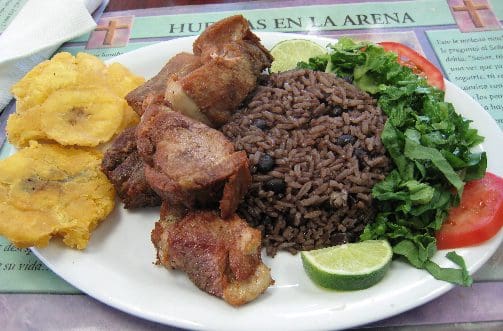
Cuando salí de Cuba, dejé mi vida dejé mi amor. Cuando salí de Cuba, dejé enterrado mi corazón. When I left Cuba I left my life, I left my love When I left Cuba I buried my heart. In a powerful expression of hope, frustration, nostalgia and introspection, the song Cuando Sali De Cuba reflects the heartfelt anguish and pain felt by every Cuban I’ve ever met who left their beloved Cuban homeland to escape persecution and oppression. It’s the spirit of Jose Marti, often referred to as the “Apostle of Cuban independence” and renown in literary circles as perhaps the greatest Hispanic poet and writer of all time. Marti posited that “Like bones to the human body, the axle to the wheel, the wing to the bird, and the air to the wing, so is liberty the essence of life.” National pride is alive in the heart and soul of all Cuban refugees, some of whom migrated to Albuquerque under the auspices of the Archdiocese of Santa Fe’s Catholic Charities Immigration Project. Though many Cubans have acculturated and become enterprising and productive United States citizens, the yen to someday return to a Cuba free of oppression and tyranny remains…

Casa Chaco – Albuquerque, New Mexico (CLOSED)

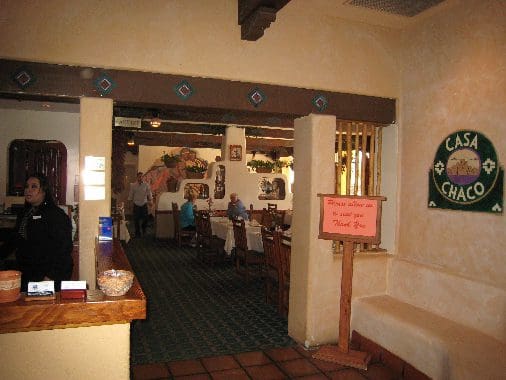
In A.D. 850, the ancient Anasazi began building the pueblos archaeologists posit were the hub of an ancient culture inhabited in its heyday by more than 5,000 people. By A.D. 1000, Chaco Canyon was the flourishing heart of religious and governmental life for an advanced culture that has since been assimilated by Native American pueblos dotting the Rio Grande valley. Using remote sensing technology, archaeologists discovered roads radiating from Chaco Canyon like the spokes of the wheel, connecting the canyon with almost 100 Chacoan outliers. In modern-day Albuquerque, the rambling Hilton hotel has also become a hub of activity (more than 27,000 square feet of flexible meeting space) and like Chaco, is on the intersection of heavily traversed thoroughfares. It’s perhaps only fitting that one of its two signature restaurants is named for the “ancient ones.” Casa Chaco is tastefully decorated with Native American art, including the full regalia of Indian women and children. On some nights, the dining experience at Casa Chaco is further enhanced by the mellifluous presence of Hector Pimental and the soothing stylings of his guitar. Similar to the Rancher’s Club, its sister Hilton restaurant, Casa Chaco places you in the lap of luxury with attentive…