Sweetwater Harvest Kitchen – Santa Fe, New Mexico

My friend Schuyler jokes that because the diet of my formative years was mostly beans, chile and tortillas as well as chile, tortillas and beans, I’ve developed an insatiable curiosity and appetite for anything that isn’t beans, chile and tortillas (although I still love those). “No one else,” he claims “is equally enthusiastic about  bacon-infused decadence one day as he is the healthy paleo foods  the next.  Schuyler calls me  “the anti-Mikey” (the little boy in the Life cereal commercials who hated everything, except of course, Life cereal).  He argues that I like everything. In his eyes it doesn’t count that I loath, abhor and detest  cumin when it desecrates the purity of New Mexico’s sacrosanct chile because I love cumin on Indian and Thai food.  I remind him of my profound dislike for tea either as a cold or hot beverage and his retort is a reminder about how much I love the tea leaves smoked duck at Budai Gourmet Chinese.  If you’re getting the impression that arguing with Schuyler is a no-win proposition or exercise in one-upmanship, you’re probably wondering why we’ve been friends for more than three decades. The great philosopher Plutarch probably explains it best: “I…

Green Chile Cheeseburger Smackdown 2018 – Santa Fe, New Mexico

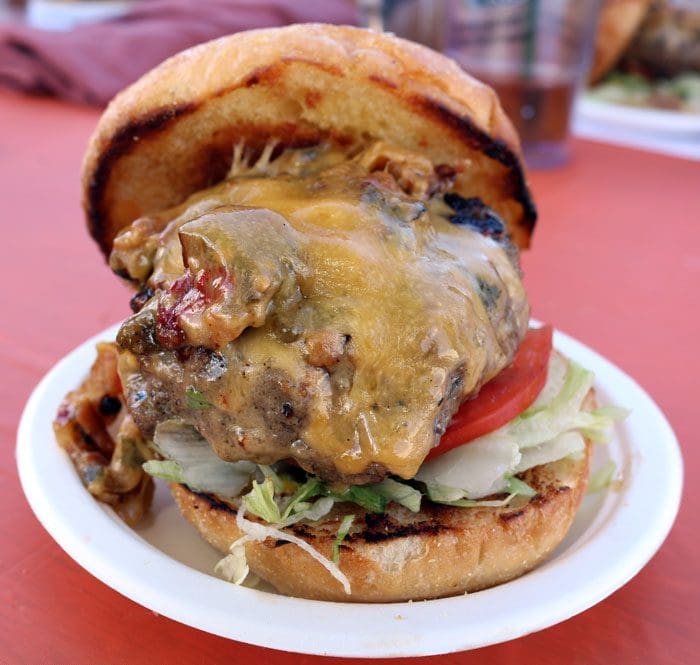
New Mexico’s storied history will recall that 2009 was the year of the green chile cheeseburger.  It all started in May when Bobby Olguin, the gregarious owner of San Antonio’s Buckhorn Tavern bested Food Network celebrity chef Bobby Flay in a “green chile cheeseburger throwdown.”  Capitalizing on the momentum, Governor Bill Richardson called for a statewide green chile cheeseburger challenge to be held at the New Mexico State Fair in September.  Two months later, four-time James Beard award-winning author, the scintillating Cheryl Jamison spearheaded the development of the New Mexico  Green Chile Cheeseburger Trail, the first of the state Tourism Department’s Culinary Trails initiatives designed to further attract savvy visitors who make travel choices based on food. Not only did these initiatives garner nationwide (if not worldwide) acclaim, they became the impetus for the dawning of a new and even more exciting period for the state’s sacrosanct green chile cheeseburger.  Creative chefs across the length and breadth of the Land of Enchantment’s 33 counties conceived of new and inventive ways of preparing and serving burgers, deploying unique and delicious ingredient combinations to complement New Mexico’s official state vegetable.  For the past six years, the catalyst for this new green chile…

Terra – Tesuque, New Mexico

Several years ago, I asked my grandmother if she might consider aromatherapy as a treatment for the nagging aches and pains she suffered daily.  Aromatherapy, I explained was being hailed by New Age devotees in Santa Fe and Taos as a holistic healing treatment used to promote health and well-being. “Mi hijito,” she said gently, “In Northern New Mexico we are always surrounded by aromatherapy. We experience it when we bake bread in our hornos and roast chile in our comals. Aromatherapy is the petrichor of wet earth after the first rain. It’s the piñon-scented air we breathe every day.” As usual my grandmother was right. In her own way, she was telling me to let others seek a trendy panacea for life’s vicissitudes; those of us fortunate to live in Northern New Mexico had an abundance of simple, life-affirming blessings to help us heal. Memories of my grandmother’s wisdom flooded back to me when we stepped out of the car and imbibed the piñon-scented air of the Sangre de Cristo’s rolling foothills just fifteen minutes or so from downtown Santa Fe.  The familiar early autumn aroma and freshness of the air were a balm.  So was the  quiet stillness. …

Tortilla Flats – Santa Fe, New Mexico

“Beans are a warm cloak against economic cold.” ~John Steinbeck, Tortilla Flat In his 1935 novel Tortilla Flat, John Steinbeck introduced the literary world to the downtrodden denizens of Tortilla Flat, an impoverished barrio on the shabby hillside just outside the respectable city of Monterey, California. The quirky inhabitants of the ramshackle community were a dichotomous lot–hedonistic drunks, adulterers and thieves on one hand; on the other, paisanos with surprisingly kind-hearts who asked nothing more from life than loyal friends and a little wine. Unlike their stodgy, orthodox counterparts in Monterey, the men of Tortilla Flat defied social mores, conventions and expectations. They rebuffed the notion of holding down steady employment or paying rent. They had no qualms about cadging for food or purloining it from neighbors or restaurants. The paisanos of Tortilla Flat were carnal beings, happiest when their appetites (food, drink, women, music) were sated. They cared nothing for accumulating material possessions or the responsibilities inherent with ownership. Though Santa Fe’s touristy-artsy Plaza area and the city’s western fringes along Cerrillos are hardly Monterey and Tortilla Flats, there is a clear demarcation between the two, a distinctness that bespeaks of vast socioeconomic differences. My friend Carlos would argue…

Casa Chimayo – Santa Fe, New Mexico

Chimayó is one of the most mythologized, misunderstood— and, some would say, maligned—places in New Mexico. On one hand, it holds a place in popular imagination as the Lourdes of America, a reference to the annual Good Friday pilgrimage to the Santuario de Chimayó, a nineteenth-century church. New Mexicans and visitors from afar also celebrate Chimayó’s weaving tradition, the potently flavorful chile grown there, and the local restaurant, where margaritas compete with the church’s holy dirt as a tourist draw. ~ Postcard From New Mexico: Don Usner’s Chimayo Named for the Tewa Indian word describing one of four sacred hills overlooking the verdant valley on the foothills of the Sangre De Cristos, Chimayó may be only 26 miles from Santa Fe and 52 miles from Taos, but in some ways seems further removed by time than by distance. While its aforementioned counterparts have transitioned to artsy and cosmopolitan service and tourism economies, Chimayó has had a harder time moving away from its pastoral-agricultural sustenance roots. Where Santa Fe and Taos may be imbued with rustic sophistication and urbane trappings, Chimayó moves at a slower pace. At the end of the day, neighbors still meet at the fence for some serious…

El Farol – Santa Fe, New Mexico (CLOSED)

For over a quarter century, the most popular section in New Mexico Magazine (the nation’s oldest state magazine, by the way) has been a humorous column entitled “One of Our Fifty is Missing.” The column features anecdotes submitted by readers worldwide recounting their experiences with fellow American citizens and ill-informed bureaucrats who don’t realize that New Mexico is part of the United States. Some travelers from other states actually believe they’re leaving their nation’s borders when they cross into New Mexico. Others think they need a passport to visit (not that they’d visit considering they’re wary of drinking our water.) Merchants and banks throughout America have been known to reject as “foreign credit cards” American Express and Visa cards issued by New Mexico banking institutions. Sometimes you have to wonder if “one of our fifty is missing” applies also to American History textbooks. As an unabashedly proud New Mexican of Spanish descent, I always wondered why public schools taught impressionable students that America’s history was the exclusive domain of the thirteen colonies. You would think this great country’s history began when the pilgrims descended on Plymouth Rock. Seemingly unbeknownst to history books was all the history transpiring across the Land…

Counter Culture Cafe – Santa Fe, New Mexico

Counterculture. Growing up in rural Taos County four decades ago, I don’t know how many of us understood that the cultural and political upheaval of the big cities had moved into our isolated corner of the world. All we knew was that these unkempt and unwashed interlopers preaching free love and practicing it in communes had invaded our idyllic agrarian communities and shocked our quiet, small town sensibilities. They rode around in psychedelic school buses and wore multi-colored smocks. The men among them wore their hair as long as their women. More shocking was how these strangers walked around unabashedly nude in the confines of the communes they christened with such colorful names as the Hog Farm, New Buffalo and Lama. There were even rumors of rampant drug use. The Taos News referred to it as “The Hippie Problem.” Weekly letters to the editor referred to them as “smelly, crazy-eyed pot and LSD ridden draft dodgers” and worse. Considering the rancor between the locals and the scores of hippies which invaded Taos County in the late 1960s, some might consider it ironic–maybe even more than a bit hypocritical–that Taos designated the summer of 2009 as the “Summer of Love.” The…

Taco Fundación – Santa Fe, New Mexico (CLOSED)

Consider it sacrilege if you will, but some pundits believe the taco is poised to become the most ubiquitous and popular dish in the fruited plain. One such heretic is eater.com’s Nick Solares who made the audacious prediction that the taco will replace the hamburger as the American national dish within fifty years. He makes a great case for his conjecture, citing such factors as the rising Hispanic immigrant population, America’s hipster culture, and people in general embracing the taco as a budget alternative to American fast foods. New York City-based chef Alex Stupak is similarly inclined. In recent years, he points out that largely because of the rising cost of beef, chicken has supplanted it as the most consumed protein in America and he believes pork is poised to make a run at beef, too. Tacos have a way to go before catching up with burgers…a long way. According to a 2012 PBS Newshour feature, Americans eat an average of three hamburgers a week. That’s a whopping total of nearly 50-billion burgers per year. By comparison, that same year Americans consumed 4.5 billion tacos, inexplicably including 554-million Jack in the Box tacos (a taco described by one source as…

Gabriel’s – Santa Fe, New Mexico

Located fifteen miles north of Santa Fe, just south of Pojoaque and within minutes of two garish native American casinos, Gabriel’s is a culinary oasis back-dropped by nearby cedar, cottonwood and pine tree-laden hills and the Santa Fe mountains further to the southeast. Gabriel’s entrance is flanked by unpeeled latillas, a “coyote fence” precursor to one of the best restaurant settings in the Santa Fe area. In the early spring and fall, weather permitting, the sprawling dining room and its Spanish colonial theme are often rebuffed in favor of an outdoor dining experience. For al fresco dining, there are few options to compare with Gabriel’s, a restaurant perhaps more renowned for its experiential qualities than it is for its cuisine. You won’t read a single review from a credentialed critic which doesn’t sing the praises of the restaurant’s ambiance. You will, however, read scathing indictments of Gabriel’s cuisine. Alex Heard of the Santa Fe New Mexican, for example, was brutally honest in his assessment: “my takeaway has been that it serves average food and not much more, closer to chain-restaurant quality than what you’re promised in its advertisements.” England’s The Guardian, on the other hand, put Gabriel’s on its list…

La Lecheria New Mexico Craft Ice Cream – Santa Fe, New Mexico

Joey: What are you talking about? “One woman. That’s like saying there’s only one flavor of ice cream for you. Let me tell you something, Ross. There’s lots of flavors out there. There’s Rocky Road, and Cookie Dough, and Bing Cherry Vanilla. You could get ’em with Jimmies, or nuts, or whipped cream! This is the best thing that ever happened to you! You got married, you were, like, what, eight? Welcome back to the world! Grab a spoon! Ross: I honestly don’t know if I’m hungry or horny. Chandler: Then stay out of my freezer. In that episode of Friends, Joey Tribbiani obviously considered the concept of one woman “monotony, not monogamy.” While the most uxorious among us might not be able to relate to the concept of polygamy, we can certainly relate to the nightmarish prospect of going through life partaking solely of one ice cream flavor–even if it’s a flavor we love. How boring would that be? There was a time, not too very long ago, in fact, in which three ice cream flavors–vanilla, chocolate and strawberry–dominated the market. That might explain why even today when dairy diversity reigns, vanilla remains the most popular flavor of ice…

TerraCotta Wine Bistro – Santa Fe, New Mexico

“Wine is constant proof that God loves us and wants us to be happy.” ~Benjamin Franklin In the 1960s, denizens of the fruited plain weren’t nearly as savvy about the fruit of the vin as they are today. Impressionable youth who tuned in every Sunday for Championship Wrestling from Albuquerque’s Civic Auditorium, for example, had the impression from Roma Wine commercials that all wine was served in large jugs. It really wasn’t far from the truth. Back then, a significant portion of wine production across the fruited plain was indeed destined for a jug. Another high percentage of wine would earn the ignominious distinction of being called “bum wine.” Sporting such brand names as Thunderbird, Mad Dog 20/20 and Boone’s Farm Strawberry Hill, bum wines were considered “bottom of the barrel.” Consumers (quite often dipsomaniacs or teenagers) often shielded their bum wine purchases from the “decent public” in brown paper bags. Fast forward five decades and America has become a nation of oenophiles—lovers and connoisseurs of wine–surpassing France as the world’s largest market for wine every year since 2013 (although on a per capita basis, the average French person still consumes about five times more wine than the average American).…