Rowley Farmhouse Ales – Santa Fe, New Mexico

Only in John Denver’s hit song “Thank God I’m A Country Boy” is life on the farm “kinda laid back.” In actuality, farm life can be downright arduous, requiring back-breaking work in climatic extremes for low wages. It was much worse in colonial days when life on a farm generally meant very few luxuries outside of a warm fire and a tankard (or ten) of house-brewed ale. Beer was brewed not only to refresh, sustain and comfort hard-working farmers, but because during sanitation-deprived colonial times, it was safer than water. Farm-brewed beer was created with what was on hand, whether it be wheat, hops, barley or rye supplemented with such ingredients as evergreen boughs, juniper berries, honey and fruit. Because beer was made with whatever ingredients were available, the lack of convention led to an emphasis of individuality over uniformity. Along with life, liberty and the pursuit of happiness, beer, it seems, was almost an inalienable right and in many cases, an integral part of a worker’s compensation package. Gentlemen farmers such as George Washington brewed beer not only for themselves, but for their farm workers whose employment contracts often stipulated a certain daily allotment of beer. Washington’s farm workers…

Gutiz – El Prado, New Mexico

I once joked with Lesley King that she is the true New Mexico Gastronome. Lesley, the wonderful author who once enthralled readers with her monthly “King of the Road” columns for New Mexico Magazine, likes to say–jokingly–that she “eats and sleeps around,” because her writing assignments require that she sample so many restaurants and accommodations.  She has literally traveled every friendly highway and byway in the Land of Enchantment, dining in as many–or perhaps even more–restaurants than I have while somehow managing to remain svelte, beautiful and elegant. I had the great privilege of collaborating with Lesley and Chef Rocky Durham in celebrating the Land of Enchantment’s cuisine in a feature for New Mexico Magazine. The June, 2010 edition of America’s oldest and best official state magazine introduced readers to “New Mexico’s Best Eats,” eight of the very best dishes served in restaurants throughout the Land of Enchantment: Huevos Rancheros, Green Chile Cheeseburgers, Green Chile Stew, Comfort Food, Deli Sandwich, Tacos, Local Seasonal Ingredients and Desserts.  Two versions of each dish–a down-home version and an uptown version–were showcased in lyrical prose. The three of us, all New Mexico natives and peripatetic diners, deliberated spiritedly as to what restaurants would fill each…

The Acre – Albuquerque, New Mexico (CLOSED)

Toula: Actually, um Ian’s a vegetarian. Uh, he doesn’t eat meat. Aunt Voula: He don’t eat no meat? HE DON’T EAT NO MEAT?! *Long silence* Oh that’s ok, I make lamb. ~Big Fat Greek Wedding A cross-sectional study conducted in 2006 by medical researchers in Austria concluded that “vegetarians are less healthy and have a lower quality of life than meat-eaters” and that “there is an association between a vegetarian diet and an increased risk of certain chronic diseases.” The “chronic diseases” cited in the study were allergies, cancer and mental illness. While this study and its methodologies have largely been discredited, my former colleague Matt Mauler, a fanatical meat-and-potatoes paramour, likes to cite this study when someone “preaches” the virtues of vegetarianism. He especially revels in emphasizing the part about mental illness. “You’ve got to be crazy not to love cheeseburgers, steak and pork chops,” he snorts with derision. The only vegetables Matt likes are those with which he tops his favorite comfort foods: pizza (lots of mushrooms and black olives followed by a six-pack chaser), burgers (only lettuce unless you consider bacon and cheese vegetables) and Chicago hot dogs (enough sport peppers to choke a dragon). Every other…

Barrio Cafe – Phoenix, Arizona (CLOSED)

A neighborhood should never be defined solely by grids and lines on a map or by a physical area where people live.  Nor should a neighborhood be defined by areas made homogeneous by restrictive covenants.  Neither should it be defined by brick-and-mortar landmarks.  What truly makes a neighborhood is its diverse and unique characters. Some are quirky and eccentric, some are brash and loud, others are indistinct and don’t stand out, but all are essential in weaving that beautiful neighborhood tapestry, that compendium of personalities that make up a community. The 16th Street “Barrio” neighborhood in Phoenix, Arizona is rich in both characters and character.  The latter is evident in the color wheel of unabashedly audacious and brash murals festooning the walls along the street.  It’s art with an attitude, art that inspires double-takes.  Who needs a gallery when you can drive up and down 16th Street and see better-than-museum-quality art depicting the culture and personality of the barrio: the iconic imagery of Dia De Los Muertos figures, low riders, masked luchadores, Mayan deities and so much more.  One of the most vivid threads in the rich and diverse tapestry that is the Phoenix’s 16th Street “barrio” neighborhood is Chef Silvana…

Kitsune – Albuquerque, New Mexico (CLOSED)

FROM THE BITE: Albuquerque’s Asian-inspired Kitsune slipped out of its Old Town location with nary an announcement last year, and now the rumors about their new fling with Sister Bar are official. This will be happening Mondays, but maybe not every Monday; the next one looks to be slated for February 26. Here are a few tips if you’ve got  a trip planned to Japan and would like to practice terms to convey your enthusiasm for the delicious meals you’re sure to experience,    After your first bite, use the term “umai” to express how delicious that first bite was. As you continue to eat, use the term “oishii” frequently to convey with alacrity that the food you’re eating is fantastic.  Because it’s considered good manners in Japanese culture not only to finish every single morsel on your  plate but to ask for a second serving, the phrase “okawari” will come in handy.  And to make it even more polite, postface the term with “kudasai” which means “please.” On the last Sunday of October when our planned lunch excursion was to Kitsune, a Japanese term for “fox,” I had hoped to be able to display this gaijin’s (foreigner’s) mastery of Japanese…

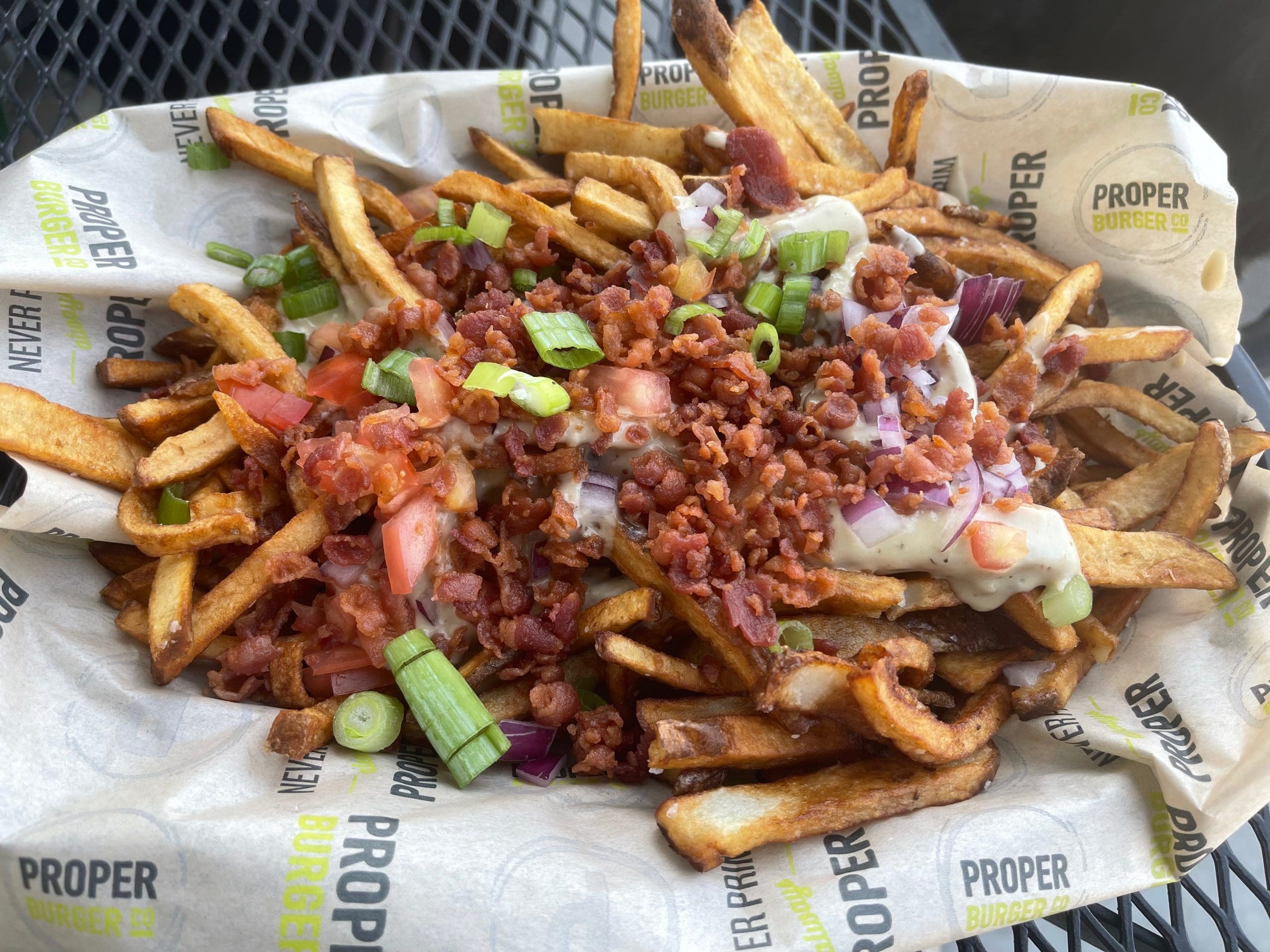
Proper Burger – Salt Lake City, Utah

Television would have you believe Mars and Venus have different ideas as to what constitutes the proper way to eat a burger.  Representing Venus (women), as depicted in a Wendy’s commercial from the 1980s, is a geriatrically advanced woman who takes a small bite of her juicy burger then daintily wipes off the detritis with a napkin.  Representing Mars (men) is Food Network superstar Guy Fieri.  The platinum-coiffed restaurant impressario’s approach to properly eating a burger is mirrored by most of us Martians.  It’s not for the faint of heart or children and you shouldn’t attempt it without a net. If the burger is what some of us more seasoned folks might call a “Dagwood” (characterized by its skyscraper height and multiple layers of meats, cheeses and condiments), Fieri will first assume the position–what he calls the “hunch.”   First you put your burger on the counter and stand in front of it with your chest about twelve-inches from the edge of the counter.  Lean forward so that your chest is at a 45-degree angle to the counter.  Cradle the burger with both hands, resting your elbows on the counter.  Angle the sandwich at a 45-degree angle to the counter with…

Haus Murphy’s – Glendale, Arizona

To some of us of a certain age and generation, the term “grandma’s food” evokes emotionally-arousing childhood memories of the foods our grandmothers would prepare. That’s especially true for those of us who no longer have those heaven-sent treasures.  Food was just one of the many ways grandma showed how much she loved her family.  Memories of grandma’s cooking sustain us and bring a flood of warm, fuzzy, happy memories to us–powerful memories that touch our senses of taste, touch, smell.  For the sentimental among us, “grandma’s food” summons the sense of love and happy familiarity in our hearts.   For restaurateur Thomas Hauck, the term “grandma’s food” also represents how German food is perceived by an American dining public more inclined to chase the shiny new culinary trend.  In a 2018 interview with the Washington Post for an an article titled “How Changing Tastes are Killing German Restaurants,” Hauck lamented the closure of his venerable German restaurant in Milwaukee, Wisconsin.  “It’s a German restaurant that’s 114 years old,” Hauck said. “It’s not what the trend is; it’s just not.” Despite ranking “high” in familiarity by respondents to Yelp polls, Yelp’s research indicated German food ranked 83rd among 100 restaurant categories…

DeFalco’s Deli: Italian Eatery & Grocery – Scottsdale, Arizona

My Kim usually leaves the recitation of movie or television quotes to me (apparently it’s a guy thing), but every once in a while she’ll surprise me with an utterance or exclamation she could have picked up only from the big screen or idiot box.  When we strode into DeFalco’s Italian Eatery & Grocery, she approached an employee and–doing her best to channel New Jersey mobster Tony Soprano–asked “where’s da gabagool?”.  She had no intention of buying gabagool and doesn’t even like the stuff much.  The moment just seemed appropriate.   Here we were in an Italian grocery brimming with comestibles you’d find at the best East Coast Italian delis and my Kim followed up her question with “gabagool is nothing but fat and nitrates ,” a line uttered by Meadow Soprano.  The Dude and I were looking for a hole to crawl into.  Fortunately the employee was also a fan of The Sopranos and had undoubtedly been asked about gabagool before, albeit probably not with a slight Chicago accent trying to sound like a New Jersey mobster.    If you’re not a fan of The Sopranos or may have missed a 2009 episode of The Office in which Michael tried…

Guava Tree Cafe – Albuquerque, New Mexico

A few years ago, my friend Bill Hanson, a gastronome of the first order, was hosting several of his Costa Rican employees at Intel’s Ocotillo (Arizona) plant. Like me, Bill delights in introducing his friends to new culinary adventures. Unfortunately, not all our colleagues were similarly inclined (despite one of Intel’s corporate values being “risk-taking”). One of them convinced the “Ticos” that the restaurant they should not miss for a “true American dining experience” was Claim Jumper, a regional chain (and slight upgrade from Chili’s). Ever the gracious host, Bill acquiesced to the Ticos’ request. I’ll let him describe the rest (from his gastronomic blog The Tao of Chow): “As each dish was produced and delivered to the table I sank further into my chair as the American decadence of over indulging was displayed in glorious Sysco provided plates heaping with food. Each dish could have easily have served three people as I sat and wondered how much food was actually consumed versus how much went into the dumpsters out back.” If the Ticos were disappointed in any way with the cavalcade of calorie-laden comestibles brought to the table, you’d never know it. To break bread (or arepas) with a…

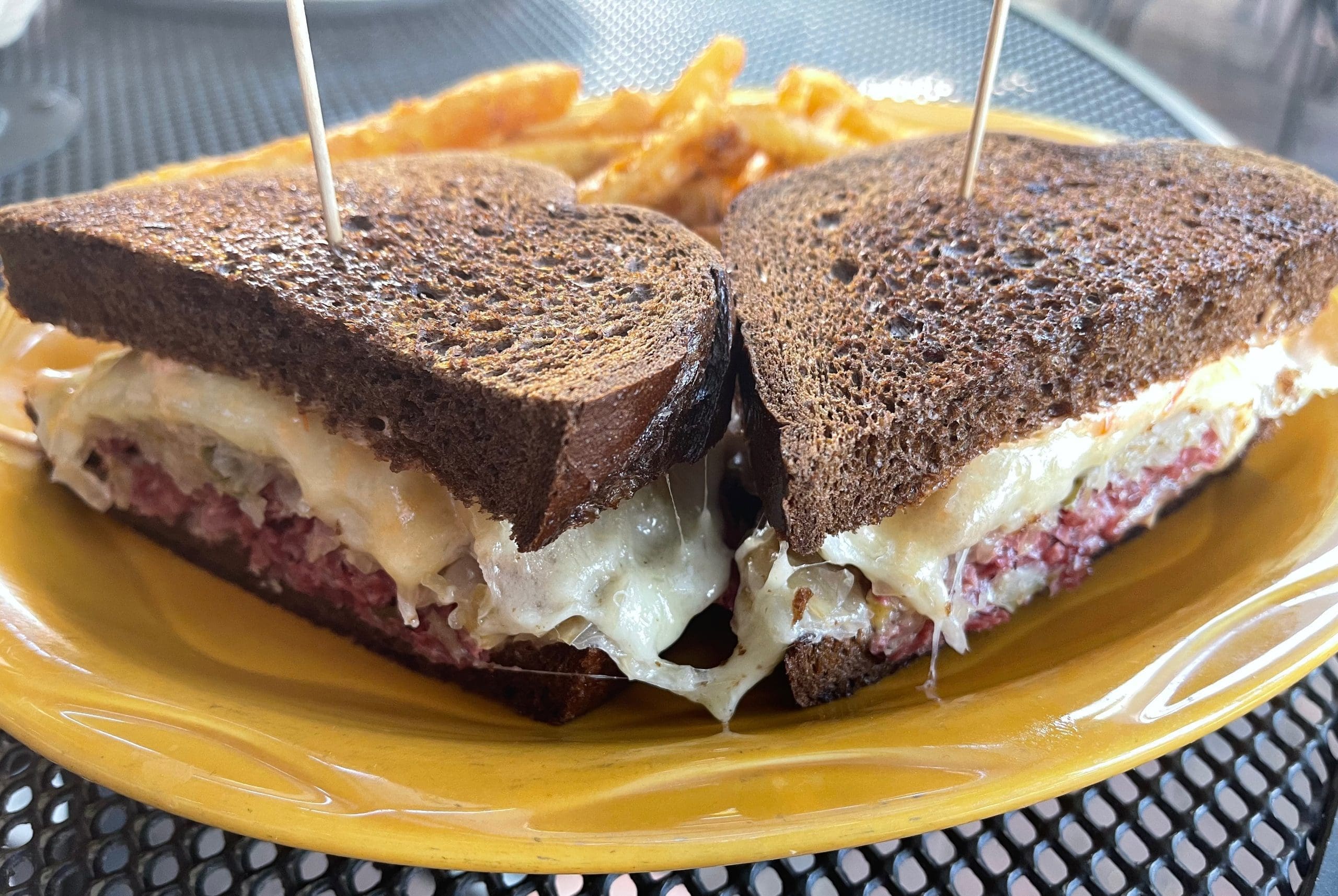
Bocadillos Slow Roasted: A Sandwich Shop – Albuquerque, New Mexico (CLOSED)

The Food Network’s television cameras just love Chef Marie Yniguez who’s been showcased on not one, not two, not even three, but four of its prime-time programs. Aficionados of her cooking will tell you that in three of those programs she even upstaged Guy Fieri, the spiky-coiffed chef-glitterati.  Marie is a larger-than-life personality whose irreverent sense of humor, Burque pride and charisma can’t be contained within the small screen.  It’s inevitable that some network executive will someday make a movie of her life.  The question is who would play her.  Lady Gaga?  Nah, not enough personality.  Meryl Streep?  Ditto and then some.  Jennifer Lopez?  Getting closer.  The truth is, only Marie Yniguez can play Marie Yniguez. There’s no question Marie has led a very (to put it mildly) interesting life.   Her childhood in Hurley, New Mexico, a hardscrabble mining town where hard-working people owed their souls to the company store, imbued her with a work ethic which has served her well.  At age ten, her family moved to Albuquerque where five years later, a formative experience at a part-time job gave her the drive to persevere and surmount criticism.  A short-sighted supervisor who told her she’d never be more than…

Cecilia’s Cafe – Albuquerque, New Mexico (CLOSED)

FROM INSTAGRAM (December, 2024):  After 25 years on the corner of 6th & Silver, Cecilia’s Café has closed its doors. This New Mexican breakfast and lunch restaurant was once featured on the Food Network and was a beloved space for locals.  Owner Cecilia Baca cited persistent challenges with homeless people, issues finding employees, and the remote/hybrid work phenomenon as key reasons for closing. Since the pandemic, “customers aren’t working a full week,” she said. “Just a lot of little things that made me realize that Downtown will not come back to life the way it was before COVID.” Pasqual Baylon’s devotion to the Mass and the Holy Eucharist was so fervent that even when assigned kitchen duty, he remained so enraptured in adoration of the Eucharist that angels had to stir the pots to keep them from burning.  It’s deliciously ironic, therefore, that San Pasqual is the recognized patron saint of Mexican and New Mexican kitchens, a beloved saint whose smiling countenance graces many a kitchen, including the one in Cecilia’s Cafe, one of Albuquerque’s most authentic (and best) New Mexican restaurants. On the day Cecilia opened her cafe back in 1999, she found a small retablo (a painting with…