L&L Hawaiian Barbeque – Rio Rancho, New Mexico

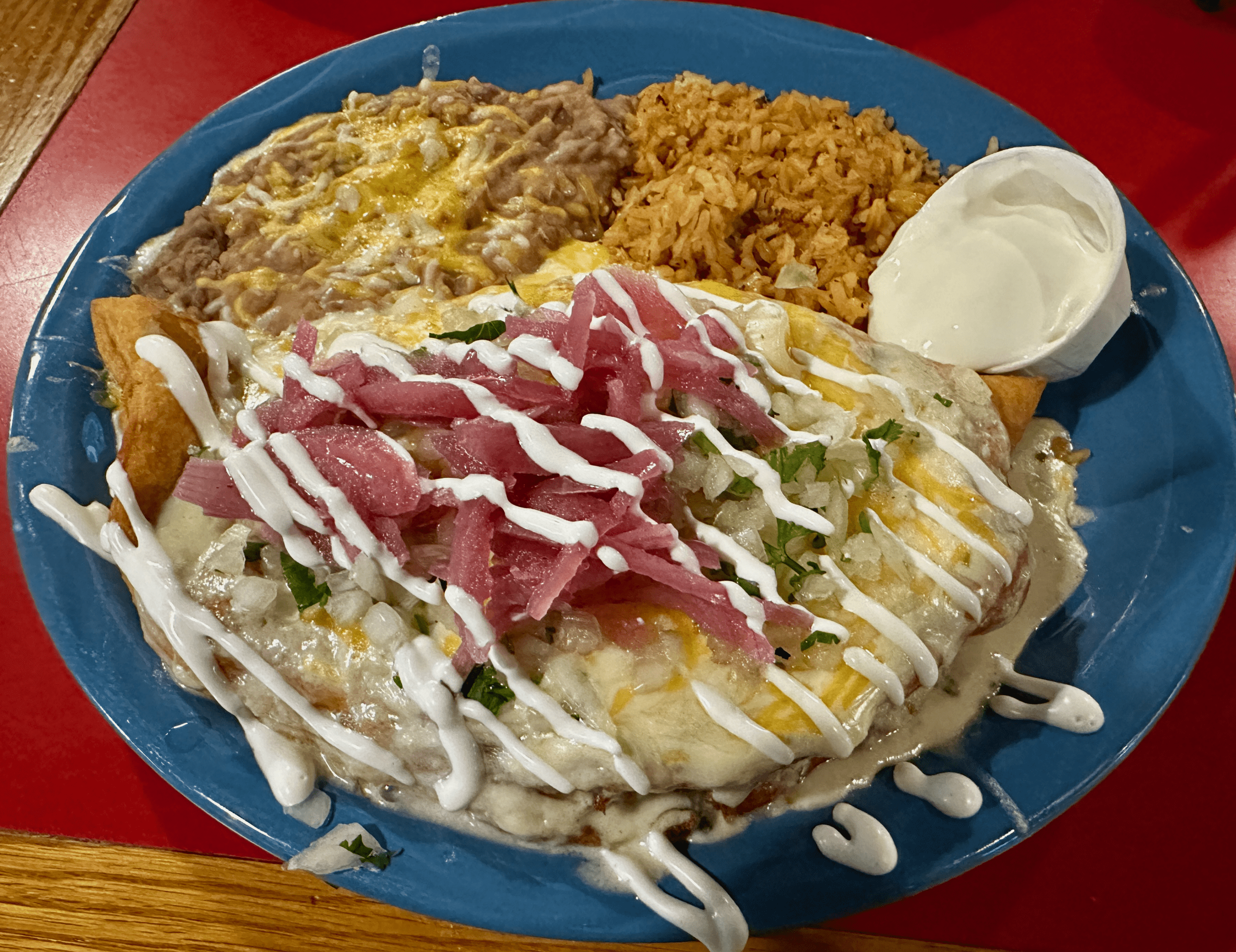
It’s amusing to reflect back on what children of my generation considered funny during the prehistoric days before Nintendo, iPhones and even before color television.  As children were apt to do, we found humor in terms related to scatalogical and bodily functions such as caca, poo poo, pee pee and moco.  The latter is the Spanish term for booger.  Our reaction to learning that Hawaiians actually ate “loco moco” (which translates from Spanish to  “crazy boogers”)  would have beeen simultaneously raucous and nauseating.  Sure, most of us grew up eating chicharrones, menudo and morsillas, but only a crazy person would admit to eating boogers. Hawaiians do indeed eat loco moco, but it has nothing to do with boogers, crazy or sane.  Loco moco is a contemporary (circa 1949) and simple Hawaiian dish consisting of rice, a hamburger patty, and an egg smothered in a savory gravy.  As to the genesis of the name, the loco moco was named for a Hawaiian boy nicknamed “Loco.”  “Moco” was added simply because it rhymed and sounded mellifluous.  During my perigrinations across the country, I’ve had loco moco a number of times.  Though palatable enough, it never struck me as particularly memorable.  “If only,”…

Lescombes Winery & Bistro (Cottonwood) – Albuquerque, New Mexico

Years ago when my job at Intel required frequent travel to the Phoenix area, I marveled at the desert landscaping at Phooenix’s Sky Harbor Airport.  Its xeriscaping approach uses  native, drought-resistant flora arranged in ways that promote efficient water usage.  Towering saguaros and spindly, spine-covered ocotillos greeted sojourners as they vacated the airport.  Not only does this xeriscaping save the city $400,000 annually and reduce water usage by more than five-million gallons per year, it gives visitors a welcome respite from the sun-baked asphalt and cement jungle that is the Valley of the Sun. Driving away from Albuquerque’s Sunport provided a stark contrast to the affable reception of the Sky Harbor.  While the latter was like a warm (scorching) embrace, the former seemed to affirm the popularly-held opinion that New Mexico’s state flower was the ubiquitous weed (or the pervasive orange cone).  Until  more recent xeriscaping and beautification efforts, my colleaugues and I were ashamed of the sights that greeted visitors to our fair state.  Leave it to my friend Dan to express a more positive spin on the contrasts between New Mexico and Arizona: “At least we can produce wine here.”  As you might expect, Dan is an oenophile. …

Del’s Restaurant – Tucumcari, New Mexico

The 1950s was the era of American Graffiti and Happy Days.  Motorists were getting their kicks on Route 66 and listening to Wolfman Jack howl as he spun Rock Around The Clock at 45rpm.  Vestiges of that era are still teeming in Tucumcari, the easternmost major town in the Land of Enchantment along Interstate 40.  Known by locals as “the town that’s two blocks wide and two miles long,” Tucumcari’s main thoroughfare traces the route blazed through town by old Route 66.  That route is festooned with vibrant neon signage that cuts a luminous swath through the town. The nocturnal spectacle of glowing neon might be the siren’s call that has drawn generations of “cruisers” to Tucumcari Boulevard. Not quite equidistant between Amarillo and Albuquerque, Tucumcari has long provided much-needed respite for weary travelers headed west.  In its halcyon days, hundreds of signs along the highways trumpeted “Tucumcari Tonite—2,000 Motel Rooms.”  There aren’t nearly as many motel rooms in Tucumcari today.  Among the survivors are the famous  Blue Swallow Motel which Smithsonian Magazine once called “the last, best, and friendliest of the old-time motels.”  Across Route 66 from the Blue Swallow stands another survivor, the landmark tepee fronting the historic Tee…

Eischen’s Bar – Okarche, Oklahoma

Even by Oklahoma small town standards, Okarche is a small town.  It’s not much bigger than a village though too big to be considered a hamlet.   With a population of  1,141 as of the 2020 United States census, Okarche is one of the most interesting spots in a state replete with interesting spots.  For one thing, the name Okarche is a portmanteau derived from parts of three words, Oklahoma (OK), Arapaho (AR), and Cheyenne (CHE).  Okarche is situated in what was part of the Cheyenne-Arapaho Reservation, after the disgraceful Trail of Tears forced relocation of Southeastern tribes.  Though only sixteen miles west of Oklahoma City and fourteen miles north of El Reno (home of Johnnie’s onion burgers), Okarche is as rural as it gets with farming having provided the town’s economic  mainstay throughout its history. Ask anybody in Oklahoma what Okarche is known for and they probably won’t tell you about its unique name or history.  Everyone in the Sooner state seems to know Okarche for Eichen’s Bar, the “oldest bar in Oklahoma.”  As a watering hole, Eischen’s has its own history.  It first opened in 1896 (eleven years before Oklahoma became the 46th state in the union).   It’s on…

Birdies by Chef Kevin Lee – Edmond, Oklahoma

My Kim and I regard ourselves as ambassadors for the great state of New Mexico, especially when we travel.  We’re often asked where we’re from.  Invariably we run into people whose perceptions about the Land of Enchantment are far from kind.  Some actually believe Breaking Bad is a documentary about the condition of life in New Mexico where wild west lawlessness is rampant.  If only perceptions of New Mexico were as gracious and kind as those of Oklahoma.  Throughout our week-long sojourn in the Sooner State, state pride was palpable.   You would expect that from locals, but some of the nicest things we heard about Oklahoma were from visitors like us.  Most visitors were genuinely touched by just how nice veryone was.  Some commented about not being cut off in traffic and not being greeted with a one-finger salute for some unforgiveable traffic transgressions (like not going 20 miles over the speed limit).  Others spoke about the personable service they received at hotels and restaurants. The niceness of Oklahomans didn’t really come as a surprise.  Two of my very favorite people–my Air Force colleague John Holmes Bennett and fellow culinary scribener Steve Coleman–were raised in Oklahoma.  You won’t find two…

Ma Der Lao Kitchen – Oklahoma City, Oklahoma

In Italian, the term “mangia, mangia,” is an encouragement to enjoy food abundantly.  In Spanish, the polite phrase “Buen Provecho” translates to “enjoy your meal.”  The French term for “enjoy your meal” is “bon appétit” while the Cajun equivalent is “Allons manger.”   You’re probably acquainted with most of these terms, but here’s one you may not know.  In Lao, “Ma Der!”(ma-derr) is a phrase that basically means “come eat! or “come through!”  Throngs of Oklahoma City’s savvy diners have been coming to eat at Ma Der Lao Kitchen since 2022.  It’s a good bet not all of them realize the meaning of the restaurant’s name.  Perhaps some of them believe “Ma Der” is someone’s mother. Even if not everyone understands the term “Ma Der,” denizens of the Oklahoma state capital and beyond are intimately familiar with the restaurant’s reputation.  Indeed, Ma Der Lao Kitchen has a national profile.  In 2022, Bon Apetit named it among the 50 best new restaurants in the country.  The New York Times went one better, in 2022 naming it one of America’s fifty best restauants.  Ma Der also made it to USA Today’s listing of restaurants of the year for 2024.  Additionally, Chef and owner…

Pho Lien Hoa – Oklahoma City

“Oklahoma, Where the wind comes sweepin’ down the plain And the wavin’ wheat Can sure smell sweet When the wind comes right behind the rain.” ~Oklahoma by Rodgers & Hammerstein The setting for Rodgers and Hammerstein’s revolutionary 1943 Broadway hit Oklahoma showcased wide-open plains and rugged landscapes that painted both a literal and metaphorical canvas.  The vastness of the territory mirrored the boundless dreams and limitless energy of its inhabitants.  This award-winning musical depicted the ushering in of organized statehood, a challenging transition from mostly unsettled agrarian land.  That transition parallels the characters’ personal journeys toward growth and self-discovery.  Oklahoma became a timeless classic largely because of the stirring music, but also its celebration of love, community, and resilience among vibrant characters. We weren’t expecting Shirley Jones belting out “Oh What a Beautiful Morning” when we crossed into the Sooner State’s sacred borders, nor did we expect John Steinbeck’s The Grapes of Wrath or warring factions of cowboys and Indians.  Frankly we didn’t know what to expect.  You’ll forgive my ignorance of modern day Oklahoma.  It was obviously stunted by my having watched the musical a few dozen times.  My friend Steve Coleman, the prolific blogger who informs and entertains…

Los Toasties – Albuquerque, New Mexico

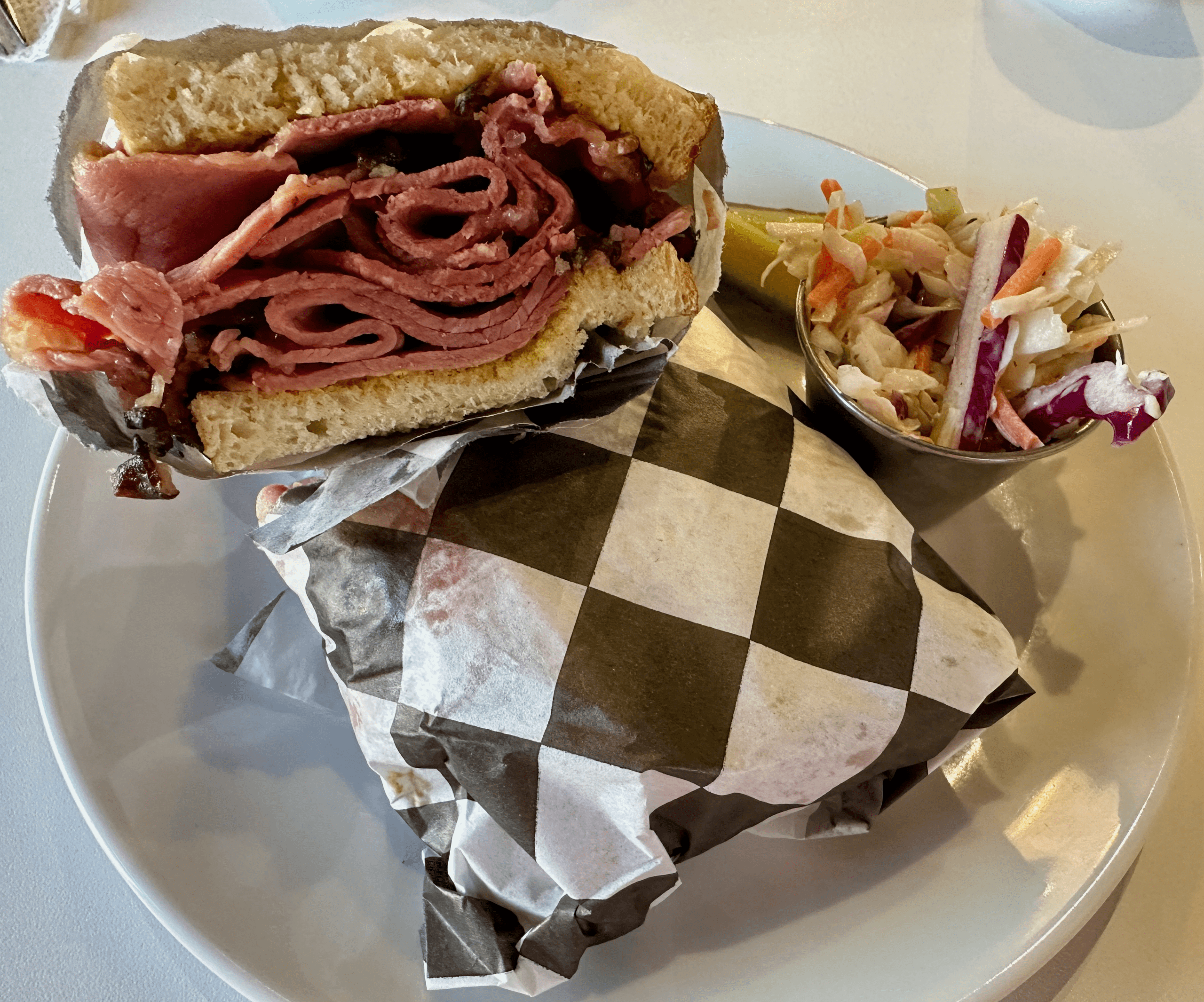
To paraphrase John 15:13, “No greater love a man has than this, that a man give up his life for a….sandwich.” In an uproariously funny episode of the television show Friends, Joey, Chandler and Ross go on a ride-along with Phoebe’s policeman boyfriend. Believing a back-firing muffler was actually a gunshot, Joey (sitting in between his two friends) dives, seemingly to protect Ross from harm.  Naturally Chandler was upset that Joey would choose to protect Ross instead of him…until he learns that Joey was actually trying to protect his sandwich.  In the finest tradition of Dagwood Bumstead, Joey Tribbiani loved sandwiches; they were his favorite food.  I don’t know how many Americans would “take a bullet” for their sandwich, but America is most definitely a nation of sandwich lovers. According to  the National Institutes of Health, “on any given day, 47% of adults ate a sandwich. A larger percentage of men (52%) than women (43%) ate sandwiches.  Most sandwiches eaten by adults contained meat, poultry, or fish (79%). The most commonly consumed types of sandwich were cold cut sandwiches (27%), burgers (17%), and poultry sandwiches (12%).  Among adults, nearly one-half of all sandwiches were eaten at lunch (48%), followed by dinner…

El Palacio Imperial – Albuquerque, New Mexico

“Tradition is everything.  It’s very important. But we need to remember that the traditions of today Were the modernity of the past. And that the things we think are very science fiction type of things Will be the traditions of tomorrow.” ~Chef Jose Andres Chef Jose Andres was the founder of the World Central Kitchen which provides large-scale relief to communities affected by natural disasters and conflicts around the world.  He’s one of Time Magazine’s  world’s 100 most influential people.  He earned a Presidential Medal of Freedom for his altruism as well as for being the Spanish-American culinary innovator who popularized tapas in the United States.  His list of accomplishments and the reach of his philanthropic efforts mark him as one of those rare human beings whose influence and impact extend far beyond the kitchen. Several years ago, my Kim and I visited China Poblano, a spectacular restaurant launched by Chef Andres in Las Vegas, Nevada.  This eatery pays tribute to the concept of East meets West, serving both Mexican and Chinese foods.  Las Vegas Weekly called China Poblano “quite simply the perfect restaurant for today’s hipster foodie.”  China Poblano is not a fusion restaurant per se in that it doesn’t…

Taconeta – El Paso, Texas

The meme below purports to show where the highest quality of tacos in Texas can be found.    Study the map and you’ll get the impression the meme’s creator believes tacos are “nonexistent” throughout about half of the Lone Star State.  That includes the Dallas-Fort Worth metroplex as well as all of West Texas.   Most of what the meme’s creator believes are the Lone Star State’s “best tacos” can be found only in San Antonio and the South Texas Plains as well as in portions of the Texas Hill Country.  A “best tacos” designation is also accorded to the El Paso area. There is, of course, no official sanctioning of this (or any other) Texas Taco Map.  It’s just someone’s opinion, perhaps someone well traveled and conversant in the exploration of taco greatness.  Much more highly regarded and as close-to-official as it comes is Texas Monthly Magazine’s “50 Best Tacos in Texas” listing.   Compiled by the Magazine’s “Taco Editor” Jose Ralat, who traveled around 14,000 miles, from Amarillo to Brownsville and El Paso to Texarkana, it actually validates that great tacos are to be found throughout the state.  Contrary to the Texas Taco Map, great  tacos aren’t the exclusive source…

Loro Asian Smokehouse & Bar – Austin, Texas

An average person spends 52 days of their life standing in line (queueing) and that not just at the Department of Motor Vehicles (DMV). The most notorious offenders are, of course, supermarket lines, public transportation, the post office, airports and barbecue joints in the great state of Texas.  Okay, that last one may not be true though it certainly feels that way.  Franklin BBQ in Austin has nothing short of a cult following–and probably the longest lines of any barbecue joint in Texas.  Standing in line is part of the Franklin BBQ experience.  Online sites advise that “wait times during the week at Franklin Barbecue are typically 2-3 hours and on weekends closer to 4 or 5 hours.”  Smoked meat savants recommend showing up even earlier.  Female Foodie recommends “be willing to spend the better part of your day (or at least the first half) waiting in line and making an experience out of it.” Since its launch in 2009, Franklin Bbq has sold out of brisket every single day.  That lengendary brisket is credited for much of the great success of Franklin Bbq.  In 2013 and 2017, Franklin BBQ captured the number one and number two spots, respectively, on…