The Cup – Albuquerque, New Mexico (CLOSED)

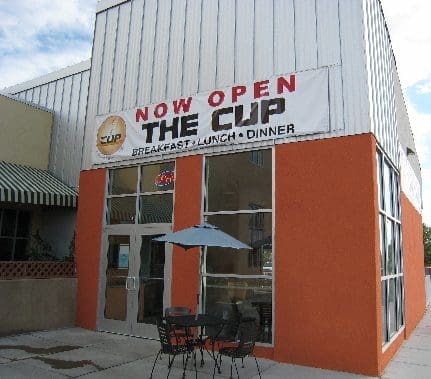
Buxom silent screen siren Mae West was so renown for her use of double entendre that she once said, “If I asked for a cup of coffee, someone would ask for the double meaning.” When my wife suggested we have breakfast at The Cup, I wondered what she really had in mind. The Cup, after all, did not impress her in the least during our inaugural visit in January, 2007. It was even worse for me as The Cup’s emptiness triggered memories of a dark day in the late 70s when I was the recipient of bad news (the “Dear John” kind) at the only restaurant I can remember as empty as The Cup that night–a long defunct Burger Chef. Considering The Cup was sister restaurant to the popular Gold Street Caffe, the emptiness seemed like something out of the Twilight Zone. We’re talking the Gold Street Caffe here–one of downtown Duke City’s darling dining destinations, the restaurant with the very best bacon (the thick cut honey chile glazed marvel) in the world. We’re also talking the Pan American frontage road area within easy walking distance to the Century 24 theater. All the restaurants clustered in this area and their…

Barb’s Place – Albuquerque, New Mexico (CLOSED)

To everything there is a season and a time to every purpose under heaven. – Ecclesiastes 3:1-8 These lyrical words from the King James version of the Holy Bible have been attributed to the most sagacious of Jewish monarchs, King Solomon. They have been recited, sung and published in numerous prayers, songs and books. The words posit that there is a time and place for all things–even cumin. I’ve been accused of making my Web site a bully pulpit against cumin (more than once referred to on my site as “the accursed despoiler of New Mexican chile.”) Perhaps it’s true that I’ve been a bit tough on cumin, a pungent spice with a distinctive salty-sweet flavor, but my rail against that spice is solely where New Mexican food (red chile in particular) is concerned. Cumin is one of the most frequently used spices in Indian food, gracing many a wonderful Indian curry dish. In combination with other sublime Indian spices, its redolence is smoky, maybe even musky, and always evocative. Why then my contempt for cumin on chile? It’s simple! Red chile needs absolutely no amelioration. Unadulterated, it is absolute perfection just as nature intended. Cumin tends to give chile…

Richard’s Mexican Restaurant – Albuquerque, New Mexico

In 2006 and 2007, the CalorieLab compiled the “fattest state” rankings based on a risk factor assessment provided by the Center for Disease Control (CDC) and Prevention. CalorieLab determined an overall increase in obesity in all states but California.  Garnering the discomfiting dishonor as the fattest state in the union two years in a row was Mississippi. The Magnolia State was the first state ever in which two-thirds of its citizenry or higher were either overweight or obese by CDC standards. Our neighbor to the north, Colorado, ranked as the leanest state in the fruited plain two years running despite the percentage of its citizens now considered obese climbing to 17.6 percent. In many national ratings involving education, health care and other quality of life measures tracked, the Land of Enchantment seems to fall in the ignominious neighborhood of Mississippi. I had expected the stout girth of our citizens to approximate the voluminous magnitude of the Deep South state’s rotund residents since statistics usually place us in the same neighborhood. Surprisingly, New Mexico was far distanced from Mississippi, ranking as the 42nd fattest state–or 8th leanest state if you prefer. By CDC standards, 59.8 percent of the state’s citizenry is…

Sushi King – Albuquerque, New Mexico

Two roads diverged in a wood, and I– I took the one less traveled by, And that has made all the difference. – Robert Frost The path to becoming a sushi aficionado is, in some ways, an assertion of individualism. You might also consider it an expression in audacity. Sushi, as most of us know, is not for everyone. Even the decision to try it the first time can be daunting. Some otherwise intrepid diners will never even get that far, the notion of consuming “raw fish” being too extreme for them. Some will take the safe path and partake primarily or exclusively of “cooked” sushi, grilled fish enrobed in tempura batter and served warm. Others, like my friend Maui Brian, take almost masochistic pleasure in dousing their sushi with wasabi incendiary enough to stream tears down their cheeks and leave them coughing and sputtering at every bite. Still, others like Duke City Food’s adventurous blogger Andrea Lin are absolutely fearless, delighting in sampling sushi only the most broad-minded sushiphiles can appreciate. Think uni, the edible part of the sea urchin, a spiny echinoderm. I also know sushi lovers who are base traditionalists. They shutter at the “spurious” nature of…

Ruben’s Grill – Albuquerque, New Mexico

During the Mexican Revolution of 1910, many women joined the army both in response to the tremendous need for their service, but also to accompany their husbands, many of whom were conscripted into service. Traveling with the revolutionary armies, it was often the role of women to forage for food and cook meals. As much as possible, the women who followed the armies tried to provide a homey meal experience complete with tablecloth, decorative plates and vases for flowers. As soldaderas, their contributions to the Mexican Revolutionary were not limited to “traditional” roles of the time–serving as caregivers and as cooks. Many women distinguished themselves on the battlefield and are today remembered in such songs as La Adelita. It was a bit of a disappointment not to see any of these women celebrated on the sunflower colored walls of Ruben’s Grill, a popular Northeast Heights Mexican restaurant whose walls are adorned with black and white posters of the heroes of the Mexican Revolution. My favorite of the lot is a “Wanted” poster issued in 1916 by the Columbus, New Mexico chief of police who offered a $5,000 reward for the capture of Francisco “Panco” Villa. History will recall that the…

Taj Palace – Albuquerque, New Mexico

Indian cuisine is one of the world’s most diverse and sophisticated cuisines, fashioned over time by ancient traditions, diversity of religion, climatic variety and the influence of neighboring countries.  It is so diverse, in fact, that the characterization “Indian cuisine” would be wholly inaccurate. There are more Indian cuisines than there are regions in this ethnically diverse subcontinent comprising 17.5 percent of the world’s population. While categorization by geographical region–North Indian, South Indian, East Indian and West Indian–is prevalent, such groupings are at least partially exclusionary of cuisines whose basis is religious, especially the Hindu and Muslim faiths.  One of the great things about being an aficionado of Indian cuisine is that we can appreciate both its tremendous diversity and the unifying threads that make it one of the world’s great cuisines. One commonality is the wide range of spices which produce its inimitable aromas and flavors. Indian restaurants have long graced the Duke City dining scene, albeit in relatively small numbers compared to restaurants of other ethnicities.   A commonality among most Albuquerque Indian restaurants is the ubiquitous presence of the buffet. Buffets are more responsible for introducing diners to Indian cuisines than any other factor. This is evidenced by…

Eldorado Court – Santa Fe, New Mexico (CLOSED)

In Spanish, the word Eldorado translates to “the gilded one” or the “golden one” and refers to an imaginary place of great wealth and opportunity sought in South America by 16th-century explorers. In Santa Fe, Eldorado means a stately landmark hotel just off the historic Plaza in which guests are graced by the art of hospitality in lavish accommodations. The heart of the hotel is the Eldorado Court, located just off the main lobby. During our first visit in 2005, the Eldorado Court was “guarded” by two multi-hued, bigger than life coyotes (the type that helped define Santa Fe style years ago). Those coyotes have been repositioned onto ledges where they still remain in vigilant watch. On Sundays, Eldorado Court hosts one of the very best brunches in Santa Fe, a sumptuous buffet that might have quelled the Spanish explorers’ lust for gold and supplanted it with a yearning for Sunday mornings. A Bacchanalian feast of dining extravagance features bounteous spreads of thematically arranged tables showcasing such brunch delights as seafood, salads, fruits and cheeses, desserts and oh so much more. You’ll be tempted to camp out at any one of these culinary stations, but there’s so much you’ll miss…

El Modelo – Albuquerque, New Mexico

Growing up in the 60s in a bucolic village in Northern New Mexico, we had no idea about such things as political correctness and multi-culturalism. It would be decades before the ascendency of the “woke” movement.  My friends included descendents of Montezuma, scions of the Spanish explorers, Native Americans from a nearby Pueblo and even a few “white” kids.  None of us really thought about things like “inclusion” and “diversity.”  We lived it! Being kids, there was naturally a lot of good-natured name-calling and teasing, but even when tempers flared, I can’t recall racial stereotype-based derogatory terms ever used in anger.  We thought nothing of teasing the “rich” white kids about their “white as them” Rainbo bread sandwiches and they retorted in kind with insults about the “poor” kids and their chicharones and chile engorged tortillas. We were teased that “Mexican” (then a collective term for all Hispanics) children received tamales for Christmas so they would have something to open on Christmas morning.  Rather than think it offensive and racist, we laughed and tried to one-up with something better. It wasn’t until years later that we found out we were supposed to be offended by race-based stereotypes and insults.  It brought…

Osteria d’Assisi – Santa Fe, New Mexico

Historians have characterized the discovery, exploration, and colonization of the Americas in the late fifteenth and sixteenth centuries as having had three express purposes: glory, gold and God. This holds true in New Mexico where Spanish Explorers may have come for glory and gold, but finding neither, stayed for God.  Believing the large population of native peoples needed to hear the Gospel, the Spaniards established New Mexico first as a colony then as a mission. The effort to Christianize the native peoples was led by Franciscans, known then as the Sons of St. Francis of Assisi.  The sandal-shod Franciscans carried the Gospel throughout the Indian pueblos, indelibly imprinting Franciscan spirituality into the fabric and soul of New Mexico’s Catholicism. Evidence of their spirituality remains in the large population of Roman Catholics in New Mexico today, but also in the names given to villages throughout the state. One example is La Villa Real de la Santa Fe de San Francisco, translated from Spanish to The Royal Village of the Holy Faith of Saint Francis of Assisi, shortened to Santa Fe. In addition to being the patron saint of Santa Fe, Saint Francis is the patron saint of animals, birds and the…

Las Mañanitas – Albuquerque, New Mexico (CLOSED)

Estas son las mañanitas, que cantaba el Rey David, Hoy por ser día de tu santo, te las cantamos a ti, Despierta, mi bien, despierta, mira que ya amaneció, Ya los pajarillos cantan, la luna ya se metió. This is the morning song that King David sang Because today is your saint’s day we’re singing it for you Wake up, my dear, wake up, look it is already dawn The birds are already singing and the moon has set Las Mañanitas, the traditional Mexican birthday song often sung in Catholic churches and birthday parties is one of my very favorite songs of any genre.  It offers the recipient a good-morning wish just as King David himself might have. During early summer days when Duke City diners feel like serenading their taste buds with New Mexican food, many head to Las Mañanitas just north of Old Town.  There they dine on a brick patio under towering cottonwoods and a canvas of blue provided by New Mexico’s incomparable skies. The sprawling adobe restaurant is a historic landmark with a colorful history.  Parts of the structure date back more than 300 years.  It has served as a stagecoach stop, saloon and brothel as…

Blue Heron Restaurant at Sunrise Springs – La Cienega, New Mexico

Fewer than ten miles separate the historic Spanish village of La Ciénega from Santa Fe, and though both have largely retained vestiges of their storied and proud histories, the differences that set them apart are as vast as El Camino Real, the Royal Road that has connected them for centuries. While Santa Fe has entered the 21st century as a burgeoning cosmopolitan city, La >Ciénega remains a rural enclave, parts of which have remained unchanged for generations–that despite becoming somewhat of a bedroom community for Santa Feans. Once a rural Indian pueblo outpost, La Ciénega  was abandoned in the seventeenth century only to be resettled by the Spanish after Don Diego de Vargas’ celebrated reconquest of New Mexico. During the second Spanish colonial period (1692-1821), haciendas and ranchos dotted the Rio Grande valley.  Dons (landlords) and their peones (workers) cultivated the fertile alluvial soils, raised livestock and tended orchards of fruit.  Hard work was a way of life.  It had to be! Ranchos HAD to be self-sufficient.  The tremendous distance from Mexico City coupled with the laborious and perilous 2,000-mile trek made visits from supply caravans infrequent.  Even when they did arrive, rarely did they transport the necessities of daily…