Sadie’s Dining Room – Albuquerque, New Mexico

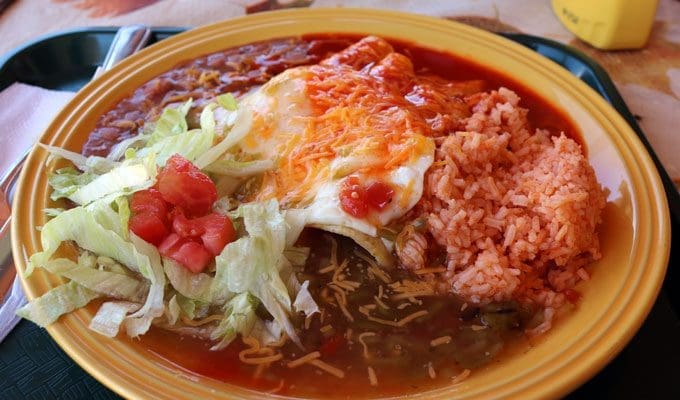
Albuquerque and Sadie’s Dining Room have come a long way since 1950. Back then the Duke City’s population was 96,815, up 173% from 1940. Sadie Koury, the oldest child of Lebanese immigrants, was four years away from launching her first Albuquerque restaurant. Located on Second and Osuna, the first Sadie’s was housed in a Lilliputian edifice not much bigger than the restrooms at the Fourth Street restaurant which today bears her name. The Duke City was much more pastoral in the early 50s and Sadie’s restaurant was but a diminutive nine-stool diner on what was then one of the city’s most busy thoroughfares (though not quite as busy as Fourth Street which in 1954, was already seventeen years removed from having been part of historic Route 66). Sadie opened her eponymous eatery for breakfast every morning at 5AM and served lunch late into the afternoon. Standing room only crowds often included truckers who deviated from their Route 66 throughway and who would park their diesel rigs around the tiny edifice. Sadie greeted her customers with a friendly “hi honey” and got to know many of her regulars as well as how they liked their favorite meals prepared. In 1973 after…

Le Troquet Bistro – Albuquerque, New Mexico

Pope Gregory the Great was a prolific writer canonized as a saint and recognized as a “doctor of the church.” Among musicians, singers, students and teachers, he is revered as a patron saint, a heavenly advocate who intercedes on their behalf. Among gluttons of the Middle Ages, however, the supreme pontiff was reviled. In his treatise Morals on the Book of Job, Pope Gregory essentially condemned them to Hell, a denouncement reflecting the strict austerity of the times. For gluttons, the unpardonable sin was in deriving too much pleasure from eating. Eating, or more precisely the pleasurable overindulgence in food, was viewed as an ungodly preoccupation with temporal and corporeal pleasures at the expense of spirituality. Church leaders of the Middle Ages didn’t just denounce the derivation of pleasure from eating in a general sense. They listed five specific ways in which gluttony was a sin: eating too soon, eating too expensively, eating too much, eating too eagerly, eating too daintily and eating wildly. By Middle Age standards, many Americans are gluttons and would be condemned to an eternity in Hell for our enjoyment of food. Fortunately the provincial dogma regarding the enjoyment of food has been replaced by more…

Bosque Brewing Company – Albuquerque, New Mexico (CLOSED)

NOTE: The Bosque Brewing Company has six locations including two in Las Cruces and one in Bernalillo.  Only the location in San Mateo reviewed here has closed. In 1978, the number of breweries across the fruited plain had fallen to an all-time, post-Prohibition low of 89. That year President Jimmy Carter signed into law, a bill that legalized home brewing on a national level. Since the craft brewing market began to pick up steam in the mid- to late-1980s there has been no surcease in sight. Today, there are more than 2,500 breweries operating across the United States with another 1,500 breweries in the planning stage. According to the Brewers Association, as of 2013 the craft beer industry experienced double-digit growth four straight years in both dollar sales and volume. So what accounts for such growth in popularity of local beer? Experts theorize that similar to the locavore trend in the culinary world, cervisaphiles (aficionados of beers and ales) have grown tired of being subjected to industrially brewed swill (anyone remember the “skunky” beer commercials?) and have discovered the pleasures of carefully crafted beer flavors made under the same roof where it’s consumed. A similar evolution among consumers also transpired…

DG’s Deli – Albuquerque, New Mexico

“There are sandwich shops in New York which offer the nobility and gentry a choice of no less than 100 different sandwiches, all of them alluring and some of them downright masterpieces.” H.L. Mencken In conversations with trusted gastronomes about what the Albuquerque area dining scene is most direly lacking, it’s not Basque cuisine, Russian food, Low-Country cooking or the food of any other race or ethnicity that’s most often mentioned. Surprisingly, what my esteemed colleagues believe is most desperately needed in the Duke City is a big city deli–and not just any kind of deli. My colleagues lament the absence of a true Kosher-style deli, the type of which were born in the Jewish enclaves of New York City in the 1930s. While the short-lived Nosh Jewish Delicatessen & Bakery quelled some of those longings, it still wasn’t the quintessential kosher deli my urban sophisticate colleagues wanted. Kosher-style delis are not true practitioners of traditional Kosher dietary laws, meaning the food they produce is not deemed “fit” for consumption by Jews in accordance with standards for cleanliness, spotlessness and for being “intact.” As an example, Kosher practices forbid the consumption of meat and milk together while Kosher-style delis break…

Chez Mamou – Santa Fe, New Mexico

When she asked me to repeat the name of the French restaurant where we were dining one slightly breezy Sunday morning, I knew my clever bride had something in mind. Relaying that we were dining at Chez (pronounced “shay”) Mamou, she retorted “are you sure it’s not called “Shame on you.” That was her reaction to a server having deposited a stale, probably older than day-old baguette on our table. She followed up with “no self-respecting French restaurant, especially one claiming to be a bakery would serve bread baked by Napoleon’s baker.” Whether or not the fossilized (her term) bread was indicative of Chez Mamou’s daily performance, it was enough to rile my usually saintly patient wife. By this point, she had already dissed the coffee, an Allegro Coffee blend, which she found entirely too strong and “more bitter than supporters of England wanting to remain in the European Union.” (In the interest of full-disclosure, she finds coffee too strong if it can’t be “cured” by five or six packets of Splenda.”) She would later repeat her “what’s the name of this restaurant” comment while eating some of the restaurant’s highly-touted pastries and croissants, reputedly baked by a master baker…

Laguna Burger (66 Pit Stop) – Albuquerque, New Mexico

In 2016 and 2017 my review of the Laguna Burger was the most frequently visited post on Gil’s Thrilling…  In 2015 and 2014, only one restaurant (Down N’ Dirty Seafood Boil) received more blog visits than Laguna Burger.  If even a small number of the visitors to the review actually also visited the restaurant, that’s thousands of visitors to Laguna Burger.  It’s probably safe to assume hundreds of thousands of visitors who haven’t read Gil’s Thrilling review have made their way to one of the four Laguna Burger locations, three of which are definitely off-the-beaten path.  In November, 2017, Laguna Burger established a presence at a 3,000 square-foot space on Avanyu Plaza on 12th Street near the Indian Pueblo Cultural Center in Albuquerque.  You can read my review of the 12th Street location here. The history of New Mexico is fraught with tales of hardship and peril. Enchanting as it may be, New Mexico is a land which can be harsh and unforgiving as early settlers found out when, amidst the ravages of climatic extremes, they traversed austere terrain in search of wealth and a better life. There were no interstate highways nor high-speed motorized conveyances to ferry them across…

Arirang Oriental Market – Albuquerque, New Mexico

“Cuisine is the tactile connection we have to breathing history. History and culture offer us a vibrant living society that we taste through cuisine. All cuisine is a reflection of the society from which it emanates … in the end cuisine is the result of culture” – Clifford Wright If cuisine is the result of culture, then it can certainly be stated that music is the expressive language of that culture. Well before the advent of the written word, music was used to tell stories, impart wisdom, express ideas, share emotions and convey the history and culture of the civilization. Until the 20th century and the rapid cultural changes wrought by the postmodern period, music also bridged the generations. Family members of every generation typically listened to the same music. In Korea, there may be no song as beloved–even in North Korea–as Arirang, an iconic folk song often considered an unofficial national anthem. Its plaintiff lyrics convey a traveler’s agony and anguish while crossing a mountain pass named Arirang with a heartfelt longing to return home. After its service in Korea during the Korean War, the South Korean government designated Arirang as the official march of the United States Army’s…

The Cellar – Albuquerque, New Mexico (CLOSED)

While touring Granada, Spain during a 2013 episode of CNN’s Parts Unknown, Emmy award-winning celebrity host Anthony Bourdain bemoaned that “we will never have tapas culture in America.” Then, to emphasize his contention even further (and perhaps to rankle the ire of American foodies who frequent “tapas” restaurants across the fruited plain), he challenged viewers: “You may think you know what a tapa is, like if you’ve had small bites at some fusion hipster bar where they do a whole bunch of little plates. Yeah, that ain’t a tapa.” Bourdain, a best-selling author, world traveler, renowned chef and “poet of the common man” doesn’t just vociferate controversial statements because it’s good television. Agree with him or not, he knows what he’s talking about. When he says we will never have tapas culture in America, the operative word is “culture” as in the social practices associated with tapas. In Spain, tapas isn’t a formulaic approach in which a restaurant (or more likely, a drinking establishment) serves “small plates.” It’s so much more than that. In modern day Spain, tapas are not only a gastronomic custom, they are a deeply rooted social and communal event described by Travel and Leisure as “walking,…

El Comal Cafe – Santa Fe, New Mexico

From a social connectedness perspective, 1995 was the dark ages. The internet as we know and love it today was in its relative infancy. There was no Urbanspoon, no Yelp, no Gil’s Thrilling (And Filling) Blog…no trusted online resource to enlighten and entice diners. My only knowledge of Santa Fe’s restaurant scene came from fading memories and a 1994 article on Fortune magazine naming the City Different as one of the fruited plain’s ten best dining destinations. The article listed such stalwarts as the Coyote Cafe, Santacafe and the Tecolote Cafe as among the city’s best. After nearly two decades of wanderlust and travel courtesy of the United States Air Force, I had finally returned home to New Mexico and looked forward to introducing my bride of ten years to one of Fortune magazine’s anointed restaurants. It was our first excursion together to Santa Fe and my first opportunity to impress my Kim with sophisticated Santa Fe cuisine. My mom who’s infinitely more intelligent than I am had other ideas, steering us away from Fortune magazine’s popular tourist destinations and introducing us to one of Santa Fe’s quintessential off-the-beaten-path, mom-and-pop restaurants, a gem named El Comal. By 1995, El Comal…

Olive Branch Bistro – Albuquerque, New Mexico (CLOSED)

The depiction of a dove in flight with an olive branch in its beak is common in early Christian art and tradition. The dove symbolizes the Holy Spirit while the olive branch is seen as a symbol of peace. Christian tradition, as chronicled in Genesis 8:11, describes a dove carrying an olive branch to signal the cessation of flooding throughout the world after forty days and forty nights of rain: “And the dove came in to him in the evening; and, lo, in her mouth was an olive leaf pluckt off: so Noah knew that the waters were abated from off the earth.” Greek mythology mentions the olive branch numerous times, including during a tale of a competition between Athena, the goddess of the wisdom and Poseidon, the god of the sea. With both immortals vying to become the patron deity of Athens, the victor and recipient of the city itself would be determined by which of the immortals bestowed the city with the best gift. Poseidon stuck his massive trident into the ground to create a well of briny sea water, a fairly useless gift. The wise Athena then planted a simple yet infinitely more useful olive tree beside…

Ruth’s Chris Steak House – Albuquerque, New Mexico

During a recent Friends of Gil (FOG) outing, a newcomer asked how my Kim and I can afford to eat out as often as we do (about three times week on average). The practice of “dating your mate” is something we began half a lifetime ago when we were stationed in Mississippi and my Air Force salary was, to put it conservatively, considerably less than one-thousand dollars for every year of my life. Despite the fact that I’d been handpicked for the only job of its kind in my career field, a position with significant responsibilities usually accorded to someone of higher grade and experience–not to mention the possibility of war and deployment every service member faces–by most standards we would probably be considered at the bottom rung of the middle-class. Our date nights could hardly be considered extravagant or high-end. Fortunately the Gulf Coast had a multitude of reasonably priced restaurants serving high quality seafood, Southern cuisine and barbecue. During our frequent visits to New Orleans, we favored“second tier” (in reputation and price, but certainly not in quality) Cajun and Creole restaurants because we couldn’t afford the anointed restaurants that had made the Crescent City a world-renowned dining destination.…