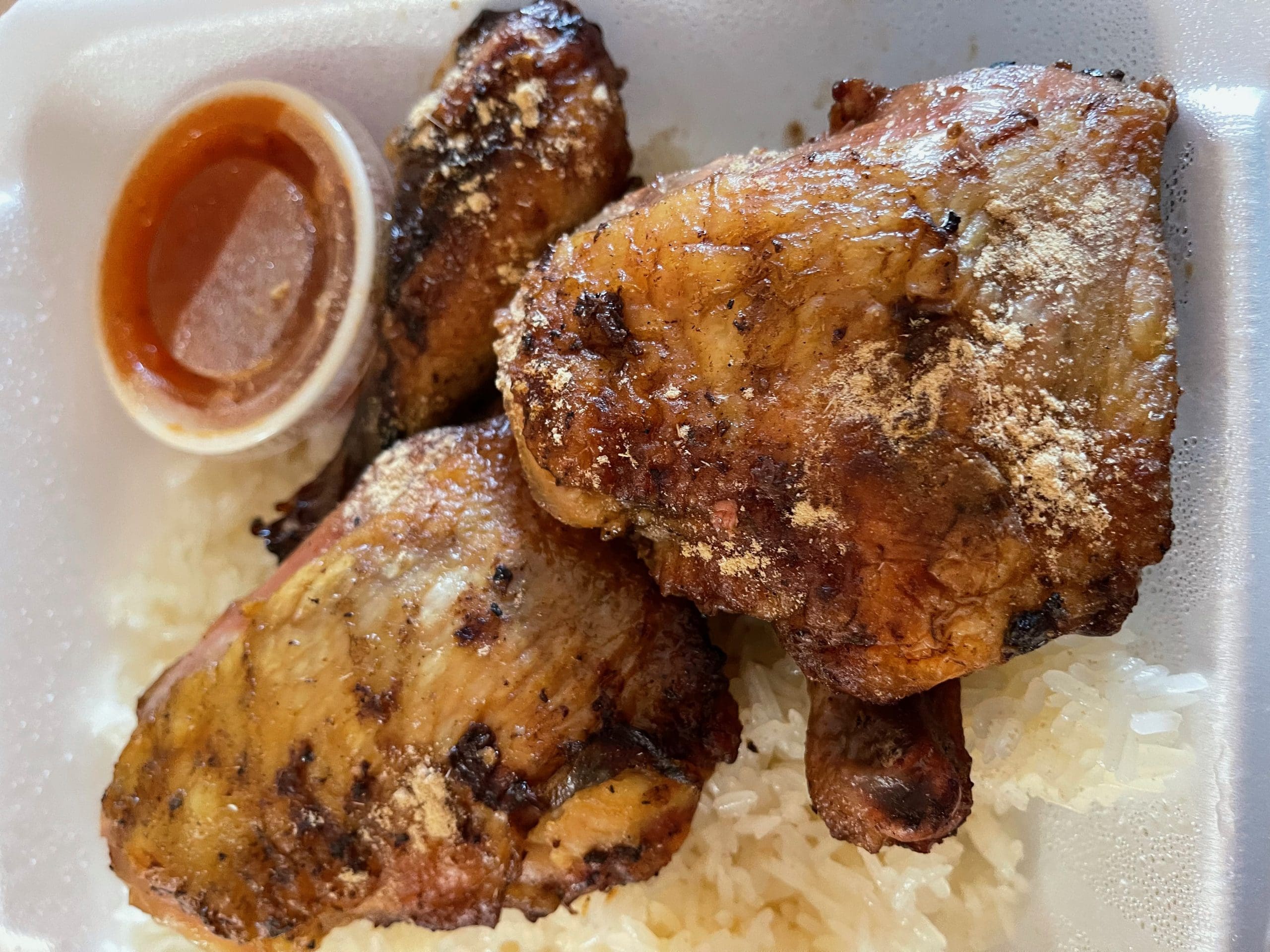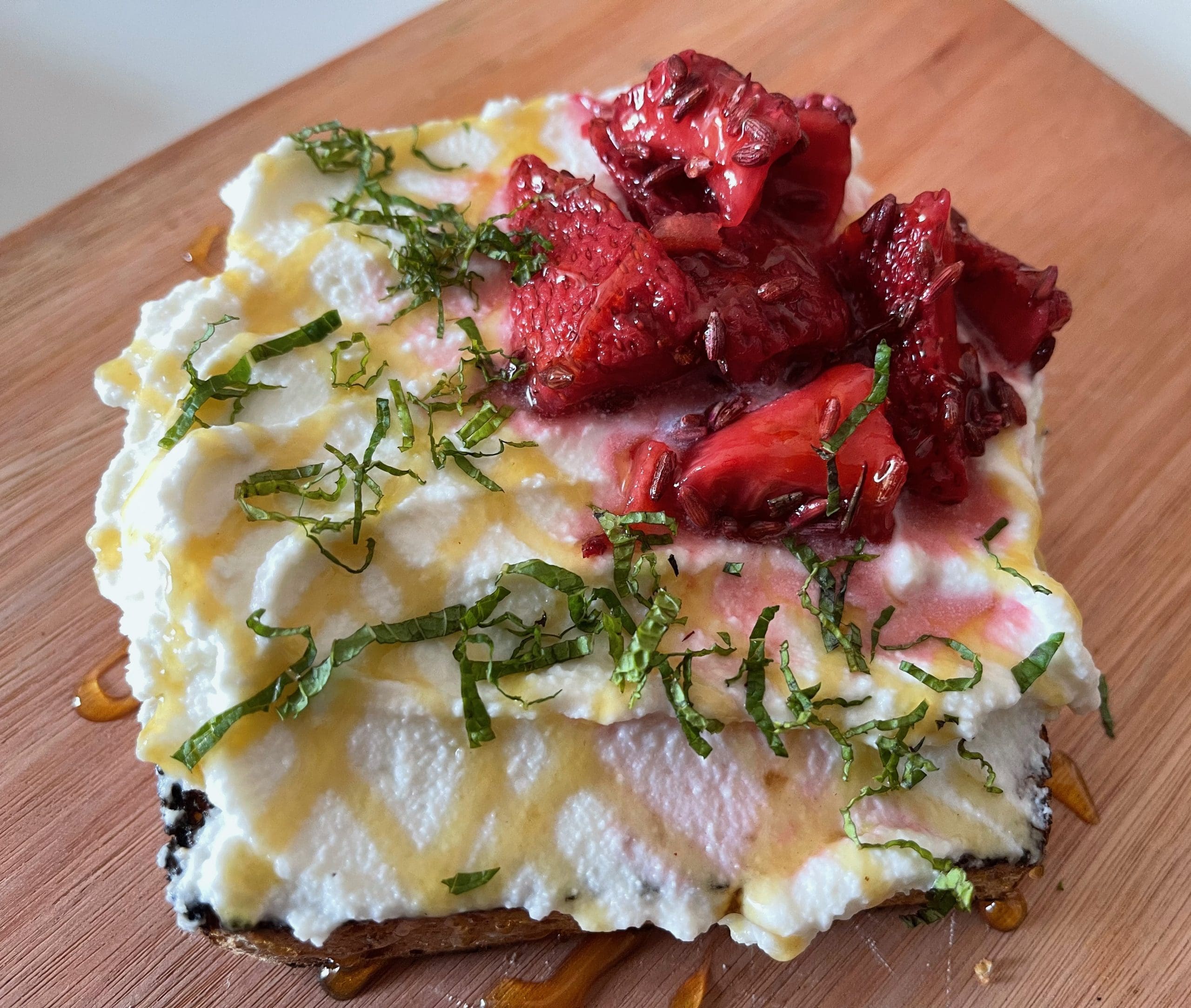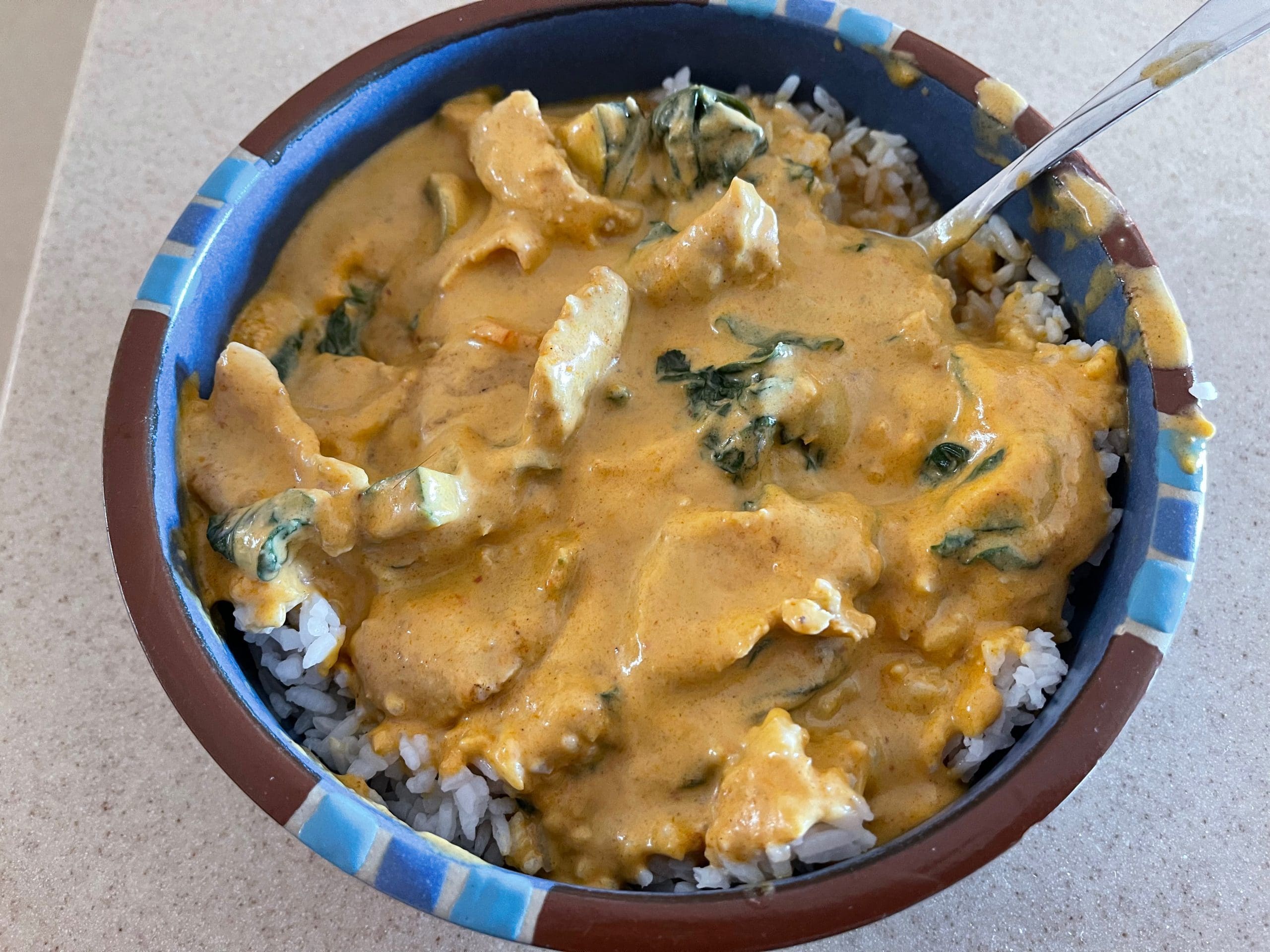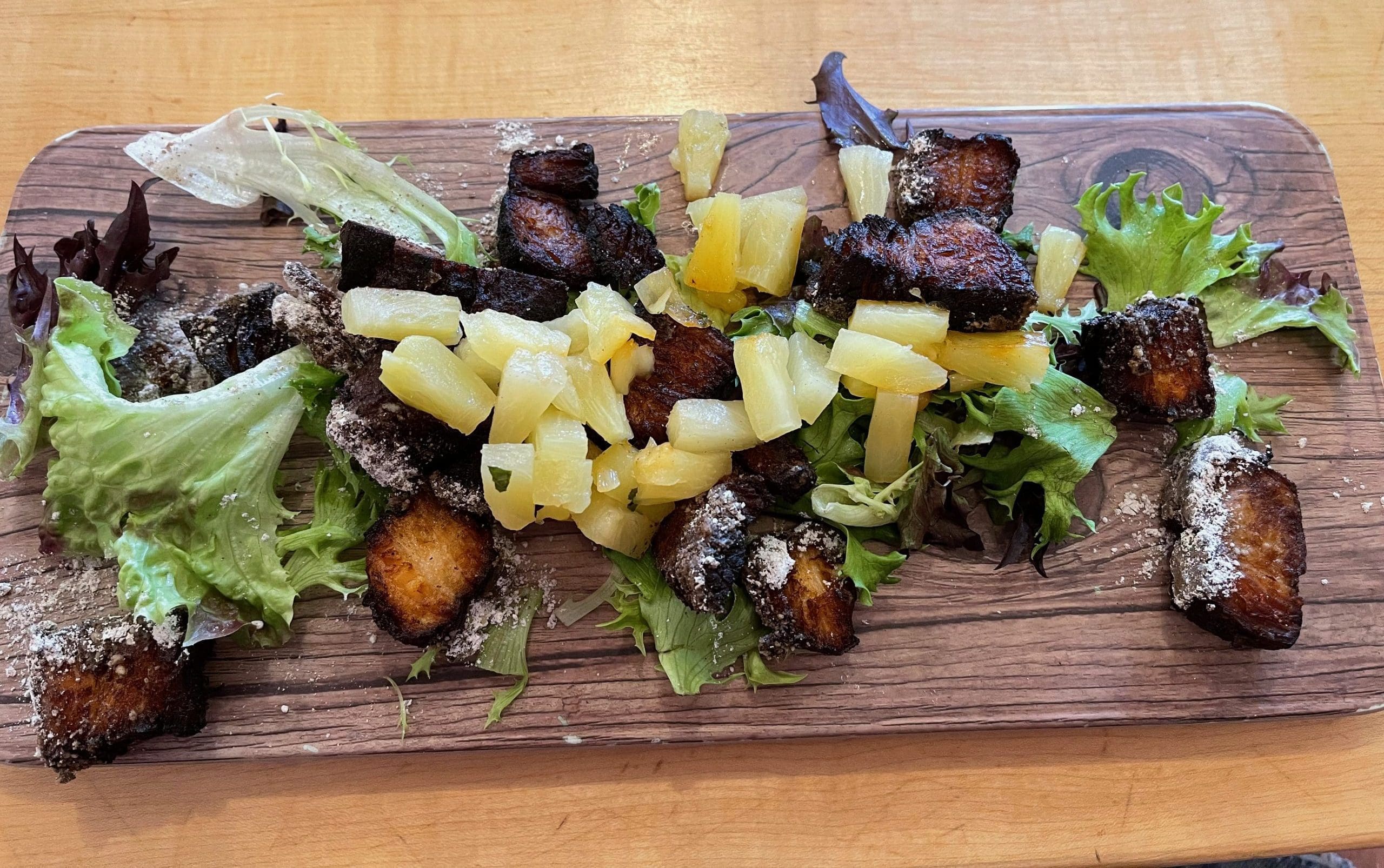
Sticky Rice – Albuquerque, New Mexico

Because of the mulicultural melting pot that is America, it’s impossible to name the one food that defines us as Americans, the one food universally loved by us all.  Hot dogs and apple pie?  Contrary to the aphorism “as American as hot dogs and apple pie,” even hot dogs and apple pie have their detractors.  Ditto for burgers, mashed potatoes, fried chicken or any of the foods named by respondents to “most popular food in America” polls such as this one. Only in countries that are more monocultural will you truly find foods that represent an entire culture and which are beloved by virtually all its citizenry.  In Vietnam, for example, the consensus national food is pho.  Pho is served in households, stalls on street corners where people gather and at upscale and inexpensive restaurants throughout the country.  It’s eaten for breakfast, lunch or dinner (and probably as a snack). Perhaps no country’s national identity is more inextricably tied to one food than the identity of Laos is linked to sticky rice.   Yes, far more than pho is considered the definitive food of Vietnam.  Sticky, or “glutinous,” rice (despite the fact that it’s actually gluten-free) has been growing in mainland…

Curious Toast Cafe – Albuquerque, New Mexico

“Toasting makes me uncomfortable, but toast I love. Never start the day without a good piece of toast. In fact, let’s toast to toast.” ~George Costanza You might think that only a short, stocky, slow witted bald man would live a life so mundane as to even consider making a toast to a good piece of toast.  That may have been the case even just a few years ago when many of us languished under the covers until the very last second then wolfed down a dry and uninspiring piece of toast while gulping a scalding cup of coffee.  With crumbs cascading down our chins and onto our button-down shirts, we rushed to our appointed rounds, destined to arrive at work two minutes after our designated start time.  Toast hadn’t sated our appetites and worse, contributed to our heartburn. Since Eater designated 2015 as “the year of the avocado toast,” “gourmet toast” has been in an ascendency that’s finally caught up with Albuquerque.   It’s an idea whose time has come.  No longer should diners be satisfied with a cold pat of butter or cream cheese on no personality bread that’s already cool by the time it gets to your table. …

Siam Cafe – Albuquerque, New Mexico (CLOSED)

It’s oft been said that “you taste first with your eyes.”  Certainly sight figures in to the enjoyment of food and sets expectations, but the first sensory receptors to engage in taste is the sense of smell.  If you’ve ever experienced a pleasant aroma wafting toward you as you approach a restaurant, you’ll agree.  The Siam Cafe is quite possibly the most aromatically-enticing, olfactory-arousing restaurant in the Duke City.  Its exotic spices and herbs waft like a gentle summer breeze over all diners entering what is conceivably Albuquerque’s best Thai restaurant. For years the marquee named its previous occupant, Pollo Loco, before the owners of the Siam Cafe finally changed the marquee in 2003. With its new signage, this gem declared “Siam, I am!.” The common denominator among all the dishes I’ve had here is consistent excellence, particularly among the curry dishes. Curry is one of those dishes about which inexperienced diners tend to generalize, tending in many cases to believe, for example, that any experiences–good or bad–they may have had with Indian curry will be duplicated with Thai, Japanese, Vietnamese or Malaysian curry. While all curry has an unmistakably pungent fragrance, there are more than subtle differences between the curries…

Urban 360 Pizza, Grill and Tap House – Albuquerque, New Mexico

Babu: Our specials are tacos, moussaka and franks and beans. Jerry: Well, what do you recommend my good fellow? Babu:Oh, the turkey. ~”The Cafe, Seinfeld, Season 3, Episode 7 While perusing the menu at Urban 360 Pizza, Grill and Tap House, my ever-witty friend Ryan “Break the Chain” Scott commented that the menu reminded him of The Dream, the very eclectic restaurant owned and operated by Pakistan emigrant Babu Bhatt in an uproariously funny episode of Seinfeld. As Jerry Seinfeld observed about The Dream’s menu, “he’s serving Mexican, Italian, Chinese. He’s all over the place.” Urban 360’s menu is similarly diverse, a melange of Asian, American and European dishes splayed temptingly onto three pages. That the menu is so “all over the place” makes great sense in that the term “360” itself represents a complete circle as in the shape of planet Earth itself. Okay, the Earth is actually an oblong spheroid, but that’s close to round. Unlike The Dream, Urban 360’s menu has a rhyme and reason, a cohesion. Moreover, Urban 360 succeeds a similarly named and similarly eclectic restaurant, the aptly named Eclectic Urban Pizzeria and Tap House, a magnificent shooting star which fizzled away much too quickly,…

Hollow Spirits Distillery – Albuquerque, New Mexico (REDESIGNATED)

“The winner is the chef who takes the same ingredients as everyone else and produces the best results.” ~Edward De Bono NOTE:  This review is no longer accurate.   According to The Bite: In other distillery news, Hollow Spirits is moving into the building vacated by Bosque Brewing’s Heights Public House. The third-largest distillery in the state, Hollow Spirits has switched gears more than once with their original downtown Albuquerque location, which now operates strictly as a production facility and events space. Their new spot in the Heights will be open to the public, with a 5,000-foot patio in addition to indoor space, but no reports yet on what will be coming out of the kitchen.  The Land of Enchantment boasts of some 3,500 restaurants, more than 1,000 of which are members of the New Mexico Restaurant Association (NMRA).  Keen competition from among hundreds of outstanding chefs throughout the Land of Enchantment makes being named the NMRA’s Chef of the Year quite an honor.  Read the resume of 2020 Chef of the Year recipient Tristin Rogers  and you just might conclude he didn’t just deserve Chef of the Year honors; he’s worthy of “person of the year” recognition, too.  He doesn’t just transform…

Storming Crab – Albuquerque, New Mexico

Archaeologists believe there’s a scientific explanation for contemporary  humankind’s  predilection for seaside vacations and trips to the beach.  Evidence–stone tools used to cut through animal flesh–seems to support the theory that the first humans migrated out of Africa by following the eastern coastline.  This, the theory posits, would have led to Australia being discovered before Europe.  As noted by Professor Chris Stringer, the head of human origins at the Natural History Museum in London: “The earliest evidence of modern humans in Europe is 40,000 years old whereas we find evidence dating to 60,000 years ago in Australia.  This (migrating along Africa’s eastern coastline) provides a possible explanation.” In addition to the tools used by our beachcombing ancestors, the archaeologists found the remains of several edible marine animals, including oysters, mussels and crabs.  Whether or not this also explains humankind’s pescatarian propensities, many of us are passionate about seafood–and not in the way Dolly Parton meant when she proclaimed “I’m on a seefood diet.  I see food, I eat it.”  According to Seafood Source, “on average, Americans consumed 16.1 pounds of seafood in 2018, a per capita consumption rate of 16.1 pounds,  the highest since 2007.”  Shrimp remains the most popular…

Taco Bus – Albuquerque, New Mexico

Perhaps no mobile conveyance in the Land of Enchantment has ferried as many interesting people on as many colorful journeys as the “Road Hog,” the psychedelic bus which shuttled its passengers from Haight-Ashbury to Woodstock to Llano Largo, New Mexico. The Road Hog’s 1969 arrival in Llano Largo heralded the start of the “summer of the hippie invasion” as The Taos News called it. There unwashed masses settled into a Utopian agrarian commune they called the Hog Farm. The Road Hog with its familiar duck hood ornament and Grateful Dead-style tie-dyed design became a common sight in Peñasco, my childhood home.   Everyone–from sanctimonious adults to horny teenagers–visited the Hog Farm.  The former feigned shock and outrage at the audacity of the hippies frolicking in their altogether.  The latter gaped in astonishment at the nubile nymphs parading a boldness exceeding the rather benign porn of the time.  By road, our home was several miles away from the Hog Farm.  By hiking over the river, through the woods and up the hills behind our home we could easily walk to the Hog Farm.  My friends and I grabbed many an eyeful and a good education in anatomy and biology every time we…

Busy Bee Frozen Custard – Albuquerque, New Mexico

Irish playwright George Bernard Shaw has been credited with the aphorism “England and America are two countries separated by the same language.” My Kim and I had no idea just how different the Queen’s English is from the English spoken by the colonists until we were assigned to Royal Air Force Fairford. As part of the newcomers orientation, we were required to attend a course in which those vast differences between American English and England English were explained. Many of those differences were rather comedic, but we were warned, “if Yanks aren’t careful, we could perpetuate the dreaded “ugly American” stereotype widely held in some parts of Europe.” We learned, for example, that if an American serviceman walks up to an English lady and introduces himself with “Hi, I’m Randy,” he’s likely to get slapped in the face. Randy has an entirely different connotation in England where it means “frisky.” It surprised me just how many terms had sexually suggestive connotations.  Terms such as shag, fag, beaver and spunk mean entirely different things in England than they do in the United States.  The double-entendre wasn’t one sided.  We learned that if offered “spotted dick” we shouldn’t create an international incident…

Nomad’s BBQ – Albuquerque, New Mexico

As a spindly teenager who hadn’t yet metamorphosed into my (then) scrawny 6’1″ stature, I had grand delusions of someday playing basketball for the University of New Mexico (UNM) Lobos.  There could be no greater aspiration for a twelve-year old from the mountains than to wear the cherry, silver and turquoise and play for UNM Coach Norm Ellenberger.  Back then Coach Ellenberger could do no wrong in my eyes…or in the eyes of every Lobo fan.  A 1974 Sports Illustrated article described him as “the Newman-Redford among coaches, a man of such striking looks and charisma that his picture, hanging in Albuquerque restaurants, must be guarded lest it be defaced with scribbled I love hims.” When my Uncle Fred introduced me to the legendary coach,  I brazenly told him I’d someday play for the Lobos (obviously that didn’t pan out).  I was so starstruck when Coach Ellenberger shook my hand and spoke with me that it’s a wonder I didn’t tell him that I’d never wash that hand again.  That’s just not something aspiring Lobo basketball players do.  Over the years I’ve met and befriended many people I’ve admired and respected, but have never uttered the platitudinous phrase “I may…

Indian Pueblo Kitchen – Albuquerque, New Mexico

>Pedro de Castaneda, a Spanish explorer who chronicled Coronado’s expeditions through the southwest from 1540 to 1542 observed that corn, beans, and squash were the main staples of the pueblo diet. Of the three, which have come to be known as “Three Sisters,” corn was the most important. It was boiled whole, toasted on the cob, or dried and ground into a fine powder easily cooked as bread or gruel.  Every day female family members knelt before metates (grinding stones), grinding corn to feed their gods, fetishes and kin. One crushed the maize, the next ground it and the third ground it even finer. Castaneda observed that the women worked joyfully at this task.  The three sisters of corn, beans and squash remain an integral part of the pueblo diet. Think “pueblo harvest” and the first image the term evokes is likely of the classical “horn of plenty” motif depicting a bountiful cornucopia in which corn, beans and squash spill out of a goat’s horn.  This rich symbolism of pueblo life also represents the cuisine at the Indian Pueblo Kitchen (formerly known as Pueblo Harvest), a restaurant which celebrates the culinary traditions of New Mexico’s nineteen Indian pueblos and showcases…

Tomasita’s – Albuquerque, New Mexico

Much as I like and respect Bob of the Village of Los Ranchos (BOTVOLR), the most prolific commentator on Gil’s Thrilling…naming this blog for him has never been a consideration.  Like Bill Richardson, the former governor of the great state of New Mexico, most of us would like to see our names immortalized on the side of a building, newspaper article or in my case, a thrilling (and filling) food blog.  Call it ego or self-aggrandizement, it’s just human nature to want our names recognized, preferably in large print and not for some act of ignominy.  That’s what makes the story of Georgia Maryol and Tomasita Leyba so compelling. That Georgia would name her new restaurant venture for her long-time friend and chef speaks volumes about both of them.  Their stories–Georgia’s and Tomasita’s—are chronicled on Tomasita’s website, told far better than this blogger is capable, but here’s just an example of a very unique and wonderful relationship:  In the early 70s when the opportunity to lease the historic former terminus of the “Chile Line” in Santa Fe’s Railyard presented itself, Georgia jumped at the chance. Nay-sayers, both press and public, predicted gloom and doom. Concerned that she’d made a mistake…